
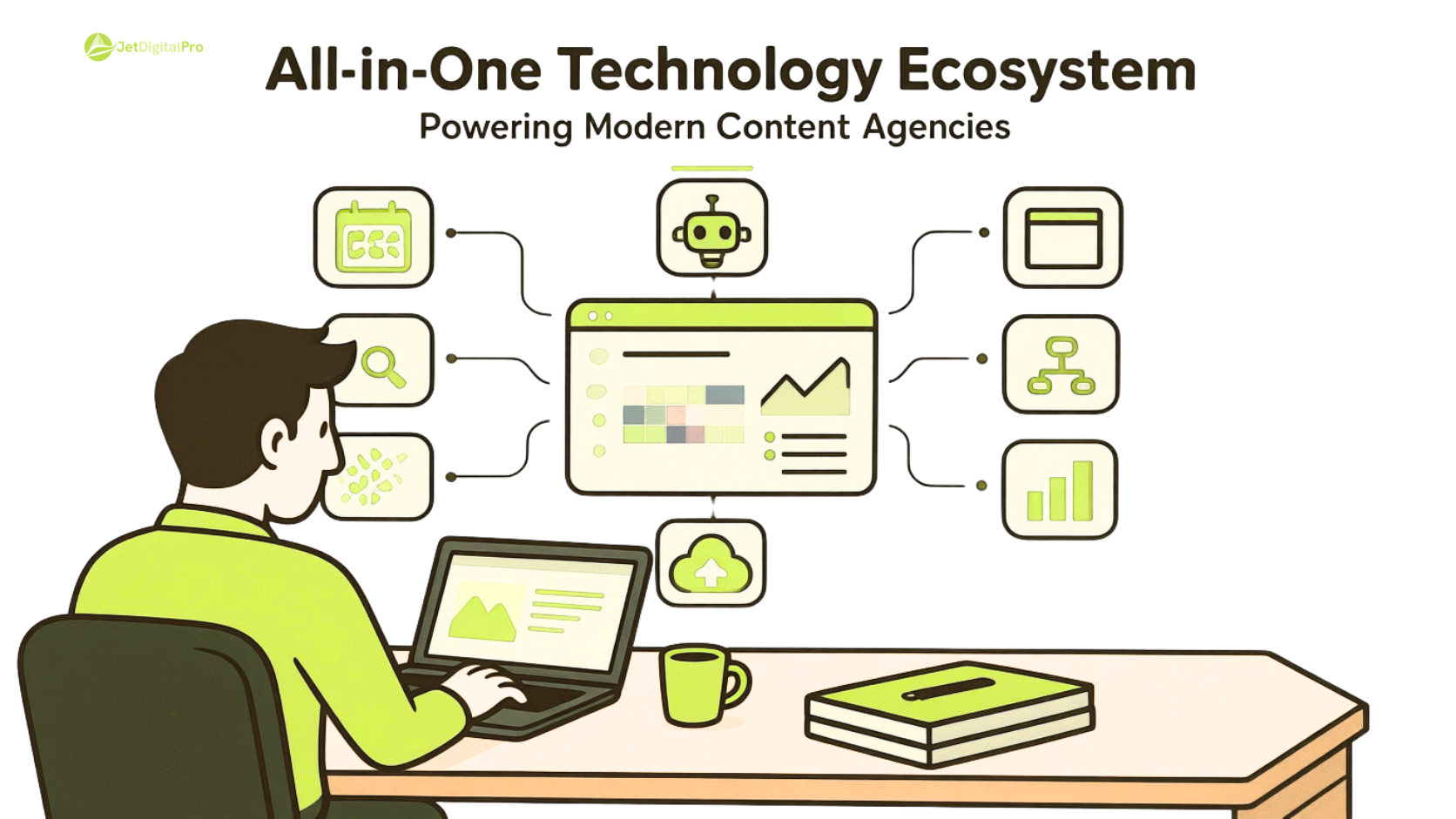
Tearing down the modern content agency tech stack and breaking down the five core tech layers top agencies use to scale content without tanking quality.
Hey, guys. Welcome to this explainer. Today, we’re tearing down the modern content agency tech stack.
We write SEO articles that rank on Google — so you can focus on your business.
See Writing Plans →So what technology actually lets you scale up content without completely tanking your quality? It’s not just about buying more writing software. You gotta build fully connected systems.
The top agencies run on these five core tech layers. Let’s break them down real quick.
First, creation. AI definitely cranks up the speed, but human editors are still totally essential for quality.
Next up, research and SEO. Heavy hitters like Semrush or Ahrefs basically act as your strategic compass.
For operations, rock solid project management systems are exactly what prevent bottlenecks and keep teams aligned.
Then we’ve got distribution. This tech makes sure your hard work actually reaches the right eyeballs.
But things are changing fast. Enter GEO or generative engine optimization. It’s a real game changer.
You literally have to optimize for citations in AI tools like ChatGPT now, not just Google.
Our final layer is analytics. This proves your worth by tying content performance directly back to revenue.
But here’s the catch. Juggling way too many disconnected tools will completely wreck your daily workflow.
That’s exactly why smoothly connected workflows absolutely crush bloated, fragmented tech stacks every single time.
The agencies winning tomorrow are building seamless pipelines where info just flows effortlessly from start to finish.
Take Jet Digital Pro, for example. They perfectly combine scalable AI workflows with that expert human touch.
So ask yourself right now, is your tech stack fueling your growth or just slowing you down?
Content agencies rely on a combination of creation, SEO, workflow, publishing, automation, and analytics tools to keep content production organized, efficient, and scalable. In 2026, managing content involves far more than writing articles. Teams must coordinate approvals, publishing schedules, search visibility, performance tracking, and AI-assisted workflows across multiple channels.
At Jet Digital Pro, we have seen how the right technology stack helps reduce delays, improve collaboration, and streamline operations from planning to reporting. Keep reading to explore the technology used by content agencies and how it supports modern content operations.
Content Agency Tech Stack at a Glance
Modern content agencies rely on connected technologies to manage content from planning and creation to distribution and performance measurement.
- Modern agencies operate through a structured 5-layer framework covering creation, research, operations, distribution, and analytics.
- AI tools accelerate production, but human review remains essential for quality and brand consistency.
- Integrated technology stacks outperform disconnected collections of software.
Definition of a Modern Content Agency Tech Stack
A content agency tech stack is the collection of tools used to plan, create, publish, distribute, and measure content.
Ten years ago, many agencies could operate with a word processor, an email account, and a basic content management system. That is no longer enough. Today’s agencies often manage multiple clients, several content channels, and large production schedules at the same time.
Because of that complexity, agencies need systems that work together. A writer may create a draft, an editor may review it, an SEO specialist may optimize it, and a client may approve it before publication. If each step happens in a different tool without clear connections, projects slow down.
At JetDigitalPro, we have found that centralizing information significantly reduces communication issues. Instead of searching through emails, spreadsheets, and chat messages, teams can access project details in a single location.
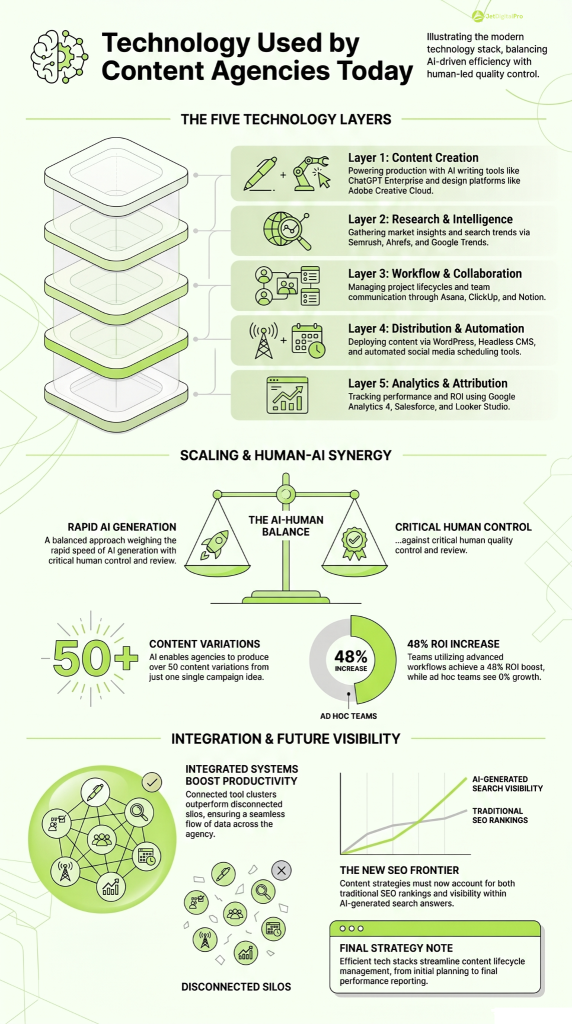
Many agencies organize their operations around five core technology layers:
- Content creation
- Research and intelligence
- Operations and collaboration
- Distribution and automation
- Analytics and attribution
As agencies grow, these layers become more important. They help teams maintain quality while handling a larger volume of work.
Content Creation Technology Powers Modern Agency Production
Content creation tools help agencies generate ideas, accelerate production, and produce text, visual, audio, and video assets at scale.
The content creation layer has evolved significantly since the widespread adoption of AI-assisted workflows. According to industry observations, agencies can generate 50+ content variations from a single campaign concept using modern content production software.
Need SEO content that actually ranks? We write data-driven articles designed to bring organic traffic to your site.
See Our SEO Writing Plans →Content creation tools help agencies generate ideas, accelerate production, and produce text, visual, audio, and video assets at scale. A structured content creation process helps agencies maintain consistency while managing larger production volumes across multiple clients and channels.
AI Writing and Ideation Platforms
- ChatGPT Enterprise for research support, outlines, and workflow assistance
- Claude Team for long-form content development
- AI writing assistants for content briefs and ideation
- Content briefing software for campaign planning
At Jet Digital Pro, we use AI as an accelerator rather than a replacement. Every article still undergoes human editing to preserve accuracy, voice consistency, and search performance.
Design and Visual Production Tools
- Adobe Creative Cloud for graphic design and asset creation
- Collaborative editing tools for design reviews
- Content database management systems for storing assets
AI Video, Audio, and Localization Systems
- AI-powered content tools for voiceovers
- Content localization tools for multilingual campaigns
- Content production software for video workflows
The strongest content teams combine automation with editorial oversight, allowing them to scale without sacrificing quality.
SEO and Research Technology Drives Content Strategy
Agencies use SEO and audience intelligence platforms to identify opportunities, analyze competitors, and build content aligned with search intent.
Search behavior continues to drive content strategy. According to Google, users perform billions of searches daily, making audience research and keyword intelligence foundational to content planning.
Core Research and Search Intelligence Tools
| Function | Common Technologies | Primary Use |
| Keyword Research | Semrush, Ahrefs | Opportunity discovery |
| Content Optimization | Clearscope, SurferSEO | On-page guidance |
| Trend Monitoring | Google Trends, BuzzSumo | Audience insights |
Research technology commonly includes:
- Semrush for keyword research software and competitor analysis software
- Ahrefs for backlink analysis and rank tracking tools
- Google Trends for identifying emerging topics
- SEO audit software for technical assessments
- Content optimization tools for improving relevance
Before building a content strategy, agencies evaluate search demand, user intent, and competitive gaps.
Data-Led Content Planning Outperforms Guesswork
We consistently see stronger results when decisions are backed by audience data rather than assumptions.
According to Google Trends and broader search intelligence platforms, audience interests can shift rapidly. Content planning tools help agencies adapt before trends become saturated.
Data-backed planning creates stronger foundations for content performance.
Workflow and Collaboration Technology Keeps Agency Operations Efficient
As agencies scale, workflow management becomes just as important as content creation.
A small team can often manage projects through email and chat. A larger agency cannot.
When dozens of people contribute to content production, agencies need systems that track responsibilities, deadlines, approvals, and project status. Without structure, delays become common.
Data from Canto demonstrates
“ROI is now strongly correlated to content workflow upgrade investments. Teams with advanced workflows are more likely to report significant ROI increases (48%), outpacing developing teams (14%) and teams with ad hoc processes (0%).” – Canto
Project management systems
Project management platforms help agencies organize work across departments.
Popular options include:
- Asana
- ClickUp
- Monday.com
- Notion
These systems allow teams to assign tasks, track deadlines, monitor progress, and manage editorial calendars.
Instead of asking for status updates in multiple conversations, stakeholders can see project progress immediately.
This visibility improves accountability across teams.
Digital asset management platforms
Content production creates a large number of files.
Agencies often manage:
- Images
- Videos
- Brand assets
- Content briefs
- Design files
- Approval documents
Digital asset management systems provide a central location for storing and organizing these resources.
Without proper organization, teams waste time searching for files or recreating assets that already exist.
Editorial workflow and approval systems
Approval workflows can become a major bottleneck.
A single article may require review from writers, editors, SEO specialists, account managers, and clients. A well-defined client approval process helps reduce delays by clarifying responsibilities and review stages before publication.
Workflow platforms help agencies create structured approval paths. Each stakeholder knows when action is required, reducing delays and confusion.
A clear workflow often improves productivity more than adding another content tool.
Distribution and Automation Technology Expands Content Reach
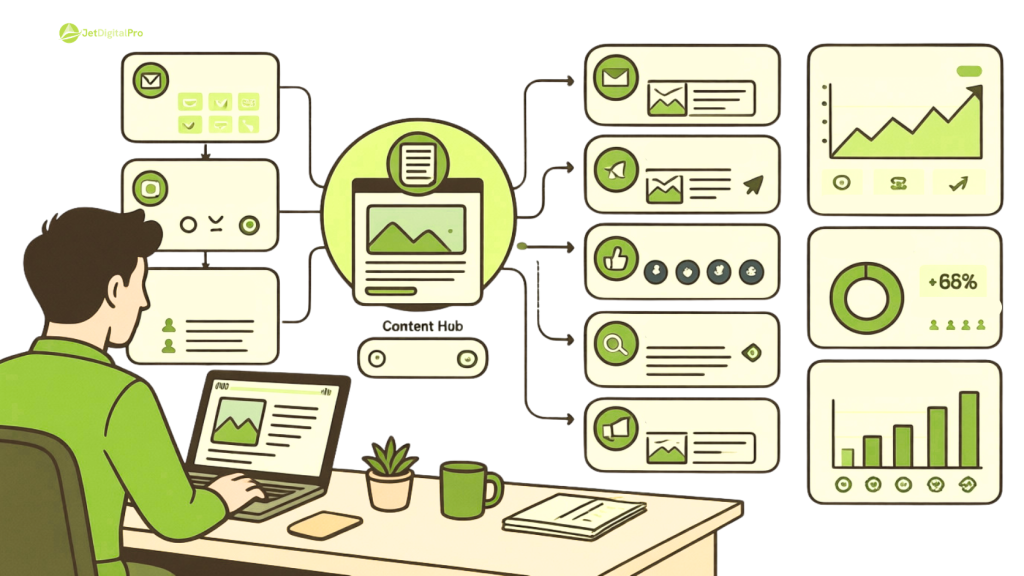
Distribution tools publish content across channels while automation platforms reduce repetitive manual work.
Publishing content is no longer limited to websites. Agencies distribute content across websites, email platforms, social channels, and customer engagement systems.
CMS Platforms Used by Content Agencies
| CMS Type | Technologies | Best For |
| Traditional CMS | WordPress | Content publishing |
| Headless CMS | Contentful, Strapi, Sanity | Omnichannel delivery |
WordPress remains the most widely used CMS because it is flexible, familiar, and supported by a large ecosystem of plugins and integrations.
Headless CMS platforms have gained traction among larger organizations. Instead of tying content to a single website, they allow agencies to publish the same content across websites, apps, customer portals, and other digital experiences.
This approach gives teams more flexibility as content requirements expand.
Social media scheduling and publishing
Most agencies manage multiple social platforms for each client.
Publishing manually can consume a significant amount of time.
Social media management platforms help teams:
- Schedule content in advance
- Coordinate campaigns
- Monitor engagement
- Maintain publishing consistency
Automation does not replace strategy, but it reduces repetitive tasks that add little value.
Marketing automation and lead nurturing
Content often supports larger marketing goals.
Publishing a blog post is rarely the final objective. Agencies want that content to generate leads, build trust, and support sales efforts.
Marketing automation platforms help connect content with customer journeys.
Common uses include:
- Email sequences
- Lead nurturing campaigns
- Contact segmentation
- Behavioral triggers
- CRM integrations
Tools such as HubSpot allow agencies to connect content activity with broader marketing initiatives.
Traditional SEO Technology Is Being Challenged by GEO Platforms
Agencies increasingly supplement traditional SEO tools with systems designed to monitor visibility inside AI-powered search experiences.
The rise of ChatGPT, Perplexity, and AI-generated answers has introduced a new layer of content visibility.
In 2026, agencies are paying closer attention to how content appears within AI-generated responses rather than focusing exclusively on traditional rankings.
The Shift from Keywords to Answer-Based Discovery
Traditional search optimization focuses on keywords.
AI search increasingly prioritizes:
- Structured answers
- Clear entities
- Verifiable information
- Topic authority
GEO and AEO Monitoring Platforms
New categories of software have emerged to help agencies monitor visibility in AI-generated responses.
These tools are often described as:
- GEO (Generative Engine Optimization) platforms
- AEO (Answer Engine Optimization) platforms
- Citation visibility platforms
Solutions such as Profound and similar emerging tools help agencies understand how frequently brands and content appear in AI-generated answers.
This data gives teams a clearer picture of content performance beyond traditional rankings.
Reasons Why Citation Tracking Matters in AI Search
A page may rank well in search results yet receive little visibility in AI-generated answers.
Conversely, a page may be frequently cited by AI systems even if it does not hold the top organic position.
As noted by Burson
“In today’s zero-click world, LLMs have become the new gatekeepers of reputation… Showing up in these LLMs is necessary but not sufficient. Our role is no longer just to make clients visible, but to build an evidence ecosystem so robust that the answers AI constructs are believable to the audiences that matter most.” – Burson
Because of this, agencies increasingly track:
- Brand mentions
- Citation frequency
- Source visibility
- Entity recognition
- Topic authority
Many content teams now optimize content for both traditional search engines and AI-powered discovery systems.
Best-of-Breed Tool Stacks Are Creating New Operational Challenges
Adding too many specialized tools often increases complexity, costs, and workflow friction instead of improving productivity.
One of the most common operational problems involves managing multiple disconnected platforms.
Industry discussions frequently reference the challenge as the “duct tape between tools” problem.
The “Duct Tape Between Tools” Problem
A typical agency may use:
- An SEO platform
- A project management platform
- A CMS
- A reporting tool
- An automation platform
- A design platform
- Several AI tools
Each system serves a purpose, but problems arise when they do not communicate effectively.
Teams often end up moving information manually between platforms.
This creates delays, duplicate work, and reporting inconsistencies.
Integration versus Tool Accumulation
One of the biggest mistakes agencies make is focusing on tool quantity rather than system design.
Adding another subscription rarely fixes workflow issues.
Strong operations depend on integration.
The most efficient agencies prioritize:
- Shared data
- Connected workflows
- Consistent reporting
- Centralized documentation
A smaller stack with strong integrations often outperforms a larger stack with disconnected systems.
Building Unified Data Model
Many agencies use platforms such as Notion or Airtable as operational hubs.
These systems provide a central location where teams can access:
- Client information
- Content calendars
- Workflow status
- Performance data
- Internal documentation
Instead of switching between multiple systems to find information, teams can work from a shared source of truth.
This approach reduces operational friction and improves collaboration.
Advanced Agencies Are Moving Beyond Generic AI Content

Leading agencies use structured workflows, specialized AI agents, and voice training systems to improve originality and consistency.
As AI adoption increases, agencies face a new challenge: avoiding generic content.
Generic AI Output Failure Reasons
Common issues include:
- Repetitive language
- Weak brand voice
- Generic recommendations
- Limited expertise signals
Many teams report only around 20% editing savings after accounting for review and revisions.
Role-Specific Agent Workflows
The Hermes Agent Framework reflects a growing trend toward specialized AI workflows.
Instead of one large automation system, agencies create separate processes for:
- Research
- Brief creation
- Optimization
- Quality assurance
Voice Training and Brand Consistency Systems
Modern AI writing assistants increasingly incorporate historical content, editorial guidelines, and style preferences.
At Jet Digital Pro, we have found that combining AI-assisted production with experienced human editors produces stronger results than relying solely on automated generation.
A consistent quality control process helps teams maintain accuracy, brand voice, and editorial standards across high-volume content production.
Analytics Technology Proves Content ROI
Analytics platforms connect content performance to business outcomes, helping agencies demonstrate measurable value.
Clients increasingly expect measurable proof that content contributes to revenue growth.
Performance Measurement Stack
| Category | Technologies | Key Metric |
| Web Analytics | Google Analytics 4 | Traffic & engagement |
| Behavior Analytics | Hotjar, Microsoft Clarity | User interaction |
| CRM Attribution | Salesforce | Revenue impact |
| Reporting | Looker Studio, Tableau | Client reporting |
Performance measurement often includes:
- Google Analytics 4 for content engagement
- Salesforce for revenue attribution
- Conversion tracking software
- Content reporting dashboards
Connecting Content to Revenue
Traffic alone does not tell the full story. A page may attract thousands of visitors but generate few leads.
The strongest reporting systems connect content engagement with outcomes such as:
- Lead generation
- Demo requests
- Form submissions
- Pipeline creation
- Closed deals
This helps agencies demonstrate business value rather than reporting vanity metrics.
Automated Reporting and Attribution
Manual reporting can consume significant time each month.
Platforms such as Looker Studio simplify the process by combining data from multiple sources into a single dashboard.
This allows agencies to provide clients with consistent reporting while reducing administrative work. More importantly, centralized reporting makes trends easier to identify.
Teams can quickly determine what content is performing well and where adjustments are needed.
The Future of Technology Used by Content Agencies
Agency technology stacks will continue evolving, but a few trends are becoming clear.
The next generation of content operations will place greater emphasis on:
- AI-assisted workflows
- System integration
- Structured content
- Automation
- Multi-channel publishing
- AI search visibility
The focus is shifting away from individual tools and toward connected systems.
Agencies that build efficient workflows around their technology will have a significant advantage over those that rely on fragmented processes.
The goal is not to collect more software. The goal is to create a technology environment where information moves smoothly from planning to production, distribution, and reporting.
FAQs
How can agencies choose the right content tools without overspending?
Agencies should start by mapping their content production process before purchasing new software. Identify where delays occur, whether during planning, creation, approvals, publishing, or reporting. Then select content planning tools, content workflow software, and content collaboration platforms that address those specific challenges. A focused content marketing technology stack with integrated systems usually provides better efficiency and lower costs than maintaining multiple overlapping tools.
What features matter most in content operations software?
Effective content operations software should help teams manage deadlines, assignments, approvals, and reporting from a central location. Useful features include content workflow automation, editorial workflow management, workflow tracking software, and content lifecycle management capabilities. These functions reduce manual coordination, improve project visibility, and help agencies handle larger content volumes without adding unnecessary administrative work.
How do remote content teams manage large production schedules?
Remote teams often depend on content project management software, collaborative editing tools, and remote content team software to coordinate work across different locations and time zones. Shared content calendar management systems and content scheduling platforms help teams track deadlines, publication dates, and review stages. A structured content approval workflow also reduces bottlenecks and ensures every asset receives proper review before publication.
Why do agencies need content governance and quality control systems?
As content output grows, maintaining consistent quality becomes more difficult. Content governance tools establish standards for formatting, tone, compliance, and editorial requirements. Agencies also use content quality assurance software, plagiarism checker tools, and grammar checking software to review content before publication. These systems help reduce errors, maintain brand consistency, and improve the overall quality of client deliverables.
How can agencies measure content performance beyond website traffic?
Website traffic provides useful information, but it does not show whether content supports business goals. Agencies use content analytics software, content performance tracking tools, conversion tracking software, and content reporting dashboards to measure lead generation, form submissions, engagement, and customer actions. These insights help teams evaluate content effectiveness, improve future strategies, and demonstrate measurable results to clients.
Insights on Technology Used by Content Agencies
Modern content agencies rely on connected technology across content creation, research, workflow management, distribution, GEO, and analytics. While AI has accelerated production, long-term success still depends on strong processes, accurate data, and human oversight. Agencies that integrate their tools into a unified system can improve efficiency, maintain quality, and better demonstrate business results across every stage of the content lifecycle.
Ready to scale content production without expanding your internal team? Contact JetDigitalPro to learn how we support agencies with white-label SEO content, managed publishing workflows, and expert human editing backed by AI-assisted efficiency.
References
- https://campaignme.com/burson-research-highlights-gap-between-visibility-and-believability-in-generative-engine-optimisation/
- https://www.canto.com/resources/state-of-digital-content/
Related Articles
- https://jetdigitalpro.com/seo-agency-content-creation-process/
- https://jetdigitalpro.com/client-approval-process-agency/
- https://jetdigitalpro.com/quality-control-process-agency/
Stop Guessing. Start Ranking.
Get a free sample article written for your niche. See the quality before you commit.
Get Your Free Sample Article →No credit card needed • 100% tailored to your niche