

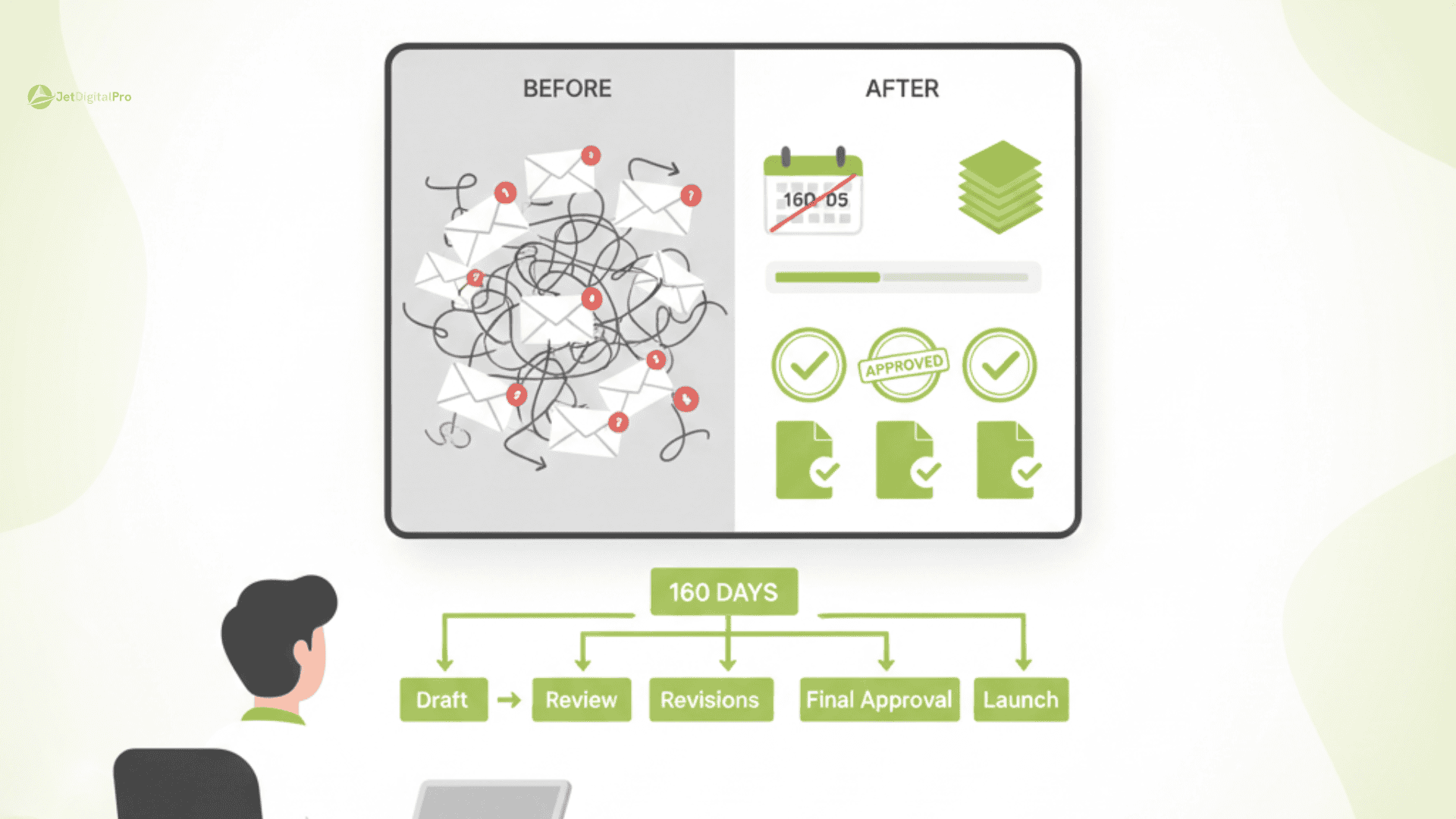
Learn how agencies save up to 160 days a year with a structured client approval process that reduces revision chaos, centralizes feedback, improves delivery speed, and protects profitability.
Your best work is probably sitting in someone else’s inbox right now.
We write SEO articles that rank on Google — so you can focus on your business.
See Writing Plans →It’s Friday afternoon. The launch is Monday. Your team is waiting for approval, refreshing emails, chasing feedback, and losing time.
This is one of the biggest hidden problems inside agencies.
A structured client approval process fixes that.
It turns messy feedback into clear decisions, prevents endless revisions, protects timelines, and improves client trust.
Here are the three core rules.
First, define revision limits and feedback deadlines in the contract.
Second, keep all feedback in one shared platform.
Third, align internally before showing work to the client.
A client approval framework is the system agencies use to review work, request changes, and approve deliverables.
It answers four key questions: who approves the work, what is being approved, when feedback is due, and how feedback should be submitted.
Without structure, projects become reactive and chaotic.
With structure, agencies create predictable workflows that scale.
A strong approval process usually follows five phases: discovery, design approval, development approval, testing and launch approval, and post-launch approval.
The biggest mistake agencies make is weak contracts.
Your contract should clearly define revision limits, feedback deadlines, change request procedures, and automatic approval rules.
Need SEO content that actually ranks? We write data-driven articles designed to bring organic traffic to your site.
See Our SEO Writing Plans →Another major issue is fragmented feedback.
Email chains create confusion and verbal approvals disappear.
The solution is one centralized feedback system where every comment is documented.
Agencies also struggle with unlimited revisions.
The solution is setting expectations early and treating extra requests as formal change orders.
Formal sign-offs are equally important.
Always get written confirmation before moving into the next project phase.
The agencies that scale successfully don’t operate on chaos.
They operate on systems.
A structured client approval process saves time, reduces burnout, improves client relationships, and protects agency margins.
Less chasing. Less confusion. More delivery. More trust. More growth.
If your agency wants smoother workflows and faster approvals, start with one clear process, one feedback platform, and one documented approval system.
That single change can transform how your agency operates.
Your best work is stuck in someone else’s inbox. It’s Friday at 4:47 PM, the launch is Monday, and you’re refreshing your email, waiting. Sound familiar? This is the silent killer of agency profit and team morale.
A structured client approval process agency framework isn’t about bureaucracy, it’s about survival. It turns chaotic feedback into clear direction, prevents those “small tweaks” that unravel timelines, and builds the trust that retains clients. Keep reading to transform your biggest pain point into a reliable engine for growth.
The Core Rules
- First, a clear contract with revision limits and deadlines stops scope creep before it starts.
- Second, all feedback must go to one shared platform. Using emails, texts, and calls for comments will cause mistakes and delays.
- Third, your team must agree internally before showing anything to the client. Conflicting feedback looks unprofessional and hurts your credibility.
What Is a Client Approval Process Agency Framework?
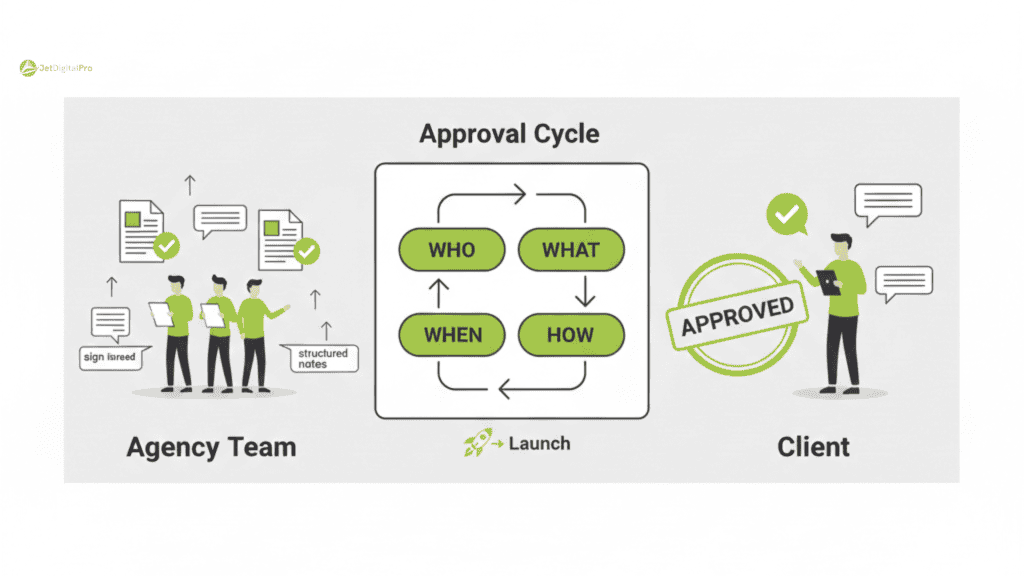
It’s the agreed-upon system between you and your client for reviewing work, providing feedback, and granting formal permission to proceed. Think of it as the rulebook for your collaboration. Without it, you’re playing a game where the goals move every time you get close. This framework transforms subjective opinions into actionable steps.
It answers the “who, what, when, and how” of approvals. Who gives the final sign-off? What exactly are they approving? When is feedback due? How should that feedback be delivered?
We’ve seen agencies crumble under the weight of unstructured approvals and watched others thrive by implementing a simple, repeatable rhythm. It’s the difference between reactive chaos and proactive partnership.
Why a Structured Client Approval Process Matters for Agencies
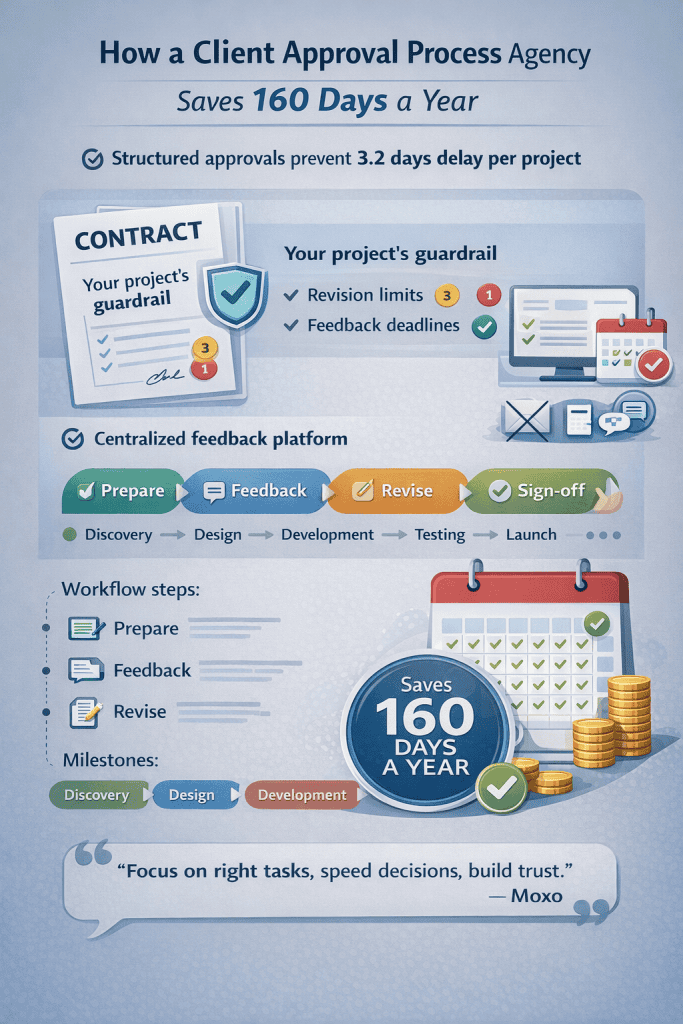
The data is brutal. Unstructured approvals add an average of 3.2 days to every project timeline. For an agency with 50 projects a year, that’s over 160 days, nearly 23 weeks, of vanished productivity. But the cost is more than time. It’s the financial bleed from rushed work during compressed timelines.
“A structured client approval process focuses your team on the right tasks, makes collaboration easier, and speeds up every decision.” – Moxo Blog
It’s the team burnout from constant context-switching and chasing vague feedback. It’s the eroded client confidence when deadlines are consistently missed. A structured process flips this script. It provides quality assurance by catching misalignments early. It acts as a legal safeguard, documenting mutual agreement.
Most importantly, it builds genuine trust. Clients feel heard and in control, while your team gains the clarity needed to do exceptional work efficiently.
Core Steps in a Client Approval Process Agency Workflow
A strong approval flow isn’t a single event, it’s a recurring cycle built into your project’s DNA. It must be predictable. The core steps are deceptively simple, yet most agencies stumble on the execution.
| Step | Agency Action | Client Responsibility | Output |
| Prepare & Present | Internal QA, contextual presentation | Review within deadline | Shared deliverable |
| Collect Feedback | Centralize comments in one platform | Provide consolidated written feedback | Clear revision list |
| Incorporate Revisions | Implement agreed changes | Confirm revisions address concerns | Updated version |
| Formal Sign-Off | Request explicit approval | Provide written approval | Go/No-Go decision |
This cycle repeats at each major project milestone, from the first sketch to the final launch. The consistency is what makes it scalable. At Jet Digital Pro, we bake this rhythm into our own client engagements and the seo content creation process we manage for agencies.
Discovery Phase Approvals: Scope, Timeline, and SOW Sign-Off
This is where you win or lose the project before a single creative asset is made. The discovery phase approval isn’t about aesthetics, it’s about alignment. You’re locking in the foundation. The key deliverable here is the Statement of Work (SOW) or project plan.
This document must be explicit. It outlines objectives, deliverables, timelines, and briefing standards to ensure everyone is reading from the same map. Getting a client’s signature here is your first official sign-off.
We never proceed without this. It’s the contract that states, for example, “Two rounds of revisions per design phase” or “Feedback required within 48 business hours.” This signature prevents 90% of future disputes by setting expectations in stone before the real work begins.
Design Phase Approvals: Mockups, Prototypes, and Visual Direction
Now the abstract becomes tangible. This phase is emotionally charged for clients, they’re seeing their vision materialize. Your approval process must guide that emotion productively. Start with low-fidelity mockups to confirm layout and flow before diving into detailed visuals.
Use a collaborative tool where clients can leave specific, pinned comments directly on the asset. This eliminates the dreaded “I don’t like it, make it pop” feedback. Each presentation should reference back to the goals signed off in discovery.
The approval at this stage isn’t just a yes on a design, it’s a confirmation that the visual direction fulfills the strategic promise. Limit the revision rounds as per your SOW. This discipline respects your team’s time and teaches clients to provide consolidated, thoughtful feedback.
Development Phase Approvals: Features, Demos, and Sprint Validation
For software and web agencies, this is the engine room. Approval here is about functional validation, not pixel perfection. It often follows an agile sprint cycle. The deliverable is a working feature or a staging site demo. The client’s role is to test and confirm the functionality against the agreed-upon requirements.
“One of the biggest sources of freelance stress is the chaotic client approval process. This section brings much-needed clarity and accountability.” – Kolect.ai Blog
We structure this as a focused review session, sometimes called a “sprint demo.” Provide a simple checklist: “Can you log in? Does the form submit data? Does the filter work as specified?” This structured feedback prevents clients from evaluating backend code or commenting on unfinished UI elements.
The sign-off at the end of a development sprint is a green light that says, “This build meets the criteria for this phase, proceed to the next.” It keeps the project moving on a technical track, separate from creative subjectivity.
Testing and Launch Approvals: QA, Final Review, and Go-Live Confirmation
The final gate before the world sees your work. This phase combines rigorous internal Quality Assurance (QA) with formal User Acceptance Testing (UAT). Your team first runs through a comprehensive Post Checklist covering functionality, cross-browser compatibility, and content accuracy.
Only after this internal sign-off does the build go to the client for UAT. Provide them with a clear, limited testing window and a structured bug-reporting template. The approval here, the Go-Live Confirmation, is a major milestone.
It’s the client’s verification that the final product meets all requirements and is ready for launch. We treat this sign-off with ceremony; it’s often a scheduled call or a signed digital form. This formal closure provides legal protection and a clear psychological endpoint for the project build.
Post-Launch Approvals: Documentation, Maintenance, and Support Agreements
The project is live, but the approval process isn’t over. This phase is about transitioning from project mode to partnership mode. The deliverables are often knowledge transfer documents, maintenance plans, or ongoing support agreements. Client approval here secures the future of your work.
For example, approving a maintenance plan defines response times and costs for future updates. Signing off on final documentation confirms the client has received all necessary assets and training. This final sign-off is critical for administrative closure.
It allows you to officially close the project budget, reallocate team resources, and trigger any final payments. It’s the polite, professional handshake that concludes the intensive project journey and sets the stage for a potential long-term relationship.
Setting Approval Rules in Contracts to Prevent Scope Creep
Your contract is your shield. This is the hard truth from countless agency veterans. Ambiguity is your enemy. The approval rules must be codified in the Statement of Work or Master Services Agreement. This isn’t adversarial, it’s clarifying. Key clauses we always include:
- Revision Limits: “This SOW includes two rounds of revisions for all design deliverables.”
- Feedback Windows: “Client agrees to provide consolidated feedback within two business days of receipt.”
- Change Order Process: “Requests altering the approved scope will be handled via a formal Change Order, with updated timeline and cost.”
- Deemed Approval: “If no feedback is provided within the agreed window, the deliverable will be deemed approved to maintain project timeline.”
These rules aren’t traps, they are the guardrails that keep the project on the road. They protect your team’s time and your agency’s profitability while giving the client a clear, predictable process. Enforcing them consistently is what separates professional agencies from order-takers.
Managing Client Feedback: Centralized Tools and Written Comments
The feedback process itself is a common breakdown point. Email chains are where feedback goes to die, buried under replies and forwards. Verbal feedback in meetings is forgotten or misinterpreted. The solution is ruthless centralization. You need a single source of truth, a client portal, a dedicated project management tool, or a proofing platform.
This becomes the Client Feedback Zone. Every comment, request, and suggestion lives there, attached to the specific asset. This creates a clear audit trail. It eliminates “I never said that” scenarios. It also allows you to quietly train your clients.
When they send feedback via email, you politely ask them to add it to the central tool “so the team doesn’t miss it.” This habit, over time, streamlines everything. The written record becomes invaluable for post-project reviews and protecting your team.
Limiting Revision Rounds Without Damaging Client Relationships
“Just one more tweak” is the siren song that wrecks project timelines. The fear of saying “no” is real, but unlimited revisions are a path to resentment and low-quality work. The secret isn’t in the denial, but in the setup. You limit rounds contractually from the start, as a standard practice for all clients.
This frames it as “how we work professionally,” not a personal restriction. During reviews, guide the feedback. Ask, “What objective is this change achieving?” Often, it clarifies their own thinking. If additional rounds are genuinely needed, initiate a Change Order.
This isn’t punitive. It’s a respectful acknowledgment that the new request represents additional work and investment. This approach maintains the relationship’s health by valuing your team’s expertise and time, which in turn allows you to deliver your best for the client.
Formal Sign-Off: How Agencies Secure Clear Go/No-Go Decisions
The moment of truth. A formal sign-off is a binary event, approved or not approved. There is no “sort of” or “mostly.” To secure it, you must make the ask clear and easy. We use a simple digital approval form or a specific email template with the subject line: “Formal Approval Request: [Project Name] – [Deliverable].”
The body states clearly: “Please reply ‘Approved’ to this email to confirm [Deliverable] meets requirements and we may proceed to [Next Phase].” This removes ambiguity. Never accept a verbal “looks good” in a meeting as approval. Follow up immediately: “Great, I’ll send the formal approval email for your records.”
This written record is your permission slip and your legal protection. It’s the definitive punctuation that ends one chapter and cleanly begins the next.
Common Client Approval Process Agency Mistakes
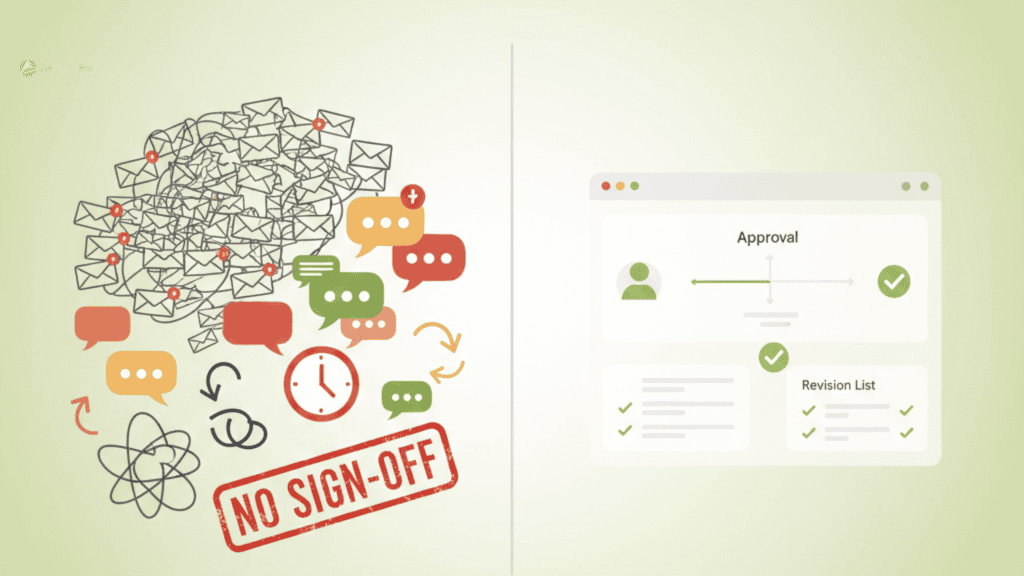
We’ve made these ourselves, so we know the cost. The first is relying on verbal approvals. They evaporate. The second is using email as the primary feedback tool, it’s a black hole. The third is failing to enforce the timelines and rules established in the contract.
If you set a 48-hour feedback window but let it slide to a week, you’ve just rewritten the contract in the client’s favor. Another major mistake is skipping the internal review. Establishing strict editing and proofreading requirements before sending work to the client prevents conflicting feedback and protects your credibility.
Finally, there’s the mistake of not having a single point of contact on the client side. When multiple stakeholders give feedback directly and separately, you’re left playing mediator, not a creative partner. Avoiding these pitfalls requires discipline, but that discipline is what clients ultimately pay for.
FAQ
How can we reduce approval delays without hurting client relationships?
Approval delays usually happen when the approval workflow is unclear. Set defined approval stages, clear approval times, and one decision-maker in the approval hierarchy. Use automated reminders and avoid messy email chains.
A structured client approval process protects project timelines while keeping client satisfaction high. It turns stakeholder limbo into predictable progress without damaging trust.
What is the best way to manage feedback from multiple stakeholders?
When too many collaborating voices comment at once, you get design by committee. Create a single Client Feedback Zone inside your project management tool. Route all feedback channels into one approval system with version control and a visible status view.
This keeps brand managers and external stakeholders aligned, reduces review surprises, and protects brand consistency.
How do we structure approval stages for social media content?
For social media approval, define clear review stages: Stage 1 content review, Content and UX validation, Final QA, then final approval. Align the process with your social media calendar and overall social media workflow. This keeps social media teams organized and prevents last-minute content approval chaos during a Marketing Campaign launch.
What should be included in a proper review and approval process?
A strong review and approval process includes internal reviews, content review checkpoints, Final QA, and a documented audit trail. Clarify approval hierarchy, approval flow, and client response strategies before work begins.
Cover Legal/Intellectual Property risks, regulatory risk, and style guide alignment. This protects creative assets, visual assets, and overall brand identity during content development.
Your Next Step to Streamlined Approvals
The difference between chaos and control is a decision. Stop reacting and start orchestrating. Use a clear contract, one feedback platform, and mandatory internal reviews. Build these rules into your next project. You’ll spend less time chasing approvals and more time creating. This is how agencies protect their margins and actually deliver.
Ready to implement a system that works? Book a free discovery call to discuss your workflow.
References
- https://www.moxo.com/blog/customer-client-approval-process
- https://www.kolect.ai/blog/the-anti-burnout-content-calendar-template-structuring-social-media-output-for-freelancers-managing-multiple-client-voices-417
Related Articles
- https://jetdigitalpro.com/seo-agency-content-creation-process/
- https://jetdigitalpro.com/agency-content-briefing-standards/
- https://jetdigitalpro.com/agency-editing-proofreading-steps/
Stop Guessing. Start Ranking.
Get a free sample article written for your niche. See the quality before you commit.
Get Your Free Sample Article →No credit card needed • 100% tailored to your niche