

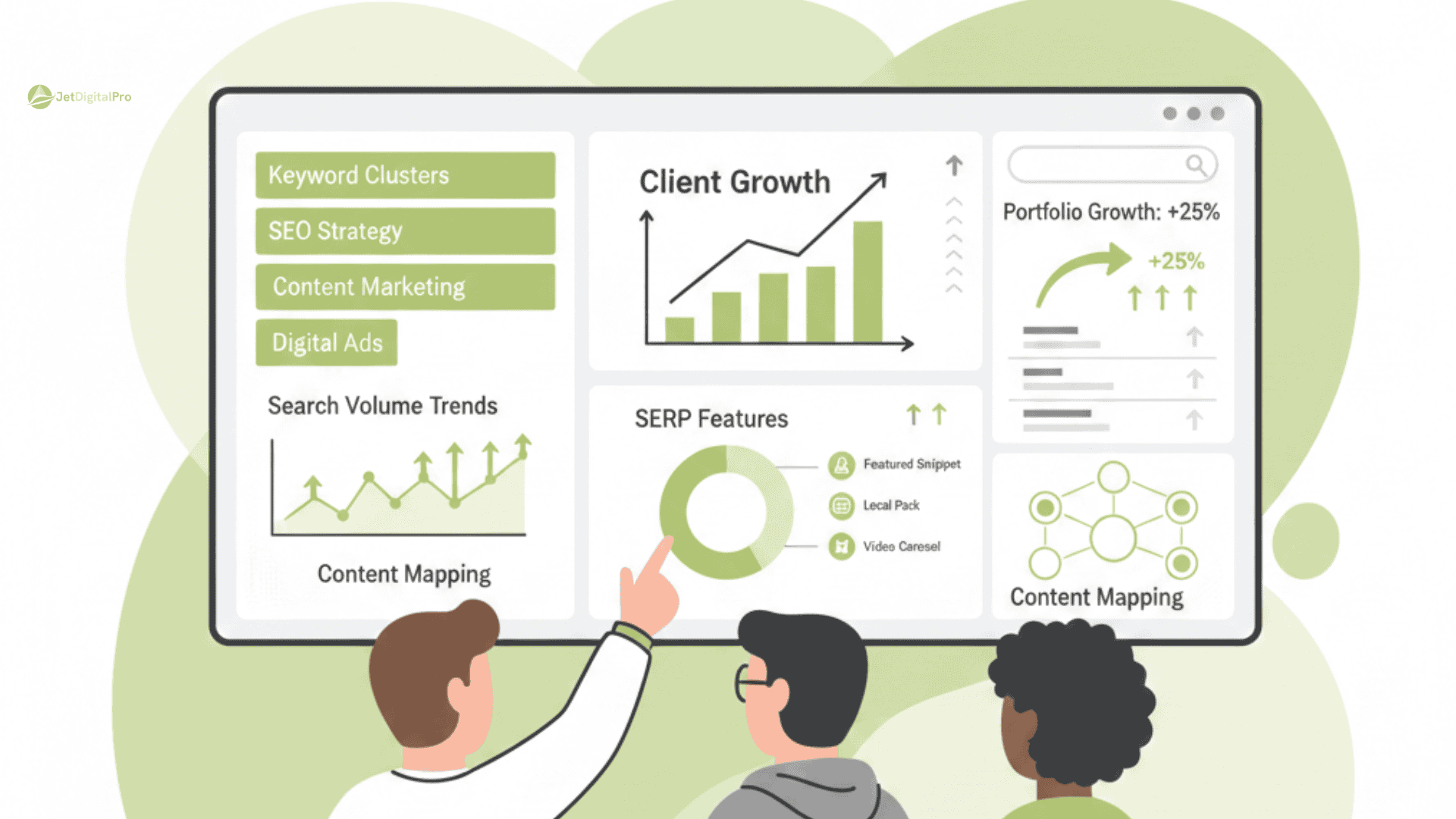
Learn how modern agencies use buyer intent, keyword clustering, long-tail SEO, and PPC validation to drive real client growth instead of chasing vanity search volume.
Hey guys, welcome to this explainer. Let’s ditch those vanity metrics and drive some real agency growth today.
We write SEO articles that rank on Google — so you can focus on your business.
See Writing Plans →We’ve all chased massive search volumes, but honestly, that strategy is just a total illusion. Here’s the secret: 100 high-intent searches can outperform 10,000 random tire kickers every single time.
Instead of focusing on empty volume, modern agencies prioritize search intent because it connects SEO directly to revenue. Understanding intent means figuring out why people search. Are they learning, comparing options, or ready to buy?
This naturally maps to the customer journey and helps guide users from discovery all the way to conversion. Since Google now rewards topical authority, creating random isolated pages no longer works.
Instead, group related keywords into tight topic clusters. This improves website structure, strengthens internal linking, and increases overall search visibility.
You can start building clusters with a few broad seed keywords and then expand into long-tail keyword opportunities. Long-tail keywords are incredibly valuable because they usually have stronger buyer intent and lower competition.
Competitor analysis also matters. It reveals keywords your competitors have already validated through real traffic and rankings. Prioritize bottom-of-funnel buyer intent keywords because they usually deliver the highest commercial value.
A strong SEO strategy should connect directly with paid ads and content marketing. Use PPC data to validate which keywords actually convert before investing heavily into organic SEO campaigns.
AI tools are powerful for semantic keyword clustering and data processing, but human validation is still essential. You still need to manually review SERPs, evaluate competition, and match real user expectations.
Most importantly, keyword research is not a one-time task. It’s an ongoing system that requires constant refinement using performance data, ranking changes, and SERP shifts over time.
So the question is simple: are you going to keep chasing empty search volume, or start capturing real scalable buyer intent? Let’s get to work.
Chasing keyword volume is busywork. The real goal is finding the right terms that drive client growth. At Jet Digital Pro, our white-label SEO service is built on this principle. We see agencies waste time on generic tool reports while real opportunities sit in search intent and customer language.
Our method combines data analysis with hands-on validation, linking business objectives directly to what people search for now. This shifts focus from vanity metrics to actual leads and revenue. Keep reading to see agency keyword research methods that actually grow client portfolios.
Need SEO content that actually ranks? We write data-driven articles designed to bring organic traffic to your site.
See Our SEO Writing Plans →Here’s How It Works
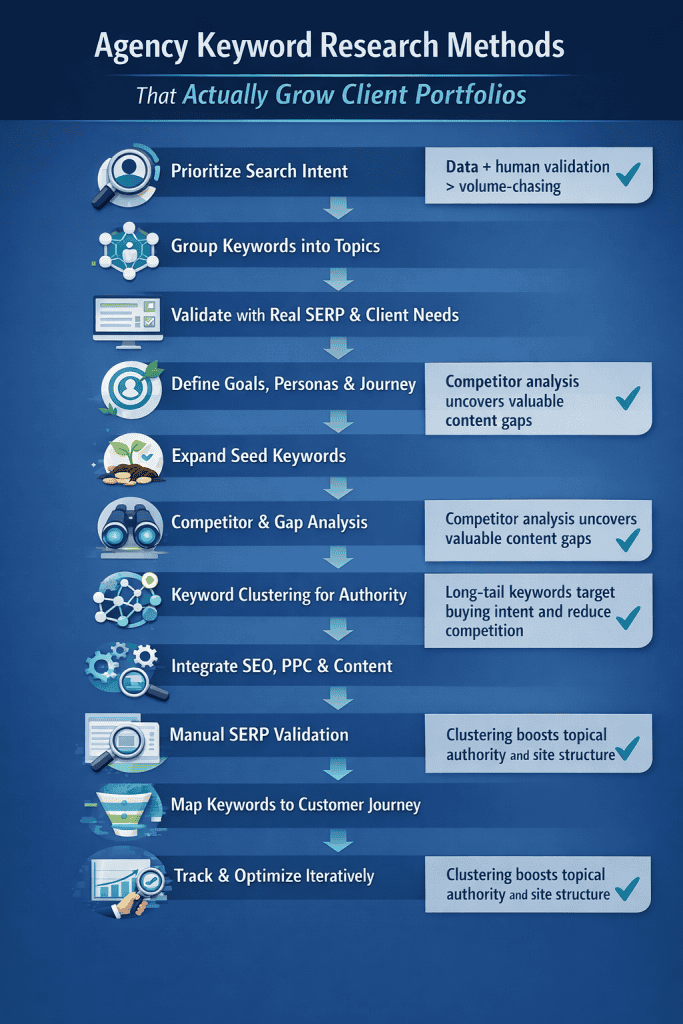
- First, we care more about why someone is searching than how often they search. A specific, commercial term with 100 searches is usually better than a broad one with 10,000.
- Second, we group related keywords into topics. This builds authority with Google and creates a sensible site structure.
- Finally, we use tools for the heavy lifting, but a person always checks the final list against real search results and client needs.
What Are Agency Keyword Research Methods?
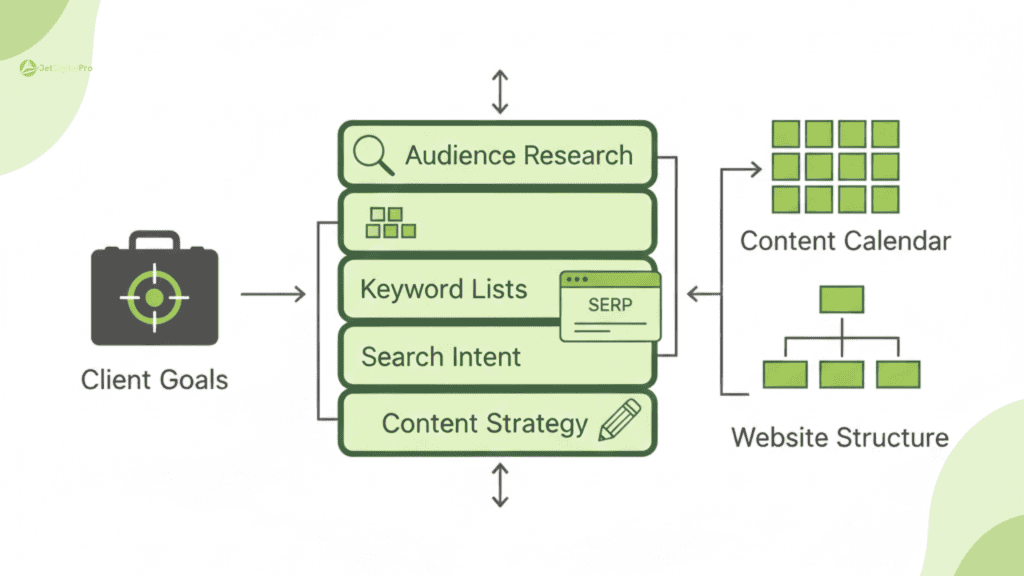
Agency keyword research methods are structured systems professional SEO marketers use to build scalable keyword lists aligned with business outcomes. It’s not just software, it’s a repeatable SEO strategy powered by data analytics, audience research, and real SERP data.
The process connects search terms to user intent, conversion value, and measurable conversion metrics. This data then flows directly into a structured agency content creation process designed to turn search volume into revenue for any international SEO campaign.
Modern keyword research blends AI keyword research, natural language processing, and machine learning with manual validation. The output supports content marketing strategy, paid media strategy, digital PR, and link building.
Done correctly, it fuels search engine optimization, strengthens website structure, and transforms raw Google’s data into strategic assets for search engines and brand traffic growth.
Defining Client Goals, Personas, and Search Intent
Every SEO strategy starts with business goals and customer personas. We analyze customer onboarding form responses, sales notes, and support logs using data collection techniques to uncover real language from the target audience.
Key steps:
- Identify primary goals (lead generation, brand traffic, sales)
- Map SEO keywords to the purchase journey
- Categorize by search intent (informational, medium intent keywords, high intent keywords)
- Validate intent using SERP data and Google’s “Related Searches”
We align keyword research with conversion metrics and conversion value, not vanity search volume. For local SEO or website migration projects, defining search intent early prevents keyword cannibalization. This ensures that every content briefing reflects real buyer behavior and aligns with the overarching strategy across search engines.
Building and Expanding Seed Keyword Lists
Seed keyword lists originate from audience research, adjacent industry/solution terms, and internal insights. From there, we expand using Google Trends, Google Keyword Planner, and SERP features.
“The goal is always to reduce ambiguity, not just interpret it, ensuring that every search query and every piece of content contributes positively to the user’s journey. … For SEO specialists, this often translates into building comprehensive content clusters around core topics, where each piece of content supports and clarifies related terms.” – Perpusnas Pro-Ideas
Expansion sources include:
- Google’s “Related Searches”
- Featured snippets and PAA boxes
- Forums and community discussions
- AI keyword research tools powered by artificial intelligence tools
We evaluate monthly search volume, keyword difficulty, and cost per click to balance organic and paid media campaign opportunities.
Long-tail keywords and long tail keywords are prioritized for clearer search intent and stronger conversion value. This approach works across industries, from project management software to local cafe SEO, ensuring keyword groups reflect how real users phrase search terms.
Competitor and Keyword Gap Analysis at Scale
Competitor analysis reveals hidden growth opportunities. We compare competitor keywords, competitor’s branded keywords, and domain rating metrics using Ahrefs Webmaster Tools and Semrush Keyword Magic Tool.
| Analysis Type | What It Reveals | Primary Action |
| Content Gap | Topics or sub-topics competitors cover that we do not. | Plan new pillar content or supporting articles. |
| Ranking Gap | Specific keywords where competitors significantly outrank us. | Optimize and improve existing page content and authority. |
| Format Gap | SERP features (like featured snippets or video) competitors own. | Adjust content format or create targeted assets to compete. |
This step moves us from an internal perspective to a market-aware one. It shows us where the uncontested space might be, or where a strategic content investment could steal valuable visibility.
Clustering Keywords for Topical Authority
Keyword clusters transform scattered keyword lists into structured content clustering systems. Using semantic keyword research and entity extraction tools, we group related search terms by shared search intent.
“Search for the phrases you’re considering: Am I in the right neighborhood? Is Google suggesting different or more specific phrases? … If rankings and organic traffic are that important to you, tweak the topic or abandon it completely [if the intent is too mismatched].” – Orbit Media Studios
Google’s algorithms now prioritize semantic search over isolated phrases. Building keyword clusters around pillar topics increases topical authority and strengthens website structure.
For example, a project management software cluster may include:
- Comparison guides
- Integration tutorials
- Pricing breakdowns
- Long-tail keywords targeting niche industries
Content clustering enhances page mapping, improves internal linking, and supports a scalable content marketing strategy. It also reduces keyword cannibalization while improving search engine optimization performance across search engines.
Prioritizing Commercial, Long-Tail, and Buyer-Intent Queries
Not all search volume converts. We prioritize high intent keywords, medium intent keywords, and transactional search terms aligned with ROI goals.
Priority framework:
- High intent keywords (buy, pricing, demo)
- Long-tail keywords with clear user intent
- Commercial comparison queries
- Strategic head terms for brand traffic
We analyze cost per click from ad accounts to gauge commercial value. If advertisers pay more, conversion value is likely higher.
This ensures the SEO strategy supports paid media strategy alignment. For eCommerce sites, local SEO, and emerging markets, this prioritization directly impacts conversion metrics and strengthens overall digital tactics.
Tools We Use for Data-Driven Research
Our stack blends automation with human analysis.
Core platforms:
- Google Keyword Planner (baseline search volume & cost per click)
- Google Search Console (existing SEO keywords & brand traffic)
- Ahrefs Webmaster Tools (backlink analysis & domain rating)
- Semrush Keyword Magic Tool (keyword groups & SERP features)
- Google Trends (demand shifts in emerging markets)
These tools support AI keyword research, semantic keyword research, and content gap analysis.
However, tools don’t replace strategy. Professional SEO marketers validate SERP data manually to ensure SEO keywords match real user intent. This protects against over-reliance on artificial intelligence tools while maintaining scalable data analytics workflows.
Integrating SEO, PPC, and Content Strategies
Modern keyword research connects SEO strategy, paid media campaign data, and content writing execution.
SEO identifies scalable keyword clusters. PPC tests high intent keywords quickly through ad accounts. Conversion metrics from paid media campaign performance validate organic priorities.
Insights then feed into:
- Content marketing strategy
- Page mapping and website structure
- Digital PR and link building
- Local SEO and international SEO planning
This integrated system ensures every keyword lists update supports both short-term revenue and long-term topical authority. It turns keyword research into a unified digital tactics engine across search engines.
Advanced Techniques: SERP Features, PAA Mining, and Semantic Optimization
Advanced methods go beyond search volume metrics. We analyze SERP features, Featured snippets, and semantic search signals.
Techniques include:
- Mining Google’s “Related Searches”
- Studying SERP data for format dominance
- Using entity extraction tools
- Applying natural language processing insights
Understanding Google’s algorithms helps optimize for Featured snippets and structured answers.
AI keyword research and machine learning models accelerate data processing, but manual interpretation ensures alignment with user intent. Following this, rigorous editing and proofreading ensures the final output maintains topical authority and adapts to Google’s data shifts.
Manual Validation vs. Tool Automation
In 2026, the balance is clear: tools for scale, humans for strategy. We let software handle the heavy lifting of data collection, initial clustering, and gap analysis. This saves dozens of hours. But we never let a tool’s keyword difficulty score or volume estimate make the final call.
Every shortlisted keyword gets a manual SERP check. Who’s actually ranking on page one? Are they true authorities or is there an opportunity? We read forum threads to hear the language. We might even do a quick search in an incognito window to see local intent modifiers.
This manual validation catches what tools miss: context, nuance, and real-world competitiveness. It’s the step that prevents us from recommending a futile chase for a keyword that’s dominated by household-name brands. Automation gives us speed, but human judgment gives us accuracy.
Mapping Keywords to the Customer Journey
A keyword list is just data until it’s mapped to a path. We organize our final, prioritized clusters across the classic customer journey stages: Awareness, Consideration, and Decision.
- Awareness: Keywords here are broad, problem-oriented. “What is inbound marketing?” “Signs of poor cash flow.” Content is educational, top-of-funnel blog posts or guides.
- Consideration: Keywords become solution-oriented. “Best marketing automation tools.” “CRM vs. spreadsheets.” Content includes comparison articles, case studies, and detailed product pages.
- Decision: Keywords are specific and transactional. “[Client Brand Name] pricing.” “Buy [product] online.” Content is focused on clear calls-to-action, demos, and free trials.
This mapping does two things. First, it ensures we have content to attract, engage, and convert a user at every stage. Second, it allows for smart internal linking, guiding users naturally down the funnel while distributing page authority throughout the site.
Reporting, Tracking, and Iterative Optimization
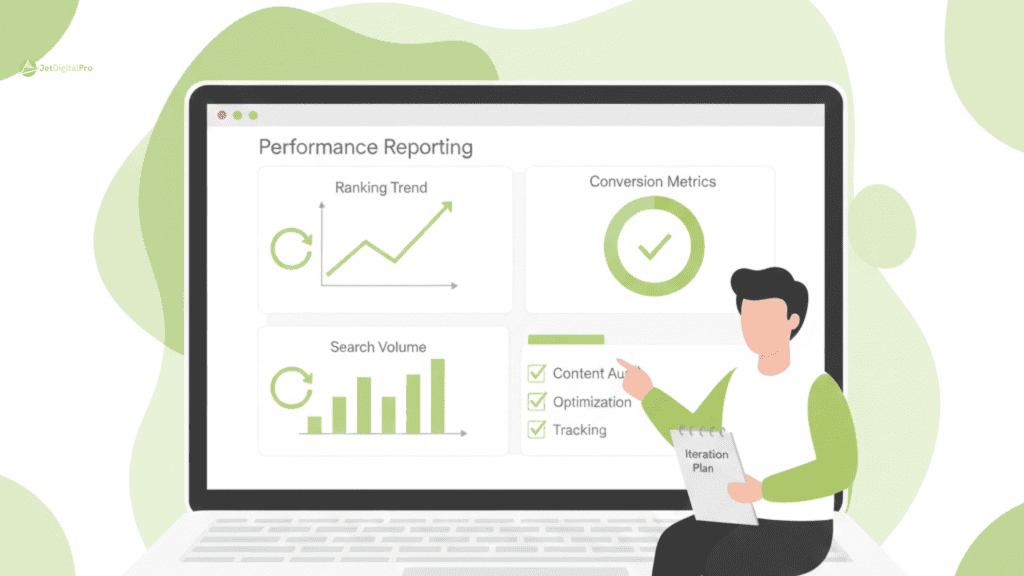
Keyword research isn’t a one-time project, it’s the first step in a cycle. For our agency partners, clear reporting is key. We show clients not just the keywords we’ve targeted, but the logic behind them, how they tie to business goals and the customer journey.
Then we track. We monitor rankings for priority terms, but more importantly, we track organic traffic and conversions tied to the new content built from this research. We use Google Search Console and analytics platforms to see what’s working and what’s not. This data feeds the next iteration.
Quarterly, we revisit the keyword strategy. We look for new “People Also Ask” questions, analyze fresh competitor moves, and check search trend shifts. We prune keywords that aren’t performing and double down on clusters that are driving results.
FAQ
How do agencies balance search volume with real user intent?
Agencies don’t chase search volume alone. They combine keyword research with audience research to understand user intent and the purchase journey. A term with lower monthly search volume but clear conversion value often beats a broad phrase.
By reviewing SERP data, conversion metrics, and Google’s data, they refine keyword lists that align with SEO strategy and real business goals.
How are long-tail keywords used in a scalable SEO strategy?
Long-tail keywords help agencies target specific search intent with less competition. These search terms usually have clearer user intent and higher conversion value. Professional SEO marketers group them into keyword clusters that support topical authority and content clustering.
This improves website structure, reduces keyword cannibalization, and strengthens search engine optimization across search engines without relying only on high-volume SEO keywords.
How does competitor analysis improve keyword research results?
Competitor analysis reveals competitor keywords, content gap analysis opportunities, and missed keyword groups. Agencies review domain rating, backlink analysis, and SERP features to see what already ranks.
Competitive gap analysis highlights high intent keywords and medium intent keywords worth targeting. This approach improves content strategy, supports digital PR and link building, and ensures SEO keywords are grounded in real market demand.
What role do AI and data analytics play in keyword research?
AI keyword research and machine learning speed up data collection techniques, but human review still matters. Artificial intelligence tools help process large keyword lists, detect search intent patterns, and support semantic keyword research.
Agencies use Google Trends and other SERP data sources to validate insights. The goal is smarter content writing and digital tactics, not automated guesswork.
The Jet Digital Pro Perspective on Scalable Research
Our content starts with a specific research framework. We analyze search intent, data, and competitive gaps for every article.
This approach builds topical authority and drives traffic, which is why agencies trust us for white-label work. We handle the complex research so you can manage client relationships, knowing the content foundation is solid. Good research isn’t an expense, it’s what makes the strategy work.
Want a content partner that does the heavy lifting? Book a free call to discuss your agency’s needs.
References
- https://presensi.perpusnas.go.id/press/1lgbhzh/perpusnas-mastering-communication-decoding-ambiguous-keywords-1764799748
- https://www.orbitmedia.com/blog/how-to-research-keywords-tips/
Related Articles
- https://jetdigitalpro.com/seo-agency-content-creation-process/
- https://jetdigitalpro.com/agency-content-briefing-standards/
- https://jetdigitalpro.com/agency-editing-proofreading-steps/
Stop Guessing. Start Ranking.
Get a free sample article written for your niche. See the quality before you commit.
Get Your Free Sample Article →No credit card needed • 100% tailored to your niche