

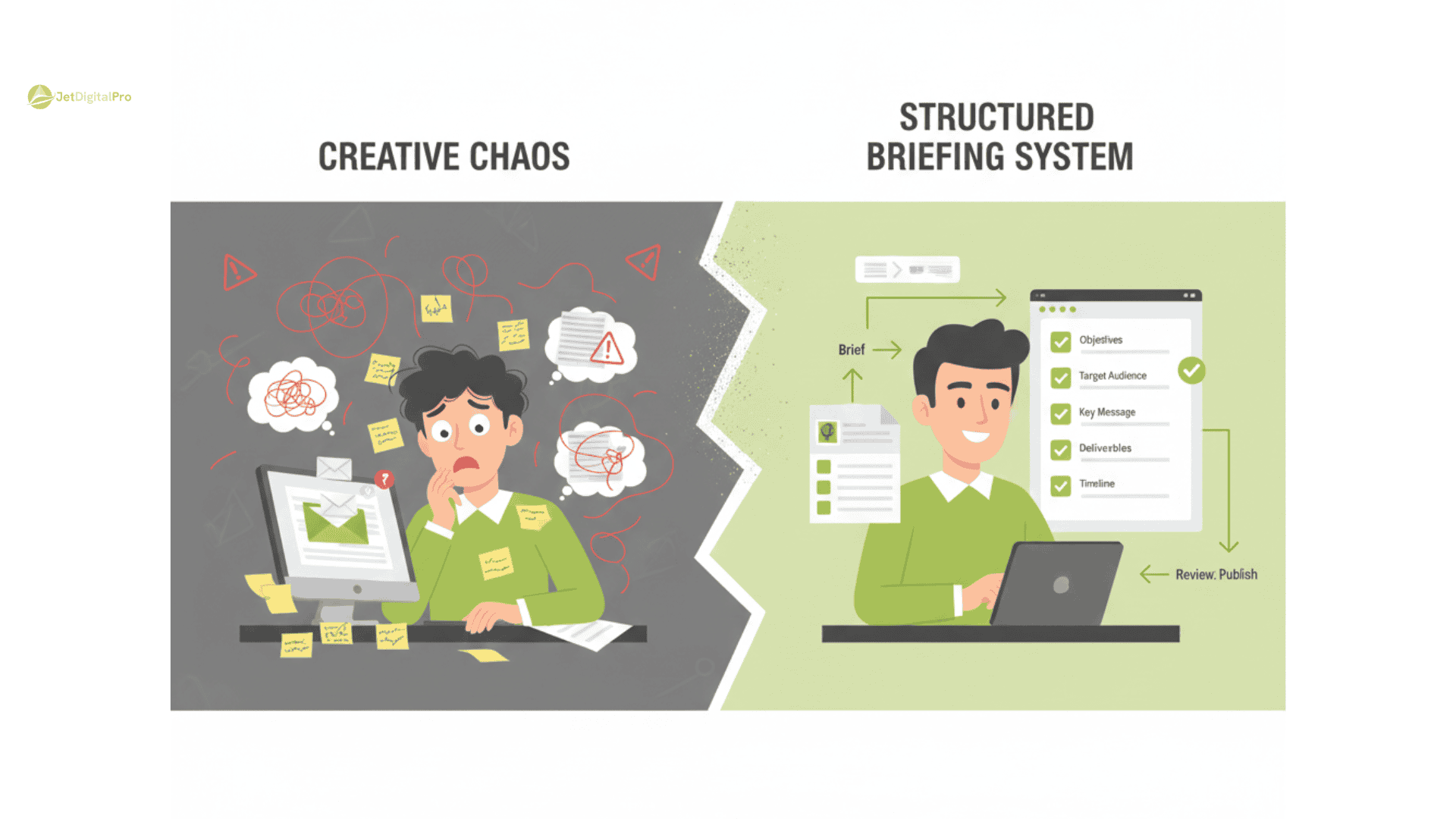
Learn how to build foolproof content briefing standards that eliminate revisions, align strategy, and drive scalable growth.
This is the brief on building foolproof content briefing standards.
We write SEO articles that rank on Google — so you can focus on your business.
See Writing Plans →When content projects drown in endless revisions, off-brand messaging, and wasted budget, the real issue is rarely a bad idea. It is unclear direction.
That is why successful agencies rely on structured briefing systems instead of guesswork, turning strategy into clear execution.
First, you need alignment and audience clarity. A strong brief connects business goals with real audience pain points and intent, not just demographics.
Without defining intent, content becomes guesswork. It is like throwing darts in the dark, and it will not resonate with what your audience actually cares about.
Second, you need creative guardrails and logistics. Your brief should act as a single source of truth, defining brand voice, timelines, budgets, and deliverables.
Clear boundaries do not limit creativity. They focus it, prevent scope creep, and eliminate miscommunication.
Finally, strong teams use reverse briefs and tracking. Before execution, they confirm alignment by restating the brief to avoid costly mistakes.
This step is simple but powerful, like a chef repeating an order before cooking to ensure accuracy.
Content success also continues after publishing. Tracking clicks and conversions allows continuous improvement.
In the end, success is not about producing more content. It is about building a repeatable system that drives consistent, scalable growth.
Stop paying for content alone and start investing in the system behind it.
Ever feel like your project is stuck on a loop? The team starts strong, but a few weeks later, you’re buried in revisions. Designs don’t fit the brand, copy misses the target, and the budget’s running out. Nine times out of ten, the problem starts with a bad brief.
Need SEO content that actually ranks? We write data-driven articles designed to bring organic traffic to your site.
See Our SEO Writing Plans →A standard briefing framework fixes that. It’s not about adding red tape. It’s about giving everyone the same playbook, turning strategy into clear, actionable work. This alignment saves time, money, and a lot of headaches from the very start. Let’s look at how agency content briefing standards save you from creative chaos.
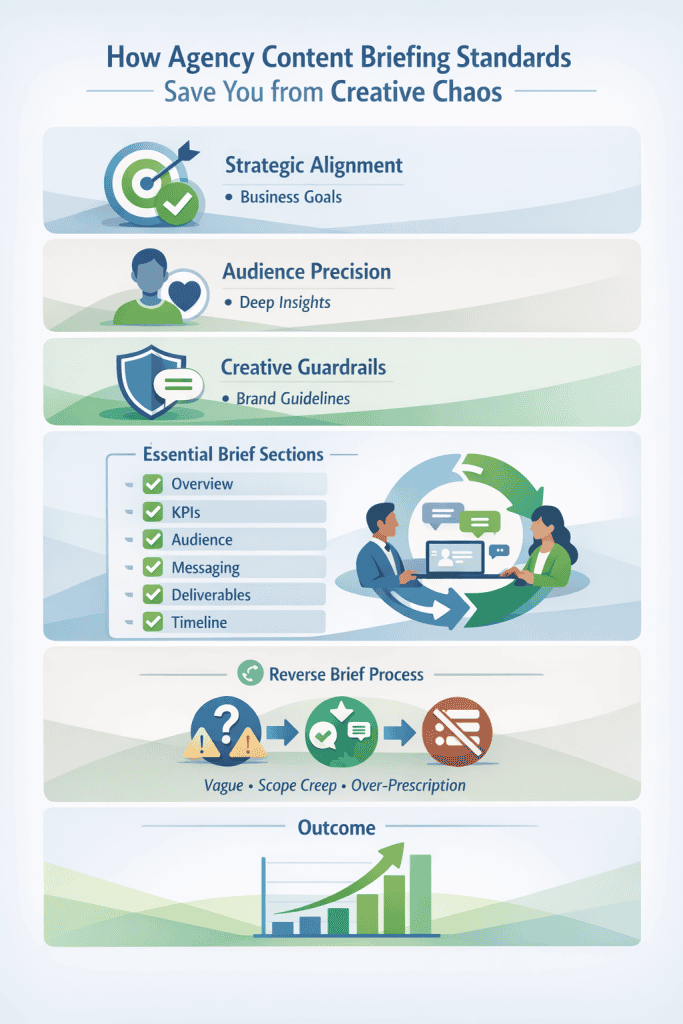
Core Principles
- Strategic Alignment: A good brief directly connects creative work to measurable business goals, ensuring every deliverable has a purpose.
- Audience Precision: Moving beyond basic demographics to psychographics and pain points creates content that truly resonates and converts.
- Creative Guardrails: Clear guidelines on brand voice and key messaging provide freedom within a framework, empowering teams instead of restricting them.
What Are Agency Content Briefing Standards?
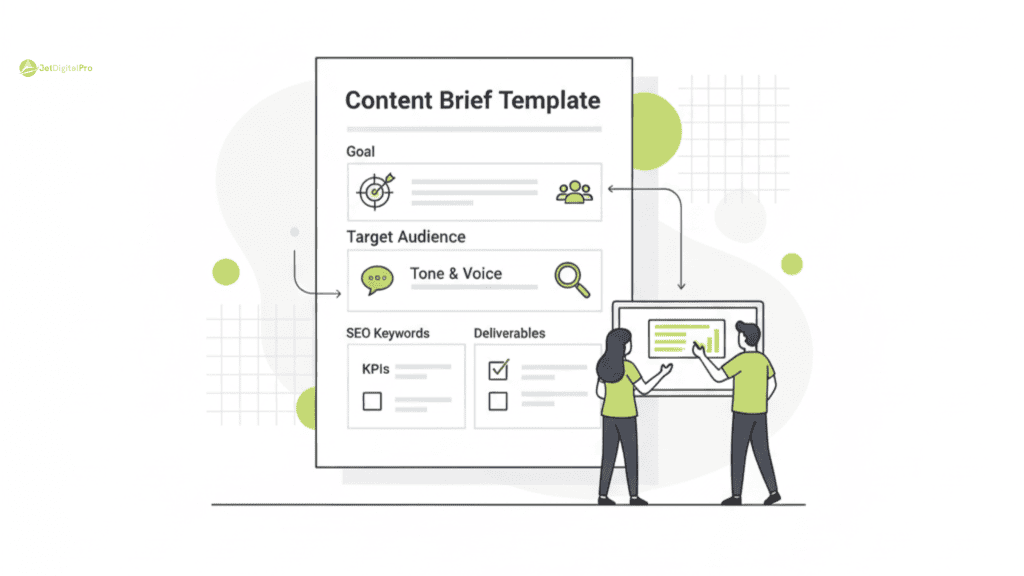
Think of them as a universal playbook. They’re a structured set of guidelines and templates that ensure every project starts on the same solid foundation. It’s the difference between a scribbled note saying “make a blog post” and a documented strategy outlining the why, who, and how.
For us at Jet Digital Pro, these standards are the bedrock of our white-label partnerships. They ensure that when an agency hands us a brief, we’re not interpreting a vision, we’re executing a clear, shared plan. This consistency is what allows for scalable, high-quality content production that feels cohesive, whether it’s one article or a hundred.
Core Purpose: Aligning Strategy, Outcomes, and Creative Freedom
The purpose of agency content briefing standards isn’t to add paperwork. It’s to connect strategy with execution in a way teams can actually use. A strong brief translates high-level business goals into clear creative direction and answers the “so what?” before production starts. Without that structure, teams guess. With it, they act with intent.
Effective briefing standards help you:
- Clarify the real business objective
- Define measurable success metrics
- Connect messaging to audience pain points
- Set guardrails without limiting creativity
This alignment builds confidence on both sides. Leaders see how content supports revenue and growth. Creative teams understand the context behind the ask. In our partnerships, we establish clear points of contact and feedback loops from day one. A structured client approval process is a big part of how we deliver scalable content solutions without the administrative headache for your team.
When everyone knows the target, they can choose the smartest way to reach it. True creative freedom doesn’t come from vague direction. It comes from clarity, focus, and shared understanding.
Essential Elements of a Standardized Agency Content Brief
A comprehensive brief isn’t a novel; it’s a strategic checklist. While the agency editing and proofreading phase catches errors later, a solid brief prevents strategic drift from the start. Based on industry frameworks, here are the non-negotiable sections every brief must have.
“The search intent is the goal behind a user’s search. Get it wrong, and your post will go down the drain before you even start. Be as specific as possible when sharing the search intent for your target keyword(s). Ambiguity is a recipe for misaligned content!” – DivByZero
| Brief Section | Core Question It Answers | Why It’s Non-Negotiable |
| Project Overview | What is this project, at its heart? | Sets the stage and provides immediate context for all stakeholders. |
| Objectives & KPIs | What does success look like, numerically? | Prevents subjective “I’ll know it when I see it” feedback loops. |
| Audience Definition | Who are we speaking to, really? | Stops generic content by forcing a human-centric approach. |
| Key Messaging | What is the one thing they must remember? | Ensures brand consistency and strategic communication. |
| Deliverables & Specs | What are we physically creating? | Eliminates assumptions about format, length, and technical needs. |
| Timeline & Budget | What are our constraints? | Manages expectations and resources from the outset. |
Objectives, KPIs, and Business Impact Metrics
“Increase brand awareness” is not an objective. It’s a hope. A standard requires specificity. What metric proves awareness increased? Is it a 15% lift in direct website traffic? A 25% increase in branded search volume? At Jet Digital Pro, we push for this clarity because it transforms content from a cost center into a measurable asset.
We tie our work directly to your sales funnel, top-of-funnel blog posts tracked by organic growth, middle-funnel guides measured by lead captures. This data-driven approach justifies spend and guides future strategy. It moves the conversation from “was it good?” to “did it work?”
Audience Definition Beyond Basic Demographics
Saying your audience is “males, 25-40” is practically useless. Modern briefing standards demand psychographics. What keeps them up at night? What do they value? What content do they already consume? We build detailed audience personas that include job frustrations, trusted information sources, and even the slang they use.
This depth is what allows us to craft blog posts and link-building content that doesn’t just get seen, it gets felt. The content speaks their language, addresses their specific pain points, and positions your agency as the obvious guide. It’s the difference between shouting into a crowd and having a conversation with a person.
Key Messaging, Brand Voice, and Guardrails
This is where you set the tone without scripting the lines. Provide clear examples of your brand voice, is it authoritative like The Economist or casual like a friend’s advice? Share a brand style guide. Define the key message pillars for the campaign.
“This section of your content brief should leave no room for ambiguity about who the content is for and what success looks like once they’ve consumed it. For SEO, aligning your content with specific user intent and a clear goal means you’re not just creating content for content’s sake; you’re creating content that serves a strategic purpose.” – Perpusnas
What are the three non-negotiable points that must come across? These aren’t creative handcuffs; they’re the bumpers on a bowling lane. They keep the work on-brand and on-strategy while giving the creative team the entire lane to play in.
For our agency partners, we use these guardrails to ensure every piece of white-label content we deliver sounds like it came directly from their team, strengthening their brand identity with every published word.
Deliverables, Channels, Timelines, and Budget Scope
Ambiguity here is a project killer. The brief must explicitly state: “We need one 1,200-word blog post with two custom graphics, formatted for WordPress, and three social media captions for LinkedIn.” Specify the channels. Detail the timeline with clear draft and review dates. And most importantly, be transparent about the budget.
A hidden budget leads to mismatched expectations, you can’t expect a cinematic video on a slideshow budget. Laying this all out upfront prevents painful mid-project conversations about scope and cost. It builds trust and allows the agency, or a partner like us, to allocate the right resources to meet your expectations within the agreed framework.
Collaboration Workflows and Stakeholder Roles
Who approves the copy? Who provides design feedback? Who is the final sign-off? A brief that doesn’t map this out invites chaos. Define the feedback and approval process clearly. Is it a single round of revisions? Two? Use a centralized tool for comments to avoid contradictory feedback from different stakeholders.
Name the decision-maker. This clarity prevents the dreaded “design by committee” and keeps the project velocity high. In our partnerships, we establish clear points of contact and feedback loops from day one. This streamlined workflow is a big part of how we deliver scalable content solutions without the administrative headache for your team.
Best Practices for Clarity, Completeness, and Efficiency
The best briefs are living documents, not set in stone. Start with a collaborative kickoff meeting to fill it out together, never just email a blank template. Keep it concise; aim for clarity over volume.
Use plain language, not jargon. And perhaps most crucially, treat the brief as the single source of truth for the project. Every question, every feedback point, should refer back to it. This practice eliminates subjective debates and keeps the team aligned on the original mission. It’s a simple habit that saves countless hours.
Common Pitfalls: Vague Inputs, Over-Prescription, and Scope Creep
We’ve witnessed the full spectrum of brief failures. The most common is the vague brief: “Make it engaging.” This leaves everything open to interpretation and guarantees revisions. The opposite is the over-prescriptive brief that dictates exact font sizes and sentence structures, stifling all creative problem-solving.
Then there’s scope creep, the quiet killer. It starts with “can we just add a small infographic?” outside the agreed deliverables. The standard brief, with its signed-off objectives and deliverables, is your primary defense against all three. It’s the agreed-upon contract that keeps the project healthy.
Reverse Briefs and Validation Frameworks
A powerful practice we advocate for is the reverse brief. After receiving the initial brief, the agency or content partner summarizes their understanding of the goals, audience, and deliverables back to the client. This validation step catches misunderstandings before a single word is written.
It’s a simple question: “This is what we heard. Is this correct?” This process builds incredible confidence and ensures both parties are literally on the same page. It turns the brief from a one-way command into a collaborative foundation.
Reddit’s Briefing Nightmares: Real-World Frustrations
Scrolling through marketing subreddits reveals the raw pain of bad briefs. Freelancers and small agency teams vent about receiving a “brief” that’s just a subject line and an attachment. One user ranted, “Client’s entire brief was ‘make it pop and increase conversions.’
What’s the product? Who knows!” Another shared the classic horror: “They approved the outline, then hated the draft because it ‘wasn’t what they envisioned.’” The consensus? Vague input directly causes burnout, wasted budget, and damaged relationships. These aren’t hypotheticals; they’re daily frustrations highlighting why standards aren’t optional.
Quora’s Structured Frameworks and Step-by-Step Models
In contrast, Quora answers often provide structured mental models from seasoned agency pros. The advice is systematic: “Step 1: Define the business problem, not your solution. Step 2: Map the customer’s emotional journey. Step 3: Set guardrails, not instructions.” The focus is on frameworks that empower agencies to ask the right diagnostic questions upfront.
The underlying message rejects one-size-fits-all templates in favor of adaptable systems built in tools like Notion or Airtable. The tone is professional, emphasizing that a good brief is a strategic tool, not an administrative task.
X (Twitter) Hot Takes on Scope Creep and Burnout
X is where the frustration turns into viral threads and burnout confessions. You’ll see rapid-fire advice like, “Your brief needs: 1. Problem 2. Audience 3. Output. Done.” alongside emotional vents: “Just declined a ‘urgent’ project with a 50-page brief and a $500 budget. My sanity isn’t for sale.” The hashtag #ScopeCreep is a graveyard of doomed projects.
These hot takes highlight the very human cost of poor briefing standards, agency team burnout, degraded creative quality, and fractured client partnerships. The community’s solution is brutal prioritization and clear, courageous communication from the start.
YouTube Comment Lessons: Templates vs. Reality
YouTube is full of videos titled “The Ultimate Brief Template 2026!” The videos are polished, but the comments tell the real story. Under a popular template tutorial, a top comment reads, “Great template, but my client refused to fill out the KPI section. Guess who got blamed when the campaign flopped?” Another shares, “Skipped to the deliverables part.
Video didn’t mention how to handle clients who change deliverables after signing off.” This gap between the ideal template and on-the-ground client behavior is the central challenge. The lesson from comments is that the tool is only as good as the discipline and buy-in behind it.
Enterprise and Technical Gaps in Current Briefing Standards
While the principles are universal, enterprise-level and technical projects expose gaps in common standards. Briefs for a multi-language website migration, a DITA-based documentation suite, or an API integration project require additional layers.
They must account for legacy system constraints, complex compliance mandates, and the involvement of multiple internal subject matter experts. The standard “brand voice” section is insufficient here; you need detailed technical specifications, governance workflows, and approval chains that can span dozens of stakeholders.
Current templates often lack this depth, leading to critical oversights in large-scale projects.
Measuring Brief Effectiveness and Iterating Templates Over Time
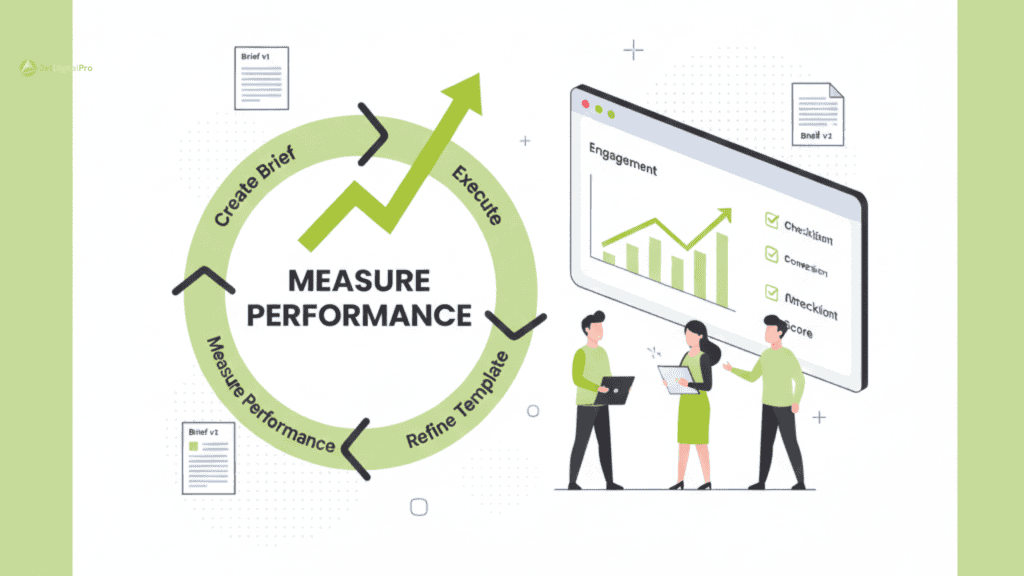
A brief shouldn’t be filed away when the project ships. Its final test is the project’s outcome. Did the content achieve the KPIs? How many revision cycles were needed? Was the timeline met? At Jet Digital Pro, we treat the brief as a starting point for a feedback loop. We analyze which briefs led to the most efficient processes and the highest-performing content.
We then use those insights to iteratively improve our own briefing frameworks and those we recommend to partners. This creates a virtuous cycle within the seo agency content creation cycle where your standards get smarter with every project, continuously reducing friction and elevating quality. That’s how you build a content engine that reliably delivers not just output, but outcomes.
FAQ
What should agency content briefing standards include for my marketing team?
Agency content briefing standards should clearly define your project goals, target audience, key message, budget and timeline. A strong content brief also outlines brand guidelines, tone and style, SEO considerations, and content goals.
This helps your marketing team and agency team align before content creation starts and reduces confusion during the feedback and approval process.
How do agency content briefing standards improve content marketing results?
Clear agency briefing improves content marketing by connecting content strategy to measurable outcomes. When your content brief defines search intent, SEO keywords, and ranking goal, your content creation process becomes focused.
It also ensures blog posts, landing pages, and social media content support the sales funnel, strengthen brand awareness, and help measure success accurately.
How detailed should a content brief template be?
A content brief template should be detailed enough to guide the writing team without limiting creative quality. Include project overview, audience personas, key messages, brand voice, SEO guidelines, and content type/format.
Avoid vague instructions. Clear audience definitions, competitor analysis, and call to action direction make the project brief practical and actionable.
How do briefing standards support SEO and search intent?
Strong agency content briefing standards include keyword research, SEO considerations, and clear search intent mapping. By defining SEO keywords, ranking goal, and content goals upfront, marketing agencies can structure blog articles and product descriptions effectively.
This ensures content matches user experience expectations and performs better across distribution channels.
Your Blueprint for Better Content Outcomes
That cycle of revisions and budget overruns usually starts with a weak brief. A standard briefing framework stops the guesswork. It turns strategic goals into clear, actionable work for your team, saving time and money from day one.
Stop managing content chaos and start delivering consistent quality.
Ready to streamline your process? Let’s talk.
References
- https://divbyzero.com/blog/content-brief/
- https://presensi.perpusnas.go.id/press/1lgbhzh/perpusnas-mastering-content-briefs-your-seo-success-roadmap-1764804578
Related Articles
- https://jetdigitalpro.com/seo-agency-content-creation-process/
- https://jetdigitalpro.com/agency-editing-proofreading-steps/
- https://jetdigitalpro.com/client-approval-process-agency/
Stop Guessing. Start Ranking.
Get a free sample article written for your niche. See the quality before you commit.
Get Your Free Sample Article →No credit card needed • 100% tailored to your niche