

Written by Nell · Interviewed: Doug Stewart, Founder of SpamZilla · April 2026 · 9 min read
Doug Stewart has been in the expired domain space long enough to see every shortcut fail. He built SpamZilla from the ground up as an in-house tool before it became a widely used tool for spam-checking expired domains. Today it’s widely used by SEOs who want to evaluate domains before buying.
We write SEO articles that rank on Google — so you can focus on your business.
See Writing Plans →The Builder Behind SpamZilla
Doug Stewart has spent years doing the work most SEOs avoid. Before SpamZilla became widely used, it was an internal solution he built to fix slow, manual spam checks. What started as infrastructure became the product itself.
What sets Stewart apart isn’t credentials, but control. He built systems to process domain data at scale, often without relying on third-party APIs. That decision, to own the data, shaped SpamZilla’s edge.
In a space full of shortcuts, Stewart’s approach is different: build systems, not hacks, and understand what actually lasts.
What the Expired Domain Industry Won’t Tell You
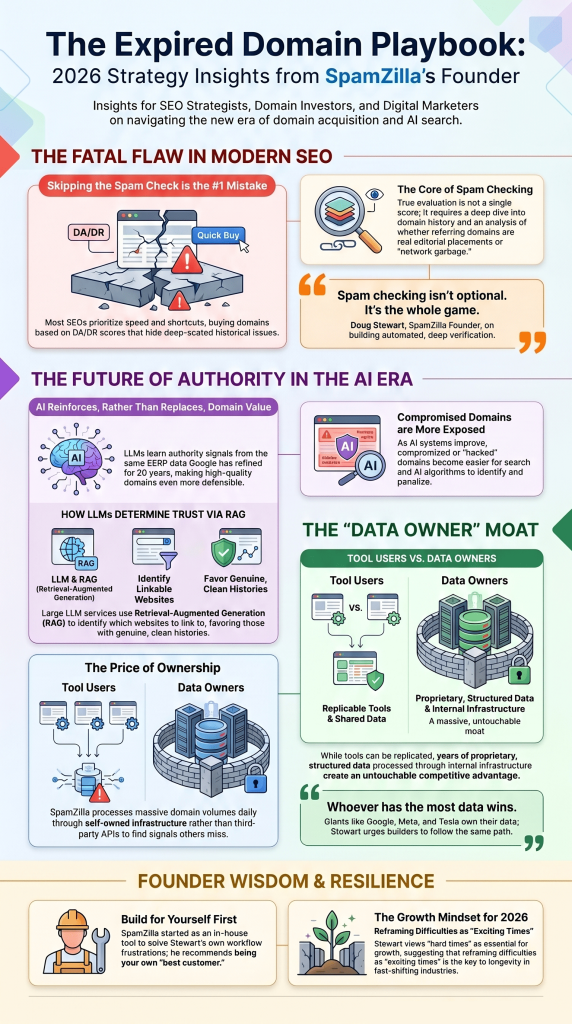
- The score everyone trusts is hiding the problem. DA, DR, and quick backlink counts don’t show you where a domain has been. The history is what determines whether it works, and most tools skip it entirely.
- The most important step in the process is the one most SEOs skip. Spam checking isn’t optional. It’s the whole game. But it’s slow, it’s unglamorous, and it’s often overlooked in practice, despite its importance.
- AI search doesn’t change the fundamentals. It reinforces them. LLMs are learning authority signals from the same SERP data Google spent twenty years refining. A clean domain gets more valuable. A compromised one gets more exposed.
- The people winning in this space are data owners, not tool users. He emphasises that proprietary data is a key advantage that is difficult to replicate.
Building From Scratch: The Price of Owning Your Own Data

Before we talked strategy, I wanted to understand what it actually took to build SpamZilla into what it is today.
The answer surprised me.
“We built everything from the ground up, this took a lot of time and effort. We only plug into third-party data where it’s necessary. We prefer to build our own systems and own as much data as possible.”
He said it plainly, without fanfare, the way people talk about things that cost them years rather than months. What it means in practice is that SpamZilla processes large volumes of domains daily through infrastructure they built and own entirely. That’s not a feature. That’s the only reason the product exists at all.
“This means building out solutions to handle processing large volumes of domain name data, as fast as possible, every day.”
Need SEO content that actually ranks? We write data-driven articles designed to bring organic traffic to your site.
See Our SEO Writing Plans →When you’re doing that at scale, with your own systems, you see things that tools relying on third-party APIs simply can’t. The gaps in the data. The signals that don’t show up on dashboards. The patterns that tell you a domain is worthless before you waste a bid on it. SpamZilla wasn’t built to be a better version of existing tools. It was built because existing tools weren’t solving the actual problem.
“We prefer to build our own systems and own as much data as possible.”
The Number One Mistake SEOs Make, And Why Nobody Says It Out Loud

I asked him directly: what is the single biggest mistake SEOs make when evaluating and buying expired domains?
He didn’t hedge.
“Spam checking. Specifically, SEO spam checking.”
That’s blunter than most people in this space will say publicly, and not because they don’t know it. They do. But it’s not something often emphasised publicly. He notes that proper spam checking is often skipped, even though it’s critical before bidding.
SpamZilla was built precisely because this step was too slow to do manually at scale. “This is the reason we initially built SpamZilla as our own in-house tool, to speed up the spam checking process. If you are going to spend thousands of dollars on a domain name, you want to make sure it will deliver a positive result. Domain history and referring domains are at the core of spam checking.”
Not the DA. Not a quick backlink snapshot. The history. What niches this domain existed in. Whether the links pointing to it are real editorial placements or network garbage accumulated over years of manipulation. That’s the work most SEOs skip because it takes time, and the whole promise of expired domains is that you’re buying a shortcut.
The conversation suggests that the shortcut only works if you do the slow part first. This implies that skipping spam checking may not actually save time. They’re spending thousands of dollars on domains that were already compromised before they showed up.
“Domain history and referring domains are at the core of spam checking.”
Why AI Search Makes Clean Domains More Valuable, Not Less

This is the question most people in the expired domain space are getting wrong right now. The assumption is that AI changing how search works means domain authority matters less. The founder of SpamZilla thinks the opposite is true.
“Root domain authority is a staple in the SEO industry; it’s been this way for over 20 years.”
He didn’t stop there.
“LLM’s want to do the same thing the SERPs do, deliver answers that best serve the user. Search engines have refined this process over many years. LLM’s are just scraping the SERP data to determine which content has the most authority.”
Then he said something more specific than most people discussing AI search are willing to get. “The large LLM services use Retrieval-Augmented Generation (RAG). This is how they ‘know’ which websites to link to.”
The logic that follows is clean and worth sitting with: if LLMs inherit their authority signals from the same SERP data Google spent two decades building, then a domain with genuine history and clean backlinks doesn’t lose value in an AI-first world. It becomes more defensible. The fundamentals don’t change. The surface changes. And he suggests that compromised domains may become easier to identify as systems improve.
“LLM’s are just scraping the SERP data to determine which content has the most authority.”
From Agency to SaaS: The Advice Nobody Actually Gives You
I asked this question because most founders who have made this transition give some version of the same polished answer. His was different, and more useful.
“Build yourself in house software tools that meet your own needs. You are your best customer. Grow these tools overtime, constantly adding any new functionality to streamline your work. Eventually it will become something other people will pay for.”
That’s the origin story of SpamZilla in one paragraph. It wasn’t built for a market. It was built for a problem the founder had himself, spam checking was too slow, existing tools weren’t solving it, so he built something that did. The product came later, almost as a side effect of solving his own workflow.
Then he added something that reframes the whole conversation about building in this space.
“Also, data is the name of the game. Whoever has the most data wins. Google, Meta, Tesla, all the LLM’s etc. they’re all data owners. Become a data owner.”
This helps explain why SpamZilla has remained competitive in its category. The interface can be replicated. The features can be copied. But years of domain data, processed and structured through proprietary systems, cannot be rebuilt with an afternoon of API calls. The moat is the data. It always has been.
“Whoever has the most data wins. Google, Meta, Tesla, all the LLM’s etc. they’re all data owners. Become a data owner.”
What This Conversation Actually Means for How You Build
I saved the last question for something personal. Running a business in a space that shifts as fast as SEO, algorithm updates, AI disruption, market swings, requires something beyond strategy. I asked how he stays focused when things get hard.
“Keep moving forward. Always remember that life gets hard before it gets good. Hard times are the most important, this is when we grow. No one met their goals without hard times, why would you be any different?”
He paused, then added the line that reframed everything.
“Remembering the above while you are experiencing ‘hard times’ flips them into ‘exciting times’.”
That’s not motivational poster language. That’s the perspective of someone who built proprietary infrastructure from scratch, watched the SEO industry shift multiple times beneath him, and kept building anyway. He’s not telling you to be positive. He’s telling you that difficulty is evidence you’re doing something real, and that reframe is the only thing that keeps most founders from quitting at exactly the wrong moment.
The expired domain space rewards the people willing to do the slow work: the history checks, the referring domain analysis, the niche relevance reviews that most people skip because the whole promise of this category is speed. The irony is that the shortcut only works when you take the time to do it properly.
And in 2026, with AI systems learning authority signals from the same data Google spent two decades refining, the fundamentals matter more than ever. Clean domains get more valuable. Compromised ones get more exposed. The people who built their advantage on real data, their own data, are the ones who will still be here when the next shift happens.
“Remembering the above while you are experiencing ‘hard times’ flips them into ‘exciting times’.”
Want Doug to check your domains before you waste another bid? Run them through SpamZilla
Stop Guessing. Start Ranking.
Get a free sample article written for your niche. See the quality before you commit.
Get Your Free Sample Article →No credit card needed • 100% tailored to your niche