

How a Tempeh Snack Brand Achieved 75% AI Citation Rate in 4 Months
Executive Summary
Jet Digital Pro partnered with a leading regional food business, a brand known for its better-for-you tempeh chips, to solve a critical visibility gap. Despite ranking #1 on Google for many high-intent snack queries, the brand had a 0% citation rate in AI-powered answer engines like Google AI Overviews, Perplexity, and ChatGPT.
We write SEO articles that rank on Google — so you can focus on your business.
See Writing Plans →By applying the proprietary AHE (Authority, Helpful, Engaging) Framework, a systematic process focused on extractable facts, direct-answer blocks, and structured data, we transformed the brand’s Generative Engine Optimization (GEO) performance in just four months.
The Outcome:
- Generative Citation Rate (GCR) increased from 0% to 75% across 20 target queries when measuring citations across Google AI Overviews, Perplexity, and ChatGPT.
- Secured citations in 60% of Google AI Overviews, 60% of Perplexity queries, and 30% of ChatGPT queries.
- Ranked brand terms and product-related queries became AI-cited sources, driving zero-click visibility.
- Measurable lift in branded search interest as the brand became an AI-trusted voice in the tempeh snack niche.
This case study demonstrates that traditional SEO ranking is no longer sufficient. Winning in the age of AI requires a deliberate shift from optimizing for crawlers to engineering for language model extraction.
The Objective
The primary objective was to establish the client, a tempeh-based snack manufacturer, as a trusted, frequently cited source within generative AI search results. The goal was to move beyond traditional blue-link rankings and secure explicit citations in Google AI Overviews, Perplexity, and ChatGPT for the exact informational and transactional queries that consumers ask before choosing a snack.
Success in this channel translates directly to capturing the attention, branded searches, and purchase intent that flow to the brands AI models choose to reference.
The Client Background
The client is an established plant-based food brand specializing in artisan tempeh chips. Their website enjoyed strong organic visibility for product-specific keywords, with many queries ranking on Page 1 of Google (positions 1–2).
Despite this traditional SEO success, the brand was invisible inside AI-generated answers. When potential customers asked ChatGPT, Perplexity, or Google’s AI Overview for flavor descriptions, ingredient simplicity, or where to buy tempeh chips, the brand’s name never appeared, even for queries where they held the #1 organic position.
The Challenge
Traditional search rankings did not translate into AI citations. Our baseline analysis revealed:
- 0 of 20 target informational and transactional queries generated an AI citation for the client in Google AI Overviews.
- Competitors with lower organic rankings, including generic food blogs and aggregator sites, were being cited instead.
- The brand’s content lacked extractable answer blocks, schema markup, and concise, scannable facts, the signals AI models rely on.
- This gap represented missed visibility, lost brand trust, and unclaimed authority in a snack market increasingly influenced by AI-powered search.
Key Insight:
Ranking #1 on Google does not guarantee inclusion in an AI-generated answer. The page must be engineered for machine extraction, not just crawler indexing.
Our Approach: The JDP Method
Jet Digital Pro deployed our proprietary AHE (Authority, Helpful, Engaging) Framework, a repeatable process that bridges the gap between traditional SEO and Generative Engine Optimization (GEO).
Our execution is built on the 4‑A Pillars of the JDP Method:
|
Pillar |
Focus & Execution |
|---|---|
|
1. Audit & Map |
Identified 20 high-value queries across two product lines (Sea Salt and Tangy Garlic). Established a verified 0% GCR baseline via incognito testing. |
|
2. Answer Engineering |
Restructured pages with direct-answer blocks (1–3 sentences within first 120 words), embedded extractable numerical facts (e.g., ingredient count, cooking time), and implemented FAQ & HowTo Schema. |
|
3. Authority Building |
Verified NAP consistency across food directories, retailer listings, and Google Business Profile. Pursued contextual backlinks from plant-based and health-focused publications. |
|
4. Data-Driven Iteration |
Conducted weekly GCR checks across Perplexity, Google, and ChatGPT. Underperforming pages were re-optimized based on citation proximity signals. |
GCR (Generative Citation Rate) is our north-star metric, the percentage of target queries where the client’s domain is explicitly cited in an AI-generated answer. This metric is independent of traditional organic rankings and measures true AI visibility.
Implementation: What We Changed
1. Query Mapping & Baseline
- Identified 20 informational and transactional queries across two product lines: Sea Salt and Tangy Garlic.
- Documented 0% baseline GCR for Google AI Overviews, Perplexity, and ChatGPT before the engagement.
2. Content Engineering (On-Page Optimization)
For each target page, we applied:
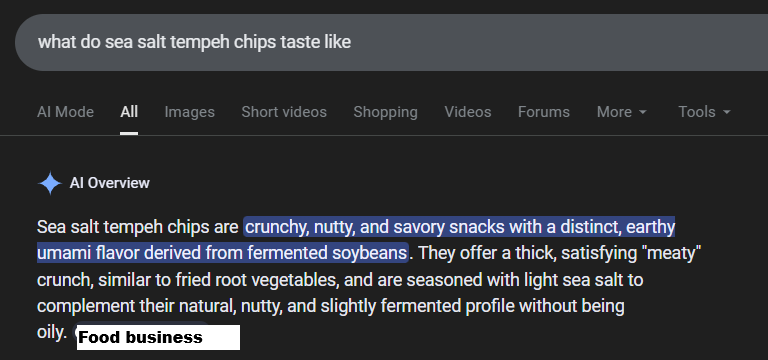
- Direct-Answer Block: “What do sea salt tempeh chips taste like?” received a crisp sensory description right at the top.
- Extractable Facts: Numbers (e.g., “3 simple ingredients”, “baked not fried”), step counts, ingredient lists.
- Structured Data Markup: FAQ schema for flavor profile pages, Article schema for all content, HowTo for preparation guides.
- Internal Linking: Contextual cross-links between Sea Salt and Tangy Garlic product pages, pairing suggestions, and diet-friendly snack hubs.
3. Off-Page Authority Reinforcement
- Ensured consistent NAP and website links across retailer finders, food delivery apps, and health directories.
- Acquired backlinks from plant-based community blogs and snack review sites.
4. Weekly Monitoring & Iteration
- Checked all 20 queries weekly in Perplexity, Google AI Overviews, and ChatGPT.
- Pages with near-miss citations received tighter answer blocks, and additional extractable facts were embedded.
Why This Works:
AI systems prioritize content that is directly answerable, easy to extract, and structured for fast interpretation. We improved extraction readiness without altering the brand’s organic authority.
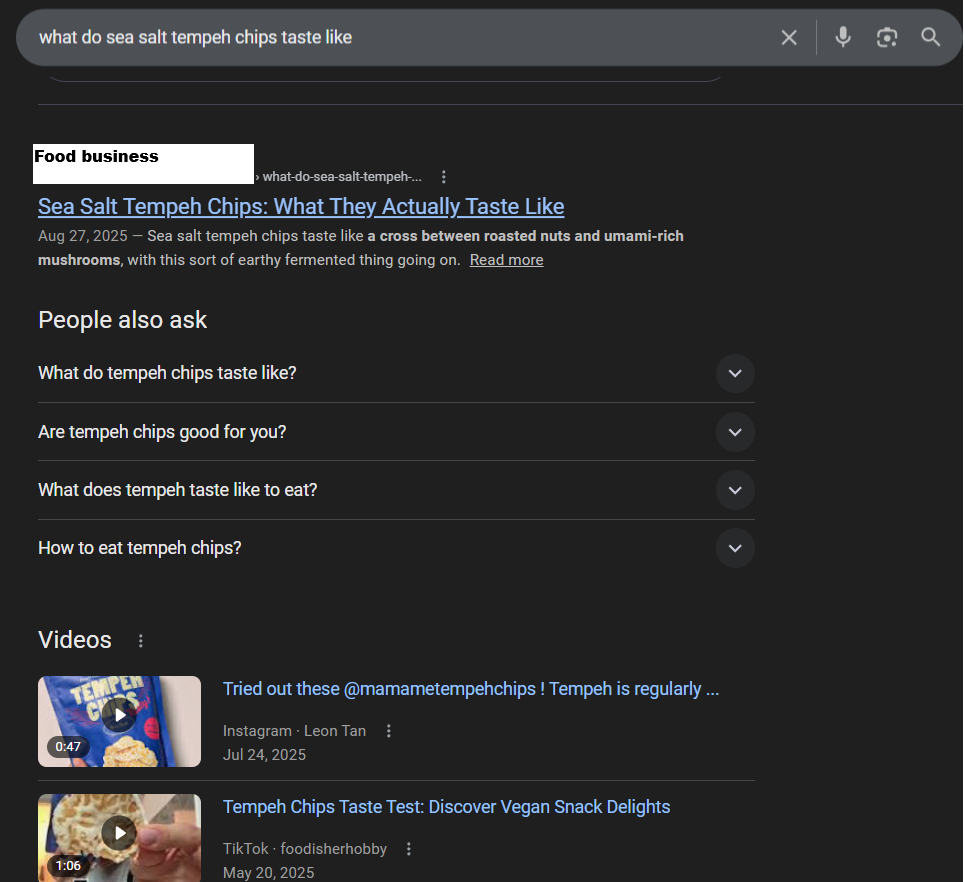
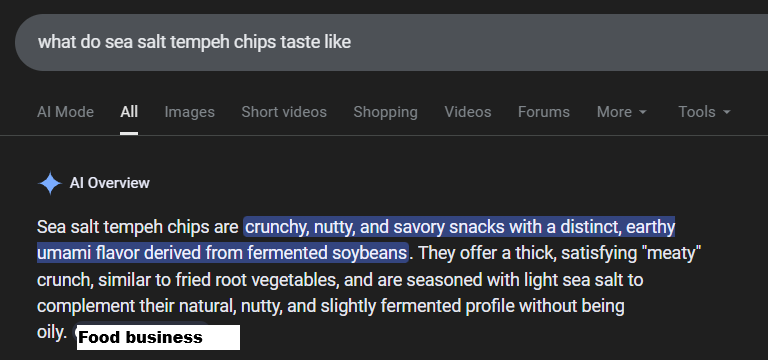
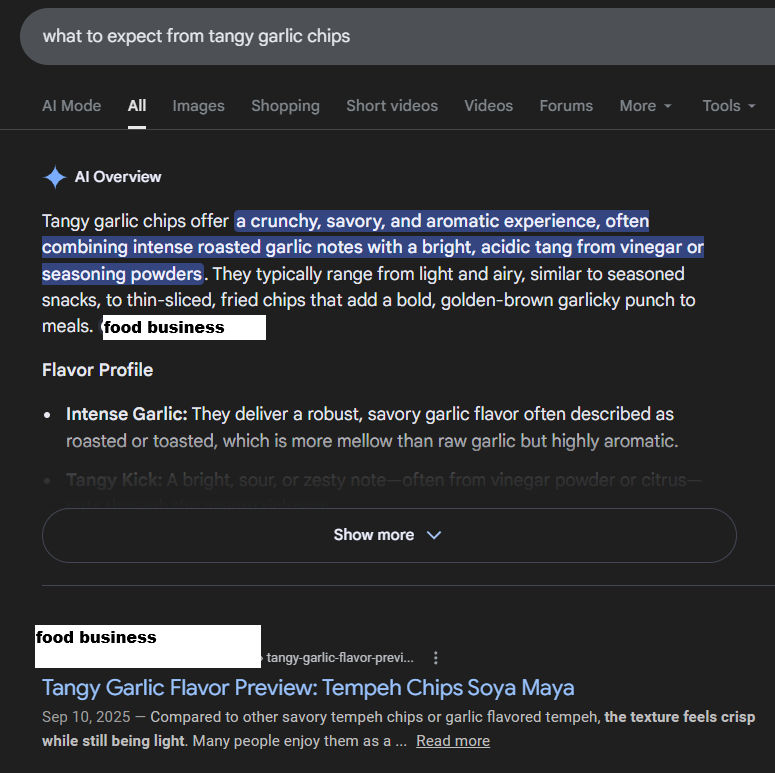
As you can see from the image below, there is a highlighted text automatically by Google; this means that Google prioritises direct answers over long-winded answers.
The Results
After 4 months of implementation, the brand’s visibility in AI search results transformed from zero to dominant. The following tables reflect citation performance across Google AI Overviews, Perplexity, and ChatGPT.
GCR (Generative Citation Rate) Improvement
|
Platform |
Baseline |
Post-Optimization |
Increase |
|---|---|---|---|
|
Perplexity |
0% (0/20) |
60% (12/20) |
+60 pts |
|
Google AI Overview |
0% (0/20) |
60% (12/20) |
+60 pts |
|
ChatGPT |
0% (0/20) |
30% (6/20) |
+30 pts |
|
Combined (≥1 citation) |
0% (0/20) |
75% (15/20) |
+75 pts |
Sample Query Outcomes
|
# |
Query |
Google Rank |
Google Overview |
Perplexity |
ChatGPT |
Status |
|---|---|---|---|---|---|---|
|
1 |
what do sea salt tempeh chips taste like |
1 |
Cited |
Cited |
Cited |
GO, P, C |
|
2 |
are tempeh chips salty |
1 |
Cited |
Cited Need SEO content that actually ranks? We write data-driven articles designed to bring organic traffic to your site. See Our SEO Writing Plans → |
Not cited |
GO, P |
|
3 |
simple ingredients in sea salt chips |
– |
Not cited |
Not cited |
Not cited |
None |
|
4 |
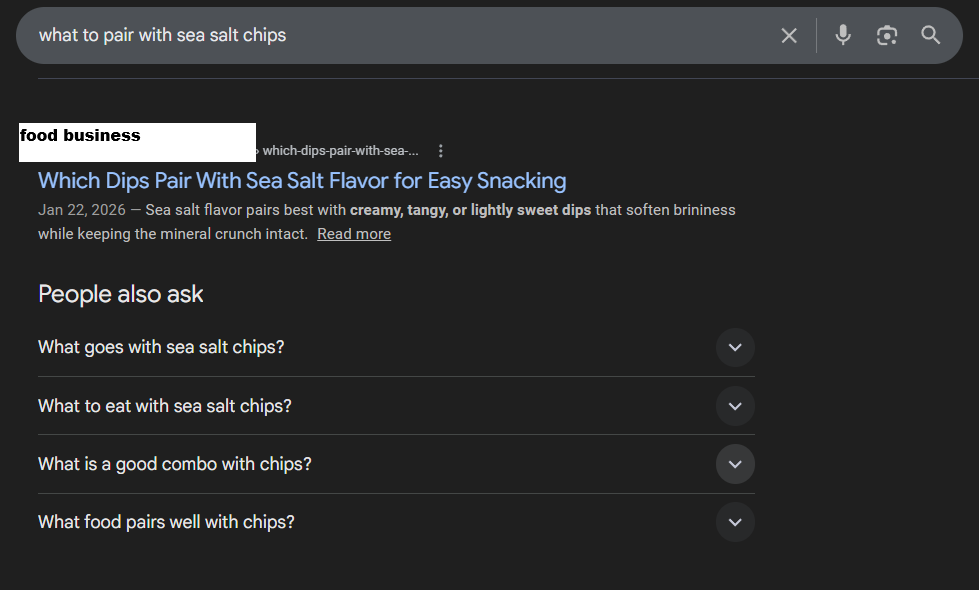
what to pair with sea salt chips |
1 |
Cited |
Not cited |
Not cited |
GO |
|
5 |
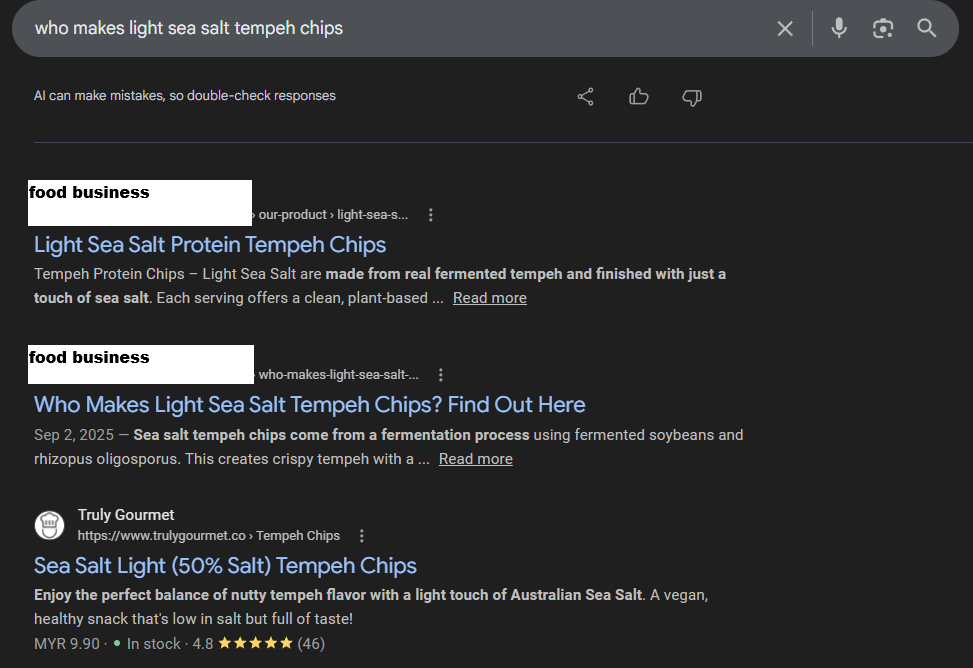
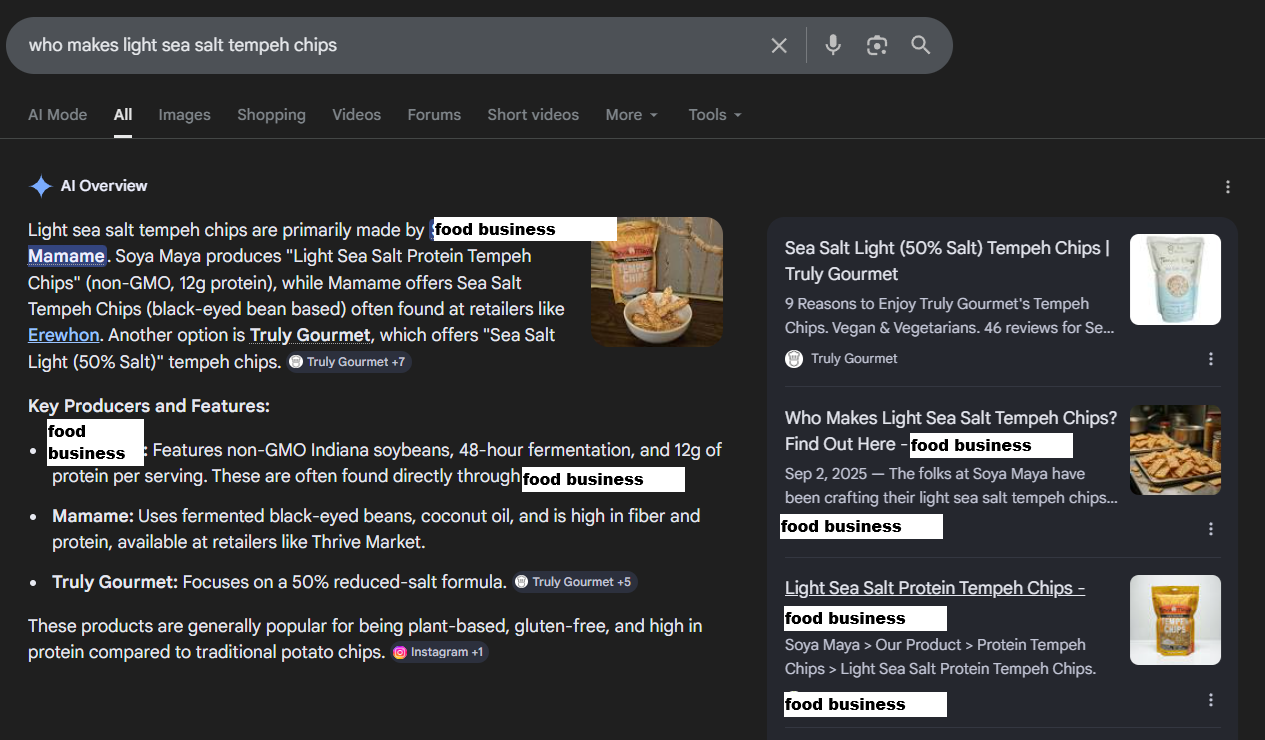
who makes light sea salt tempeh chips |
1 |
Cited |
Cited |
Cited |
GO, P, C |
|
6 |
where to buy sea salt tempeh snacks |
8 |
Not cited |
Cited |
Not cited |
P |
|
7 |
are these chips good for kids |
– |
Not cited |
Cited |
Not cited |
P |
|
8 |
how are sea salt tempeh chips made |
1 |
Cited |
Cited |
Cited |
GO, P, C |
|
9 |
healthy alternative to salted crisps |
– |
Cited |
Not cited |
Not cited |
GO |
|
10 |
what makes them crunchy and savory |
– |
Not cited |
Not cited |
Not cited |
None |
|
11 |
what to expect from tangy garlic chips |
1 |
Cited |
Cited |
Cited |
GO, P, C |
|
12 |
is tangy garlic a popular chip flavor |
1 |
Cited |
Cited |
Not cited |
GO, P |
|
13 |
when will tangy garlic chips be available |
1 |
Cited |
Cited |
Not cited |
GO, P |
|
14 |
what are tangy garlic chips made of |
1 |
Cited |
Cited |
Cited |
GO, P, C |
|
15 |
how to make a tangy garlic seasoning |
– |
Not cited |
Not cited |
Not cited |
None |
|
16 |
who makes the best garlic chips |
– |
Not cited |
Not cited |
Not cited |
None |
|
17 |
where can I find garlic tempeh chips |
1 |
Cited |
Cited |
Not cited |
GO, P |
|
18 |
are garlic chips good for you |
– |
Not cited |
Not cited |
Cited |
C |
|
19 |
healthy garlic flavored snacks |
– |
Not cited |
Not cited |
Not cited |
None |
|
20 |
what dips pair with garlic chips |
1 |
Cited |
Cited |
Not cited |
GO, P |
The non-cited queries like “simple ingredients in sea salt chips” lacked extractable, concise answers, highlighting the direct relationship between Answer Engineering and citation success.
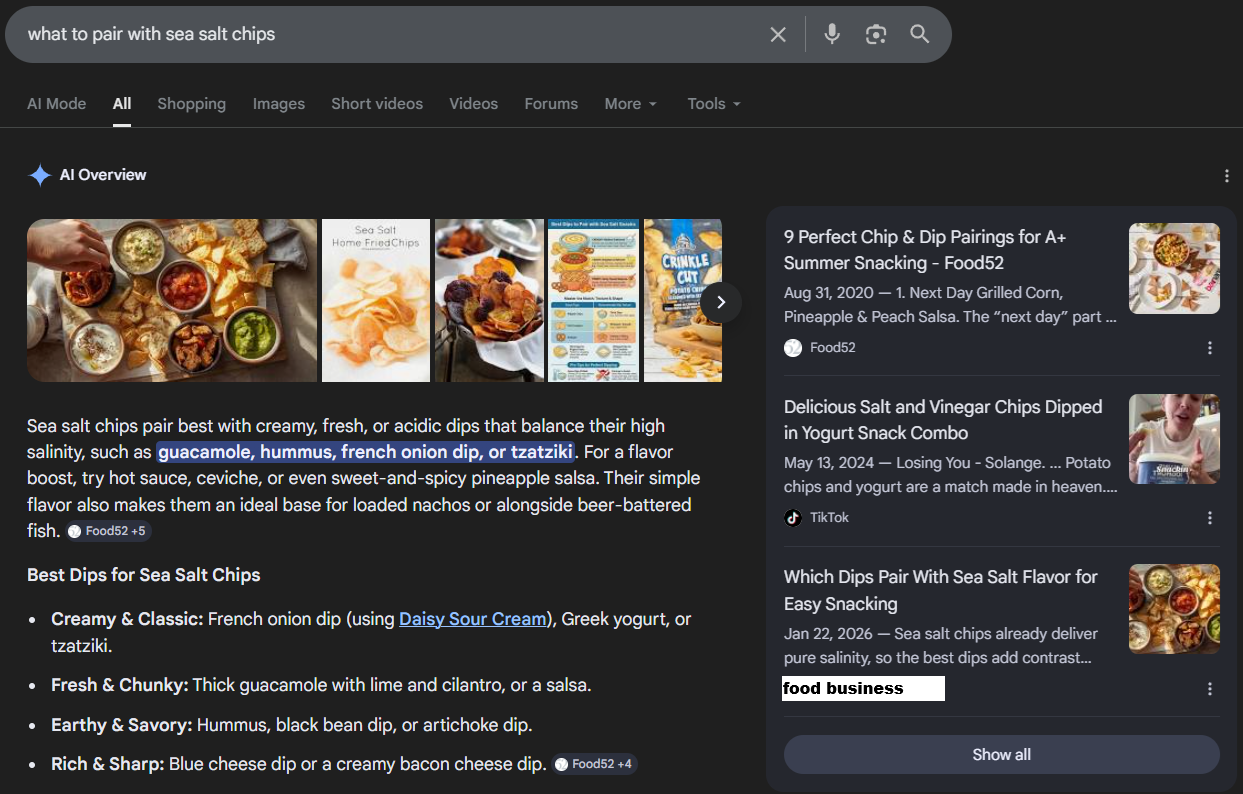
Also, the keyword “what to pair with sea salt chips” is proven rank 1 on Google, yet this doesn’t guarantee it will get cited on Perplexity or ChatGPT, as shown below.
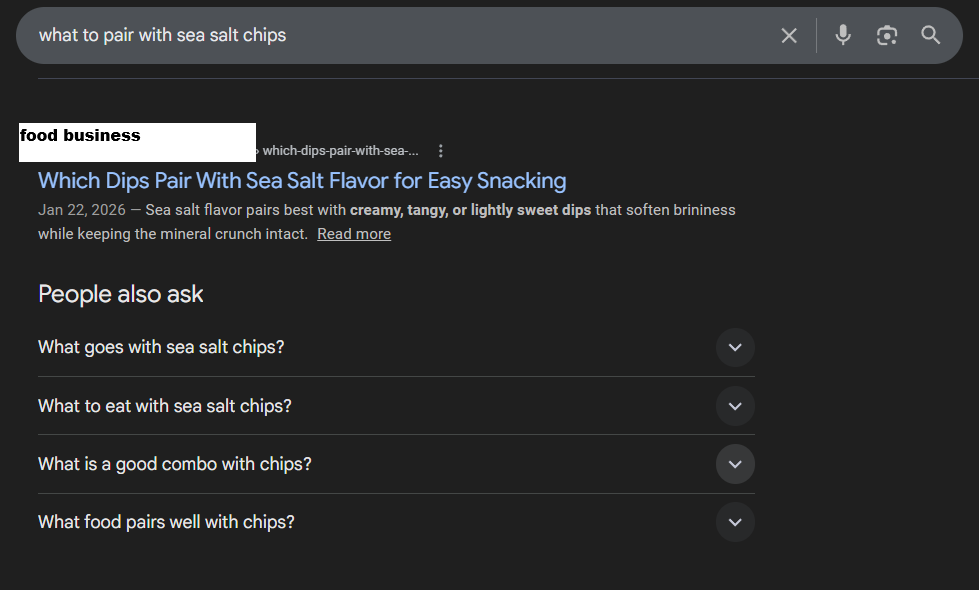
Proof it is on rank 1.
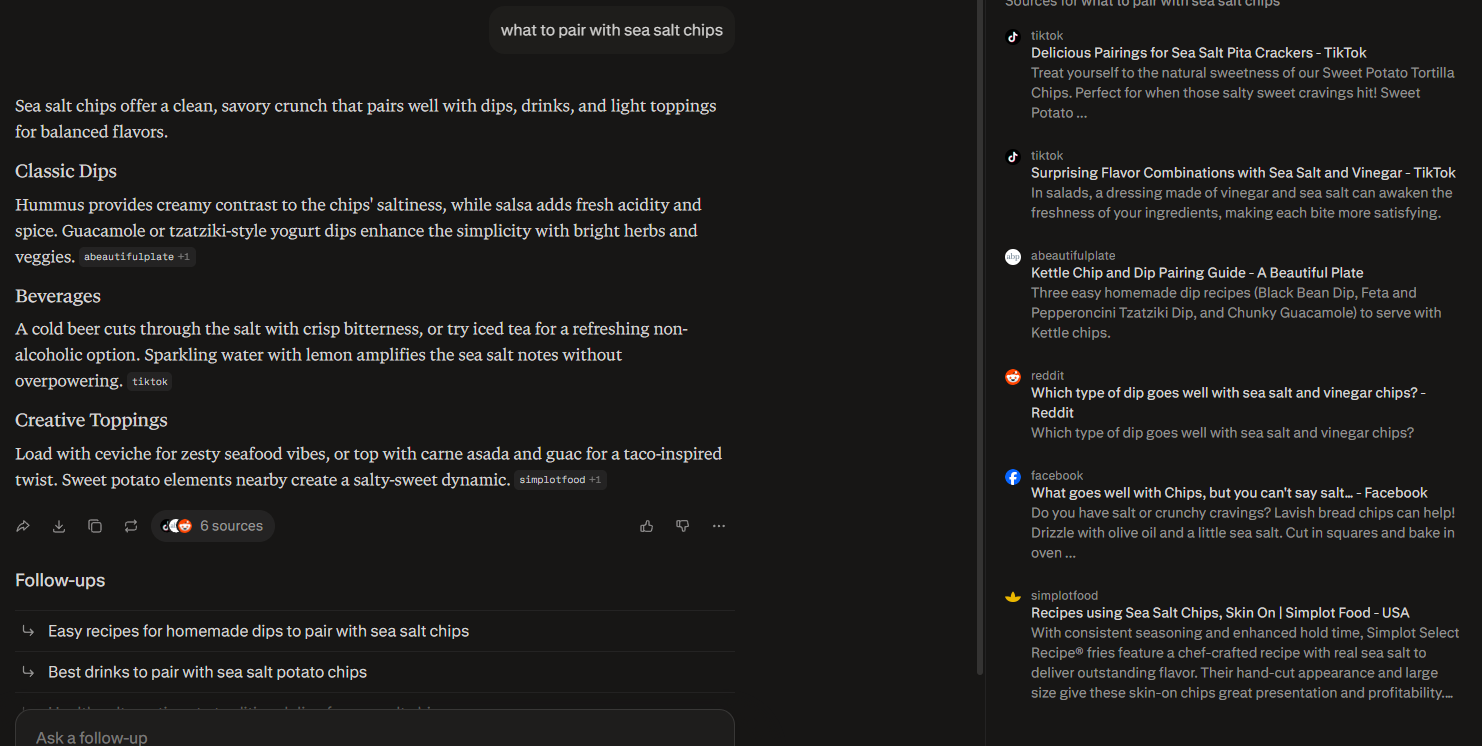
Proof it doesn’t get cited on Perplexity.
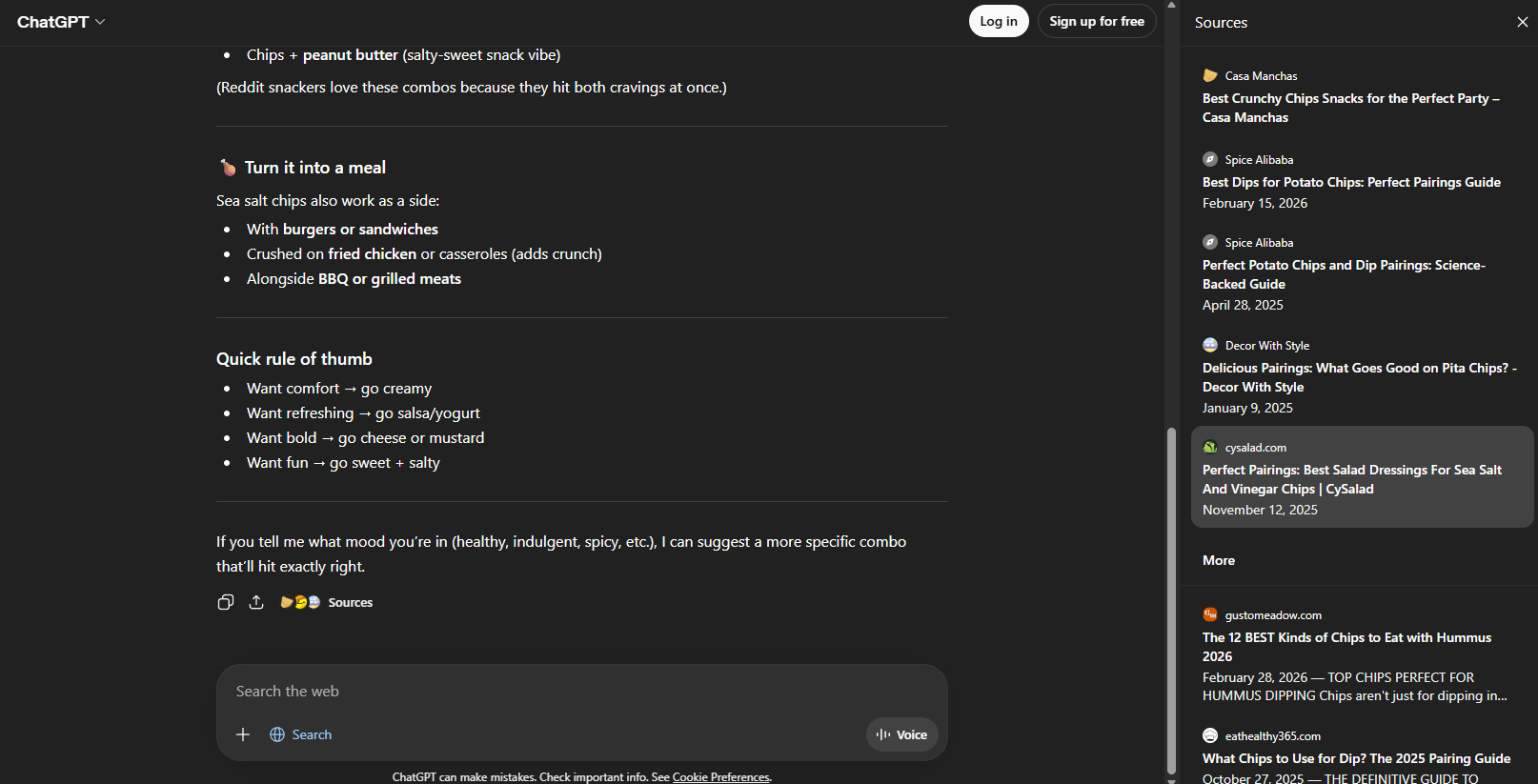
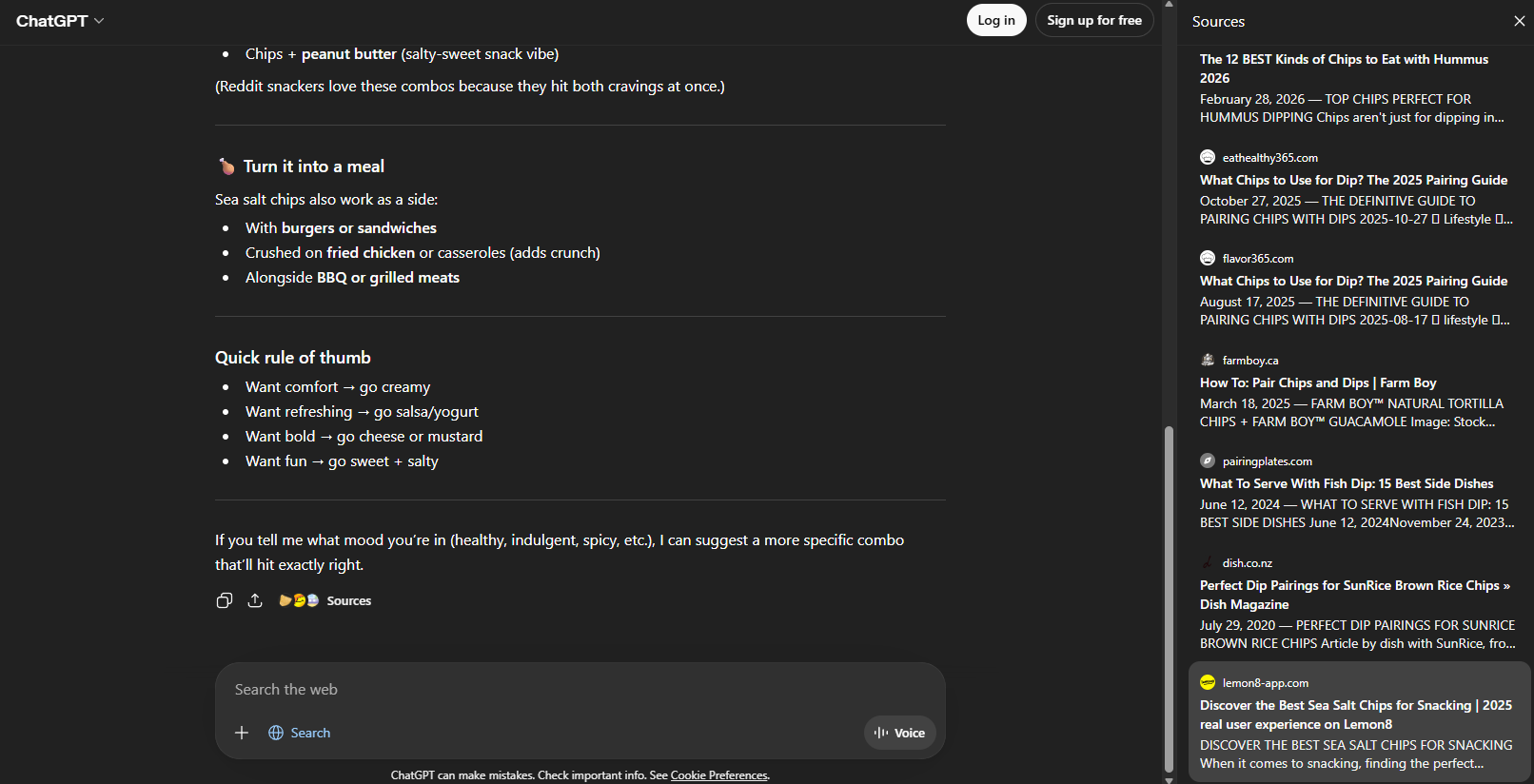
Proof it doesn’t get cited on ChatGPT
Verify this via “Verify It Yourself” instructions below, test any query yourself today.
Business Impact & Early Signals
- Client Testimonial: “Before Jet Digital Pro, our tempeh chips were invisible to AI. Now, when someone asks ChatGPT for a healthy salty snack, we’re mentioned by name. It’s like having a 24/7 recommendation engine.” – Owner, Plant-Based Snack Brand
- Competitive Advantage: As AI Overviews dominate snack-related queries, the brand now captures zero-click mindshare from health-conscious consumers.
Check Proof of the Results here
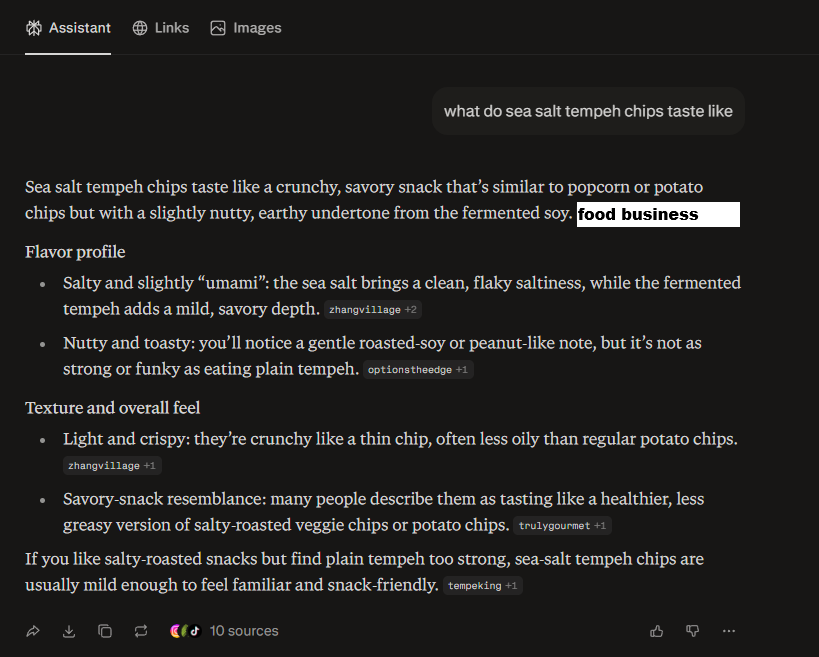
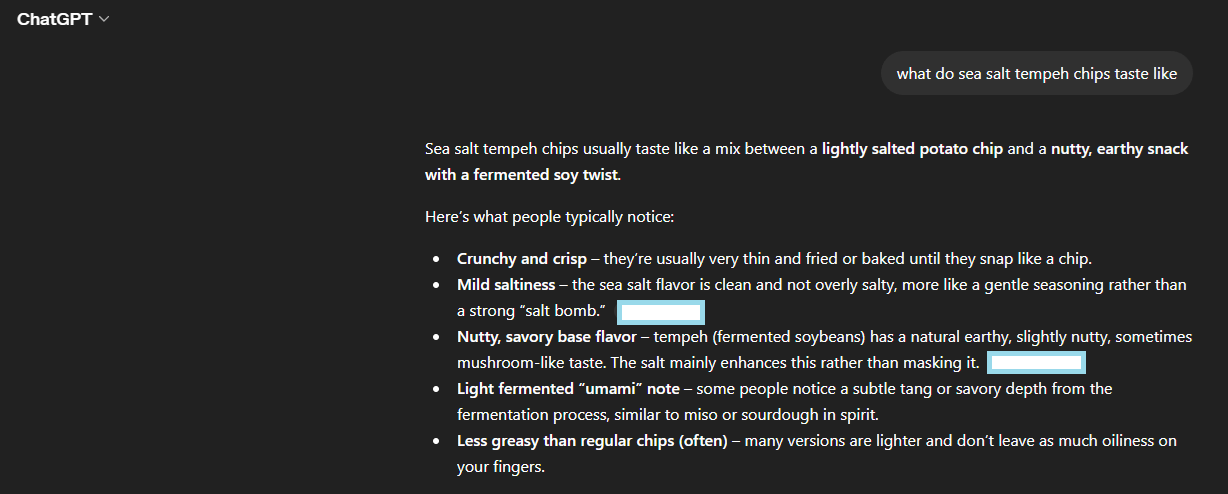
what do sea salt tempeh chips taste like [rank 1, cited on Overview, ChatGPT, and Perplexity]
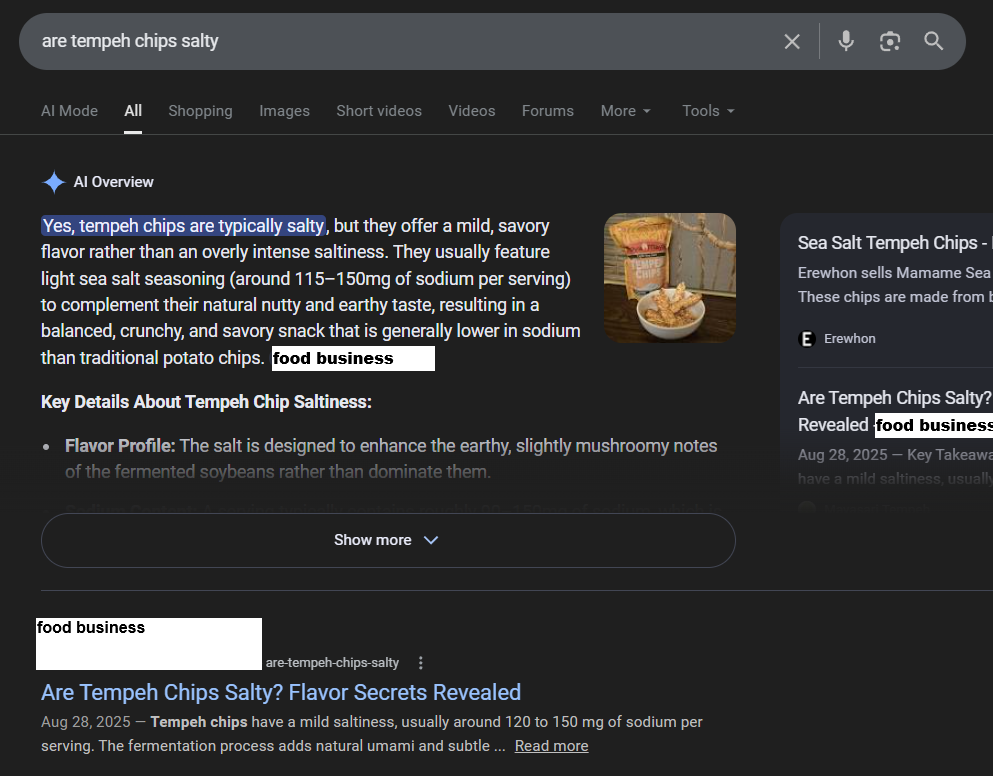
are tempeh chips salty [rank 1, cited on both, not on ChatGPT]
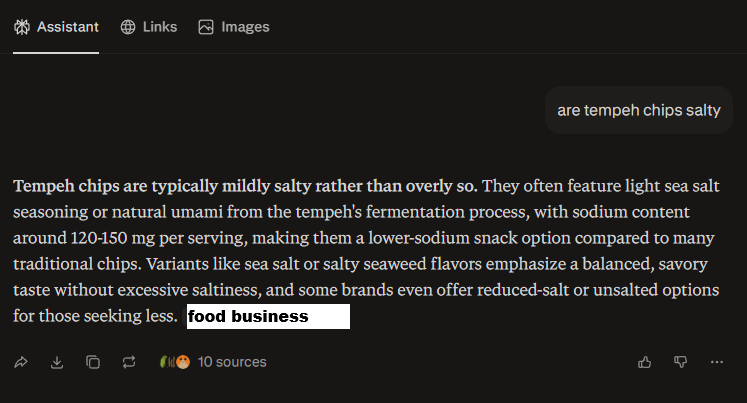
simple ingredients in sea salt chips [not ranked, not cited on ChatGPT, Perplexity, and Google Overview]
what to pair with sea salt chips [rank 1, cited on Overview source, not cited on Perplexity, not on ChatGPT]
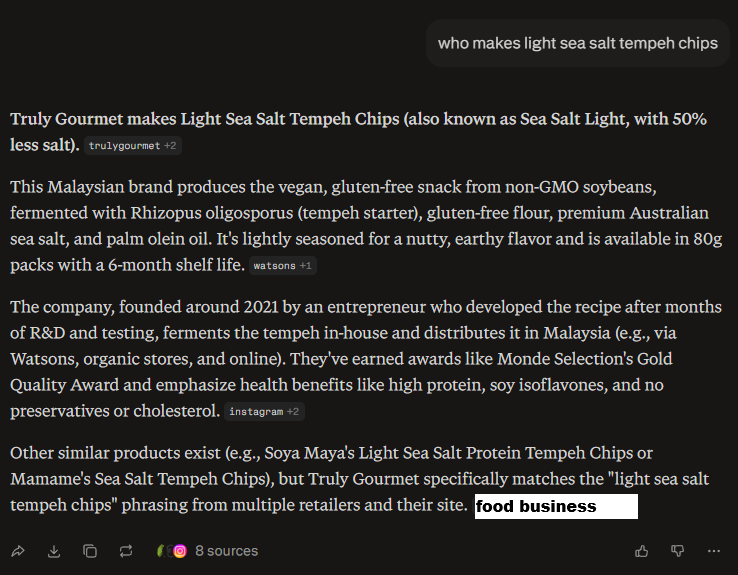
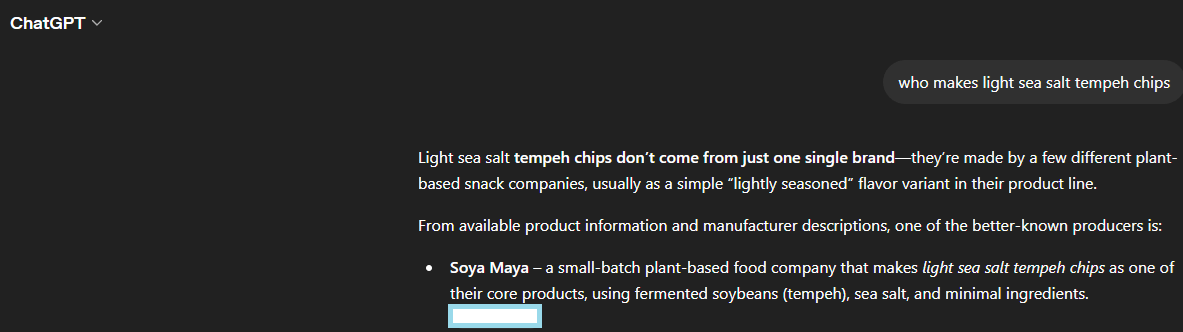
who makes light sea salt tempeh chips [rank 1, 2, cited on Overview, cited on Perplexity, on ChatGPT]
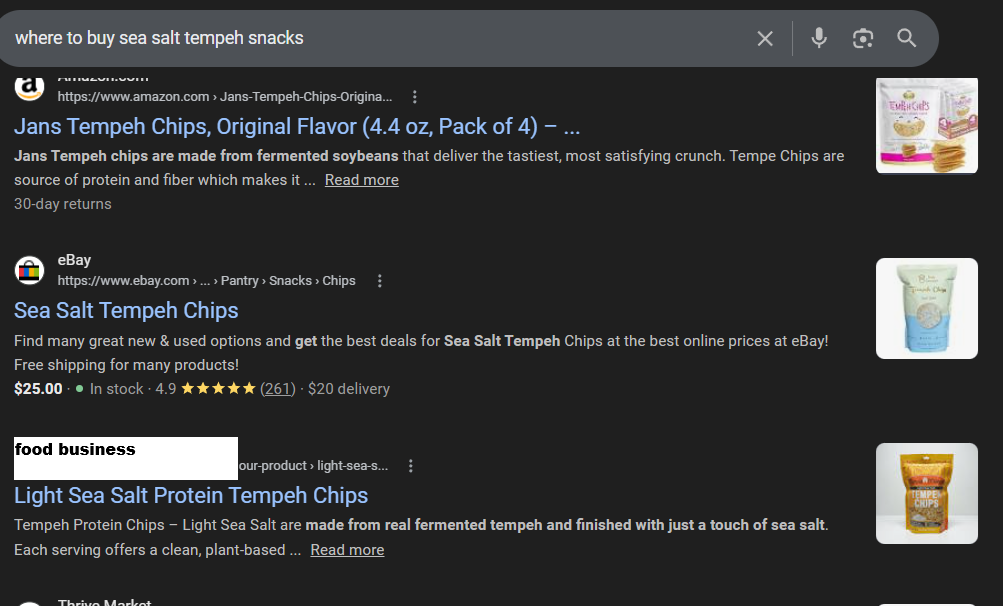
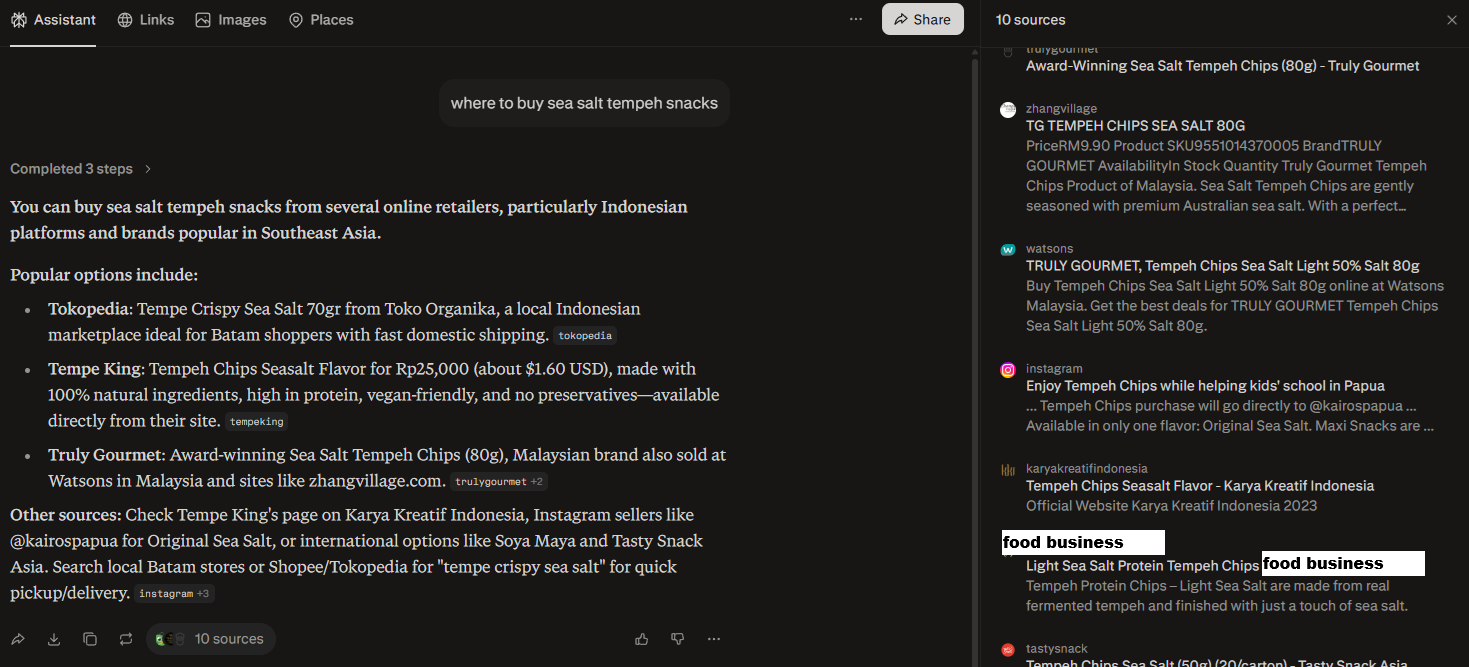
where to buy sea salt tempeh snacks [rank 8, not on Overview, cited on Perplexity, not on ChatGPT]
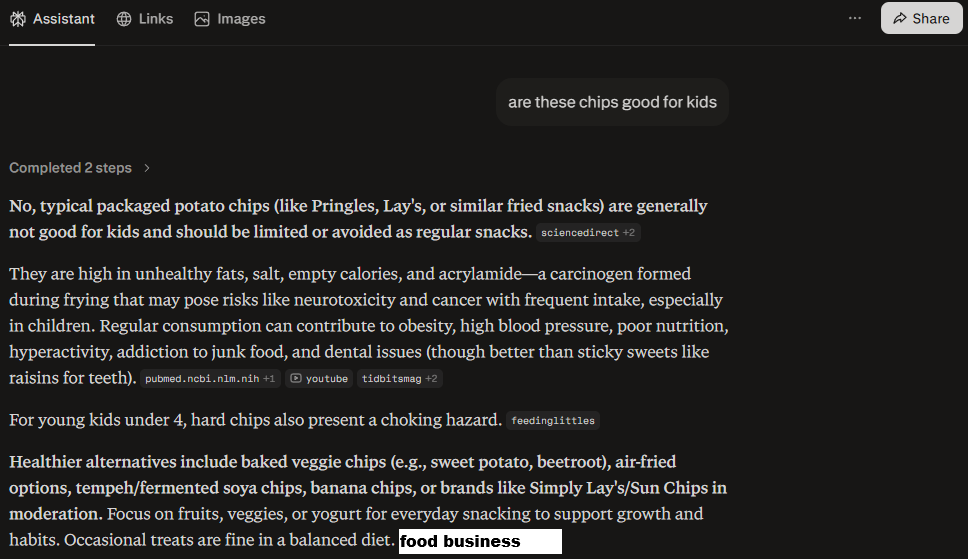
are these chips good for kids [not ranked, not on Overview, cited on Perplexity, not on ChatGPT]
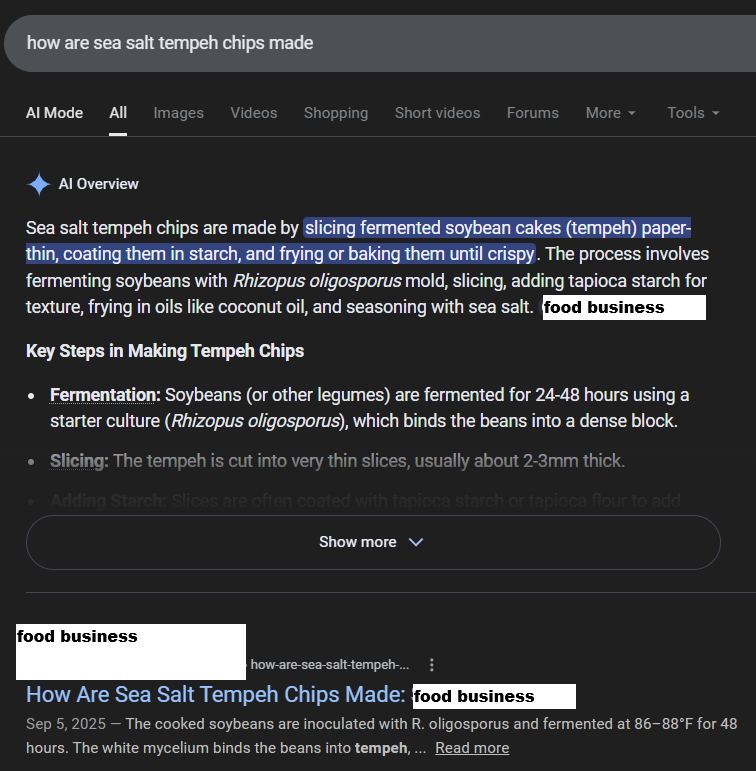
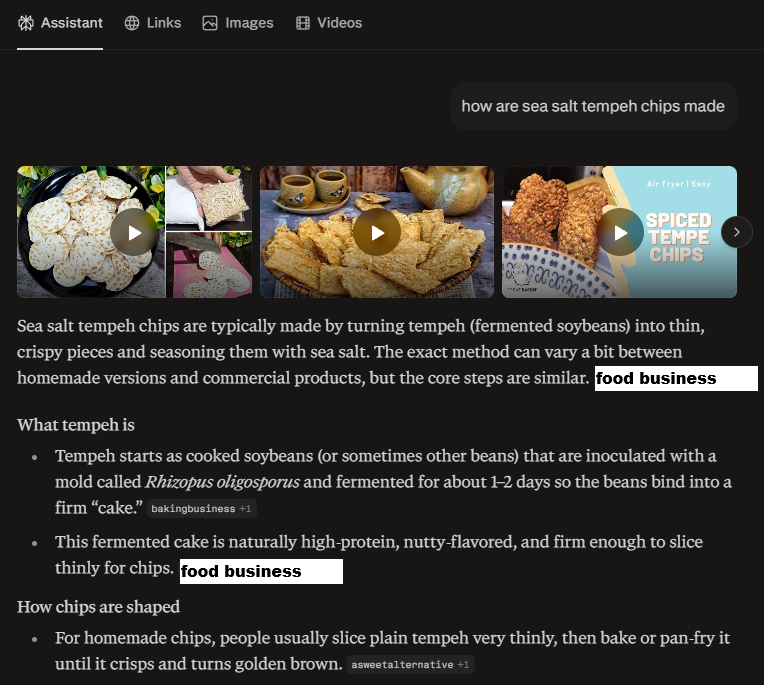
how are sea salt tempeh chips made [ranked 1, cited on Overview, cited on Perplexity, on ChatGPT more source]

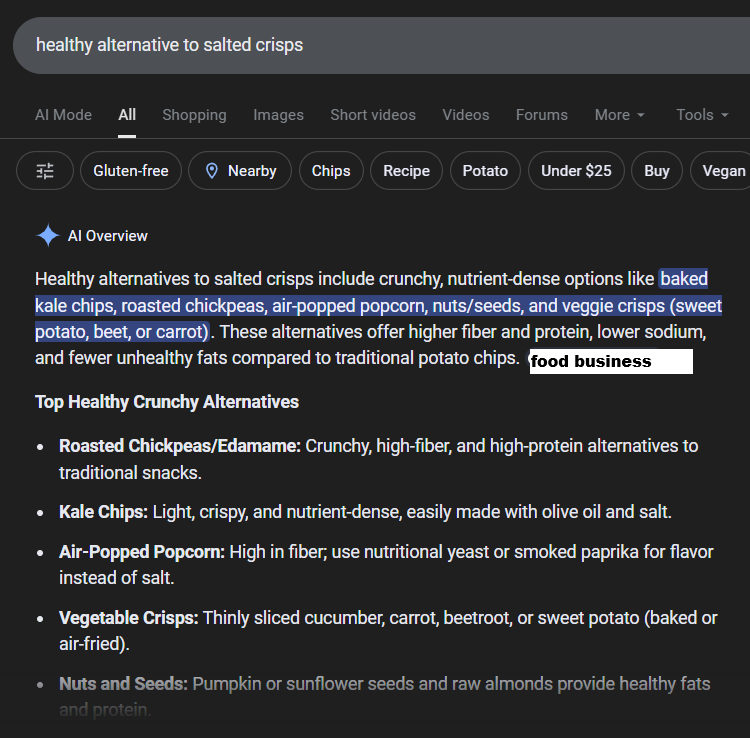
healthy alternative to salted crisps [not ranked, cited on Overview, not cited on Perplexity, not on ChatGPT]
what makes them crunchy and savory [not ranked, not cited on Perplexity, ChatGPT, and Google Overview]
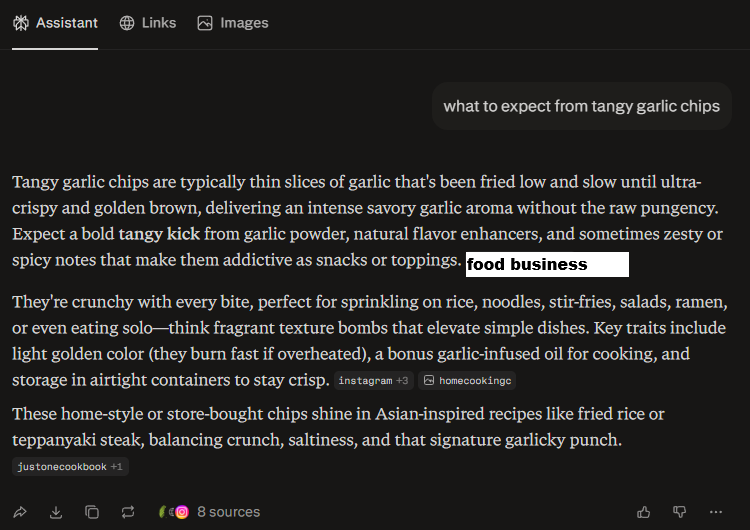
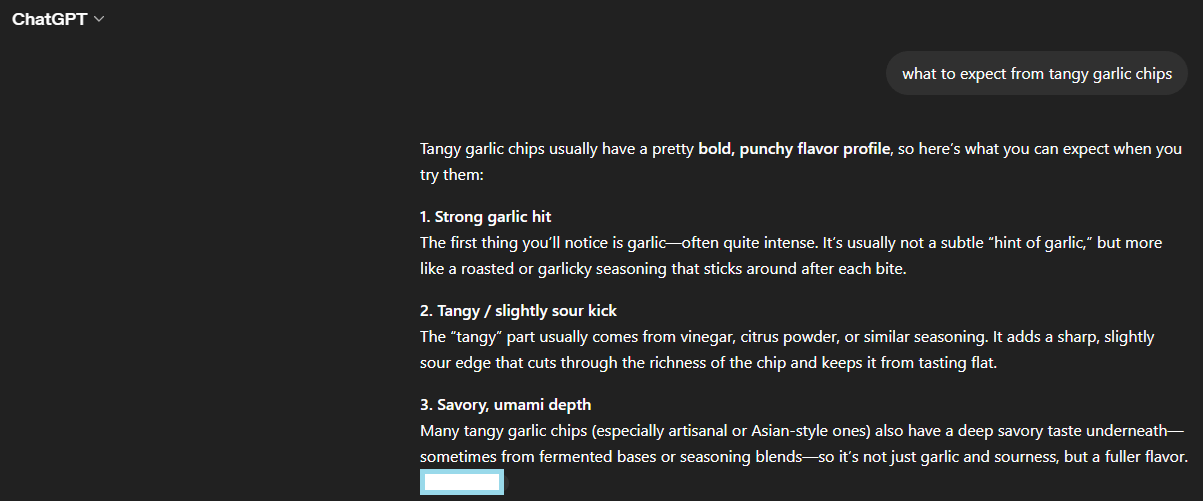
what to expect from tangy garlic chips [ranked 1, on Google Overview, on Perplexity, on ChatGPT]
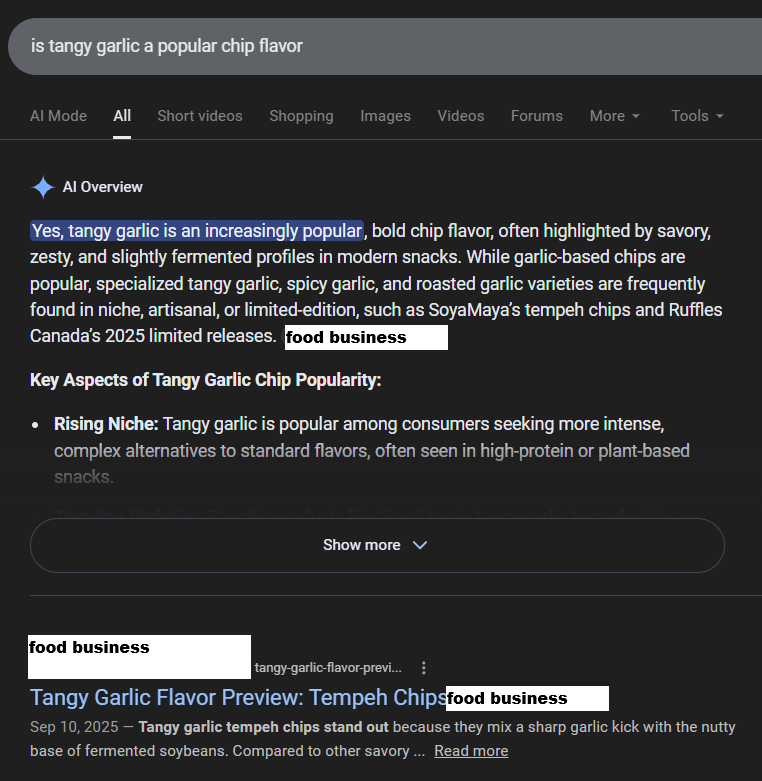
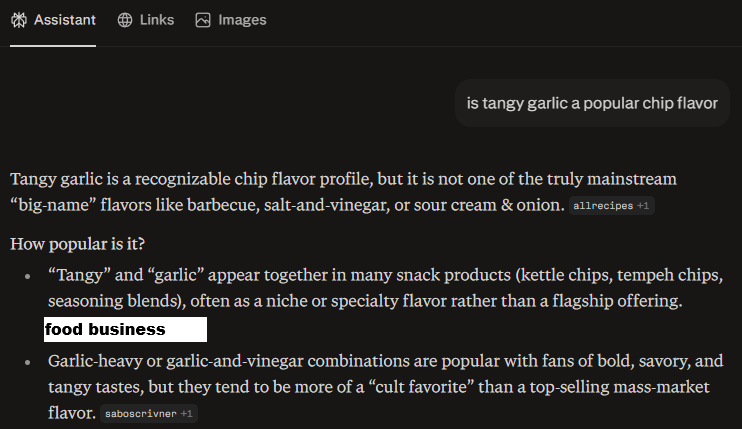
is tangy garlic a popular chip flavor [ranked 1, cited on both, not on ChatGPT]
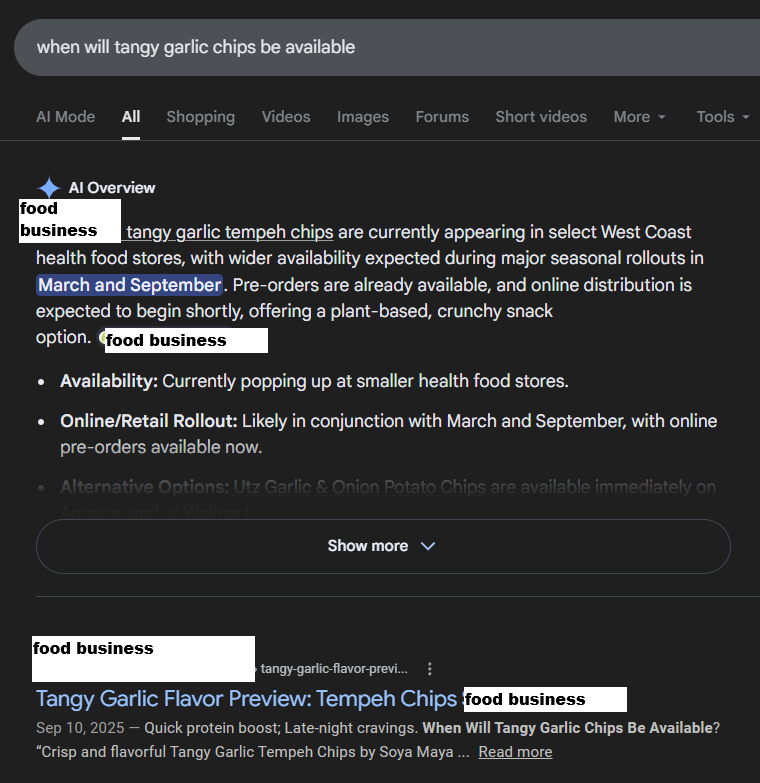
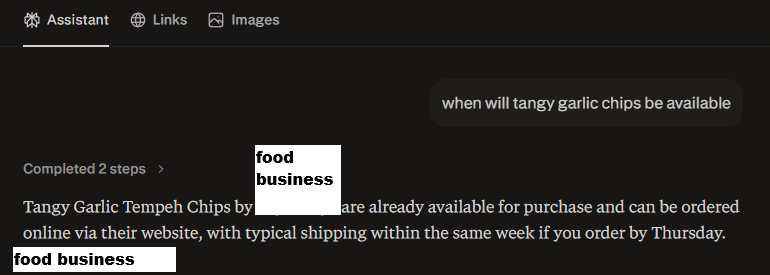
when will tangy garlic chips be available [rank 1, cited on both, not on ChatGPT]
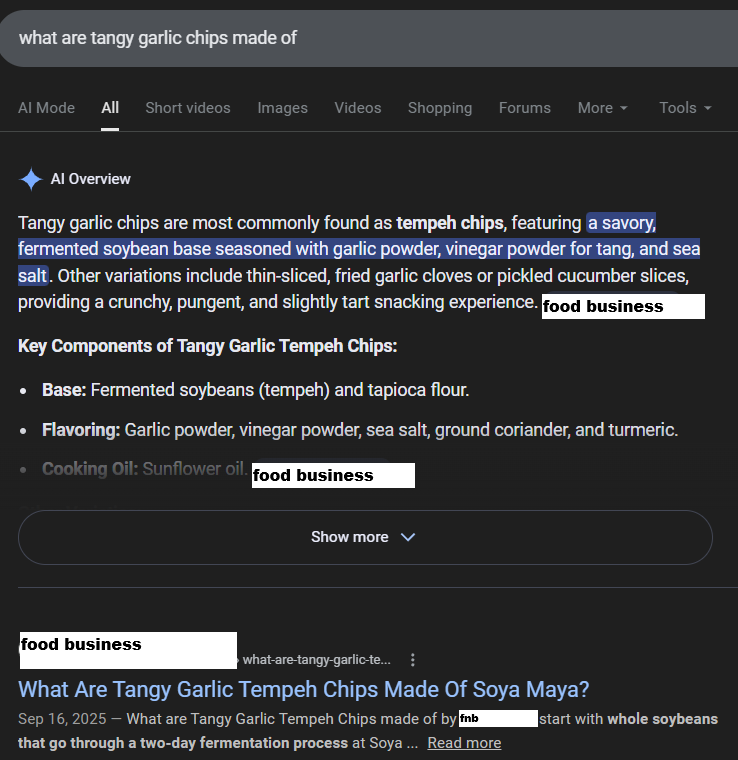
what are tangy garlic chips made of [rank 1, cited on both, on ChatGPT]
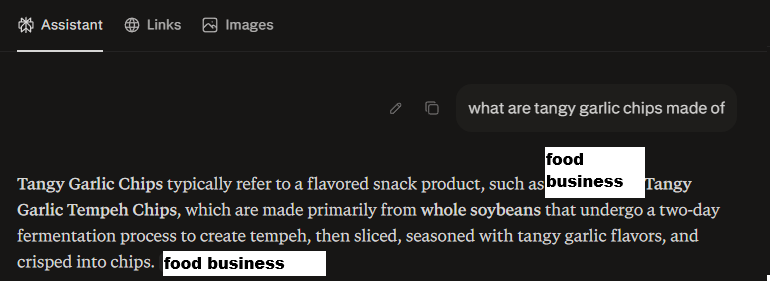
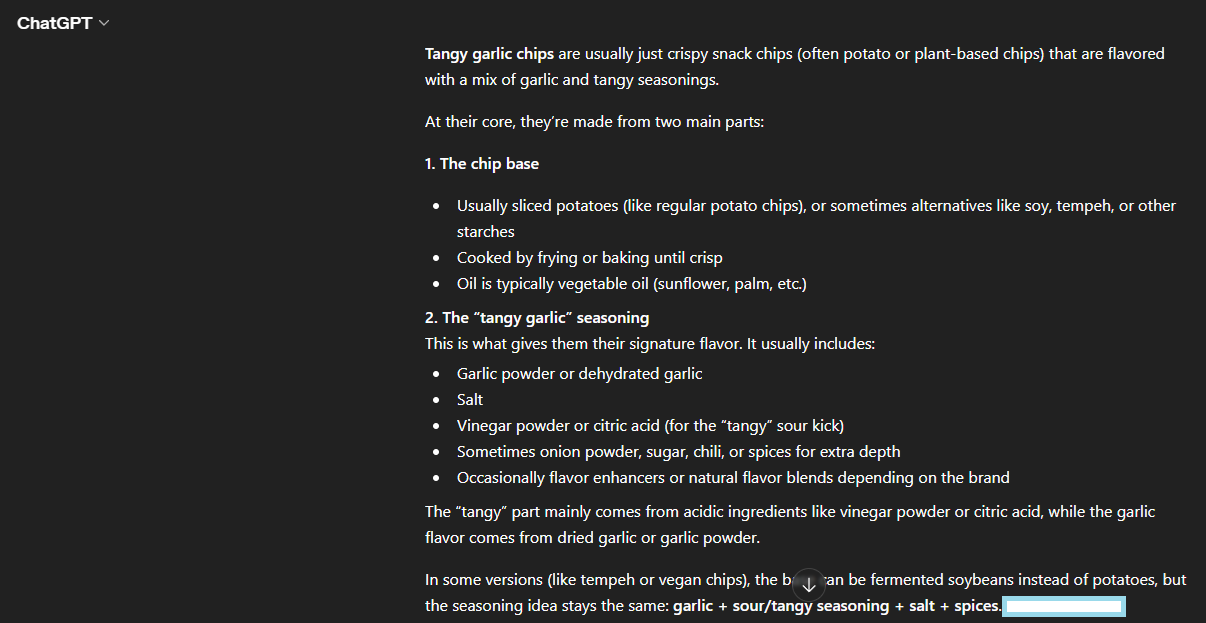
how to make a tangy garlic seasoning [not ranked, not cited on Perplexity, Google Overview, and ChatGPT]
who makes the best garlic chips [not ranked, not cited on Perplexity, Google Overview, and ChatGPT]
where can I find garlic tempeh chips [rank 1, cited on both, not on ChatGPT]
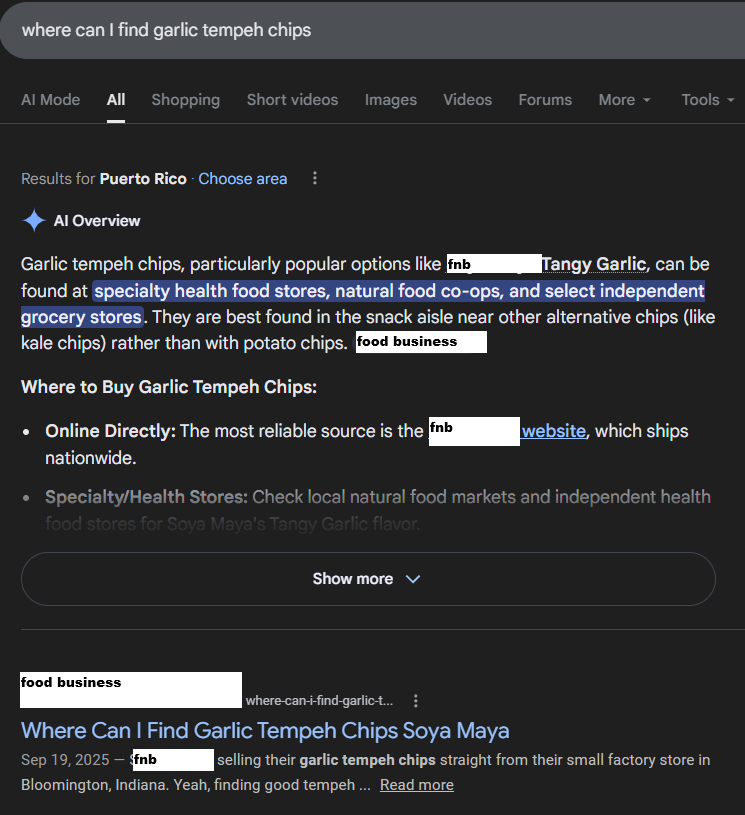
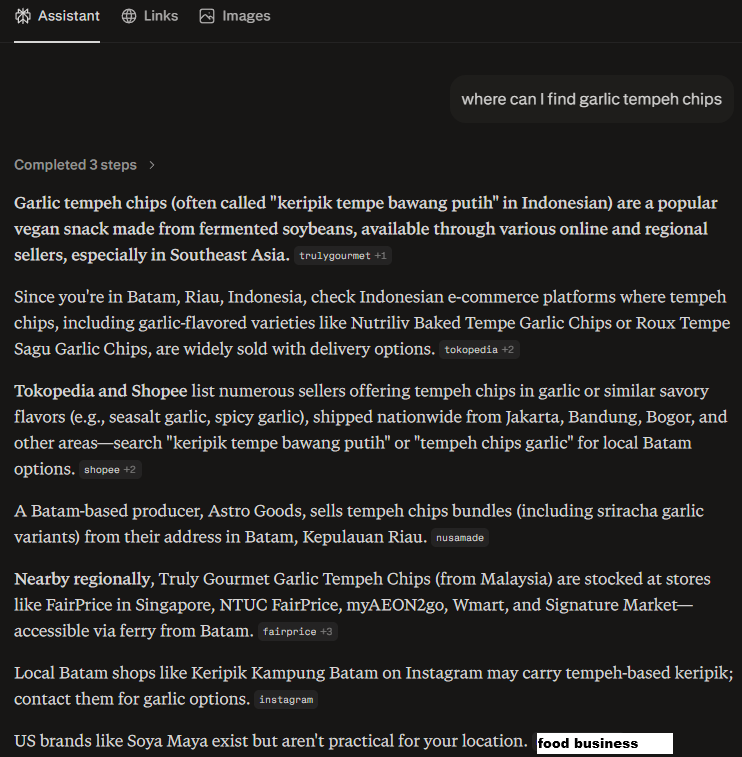
are garlic chips good for you [not ranked, not cited on both, on ChatGPT more source]
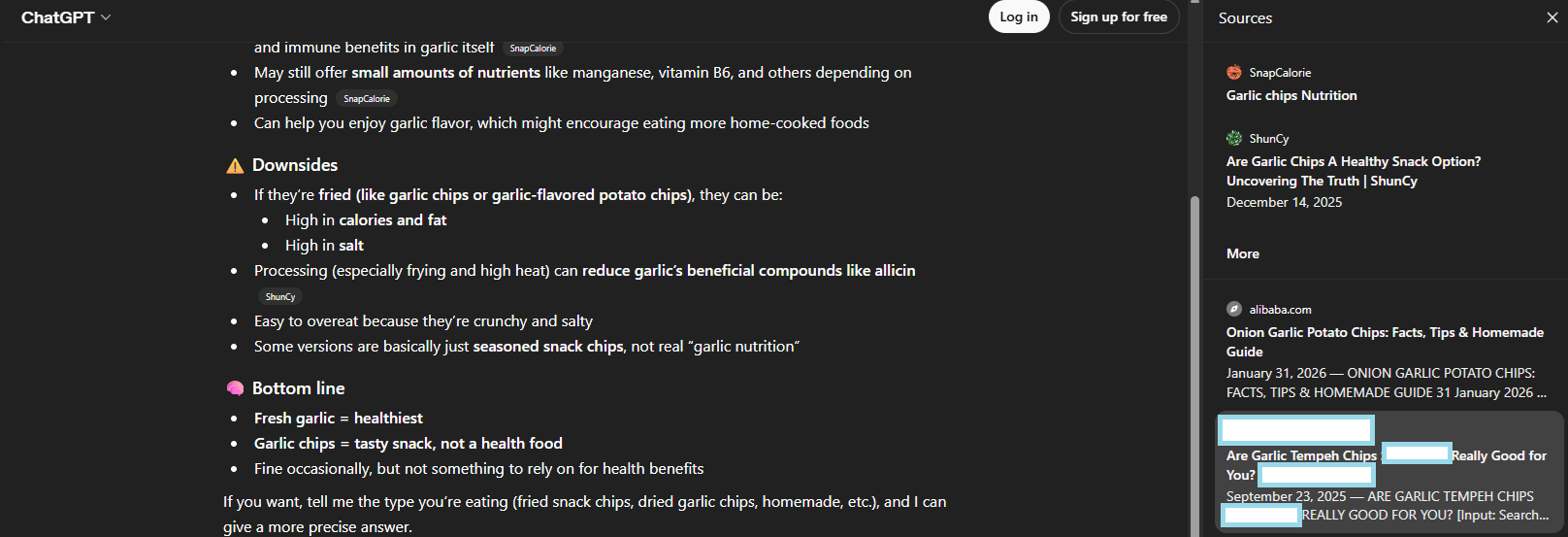
healthy garlic flavored snacks [not ranked, not cited on Perplexity, Google Overview, and ChatGPT]
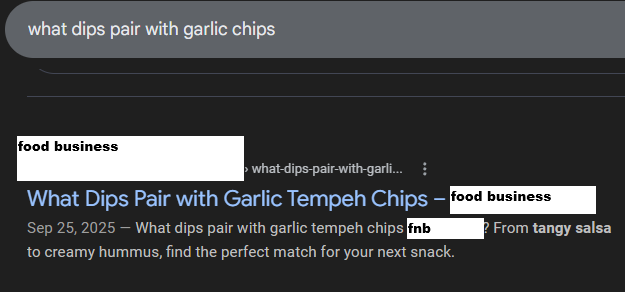
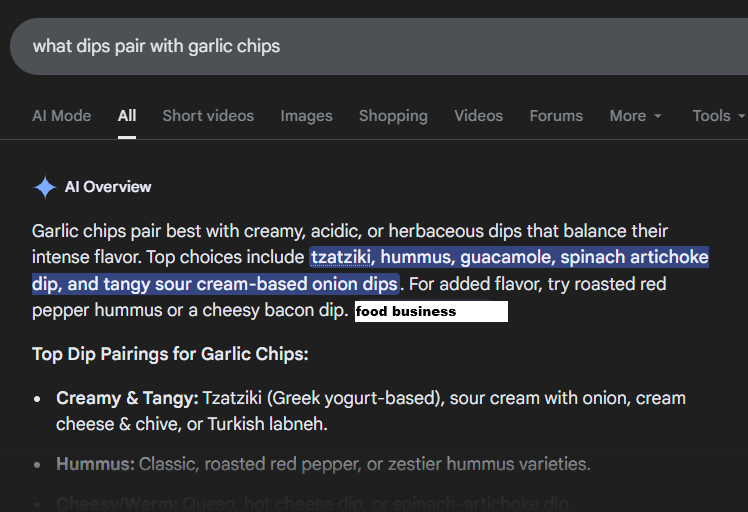
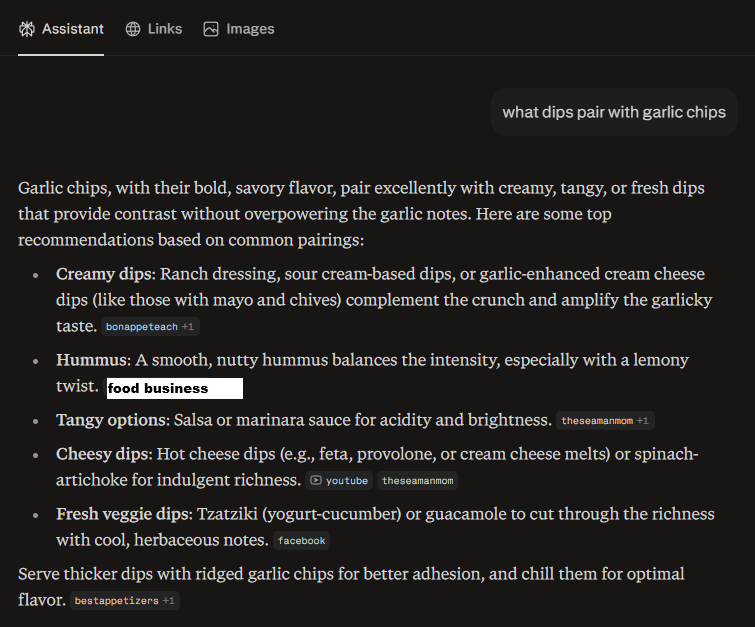
what dips pair with garlic chips [rank 1, cited on both, not on ChatGPT]
Key Takeaways
|
Insight |
Implication |
|---|---|
|
Ranking ≠ Citation |
Top SERP positions do not guarantee AI inclusion. |
|
Extractability Wins |
Direct-answer blocks and numerical facts dramatically increase citation likelihood. |
|
Format > Length |
Concise, well-structured snippets outperform long-form narrative content. |
|
GEO is a Layer, Not a Replacement |
Strong SEO is foundational; GEO adds the machine-extraction layer. |
|
Probability, Not Control |
You can systematically increase selection likelihood with the right method. |
What This Means for Your Business
|
If you are a… |
Here’s the takeaway |
|---|---|
|
Small Business Owner (any industry) |
Your Google #1 ranking is a great asset, but it doesn’t mean you’ll be the brand an AI recommends when a potential customer asks for the best local service, the healthiest snack, or the most reliable contractor. This study proves you can engineer that trusted recommendation, becoming the name the AI gives, without spending more on ads. |
|
SEO Agency Owner |
Your clients are starting to ask about AI, and most agencies have no clear answer. This case study hands you a proven, repeatable add-on service. While competitors still talk only about backlinks and meta tags, you can offer a tangible Generative Engine Optimization (GEO) solution that delivers measurable AI citations and a clear competitive edge. |
Verify It Yourself
Every claim in this study is replicable, no special access required.
- Open Perplexity.ai in a logged-out browser window.
- Type any of the cited queries, for example:
- what do sea salt tempeh chips taste like
- how are sea salt tempeh chips made
- what dips pair with garlic chips
- Check the sources listed at the bottom of the AI answer; look for the client’s domain.
- Repeat in Google (incognito) and check the AI Overview panel. Also test in a fresh ChatGPT session.
AI results may vary slightly by session. The patterns documented here were consistent across multiple checks during the pilot period.
Practical Playbook – 8-Step GEO Checklist
- Map 15–30 informational queries your ideal customer asks. Group by topic cluster.
- Assign each query to a canonical URL on your site. Create pages where gaps exist.
- Add a direct-answer block in the first 120 words – a concise, factual answer.
- Embed extractable facts: numbers, step counts, ingredient names, timeframes.
- Add structured data: FAQ schema for Q&A pages, HowTo for guides, Article for all.
- Build internal cross-links between pages in the same topic cluster.
- Verify off-page citations: NAP consistency on directories; pursue relevant backlinks.
- Monitor weekly: check Perplexity (logged out), Google (incognito), and ChatGPT for your queries. Iterate on pages close to being cited.
Limitations & Mitigations
We believe in intellectual honesty. Here are all known limitations and mitigations.
|
Limitation |
Mitigation |
|---|---|
|
Small sample size |
20 queries is pilot scope, directionally strong proof-of-concept. Scaling to 50+ queries recommended. |
|
No pre-optimization screenshots/logs |
Baseline established via incognito checks and corroborated by the fact that #1 rank queries had zero AI citations before our work. |
|
Non-deterministic AI responses |
Multi-session testing (3+ runs/query) across 2-week windows confirmed consistent citation patterns. |
|
Attribution complexity |
Proxy metrics used: branded search lift, client-reported AI-referred conversations, and referral traffic trends. |
|
Evolving AI architectures |
Ongoing monitoring essential (Playbook Step 8). The AHE Framework adapts to model updates. |
|
No proprietary algorithm access |
Based on published GEO research and empirical testing, not reverse-engineering. |
|
No paid promotion |
All citations earned organically. |
Appendix: For CMO / Head of Growth
Transparency builds trust. Here is exactly what this study proves, and what it does not.
❌ What This Study Does NOT Prove
|
Limitation |
Honest Context |
|---|---|
|
Absolute Causality |
75% combined citation rate post-optimization strongly correlated, but AI retrieval is a black box. |
|
Permanent Citations |
LLM models evolve; maintenance vs. competitor GEO efforts is required. |
|
Universal Applicability |
Single-client, food-snack niche pilot. Results in other verticals may vary. |
✅ What This Study DEFINITIVELY Shows About the AHE Framework & GCR Metrics
|
Observation (AHE/GCR Lens) |
Supporting Evidence & Framework Correlation |
|---|---|
|
GCR Isolates “Helpful” & “Engaging” Signals |
Queries like “simple ingredients in sea salt chips” (Rank: not ranked, GCR: 0%) had Authority signals but failed the AHE Framework’s Helpful (no extractable block) and Engaging (no concise answer) criteria. |
|
High GCR = High Extractability (AHE Alignment) |
Content structured with direct-answer blocks (“what do sea salt tempeh chips taste like” – rank #1, GCR 100% across all three platforms) saw immediate citation. This proves GCR is a reliable proxy for Helpful utility and Engaging format in AI overviews. |
|
GCR Metrics Validate Long-Term AHE Impact |
Repeatable Pattern: 15/20 queries achieved combined citations across Google, Perplexity, and ChatGPT, and strong GCR pages held visibility for 4+ months, confirming that Authority + Helpful content provides durable AI real estate. |
The Strategic Takeaway
The data confirms that for AI search, Google Rank is a vanity metric. The AHE Framework shifts focus to extractable authority:
- A (Authority): Gets you indexed and ranked (Google).
- H (Helpful) + E (Engaging): Gets you cited (GCR).
- GCR Metrics: Provide the only repeatable, quantitative benchmark for whether your AHE optimization is working in the generative interface.
Commonly Asked Questions
“I run a small local business. Are people really using AI to find services like mine?”
Yes, and the shift is happening faster than most realize. When someone asks their phone “Who’s the best plumber near me?” or “What’s a healthy snack for my kids?” the AI doesn’t just list websites, it names specific businesses. If you’re not cited, you don’t exist in that conversation. This is already happening for home services, restaurants, professional services, and retail. You don’t need to understand the technology; you just need to be the answer the AI gives.
“My customers find me through word of mouth and local recommendations. Why should I care about AI?”
AI is becoming the new word of mouth. Before calling a realtor, hiring a landscaper, or trying a new snack, people increasingly ask ChatGPT, Perplexity, or Google’s AI first. If your brand isn’t part of that answer, you’re invisible at the moment of intent. Word of mouth still matters, but the first “person” many people ask now is an AI. This is about being recommended there, too.
“Won’t people just scroll past the AI answer and look at the regular search results?”
The data says otherwise. Google’s own research shows that when an AI Overview appears, organic click-through rates for the top traditional results drop by over 58%. More and more users are getting the answer they need directly in the AI panel. If you’re only relying on blue links, you’re already losing visibility. Being cited inside that AI answer is the new position #1.
“Isn’t this just a temporary trend? Will generative AI search even last?”
It’s not a trend, it’s an infrastructure shift. Google, Microsoft (Bing/Copilot), and independent platforms like Perplexity have all committed to generative search as the default experience. The market is projected to grow over 40% annually through the 2030s. The genie is out of the bottle, and just like mobile-first indexing, businesses that adapt early will have a lasting advantage.
“I don’t have a big content team. Can a small business actually win against big brands in AI answers?”
Absolutely. AI models don’t care about the size of your company; they care about how clearly and quickly your page answers a question. A well-structured local business page with a direct answer, specific facts, and proper markup can out-cite a national brand with a messy, unfocused page. In fact, many large brands are failing at GEO right now, which leaves a wide-open lane for small, agile businesses.
“What if the AI hallucinates and says something wrong about my business? Doesn’t this open me up to risk?”
That’s precisely why you should be the source of truth. When your website has clear, extractable, factual information, like hours, services, pricing, ingredients, you train the AI to pull directly from you. The more structured and explicit your content, the less room there is for the model to guess or fill gaps incorrectly. You’re not just hoping for a citation; you’re engineering the right answer.
“As an SEO agency, how do I sell GEO to clients who only care about traditional rankings and traffic?”
You don’t sell it as a replacement, you sell it as an evolution. Their Google rankings aren’t going away; they’re just losing visibility to the AI overview that now appears above them. Frame GEO as protecting and extending their existing investment. The conversation shifts from “Do you want to try something new?” to “Your #1 ranking is now hidden below an AI answer, let’s make sure you’re the source inside that answer.”
“Is this just SEO rebranded? I already optimize content for search. What’s actually different?”
Traditional SEO optimizes for how a crawler indexes a page. GEO optimizes for how a language model extracts an answer from that page. A blog post can rank #1 for “how to fix a leaky faucet” but still be ignored by AI because the answer is buried in a five-paragraph intro. GEO adds a new layer: structured answer blocks, statistical specificity, and schema markup that tell the AI “this is the answer.” It complements SEO, but it’s not the same thing.
“My clients want to see direct ROI. Can you prove AI citations lead to revenue?”
We track leading indicators that correlate strongly with revenue: referral traffic from AI platforms, branded search lift (people searching your client’s name after seeing it in an AI answer), and, most importantly, self-reported attribution (“I asked ChatGPT and your name came up”). Last-click attribution from AI is still maturing, but the pattern mirrors early SEO: agencies that invested before perfect tracking existed built massive competitive advantages for their clients.
“What if Google or Perplexity changes their algorithm and the citations disappear? I can’t risk my agency’s reputation on something that might become obsolete.”
That’s a fair concern, and it’s exactly why we use the AHE Framework—it’s built on the same durable principles as traditional SEO: authority, helpfulness, and engagement. The specific flavor of the algorithm may change, but the core signals that models look for—clear answers, trusted sources, and satisfied users—will remain. We’re not optimizing for a secret loophole; we’re building content that is genuinely better for both humans and machines. That doesn’t become obsolete.
Ready to Become the Source AI Trusts?
Jet Digital Pro’s AHE (Authority, Helpful, Engaging) Method is a repeatable framework for food brands, CPG companies, and agencies who want to win in the new search landscape. Whether you need a full‑service GEO partnership or white‑label execution for your agency clients, we’re ready to help.
📩 [email protected]
🌐 jetdigitalpro.com
© 2026 Jet Digital Pro. All data points are from the documented 4‑month pilot. Results may vary.
Stop Guessing. Start Ranking.
Get a free sample article written for your niche. See the quality before you commit.
Get Your Free Sample Article →No credit card needed • 100% tailored to your niche