

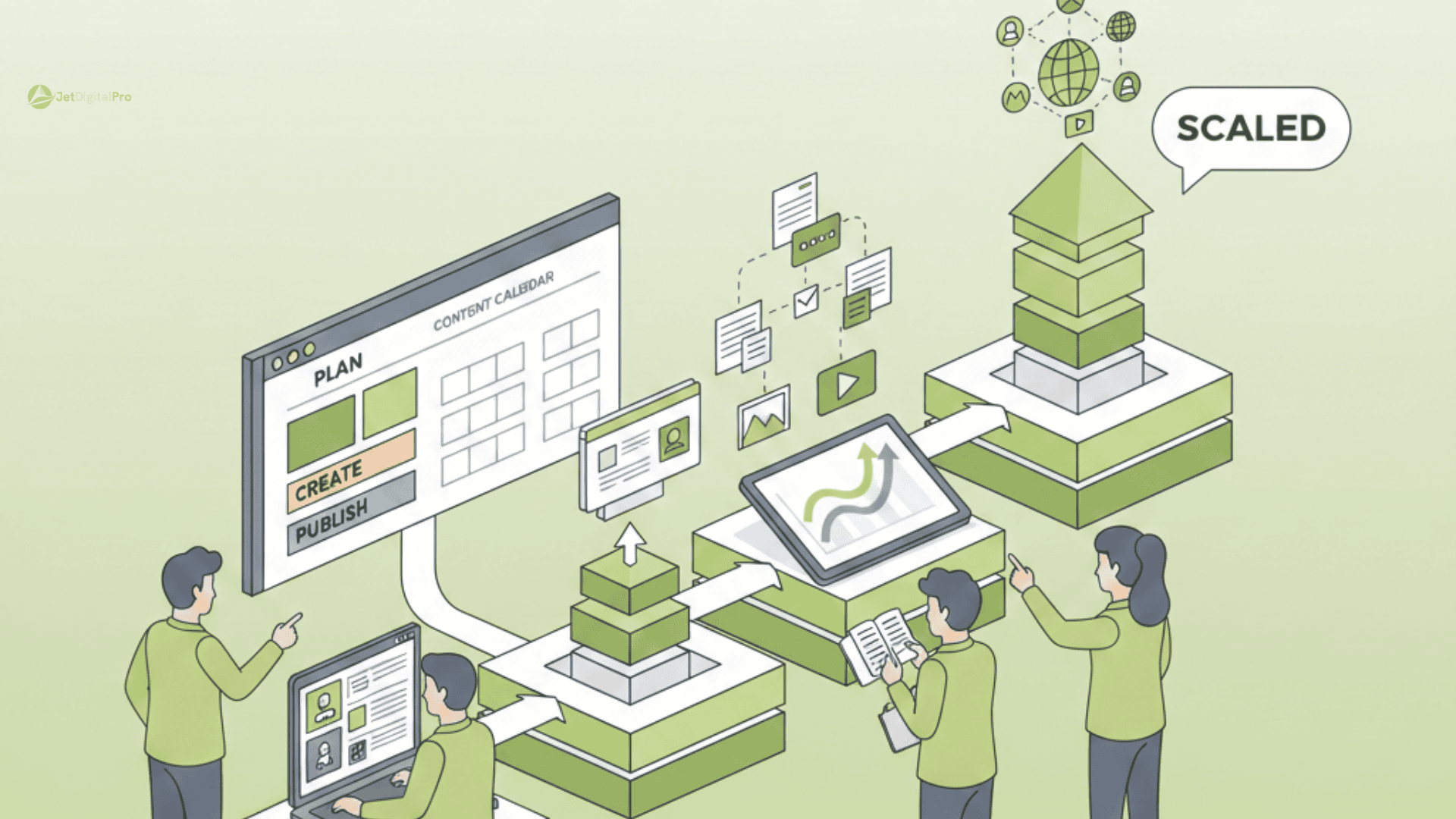
Learn how agencies scale content production using structured workflows, SEO systems, AI optimization, and repeatable content strategy processes.
Scaling with a content strategy process agency starts with building a real system. Most agencies struggle with content because they rely on reactive workflows instead of repeatable processes.
We write SEO articles that rank on Google — so you can focus on your business.
See Writing Plans →Without structure, content production becomes chaotic. Teams burn out, revisions pile up, deadlines slip, and clients lose confidence.
A documented content strategy process changes that. Smart agencies build scalable content systems where every stage is connected to business goals, SEO performance, and client retention.
The process begins with strategy. Agencies define their target audience, map the buyer journey, identify content gaps, and create clear content pillars that guide future production.
Next comes execution. Strong agencies use detailed content briefs, approval checkpoints, and defined team roles. Writers know what to create, editors know what standards to enforce, and clients know what to expect.
This structured workflow reduces revisions and keeps production moving efficiently.
Publishing alone is not enough. High-performing agencies also build multi-channel distribution systems. One article can become SEO content, LinkedIn posts, email newsletters, and social media assets.
Top agencies also focus heavily on optimization. They track KPIs, refresh outdated pages, improve internal linking, and continuously update content to improve long-term ROI.
In 2026, successful agencies combine SEO with AI workflows. AI tools help with research, outlines, and scalable production, but human strategy still matters most.
Google increasingly rewards trustworthy, experience-driven content that matches real search intent. That is why agencies focus on semantic SEO, authority building, and Generative Engine Optimization.
Many agency problems like scope creep, endless revisions, and team burnout are usually process problems, not client problems.
When agencies implement repeatable systems, they improve profitability, scale operations more efficiently, and build stronger long-term client relationships.
That is the real power of a content strategy process agency.
You need a system. A chaotic, reactive approach to client content burns out your team, frustrates your clients, and makes profitability a guessing game. The solution is a structured, repeatable content strategy process agency.
Need SEO content that actually ranks? We write data-driven articles designed to bring organic traffic to your site.
See Our SEO Writing Plans →This framework transforms your agency from an order-taker into a strategic partner, building a scalable content machine that delivers consistent results and client retention. We’ll walk through the proven phases, from initial planning to ongoing optimization, that turn content from a cost center into a reliable growth engine. Keep reading to learn how to build yours.
Content Strategy Process: Key Insights for Agencies
- A documented process aligns client goals with scalable production, reducing revisions by over 50%.
- Strategic audience and journey mapping ensures every piece of content serves a purpose in the conversion funnel.
- Continuous measurement and optimization, informed by real performance data, prove ROI and guide future strategy.
What Is a Content Strategy Process Agency Framework?
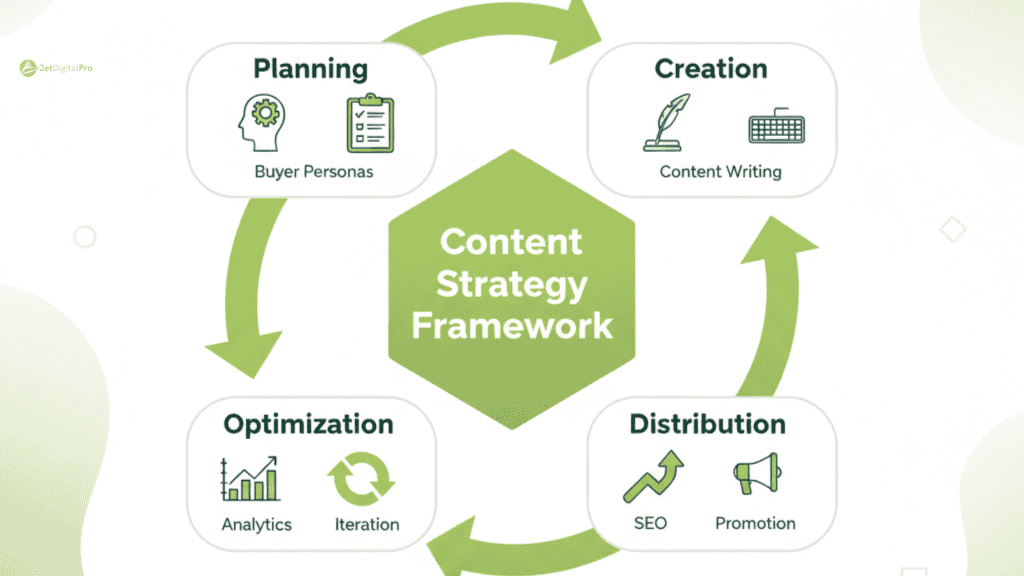
It’s your agency’s operating system for content. Think of it as a blueprint that standardizes how you plan, create, deliver, and optimize content for every client. Without it, you’re rebuilding the wheel with each new project. With it, you have a repeatable machine.
This framework isn’t a single document. It’s an interconnected set of phases and workflows. It starts with deep strategic planning and flows into an efficient seo content creation workflow.
For us at Jet Digital Pro, this framework is the backbone of our white-label partnerships. It allows us to seamlessly slot into an agency’s workflow, providing the scalable content production and SEO muscle while the agency maintains strategic oversight and client relationships. It turns content from a bottleneck into a leverage point.
Why Agencies Need a Structured Content Strategy Process
Chaos is expensive. Unstructured content work leads to massive inefficiencies, endless revisions, misaligned expectations, and team burnout. A process brings order. It provides clear guardrails for your team and sets firm expectations with clients from day one.
“Content strategy’s main purpose is to have all the stakeholders on the same page and working toward the same goal.” – Marketing DigiBook
The biggest benefit is scalability. A templated intake form, a standardized brief, a clear approval chain; these tools let you handle ten clients as smoothly as you handle one. They free your senior strategists from day-to-day firefighting, allowing them to focus on high-level client growth and innovation.
Perhaps most importantly, a process proves your value. It transforms content from a vague “marketing thing” into a tangible, managed service with clear inputs and outputs. You can track time, measure ROI against specific KPIs, and have data-driven conversations with clients. This builds trust and turns project-based clients into long-term retainers.
Phase 1: Strategic Planning and Content Foundations
This phase builds the groundwork most agencies skip. Instead of jumping into content production, you define the strategic “why” first. Start with deep audience and journey mapping that goes beyond demographics to uncover motivations, questions, and decision triggers.
Next, align every planned asset with clear business goals and measurable KPIs set during onboarding. Finally, run a strategic audit of existing and competitor content to identify gaps and opportunities.
From these insights, establish 3–5 core content pillars that guide all future production. When this foundation is solid, your content stays focused, purposeful, and far easier to scale.
| Foundation Element | Agency Deliverable | Purpose |
| Audience Insight | Detailed Persona Profiles & Journey Maps | Targets content to real user intent and pain points. |
| Competitive Landscape | Gap Analysis Report | Identifies content opportunities competitors are missing. |
| Content Architecture | Pillar & Cluster Model | Organizes topics for SEO strength and user experience. |
Phase 2: Content Creation and Production Workflows
This is where strategy turns into repeatable execution. The goal is a scalable, quality-controlled workflow, not creative chaos. Key components include:
- Content briefs that do the heavy lifting: include keyword targets, structure, voice notes, and CTA.
- Clear role matrices: define who researches, writes, edits, approves, and publishes.
- Approval gates: nothing advances without meeting quality checks.
- Hybrid production model: combine in-house strategy with specialized external talent.
When these systems are documented, agencies dramatically reduce revisions, avoid bottlenecks, and maintain consistent output quality across multiple clients and campaigns.
Phase 3: Delivery, Distribution, and Promotion Systems
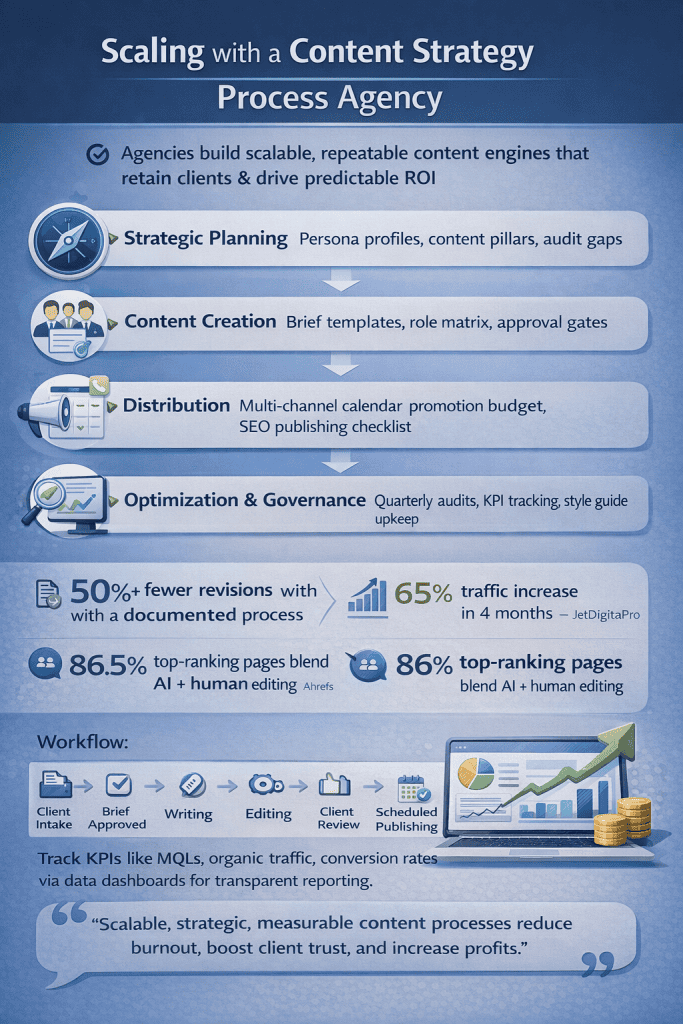
Publishing is not a strategy. This phase ensures your beautiful content doesn’t just vanish into the void. You need systems to get it seen.
Multi-Channel Distribution Calendar: You don’t just publish a blog post. You schedule the social media snippets, the email newsletter blurb, the LinkedIn post from the CEO. A unified calendar coordinates this rollout across owned media platforms to maximize reach.
Promotion Beyond Organic: You plan for amplification. This could be a targeted social media ads campaign boosting a top-performing piece, submitting a guide to industry newsletters, or a structured link-building program to earn authoritative backlinks. Promotion is a budgeted line item, not an afterthought.
SEO-Centric Publishing: Every asset is optimized before it goes live. This means meta descriptions, image alt text, internal linking to related content, and ensuring fast page load speeds. The technical user experience is part of the delivery checklist.
Phase 4: Maintenance, Optimization, and Governance
Content performance compounds only with ongoing care. Establish a regular measurement loop that compares results against the KPIs defined earlier. Use real data to guide what to expand, update, or retire. Schedule quarterly content audits to refresh high performers, fix outdated information, and consolidate weak pages.
Maintain a living style guide and brand voice document so output stays consistent across teams and over time. Strong governance also includes clear update workflows and organized content libraries. Agencies that treat content as a living asset consistently extract more long-term ROI from every piece they publish.
Agency-Specific Workflow: From Client Intake to Quarterly Audits
How does this all come together day-to-day? It starts with a templated client intake process that captures goals, KPIs, and brand voice upfront. This feeds into a centralized project management tool where briefs are built, tasks are assigned, and deadlines are tracked.
“Initial consultation, understanding your needs, goals, and vision through detailed discussions… is the starting point in the content strategy process.” – Today Digital Agency
The workflow has clear stages: Brief Approved > In Writing > In Editing > Client Review > Final Revisions > Scheduled. Each stage has an owner and a deadline. Approval gates prevent work from moving backward. After publication, the asset moves into a “Maintenance” bucket for its scheduled performance review and future update.
Quarterly, you run a full audit. You analyze performance data, survey the competitive landscape again, and sit down with the client to review what’s working and pivot what’s not. This closed-loop system turns one-off projects into an evergreen, evolving program.
Goals, KPIs, and ROI Alignment in Agency Content Strategy
Avoid vanity metrics. Client goals must translate into specific, measurable KPIs you can influence. If the goal is lead generation, the primary KPI is marketing-qualified leads (MQLs) from content. Track secondary KPIs like organic traffic and time-on-page that feed into that goal.
You build your reports around these KPIs. Use a dashboard in Google Data Studio or similar to show trend lines, not just monthly snapshots. The story you tell is, “Here’s how our content moved the needle on the goal we agreed upon.” This shifts the conversation from cost to investment.
ROI calculation becomes clearer. You can tie content costs to leads generated, or show how top-of-funnel brand awareness content supported a sales team’s efforts. This tangible proof is what justifies retainers and builds unshakable client trust.
Audience Research and Buyer Journey Mapping at Scale
Forget generic “business owner” personas. You need to uncover the real emotional and professional triggers. We use a mix of client interviews, sales team feedback, and analysis of social media activity in niche communities to build a multi-dimensional picture.
The journey map is visual. It plots out the awareness, consideration, and decision stages specific to your client’s B2B service or product. At each stage, you note the prospect’s key questions, the content format that best answers them (e.g., blog post vs. case study), and the desired action. This map directly informs your content calendar.
For scale, you templatize this research process. A standard persona template and journey map framework can be adapted for each client, making deep research efficient and repeatable, not a massive custom project every time.
Scalable Production: Briefs, Role Matrices, and Approval Gates
The secret to scaling quality is standardization. Your content brief template should have locked-in sections for objectives, audience, keyword, outline, and brand voice. This consistency helps writers and designers deliver on-brand work faster.
A RACI matrix (Responsible, Accountable, Consulted, Informed) defines roles for every task. The writer is Responsible for the draft, the content lead is Accountable for quality, and a structured client approval process ensures the right stakeholders are consulted for review.
Approval gates are non-negotiable checkpoints. Common gates include: Brief Approval, First Draft Review, SEO/Editorial Check, and Final Client Sign-off. Work cannot proceed past a gate without the sign-off from the accountable party. This is the single biggest reducer of painful, profit-killing revision cycles.
Multi-Channel Measurement and Attribution Models
You need to connect content to outcomes across channels. Track how a LinkedIn post drives newsletter sign-ups, how a blog post nurtures an email subscriber into a demo request. Use UTM parameters religiously to trace the path.
Your attribution model should reflect the buyer’s journey. While last-click attribution is simple, it undervalues top-of-funnel content. A multi-touch model gives credit to all content that influenced a conversion, providing a truer picture of your content program’s full impact.
Report on the ecosystem, not silos. Instead of separate social and blog reports, show how they worked together. “This whitepaper, promoted via LinkedIn ads and email, generated 50 leads, 10 of which became opportunities.” This tells a powerful story of integrated strategy.
Governance, Compliance, and Brand Consistency Controls
Governance is the quality control system for your content machine. It starts with a central, accessible brand hub containing the style guide, voice and tone guidelines, logo usage, and compliance checklists (especially critical for finance or healthcare clients).
You implement a formal review process for any content that touches on regulated topics or makes specific claims. This often involves a legal or compliance sign-off gate in your workflow. It’s boring, but it prevents catastrophic errors.
Finally, you conduct regular consistency audits. Are all writers using the approved terminology? Is the brand voice consistent across a new ebook versus a six-month-old blog post? This ongoing maintenance ensures the brand presents a unified, professional face to the world at all times.
Integrating SEO, AI, and 2026 Search Trends
SEO can’t be a bolt-on. Implementing robust keyword research methods must happen in Phase 1 to inform content pillars and briefs. You’re optimizing for user intent and semantic search, not just stuffing keywords.
AI is a powerful assistant, not a replacement. We use it for brainstorming content ideas, analyzing data trends, and creating first-draft outlines. But human expertise is irreplaceable for strategic insight, brand voice, and ensuring content truly meets E-E-A-T (Experience, Expertise, Authoritativeness, Trust) standards that Google demands.
For 2026, focus on Google’s shift towards “Generative Engine Optimization.” This means creating comprehensive, authoritative content that serves as the best possible answer. It also means optimizing for new formats like AI-generated answers in search. Your content needs to be the source those answers draw from.
Common Agency Pain Points: Revisions, Scope Creep, and Burnout
These are process failures, not client failures. Excessive revisions usually stem from a vague brief or missing brand guidelines. Solve it by strengthening Phase 1 and Phase 2 controls. Make the brief the contract for the work.
Scope creep kills profitability. It happens when you say “yes” to unplanned requests. The fix is a clear statement of work and a change order process. Any request outside the agreed scope triggers a conversation about timeline and budget impact.
Burnout comes from chaos and constant context-switching. Your structured process is the antidote. Clear roles, realistic timelines set by the system (not by client pressure), and dedicated time for deep work protect your team’s energy and creativity. A burned-out team cannot do great work.
Pricing and Packaging a Content Strategy Process Agency Offer
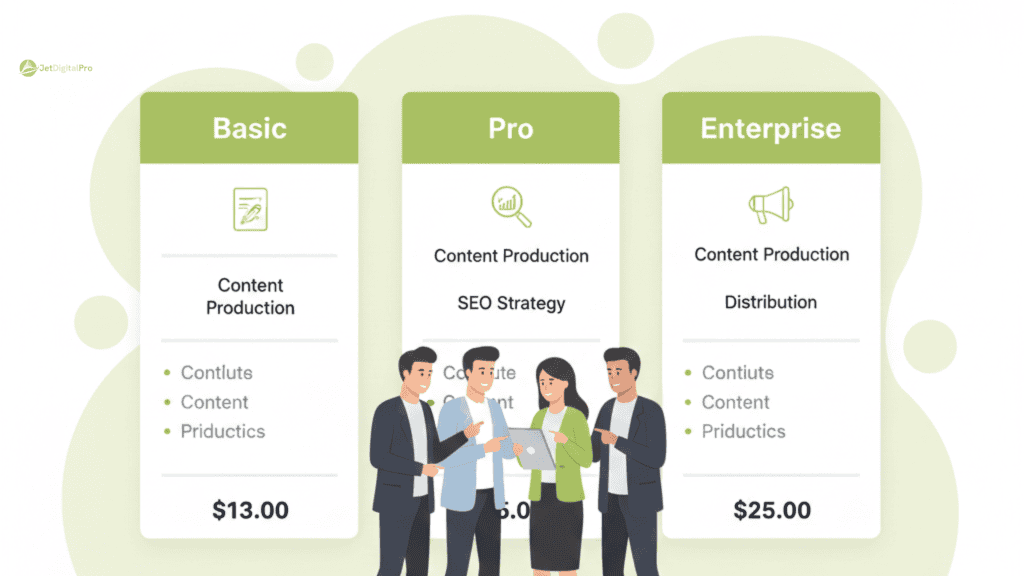
Stop selling hours or single pieces. Package your process. A common model is a monthly retainer covering Strategy & Planning (audits, briefs), Content Production (a set number of assets), and Distribution & Reporting. This reflects the full value you provide.
Tier your packages. A “Foundational” tier might include blog content and basic SEO. A “Growth” tier adds premium formats like video production or webinar development. An “Authority” tier includes aggressive link building and advanced content amplification. Let clients buy into the level of results they need.
Always price for profit and scalability. Factor in the cost of your team, your technology stack, and your partnership costs (like our white-label services at Jet Digital Pro). Your pricing should allow you to deliver exceptional quality without grinding your team into dust. Value-based pricing, tied to the client’s goals, is always stronger than cost-plus.
FAQ
How does a content strategy agency improve overall content effectiveness?
A strong content strategy agency connects content planning, keyword research, and audience insight into one system. Instead of random content creation, the agency builds buyer personas, maps the customer journey, and aligns SEO strategy with business goals.
Using data analytics and content audits, they continuously refine content optimisation, improve Google rankings, and generate more qualified leads over time.
What should be included in an effective content calendar?
An effective content calendar supports your full content marketing and social media marketing efforts. It should outline content ideas, publishing dates, target audience segments, SEO keywords, distribution channels, and promotion plans.
Advanced calendars also track content assets, email newsletters, LinkedIn posts, and social media activity. This structure keeps content production consistent and aligned with your broader brand strategy.
How do agencies use keyword research to drive better results?
Agencies combine SEO tools, keyword volume data, and search engine optimization best practices to guide content development. They prioritize long-tail keywords that match real user intent and map them to each stage of the customer journey.
With proper internal link building and content briefs, this approach strengthens domain expertise, improves user experience, and increases visibility in competitive Google rankings.
How can artificial intelligence support modern content development?
Artificial intelligence and AI tools help agencies scale content research, structured authoring, and content organization. They can surface content ideas, analyze psychographic information, and support content writing workflows.
Some teams also use Generative Engine Optimization and LLM optimization to adapt for AI-generated answers. However, human oversight remains essential to maintain brand communication quality and authenticity.
Building a Repeatable Content Machine That Reduces Revisions
Building a content machine that works every time. The goal is predictable, high-quality output that gets results. You start with a precise brief and a solid strategy, which makes the writing almost automatic. Clear checkpoints catch problems early. A good process cuts revisions by half or more.
For agencies, this system is essential. It keeps clients happy and coming back, which makes your business easier to scale and sell. You stop being just a service and become a reliable engine for growth.
Ready to build yours? Get started with a free discovery call.
References
- https://www.marketingdigibook.com/blog/content-strategy-example-framework/
- https://todaydigitalagency.com/services/digital-marketing/content/strategy
Related Articles
- https://jetdigitalpro.com/seo-agency-content-creation-process/
- https://jetdigitalpro.com/agency-keyword-research-methods/
- https://jetdigitalpro.com/client-approval-process-agency/
Stop Guessing. Start Ranking.
Get a free sample article written for your niche. See the quality before you commit.
Get Your Free Sample Article →No credit card needed • 100% tailored to your niche