

Written by Nell · Interviewed: Georgi Todorov, Founder of Create & Grow · April 2026 · 8 min read
We write SEO articles that rank on Google — so you can focus on your business.
See Writing Plans →Georgi Todorov has been building links since 2016. Semrush hired him in 2021 to build their internal link building team from scratch. Before that, he built thrivemyway.com from zero to 100,000 organic visitors a month in eight months, then sold it on Flippa for a six-figure sum. He now runs Create & Grow, where he works with B2B, Tech, and Marketing brands who want links that actually move rankings.
The Part Nobody Talks About in Sales Calls
Before we got into anything else, I wanted to understand how Georgi’s background shapes the way he looks at link building today.
Having built, ranked, and sold his own site using his own budget, his perspective is very different from most agencies. When you are investing your own money into links and content, what works becomes very clear, very quickly.
That context matters for everything that follows.
What the Link Building Industry Won’t Tell You
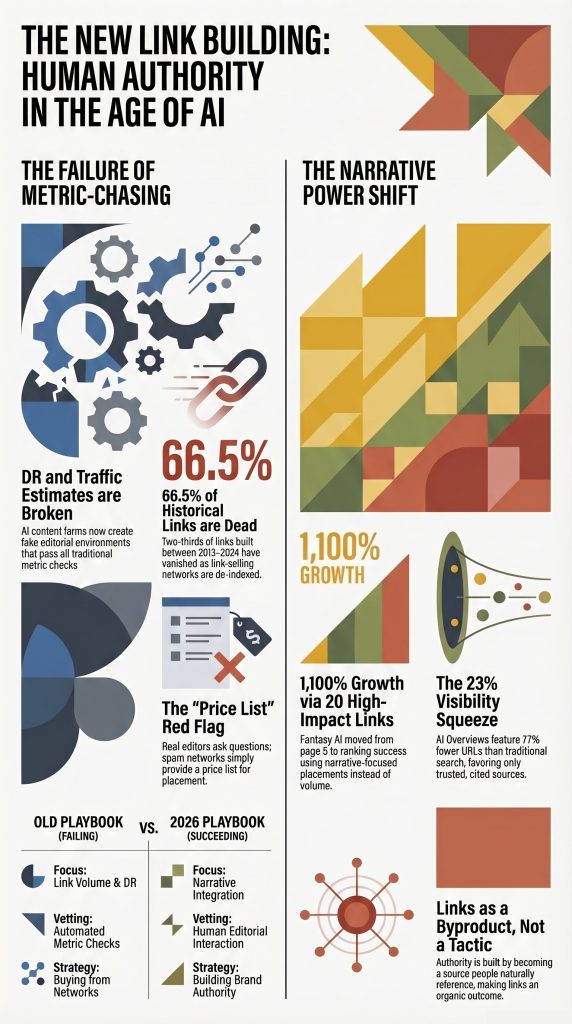
- The metric everyone trusts is no longer enough. A growing challenge is identifying AI-generated sites. These can look legitimate across standard SEO checks.
- The biggest threat is invisible. AI-generated sites can look legitimate across all standard SEO checks.
- The real differentiator is human validation. Real sites show clear signs of human publishing activity and editorial involvement.
- A key shift in approach. Links are increasingly a byproduct of authority, not just a tactic to build it.
When the Vetting Process Actually Matters

Most agencies get this completely backwards.
“They evaluate providers on deliverable counts and turnaround speed,” Georgi says. “Those are exactly the questions a link farm is built to answer well.”
In many cases, agencies only realise the problem after results fail to materialise, even when links have technically been delivered.
The first thing agencies should look for is process transparency. Ask the provider to explain how they find websites, how they pitch editors, and how they ensure relevance, in plain language. “If someone cannot explain their process in simple terms, it usually means they are buying links from networks.”
Need SEO content that actually ranks? We write data-driven articles designed to bring organic traffic to your site.
See Our SEO Writing Plans →The second signal is editorial control. Good links come from real sites with real editors. If a provider guarantees large volumes of links with fixed pricing and fast turnaround, that usually indicates controlled inventories or private networks.
The red flag most agencies ignore is repetition. The same domains appearing across multiple clients is a strong sign of a link farm. Another is perfect metrics with no traffic. A site with high DR but no real audience often exists only to sell links.
“Real link building is slower, relationship-driven, and sometimes unpredictable. If everything looks too clean and too scalable, it is usually artificial.”
The Problem Nobody Is Talking About: AI Spam Farms Look Real Now

Here’s where the conversation got uncomfortable.
I mentioned that most people still treat DR and traffic estimates as reliable filters. Georgi shook his head before I finished the sentence.
“The biggest mistake people make is relying only on SEO metrics. Today, metrics alone cannot distinguish real sites from AI content farms.”
So what does he actually look for?
Signals of real publishing activity. Real authors. Active social profiles. A consistent editorial tone. Clear signs that humans are behind the content.
Traffic patterns also matter. Real sites tend to show stable or gradually growing traffic, not sudden spikes followed by sharp drops. AI spam farms often publish large volumes quickly and disappear just as fast.
One of the most reliable signals is human interaction.
“When you communicate with a real editor, they ask questions, request changes, and care about their audience. Spam networks usually reply with price lists.”
“In the AI era, link building is becoming less about metrics and more about human validation.”
Why “Contextual” Is No Longer Good Enough

One of the more counterintuitive things Georgi said came when I asked about contextual links.
“Contextual is not enough on its own anymore. What matters is whether the link naturally fits the idea being discussed.”
A powerful link in 2026 is not just placed inside an article. It appears naturally within a concept the article is genuinely covering.
The strongest examples come from content where the brand is part of the narrative. A product included in a real comparison. A tool referenced because it genuinely solves the problem being discussed.
“The key is not placement but context and credibility. When the author genuinely recommends or references the brand, the link becomes much stronger.”
So how do you earn those links?
Through digital PR, expert contributions, and data-driven content. Journalists and editors link when something is genuinely useful, interesting, or authoritative. The more a brand participates in industry conversations, the more these opportunities appear.
The Reciprocal Link Debate, Settled
I brought up reciprocal links expecting a standard answer. What I got was more precise.
“Direct reciprocal linking, where two sites agree to link to each other purely for SEO, is still risky and rarely valuable.”
But not all reciprocal links are equal.
Natural ecosystem linking is completely normal. Businesses collaborate, partners reference each other, and products that integrate naturally get mentioned together.
The example he gave was straightforward: two SaaS companies that integrate their products and publish guides on how to use them together. Linking to each other in that context is legitimate because it helps the user.
The distinction comes down to intent.
If the link exists to manipulate rankings, it’s a risk. If it exists to create real value for the reader, it’s natural.
“Google is very good at recognizing patterns. Forced link exchanges leave patterns.”
The Shift That Changes Everything
I saved the biggest question for last. If someone is starting from zero today, what does the right approach actually look like?
Georgi didn’t overcomplicate it.
“Focus on becoming a source, not just a website.”
In the past, link building was often about promoting content. Going forward, links come from authority signals around a brand. That includes expert commentary, original data, useful tools, community participation, and strong brand mentions.
AI systems like ChatGPT, Google Gemini, Perplexity AI, and Microsoft Copilot increasingly rely on trusted sources when generating answers.
If a brand appears consistently in credible publications, industry discussions, and expert roundups, those systems start recognising it as a trusted entity.
“Build a brand that people naturally reference. Links then become a byproduct of authority, not just an SEO tactic.”
Want to work with Georgi directly? Reach out to his team at Create and Grow
Stop Guessing. Start Ranking.
Get a free sample article written for your niche. See the quality before you commit.
Get Your Free Sample Article →No credit card needed • 100% tailored to your niche