

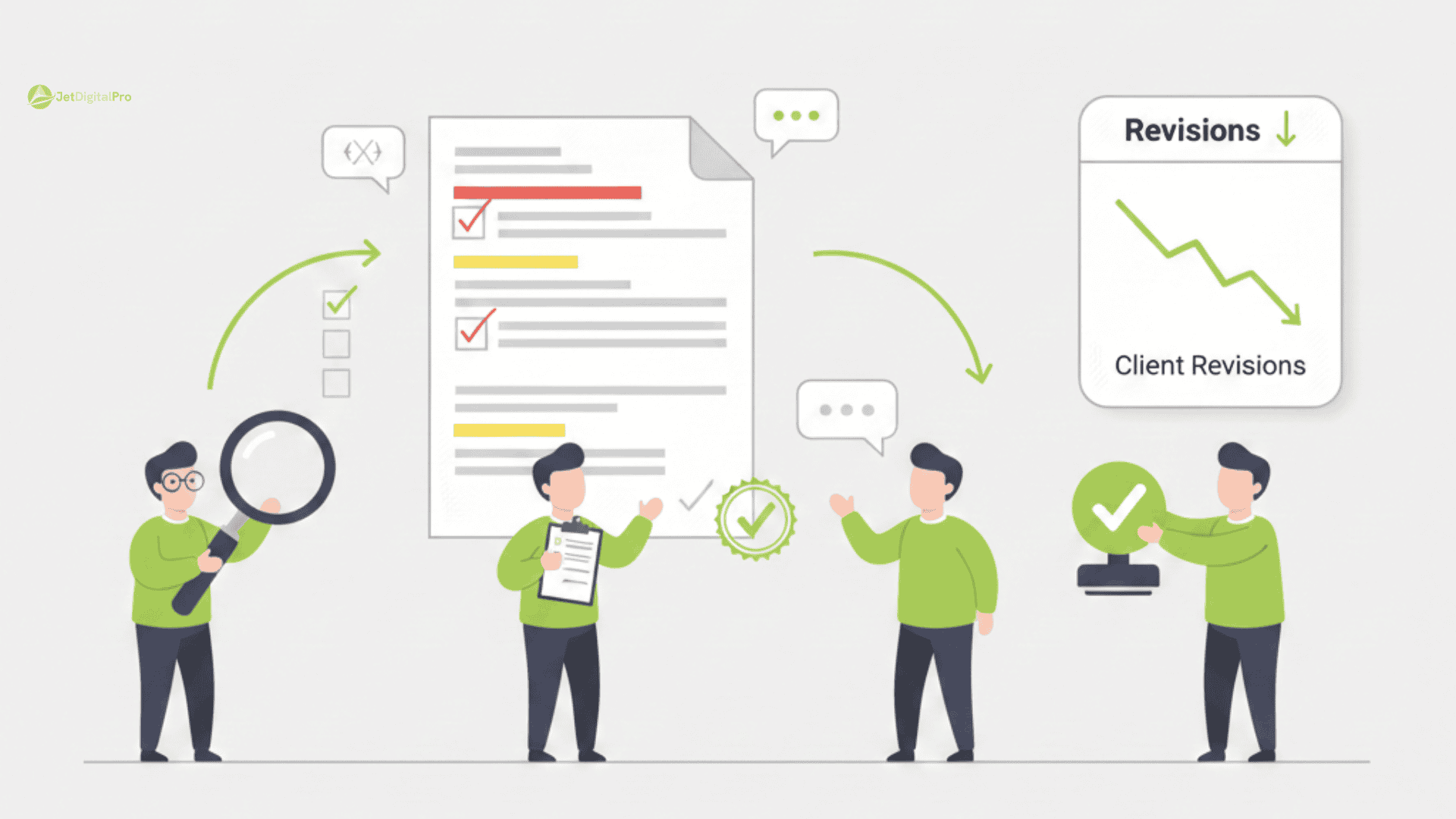
Learn how a structured agency editing system eliminates revisions, improves quality, and scales content production efficiently.
This is the brief on agency editing systems.
We write SEO articles that rank on Google — so you can focus on your business.
See Writing Plans →If your team is stuck in endless client revisions, the writing usually is not the problem. It is the lack of a structured editing system.
You would not frame a house and paint the walls on the same day. So why try to fix high-level structure and grammar at the same time?
First, build the foundation. Start with brief alignment to ensure the draft meets the client’s goals and audience before writing begins.
Then move into developmental editing. Review structure, flow, argument strength, and remove unnecessary content.
Once the structure is solid, shift focus to the words themselves.
Second comes the polish. This is where line editing and copy editing refine tone, tighten sentences, and enforce style guidelines.
Follow this with internal peer review and a final proofread to catch typos, formatting issues, and broken links.
One editor is not enough. A fresh set of eyes is critical for maintaining objectivity and catching overlooked issues.
Once the content is internally refined, it is ready for the client.
Third is delivery and scaling. Implement client feedback carefully without introducing new errors, followed by a final QA for platform optimization.
To scale effectively, agencies rely on checklists, style guides, task batching, and realistic timelines.
Need SEO content that actually ranks? We write data-driven articles designed to bring organic traffic to your site.
See Our SEO Writing Plans →AI tools can accelerate the process, but human editors remain essential for tone, clarity, and nuance.
Ultimately, quality content is not accidental. It is built intentionally through a structured process.
To get client-ready work out the door, you need a real editing system. Sending a draft through one quick proofread isn’t enough. That’s how mistakes slip through, and you end up stuck in revision hell.
A proper process uses separate stages for big-picture edits, line-by-line polish, and final proofing. Different people should handle each step to keep things objective. Tools help, but a human editor has to make the final call on voice and nuance. This isn’t just about grammar; it’s about protecting your agency’s reputation for quality.
Agency Editing Proofreading Steps at a Glance
- Editing needs multiple, distinct stages.
- Different people should handle editing and proofreading.
- Use tools to help, but keep a human in charge.
What Are Agency Editing Proofreading Steps?
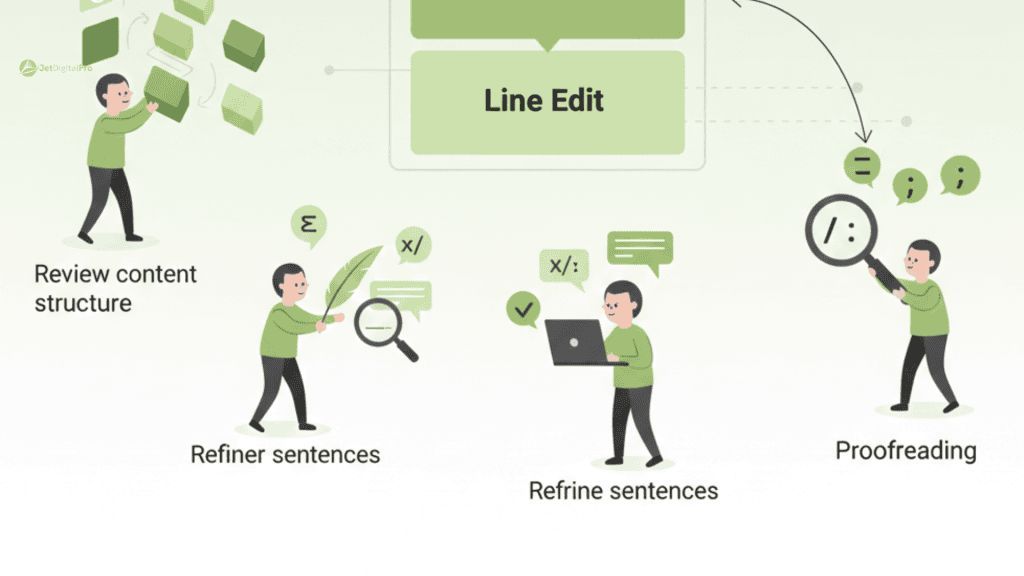
Think of it as a quality control assembly line for words. At our agency, Jet Digital Pro, we don’t just “give it a once-over.” Agency editing proofreading steps are a defined sequence of reviews that methodically transform a raw draft into client-ready content.
“Start your SEO optimization editing process by running a Clearscope draft report for the focus keyword (or target search query) you’re optimizing for. This report is your SEO content editor’s roadmap… This ensures you’re covering the right angles to satisfy your target search intent.” – Clearscope
It starts with the big picture, the argument, the flow, the structure, and methodically works down to the microscopic details of punctuation and formatting. Each stage has a clear owner and a specific checklist. This process exists because our brains are terrible at seeing everything at once.
You can’t effectively question the core message of a blog while also hunting for a missing period. By splitting the work, we ensure both jobs get done well. It’s the system that prevents great ideas from being undermined by sloppy execution.
Core Stages in an Agency Editing and Proofreading Workflow
The magic isn’t in a single brilliant proofreader, it’s in the handoffs. A smooth workflow moves a document through several pairs of hands, each tasked with a specific type of scrutiny. This separation is crucial. The writer is too close to the text. The developmental editor is too focused on the forest to see a misspelled tree.
“Rather than attempting to catch everything in one go, break the process into focused steps. Start with grammar and spelling, then move to punctuation, and finally check formatting and style consistency. This layered approach allows you to concentrate on specific aspects of your content.” – Goodman Lantern
The proofreader, coming in last with a clean perspective, spots the glitches everyone else learned to ignore. We structure this as a relay race, not a solo sprint.
The goal is to build in natural breaks and fresh perspectives, which is the only reliable way to achieve the error-free consistency clients pay for. Without these defined stages, you’re just hoping for the best.
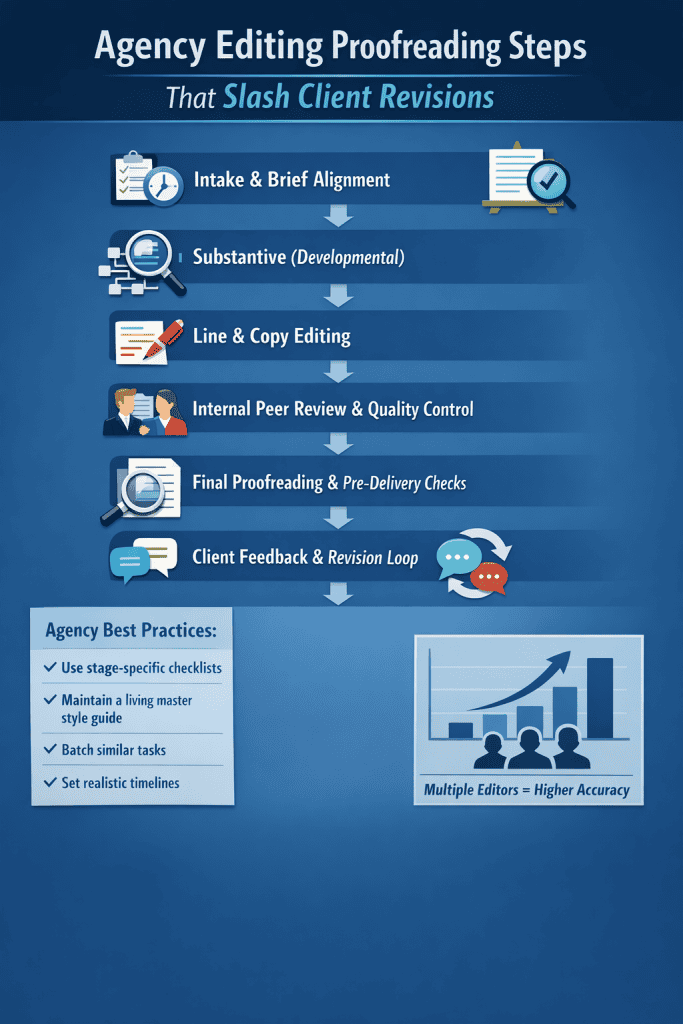
Step 1: Intake and Brief Alignment
Everything begins before a single word is edited. We receive the draft and verify it against established agency content briefing standards, and this is where we align. Our first move is a triage review. We scan the document against the client’s goals, target audience, and key messaging points.
This step decides everything that follows. It determines which team member with the right subject expertise, say, for a technical whitepaper versus social media copy, gets assigned. Skipping this is like building a house without checking the blueprint. You might end up with a beautiful structure that’s completely wrong for the plot of land.
Step 2: Substantive (Developmental) Editing
This is surgery, not cosmetics. Here, we put on our strategist hats. We’re not looking at sentences yet, we’re looking at the skeleton of the piece.
Does the introduction hook the right reader? Do the arguments flow logically? Is there redundant content that needs cutting, or gaps that need filling with research? We assess the overall organization and how well it serves the client’s objective. For instance, a blog meant to generate leads needs a clear path to a call-to-action.
This stage often involves moving whole paragraphs, rewriting sections for clarity, and flagging major questions for the client. It’s the most impactful edit, because no amount of grammatical polish can fix a fundamentally weak or misaligned structure.
Step 3: Line and Copy Editing
Now we zoom in. With the structure solid, we focus on language, style, and accuracy. Line editing polishes the prose itself for clarity, flow, and engagement. We tighten verbose sentences, sharpen vague phrasing, and ensure the tone consistently matches the brand’s voice.
Copy editing runs in parallel, enforcing the rules. We fix grammar mistakes, ensure the content aligns with the agency keyword research methods used during planning, apply the correct style guide, and verify factual details like names, dates, and data points.
This is where we build and reference a style sheet for the project, deciding on things like “e-commerce” versus “ecommerce” so every mention is consistent.
Step 4: Internal Peer Review and Quality Control
No single editor is infallible. Before anything goes to the client, the edited document undergoes an internal peer review. Another senior editor or a team lead examines the work. They’re checking for consistency in the edits, ensuring the style sheet was followed, and looking for any subjective calls that might need a second opinion.
This step acts as a crucial safety net. It catches things the first editor might have missed because they’ve been staring at the text for hours.
It’s a collaborative quality gate that ensures the agency’s standard is met every single time, turning individual work into a team-verified deliverable.
Step 5: Final Proofreading and Pre-Delivery Checks
This is the last line of defense. A proofreader, ideally someone who hasn’t seen the document before, takes the nearly-final version. Their job is purely surface-level: hunting for typos, spelling errors, punctuation issues, and formatting glitches. They check page numbers, header consistency, and the functionality of hyperlinks.
We use classic tricks here: reading the text aloud to catch awkward rhythms, or reading backwards to focus purely on individual words. This stage also includes a pre-delivery check, ensuring the file is in the correct format and ready for its intended use, whether that’s a print PDF, a web page, or a social media graphic.
Step 6: Client Feedback and Revision Loop
We deliver the polished document with tracked changes or clear comments. The client reviews it, and they almost always have feedback, that’s a good sign of engagement. We incorporate their requested revisions meticulously. But here’s the critical part: any change, no matter how small, introduces the risk of a new error.
A client tweaking a sentence can accidentally create a grammar mistake. So, after we implement their feedback, the document goes back for a targeted re-proofread. We don’t re-edit the whole thing, but we carefully scrutinize the altered sections and their surrounding sentences to catch any “flow-on” errors introduced in the revision.
Step 7: Final QA, Formatting, and Delivery
The project-closure mode. This final stage of the seo agency content creation cycle involves a final quality assurance pass on the exact file to be delivered. For digital content, this might mean checking how it renders on mobile or ensuring meta descriptions are populated.
We confirm all client amendments are correctly implemented and that the version history is clean. Then, we deliver the final files through the agreed-upon channel and archive the project assets. This formal closure ensures nothing is left dangling and creates a clear record, which is invaluable if questions arise later or if the content needs to be repurposed.
Agency Best Practices for Scalable Editing and Proofreading
Scale requires systems, not just more people. To manage high volumes without burning out your team, standardization must drive your agency editing proofreading steps.
We focus on structured safeguards that protect quality at every stage:
- Stage-specific checklists, Separate checklists for developmental editing, copy editing, and proofreading ensure no step gets skipped, even under tight deadlines.
- Living master style guide, A centralized guide (plus project-specific sheets) resolves hyphenation, capitalization, tone, and terminology decisions instantly.
- Task batching, Group similar assignments, like proofreading multiple blog posts in one session, to reduce mental switching and increase accuracy.
- Realistic production timelines, Build schedules that protect the proofreading phase, since rushed final passes cause the most visible errors.
When these systems support your agency editing proofreading steps, quality becomes repeatable, not accidental.
Common Workflow Pitfalls (Burnout, AI Overload, Revision Creep)
We’ve hit these walls ourselves. Burnout happens when editors are stuck in a reactive loop with no breaks between deep-focus tasks. The fix is enforcing those stage handoffs and allowing real downtime. AI overload is the new temptation. Tools are fantastic for a first pass to catch obvious glitches, but over-reliance is a trap.
They miss nuance, brand voice, and sophisticated context. We use them as assistants, not arbiters. The worst pitfall is revision creep, when a project gets stuck in endless tweaks. This is often born from a vague initial brief.
Our solution is crystal-clear scope definition at intake and setting firm boundaries on the number of revision rounds included. It protects the project’s viability and our team’s sanity.
How We Structure Teams for Objectivity and Accuracy
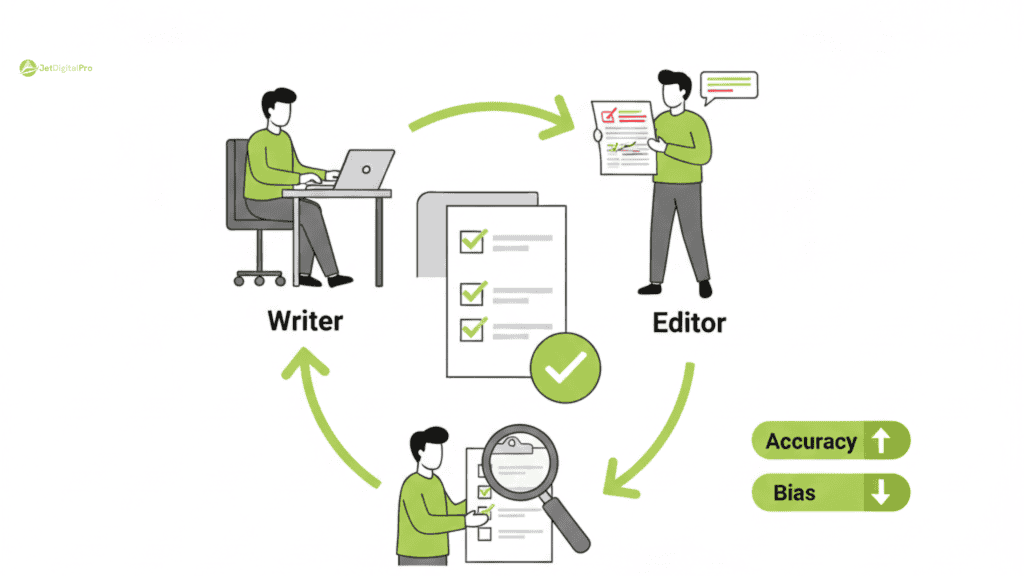
Our structure is designed to combat the inherent blindness that comes with familiarity. The writer who drafted the piece is never its only editor. We separate the roles: a developmental editor, a copy editor, and a proofreader are typically three different people. This creates built-in objectivity.
The developmental editor isn’t attached to the original phrasing, the copy editor isn’t tired from restructuring the whole piece, and the proofreader sees it with completely fresh eyes. For smaller projects, we at least enforce a mandatory “cooling-off period” where the editor steps away before proofreading their own work.
This layered human review is the irreplaceable core of our process, and it’s what truly ensures accuracy.
FAQ
How do agency editing proofreading steps differ from book editing?
Agency editing proofreading steps focus on client goals, deadlines, and content performance, often tied to Content marketing or Business Writing. Book editing usually supports a longer publishing process with chapter titles, bibliographic information, and book layout checks.
Agencies prioritize fast turnaround time and structured workflow, while book editing may include deeper editorial assessment and multiple publishing stages.
What should I expect during developmental editing in an agency workflow?
Developmental editing looks at structure, clarity, and purpose before fixing grammar mistakes. Editors review flow, argument strength, audience fit, and overall Content Creation goals.
They may use a Developmental Editing Checklist or Substantive/Structural Editing Checklist to guide changes. This stage often reshapes sections, improves user engagement, and aligns the draft with business objectives.
Do agencies use proofreading tools or only human editors?
Most agencies combine human judgment with proofreading tools and AI tools. An AI editing tool can flag punctuation issues or layout problems, but it cannot fully understand tone or context. Human editors still handle line editing, copy editing, and professional edits. The best editing process treats AI-powered proofreading as support, not a replacement.
How are layout problems and formatting checked before delivery?
During page proofing or galley proofing, editors review page numbers, footnote/endnote markers, and other text elements. They check file type, spacing, and formatting in tools like Microsoft Word.
A structured Proofreading Checklist helps catch layout problems before project-closure mode. This ensures the final document looks polished and consistent across platforms.
The Jet Digital Pro Approach: Built for Agency Partnerships
JetDigitalPro operates as a white-label content engine for digital agencies. Our system merges AI efficiency with a rigorous 11-step human edit, delivering Google-friendly articles that feel genuinely human.
We handle everything from keyword research to publishing, scaling to your volume. This lets you offer more content to clients without the operational headaches, focusing instead on strategy and growth.
Stop managing freelancers and start scaling your content output. Book a free discovery call to see how it works.
References
- https://www.clearscope.io/blog/seo-content-editing
- https://goodmanlantern.com/blog/proofreading-and-editing-strategy/
Related Articles
- https://jetdigitalpro.com/seo-agency-content-creation-process/
- https://jetdigitalpro.com/agency-content-briefing-standards/
- https://jetdigitalpro.com/agency-keyword-research-methods/
Stop Guessing. Start Ranking.
Get a free sample article written for your niche. See the quality before you commit.
Get Your Free Sample Article →No credit card needed • 100% tailored to your niche