


Learn how to compare agency pricing fairly, uncover hidden costs, evaluate total engagement value, and avoid expensive pricing traps before signing a contract.
Hey, welcome to this explainer. Let’s skip the corporate jargon and expose those hidden agency pricing traps.
We write SEO articles that rank on Google — so you can focus on your business.
See Writing Plans →Here’s the harsh truth. That dirt-cheap proposal is almost never your actual least expensive option. Stop fixating on the sticker price and focus on the total value you’re receiving instead.
Always ask agencies to break down exactly where their time and effort are going. A low hourly rate can be a major trap if the work takes far longer than expected or includes unnecessary overhead.
That five-thousand-dollar retainer may be paying for an agency’s sales team, account management layers, and internal expenses long before it contributes to your actual project outcomes.
Ask yourself how much of your budget is genuinely driving meaningful results. The answer often reveals whether you’re investing in expertise or simply funding operational costs.
Be especially cautious of vague scopes of work. Missing details about revisions, deliverables, reporting, and timelines frequently lead to costly change orders and unexpected fees later in the engagement.
The best way to compare agencies is to place proposals side by side and standardize the scope before comparing prices. Without equal scopes, price comparisons become misleading.
This leads to the most important metric: your true cost of engagement. Looking beyond the quoted fee can completely change how you evaluate agency proposals.
Consider the hidden costs. If your internal team spends hours correcting mistakes, clarifying deliverables, or managing project delays, those expenses can quickly eliminate any savings from choosing a lower-priced agency.
Always interview the actual strategists and specialists who will be working on your account. A highly capable team often creates significantly more value than a cheaper provider with limited expertise.
Ultimately, the best agency partners offer transparent pricing, clearly defined deliverables, and a proven track record of successful execution.
Need SEO content that actually ranks? We write data-driven articles designed to bring organic traffic to your site.
See Our SEO Writing Plans →So here’s the question to leave you with: are you paying for an agency’s expertise, or are you simply paying for its overhead?
Every cheap agency quote hides a trap. The initial number is bait, and the real cost hits you later. To protect your budget, you need to see past the sales pitch, spot the hidden gaps, and compare bids fairly. Keep reading to learn how.
What Should You Know Before Comparing Agency Pricing?
- Agency pricing decides who takes on the financial risk and what your costs look like.
- The real price you pay comes from how the agency runs, not simply its hourly rate or monthly fee.
- To compare agencies fairly, you need to define the same work for each and figure out the total cost of the project, not just the initial quote.
What Does the Hourly Rate Actually Tell You?
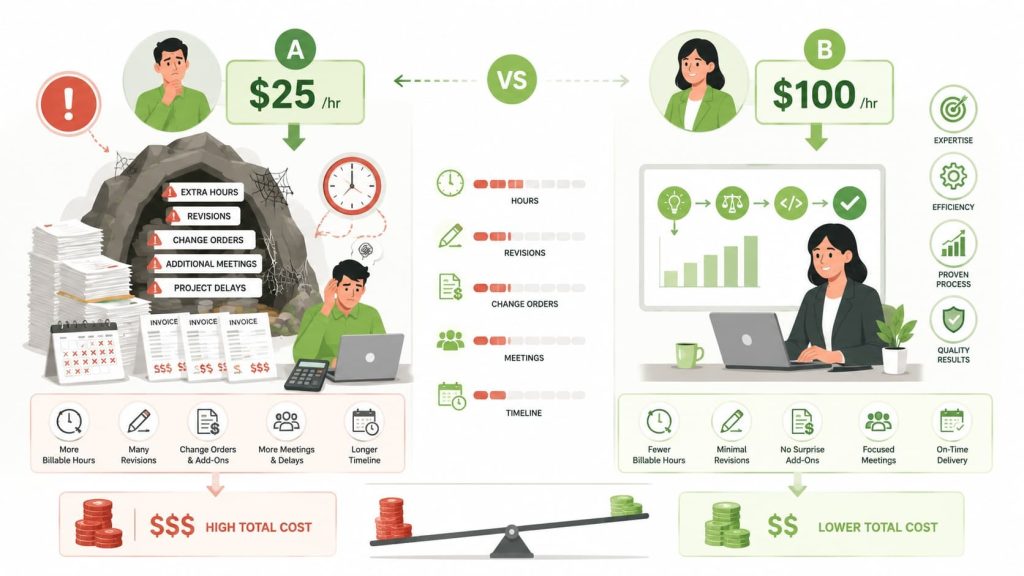
Most agencies no longer bill by the hour. It rewards taking longer, not delivering better results. But hourly rates still matter because every retainer or fixed-price proposal starts with an internal estimate of hours.
Ask for an effort breakdown. If they won’t provide one, treat it as a warning sign. One agency may charge $15,000 for 60 hours of work, while another charges $12,000 for 120 hours. The lower hourly rate isn’t automatically the better deal. What matters is how those hours are used.
Check how the time is allocated:
- Strategy and planning versus routine execution
- Senior specialist hours versus junior staff hours
- Project management, reporting, and client communication
- Deliverables produced versus time spent
A blended $125 hourly rate can look reasonable. But if a large share of that budget goes toward an account manager who mainly relays messages, you’re effectively paying premium rates for administrative work.
Our partners avoid that uncertainty. Pricing is tied to deliverables and outcomes, giving you predictable costs and a clearer understanding of what you’re actually paying for.
Where Your Retainer Actually Goes?

Most agencies work on a monthly retainer. Smaller shops may charge under $2,500, but a full-service engagement typically falls between $2,500 and $7,500 per month.
What many clients don’t see is how that fee gets divided. It doesn’t go straight to the specialist doing the work.
Picture a $5,000 retainer being split across the agency:
- Office rent and software
- Sales and business development
- Account management and client communication
- Reporting and administrative work
- Strategy and specialist execution
Only after those costs are covered does the SEO specialist, writer, or marketer begin working on your account.
As a result, a specialist may have only 10–15 hours allocated to your project each month. You’re not buying one person’s full-time attention. You’re buying access to a team. Research from Disruptive Advertising shows.
“Industry analysis of agency cost structures reveals that approximately 50-60% of a client’s payment goes directly to strategy and execution, with the remainder allocated to operational overhead (15-20%), sales and marketing (10-15%), and profit (10-15%). This breakdown helps explain why a $5,000 retainer doesn’t translate to $5,000 worth of specialist time on your account.” – Disruptive Advertising
This is why niche agencies often charge more. They aim to reduce layers, invest more in expert work, and serve fewer clients. The retainer model isn’t good or bad. The key question is simple: are you paying for results or just covering overhead?
Could a Cheap Project Fee End Up Costing More Later?
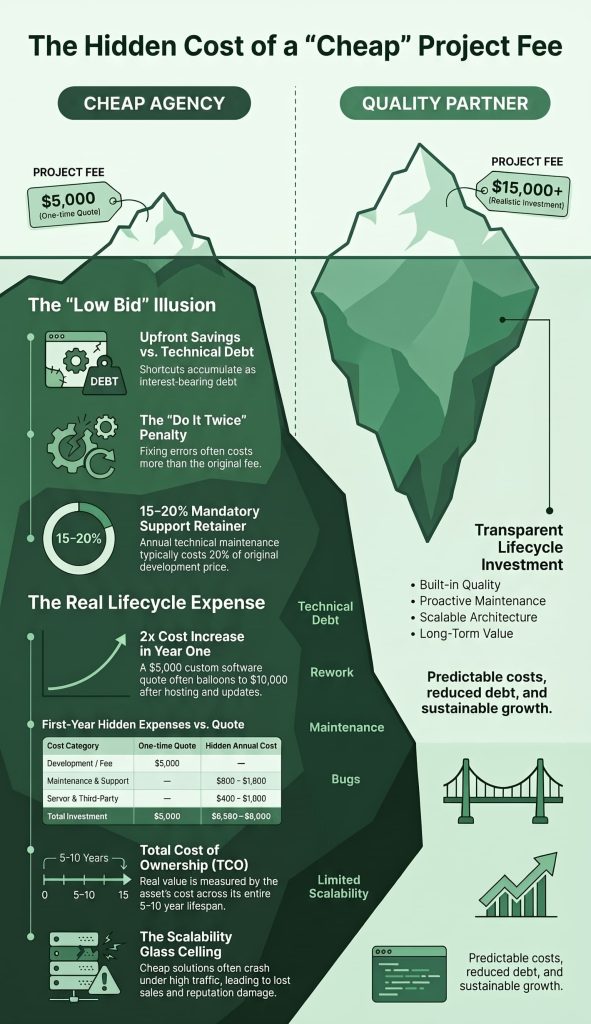
A fixed project fee looks simple. You pay one price for a specific list of work. The agency takes the risk to finish it. So what’s the problem? The details are everything, and so are the change orders.
A low bid usually wins by cutting the scope. The proposal seems complete, but the definitions are thin. “Website copy for 5 pages” seems clear.
But does that cover SEO keyword research? Does it include making changes based on your team’s feedback? What if you want to rearrange a page after the first draft? That’s where extra fees, often stretching from $150 to over $300 an hour for specialized strategy tweaks, suddenly appear.
When “Authoritative” Means Two Different Things?
Early in my career as an agency operator, a single vague contract taught me how destructive loose scoping can be. My team signed a SaaS client under a contract that simply promised a ‘1,500-word authoritative article’.
To us, that meant standard SEO copywriting. To the client’s internal engineers, it meant an exhaustive, original technical teardown with custom architectural diagrams and interviews.
Because our contract didn’t specify limits on revisions or asset design, we ended up sinking 42 unbilled hours into a single piece of content just to protect the relationship.
We lost thousands on that project, and it taught me that vague scopes hurt everyone. We were using the same words for totally different things.
How Does Radical Scope Clarity Prevent Hidden Costs?
Now, our scopes at Jet Digital Pro are extremely detailed. We write down what’s included, and just as crucial, what isn’t. This honesty stops those awful, trust-breaking talks later.
When you look at project fees, you have to make sure you’re comparing the same things. Match the scope from every bid, line by line, before you even check the price.
How Can You Compare Agency Proposals Fairly?
How do you make sense of it all? You need a clear system. Don’t just glance at the proposals. Take them apart and put them back together your way.
To find the true cost, map every proposal task side-by-side in a simple spreadsheet. This layout removes marketing sales pitches and shows you exactly what you are paying for. If Agency A includes competitor tracking but Agency B lists it as a $500 add-on, adjust your spreadsheet. Add that $500 to Agency B’s total so you compare identical services.
This is the only way to expose who is offering real strategic weight and who is simply overcharging for basic account management. Make the scopes identical. Only then can you truly compare the costs.
| Deliverable | Agency A | Agency B | Agency C |
| Competitor Analysis | Included | Add-on ($500) | Included |
| Keyword Research | Included | Included | Included |
| Content Creation | 4 Articles/Month | 2 Articles/Month | 4 Articles/Month |
| SEO Reporting | Monthly | Quarterly | Monthly |
| Revision Rounds | 1 Round | 2 Rounds | Unlimited |
| Account Manager | Dedicated | Shared | Dedicated |
| Contract Length | 12 Months | Month-to-Month | 6 Months |
How Do You Calculate the True Cost of Engagement?
To protect your budget, calculate the True Cost of Engagement (TCE) instead of just looking at the monthly price. Use this simple formula to grade every proposal:
TCE = Onboarding Fee + (Monthly Retainer x Contract Length) + Projected Change Orders + Internal Oversight Cost
(Note: As a rule of thumb, budget an extra 10% to 15% for projected change orders if the initial contract scope is vague.)
For example, a $3,000/month agency requiring a 12-month lock-in is a strict $36,000 cash commitment. If a low-cost agency leaves out technical setup, your in-house developer must do it.
If your developer spends 5 hours a week fixing agency work at $75 an hour, you are spending an extra $1,500 every month.
That hidden internal cost pushes your real annual price from $36,000 up to $54,000. That is how you compare numbers accurately. A $3,000 a month retainer with a 12-month lock is a $36,000 promise.
A $4,000 a month plan you can cancel with 30 days’ notice might be less risky and could cost you less overall.
Why Should You Evaluate the Team, Not Just the Proposal?
Meet your actual day-to-day team before signing. Ask to talk directly with the strategist and account manager assigned to your business. Do not evaluate an agency based on senior executives who disappear after the sales pitch. Insights from University of Ghana indicate.
“Research examining client-agency relationships has identified credibility, commitment, partnership, proactiveness, and communication as the main factors underpinning successful engagements. Evaluating the team you will work with daily, not just the proposal or the pitch team, is essential for building the trust and collaboration that drive real results.” – University of Ghana
Chemistry matters more than a small discount. In fact, two-thirds of marketing leaders choose agencies based on partnership fit. You build trust with real people, not polished paperwork.
FAQ
How do you evaluate agency proposals when the services look identical?
Ignore the marketing copy and list the hard numbers side-by-side. Count the exact monthly articles, revision rounds, and meeting hours each vendor guarantees. A low price loses its value if you have to pay extra for strategy, edits, or reporting later.
Why do quotes for identical marketing projects vary so drastically between agencies?
Price discrepancies usually come down to resource allocation and talent seniority. A lower bid often indicates that your project will be assigned to entry-level junior staff, whereas a premium bid typically reflects the involvement of seasoned, senior specialists. Comparing deliverables and responsibilities helps explain why two agencies may quote very different prices.
What should I review before agreeing to agency pricing contracts?
Check five critical contract details before signing: the exact list of tasks, the payment dates, the contract length, the notice period to cancel, and intellectual property ownership. Fair contracts list every possible fee upfront. Ensure the agency explicitly defines costs for extra content revisions or unscheduled strategy meetings before work starts.
Is project based agency pricing better than monthly retainer agencies?
Project based agency pricing is often suitable when you need a specific deliverable with a defined deadline and budget. Monthly retainer agencies are generally more appropriate when ongoing work is required each month. Comparing pricing models agencies use can help determine which structure aligns with your objectives, workload, and expected level of support throughout the engagement.
How can I determine whether an agency quote fits my budget?
Start with an agency budget comparison based on your goals and required services. Compare agency quotes that include similar deliverables, timelines, and reporting requirements. Review agency pricing structures carefully to identify differences in service coverage. Whether you need small business agency pricing or enterprise agency pricing, focus on the expected return from the services rather than the lowest price.
Why Should You Choose Value Over Sticker Price?
A successful agency partnership relies on predictable execution, transparent scopes, and mutual trust. If you are looking for an extension of your team that values radical pricing transparency and clear deliverables, discover how Jet Digital Pro builds scalable, reliable content solutions to support your growth.
Ready to grow with confidence? Contact Jet Digital Pro today and see how scalable content can support your agency’s growth.
References
- https://journals.librarypublishing.arizona.edu/arizlrev/article/7022/galley/6493/download/
- https://journals.sagepub.com/doi/full/10.1177/14413582241303978
Related Article
- https://jetdigitalpro.com/seo-agency-pricing-and-packages/
- https://jetdigitalpro.com/comparing-top-seo-content-agencies/
- https://jetdigitalpro.com/choosing-the-right-seo-content-agency/
Stop Guessing. Start Ranking.
Get a free sample article written for your niche. See the quality before you commit.
Get Your Free Sample Article →No credit card needed • 100% tailored to your niche