

Learn what really affects agency pricing, why agency quotes vary, and how to compare proposals based on value instead of price alone.
Welcome to this explainer. Ever wonder why agency quotes for the exact same services vary so wildly? Getting different prices for the same work can be confusing, so let’s break down what really drives agency pricing.
We write SEO articles that rank on Google — so you can focus on your business.
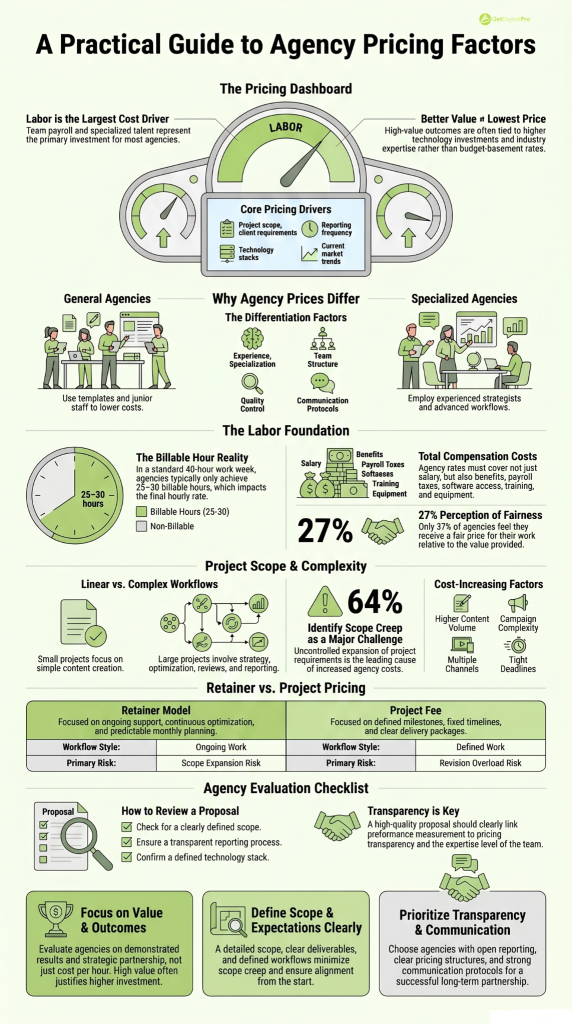
See Writing Plans →Think of agency pricing like an iceberg. The deliverables are visible, but most operational costs stay behind the scenes. Labor is the biggest factor, covering salaries, training, employee benefits, and quality control that support every project.
Project scope is another major pricing factor. More revisions, additional stakeholders, and tighter deadlines require more time and resources, increasing the overall cost.
Experience and specialization also influence pricing. Agencies with expertise in industries like healthcare or finance often charge more because their knowledge reduces project risks and improves execution.
Client requirements can significantly affect pricing. Frequent meetings, executive reporting, and custom dashboards require additional administrative work and ongoing communication.
Technology investments are another hidden cost. Agencies rely on premium SEO tools, analytics platforms, AI software, and other technologies to deliver high-quality work, and these expenses are reflected in their pricing.
Finally, market conditions also influence agency rates. Inflation, labor costs, and changing demand all affect how agencies price their services over time.
When comparing proposals, don’t focus only on the lowest price. Evaluate each agency’s scope of work, expertise, communication standards, and long-term value. In the end, ask yourself: are you buying deliverables or investing in outcomes?
Agency pricing is shaped by more than the services listed in a proposal. Factors such as expertise, project scope, labor costs, technology, reporting requirements, and market conditions all influence what agencies charge.
At JetDigitalPro, we’ve seen that two agencies can offer similar services while operating with very different teams, processes, and cost structures. That’s why the lowest quote isn’t always the strongest value. Keep reading to understand what drives agency pricing and how to compare proposals with greater confidence.
What Are the Key Agency Pricing Factors at a Glance?
- Labor costs remain the single largest factor behind agency service costs.
- Project scope, client requirements, and reporting expectations can significantly influence pricing.
- Technology investments, market conditions, and industry expertise also contribute to agency rates.
Together, these factors provide a clearer understanding of how agencies price their services and how businesses can evaluate proposals more effectively.
Why Do Similar Agency Services Have Different Prices?
It’s common to receive two proposals for the same service and see a large gap in pricing.
For example, two agencies may both offer SEO, content marketing, or paid advertising. On the surface, the services look similar. But behind the scenes, their business models may be very different.
One agency may rely on senior specialists with years of experience. Another may use junior staff supported by templates and standardized processes. Both approaches can work, but they create different costs.
Other factors that influence pricing include:
- Agency experience
- Industry specialization
- Team structure
- Technology investments
- Quality control processes
- Communication requirements
- Profit targets
We’ve seen this firsthand in SEO content production. At Jet Digital Pro, we combine AI-assisted workflows with human editorial review, allowing us to scale content efficiently while maintaining quality standards. Different operational models naturally lead to different pricing structures.
How Do Experience and Specialization Affect Agency Pricing?

Experience often comes at a premium.
Agencies with deep knowledge of a specific industry may charge more because they can start faster and avoid common mistakes. Their teams already understand customer behavior, competitors, and industry requirements.
This can be especially valuable in industries such as:
- Healthcare
- SaaS
- Financial services
- Enterprise B2B
Specialized expertise may reduce project risk, shorten onboarding, and improve execution quality. This is one reason why SEO agency pricing can vary considerably between providers offering similar deliverables.
That doesn’t mean every business needs the most expensive specialist. But it’s worth considering whether industry knowledge could save time and improve results.
Does Agency Size Affect Pricing?
| Agency Type | Typical Pricing Impact |
| Freelancer | Lower overhead |
| Boutique Agency | Moderate pricing |
| Full-Service Agency | Higher operational costs |
Larger organizations often absorb greater agency overhead costs, including management layers, software subscriptions, office expenses, and administrative support.
Need SEO content that actually ranks? We write data-driven articles designed to bring organic traffic to your site.
See Our SEO Writing Plans →Why Are Labor Costs the Biggest Agency Pricing Factor?
Labor is still the biggest expense for most agencies.
Clients see deliverables such as blog posts, SEO audits, campaigns, and reports. Agencies see the people required to create and manage those deliverables.
What Are Fully Loaded Employee Costs?
Employee costs usually include:
- Salary
- Benefits
- Payroll taxes
- Software access
- Training
- Equipment
There’s another factor many businesses don’t consider: not every working hour is billable.
Employees spend time on training, internal meetings, process improvements, business development, and administrative work. Because of this, agencies must spread their costs across a smaller number of billable hours.
This is one reason agency hourly rates may seem higher than expected.
Why Utilization Rates Affect Agency Profitability?
Utilization refers to the percentage of time employees spend on client work.
For example, an employee may work 40 hours per week but only spend 25 to 30 hours on billable projects. The remaining time supports agency operations.
Lower utilization means agencies need to recover costs from fewer billable hours. As a result, utilization has a direct impact on pricing and profitability.
As noted by Institute of Practitioners in Advertising (IPA)
“The IPA found that only 27% of agencies feel they receive a ‘fair’ price for the work they do.” – Institute of Practitioners in Advertising
This is especially important for specialized services such as:
- SEO strategy
- Technical audits
- Content planning
- Paid media management
The more specialized the work, the more difficult it can be to maintain high utilization rates.
How Does Project Scope Influence Agency Pricing?
Project scope is one of the biggest variables in agency pricing.
When the scope is clear, agencies can estimate costs with greater accuracy. When the scope is vague, pricing often increases because the agency is taking on more risk.
Several factors influence project scope:
- Deliverables
- Timelines
- Number of channels
- Approval requirements
- Revision limits
- Stakeholder involvement
A simple content project is very different from a campaign that includes strategy, content creation, optimization, reviews, and executive approvals.
The larger the workload, the higher the cost.
Which Project Elements Increase Agency Costs?
The following typically increase agency workload pricing:
- Higher content volume pricing
- Campaign complexity pricing
- Multi-channel execution
- Tight deadlines
- Additional stakeholder reviews
The Financial Impact of Scope Creep
Industry data shows 64% of agencies identify scope creep as a major challenge.
Scope creep increases costs through:
- Additional labor
- Extended timelines
- Resource reallocation
- Reduced profitability
Research from Project Management Institute (PMI) shows
“A recent global PMI survey found that over 70% of project professionals in the construction industry experience scope creep, resulting in project delays and cost overruns.” – Project Management Institute
From our experience, scope clarity often determines whether a project remains efficient or becomes significantly more expensive than originally planned.
Retainer Pricing vs. Project-Based Pricing
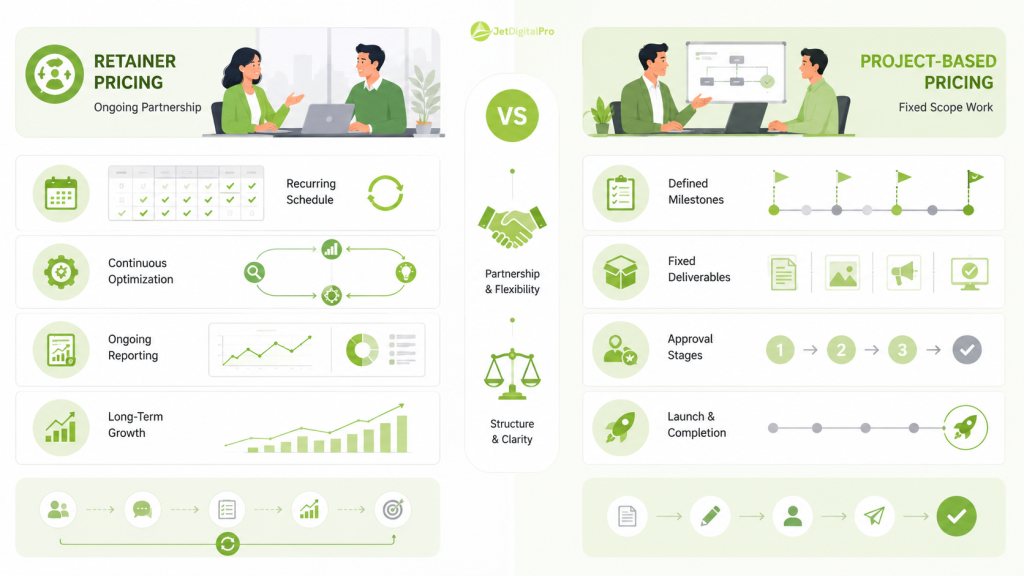
Most agencies offer two common pricing models: retainers and project-based fees.
A retainer is an ongoing monthly agreement. Project pricing is built around a specific deliverable or defined scope of work.
Neither model is better in every situation.
Retainers are designed for ongoing marketing initiatives that require continuous optimization and support. An agency retainer is often preferred when businesses need consistent content production, optimization, and long-term campaign management rather than one-off deliverables.
Situations Where Retainers Deliver Better Value
Retainers are commonly used for:
- SEO
- Content marketing
- PPC management
- Social media campaigns
- Ongoing consulting
The biggest benefit is consistency. Agencies can plan resources more effectively, and businesses receive ongoing support without renegotiating every task.
Projects Best Suited for Fixed-Fee Pricing
Project-based pricing is often used for:
- Website redesigns
- Technical audits
- Branding projects
- One-time campaigns
- Content migrations
Because the deliverables are clearly defined, both sides usually know what to expect from the start.
| Model | Best For | Primary Risk |
| Retainer | Ongoing work | Scope expansion |
| Project Fee | Defined work | Revision overload |
The right model depends on the type of work being performed and how much flexibility is required.
How Do Client Requirements Affect Agency Costs?
Two companies can purchase the same service and still receive very different quotes because client expectations often create different workloads.
One company may need a monthly report and a short check-in call. Another may require weekly meetings, executive presentations, multiple approval stages, and extensive documentation.
Those extra requirements take time.
Common requests that increase agency costs include:
- Weekly meetings
- Executive reporting
- Compliance reviews
- Multiple approval layers
- Multi-location campaigns
- Custom reporting
Larger organizations often require more stakeholder involvement. As a result, agencies may need to allocate additional resources to manage communication and reporting.
Why Do Reporting Requirements Increase Agency Costs?
Reporting requires more than exporting data into a spreadsheet.
Meaningful reporting involves collecting information from multiple platforms, validating data accuracy, identifying trends, and translating performance metrics into actionable recommendations.
Depending on the scope of a campaign, agencies may spend several hours each month preparing reports, updating dashboards, reviewing results, and communicating findings to stakeholders.
Common reporting activities include:
- Data gathering and validation
- Dashboard management
- Performance analysis
- Presentation preparation
- Strategic recommendations
For businesses with multiple campaigns, locations, or marketing channels, reporting requirements can become a significant contributor to agency workload.
The Time Investment Behind Agency Reporting
Many agencies dedicate specific team members to analytics and reporting functions. As reporting expectations become more detailed, the labor required to produce accurate and useful insights increases as well.
This is particularly true when clients require custom dashboards, executive summaries, or frequent performance reviews.
Using Automation to Improve Reporting Efficiency
Automation can reduce reporting workloads through:
- Automated dashboards
- Scheduled reports
- Data integrations
- Workflow automation
While automation improves efficiency, agencies still need experienced professionals to interpret data, identify opportunities, and provide strategic recommendations.
How Do Technology and Software Costs Affect Agency Pricing?
Modern agencies rely on a growing collection of software platforms to manage campaigns, collaborate with clients, analyze performance, and improve efficiency.
Although clients may never directly interact with many of these tools, they represent a significant operational expense.
Common software categories include:
- CRM platforms
- Analytics tools
- SEO software
- Project management systems
- Reporting platforms
- AI-assisted production tools
Most software products operate on subscription-based pricing models, creating recurring expenses that agencies must account for when setting rates.
Agencies still require strategists, editors, analysts, account managers, and quality-control processes to deliver results.
The Hidden Cost of Per-Seat Software Licensing
Many software providers charge on a per-user basis.
As agencies grow and add employees or contractors, software costs often increase alongside labor expenses. This creates a compounding effect where growth generates both staffing and technology costs.
Per Forrester metrics, 75% of agencies bear the cost of generative AI integration directly without passing it to clients. At Jet Digital Pro, our proprietary AI-assisted workflows scale content efficiency without adding software bloat to your final invoice.
How Do Market Conditions Influence Agency Pricing?
Economic conditions, competition, and demand influence agency pricing structures.
Agency pricing trends rarely remain static.
Inflation, labor market shifts, and changing client demand all impact pricing strategies.
Inflation’s Effect on Agency Pricing Structures
Inflation increases:
- Agency labor costs
- Software subscriptions
- Administrative expenses
- Technology investments
These pressures eventually influence client pricing.
Industry-Wide Agency Pricing Adjustments
Research indicates 97% of small and midsize agencies planned pricing increases to maintain profitability and operational sustainability.
Gartner findings also suggest organizations continue reassessing vendor relationships, creating additional pricing pressure throughout the agency marketplace.
Market rate agency services therefore fluctuate alongside broader economic conditions.
Industry Expertise and Premium Service Pricing
Specialized agencies often charge higher rates because they bring industry-specific knowledge that reduces learning curves and execution risk.
Rather than spending time becoming familiar with regulations, customer behavior, or market dynamics, experienced specialists can begin contributing value more quickly.
The Business Value of Agency Specialization
Businesses often pay premium rates for specialization because it can lead to:
- Faster implementation
- Better compliance awareness
- More informed strategic recommendations
- Reduced project risk
We’ve found that industry familiarity frequently shortens onboarding timelines and improves execution efficiency.
Expertise influences pricing, but it isn’t the only factor. A proven track record and market reputation can also affect how agencies position their rates.
Does Agency Reputation Affect Pricing?
Reputation can influence pricing as much as technical skills.
Agencies with a proven track record often have more pricing flexibility because buyers see less risk in the relationship.
Trust is usually built through:
- Case studies
- Testimonials
- Referrals
- Industry recognition
- Long-term client relationships
A strong reputation doesn’t guarantee success. But it often gives businesses greater confidence when making a purchasing decision.
At the same time, agencies must continue proving value through measurable outcomes and clear communication.
How Can Businesses Evaluate Agency Pricing More Accurately?
Comparing agencies based only on price rarely tells the whole story.
A lower quote may exclude services that another agency includes. A higher quote may cover strategy, reporting, project management, and quality assurance that aren’t immediately visible.
To compare pricing between different agencies more effectively, businesses should review deliverables, expertise, reporting standards, and communication processes, not just the final cost.
Before making a decision, look closely at what’s included.
Essential Questions to Ask Before Comparing Proposals
Consider asking:
- What deliverables are included?
- How are revisions handled?
- What reporting is provided?
- How is success measured?
- Are there additional fees?
Pricing Red Flags Businesses Should Recognize
Watch for:
- Undefined deliverables
- Extremely low pricing
- Limited transparency
- Missing performance metrics
- Unclear reporting processes
A proposal should make it easy to understand what you’re buying and how results will be measured.
Agency Pricing Evaluation Checklist
| Evaluation Factor | Why It Matters |
| Defined Scope | Reduces scope creep risk |
| Reporting Process | Clarifies accountability |
| Expertise Level | Influences execution quality |
| Technology Stack | Supports efficiency and insights |
| Pricing Transparency | Improves trust and budgeting |
| Performance Measurement | Connects work to outcomes |
FAQ
How can businesses estimate agency costs before requesting proposals?
Businesses can improve agency cost estimation by clearly defining their goals, deliverables, timelines, and required services before contacting agencies. Factors such as project size, campaign complexity, reporting requirements, and expected turnaround times all influence agency service costs. Providing detailed requirements helps agencies develop more accurate proposals and allows businesses to make fairer agency pricing comparisons.
What is the difference between value-based and performance-based pricing?
A value based pricing agency sets fees according to the business value the service is expected to generate. Performance based pricing ties compensation to measurable outcomes such as leads, conversions, or revenue growth. Unlike hourly agency rates, both pricing models focus on results. However, performance-based agreements typically require clearly defined goals and tracking methods.
How do service level agreements affect agency pricing?
Service level agreement pricing is influenced by the level of support and responsiveness a client requires. Agreements that include faster response times, dedicated account management, detailed reporting, or guaranteed service availability often increase agency operational costs. As a result, agencies may adjust pricing to cover the additional resources needed to meet those commitments consistently.
Why do agency pricing benchmarks vary across different markets?
Agency pricing benchmarks vary because labor expenses, operating costs, competition, and client demand differ by location. Local agency pricing is often influenced by regional economic conditions, while international agency pricing may reflect different staffing costs and market expectations. Businesses should compare agencies within similar markets instead of relying solely on industry-wide pricing averages.
How does contract length influence agency pricing?
Contract length pricing can affect both agency pricing flexibility and overall costs. Longer agreements provide agencies with more predictable revenue, which may allow them to offer long term retainer discounts or more favorable pricing structures. Short-term engagements often involve higher costs because agencies must recover onboarding, planning, and resource allocation expenses over a shorter period.
Final Thoughts on Agency Pricing
Agency pricing often varies because every project requires different levels of expertise, effort, and oversight. That’s why comparing providers based only on price rarely tells the full story.
The better approach is to focus on long-term value and measurable results. JetDigitalPro helps agencies scale with white-label SEO content, link building, on-page optimization, and managed content workflows that reduce internal workload. Ready to grow more efficiently? Contact JetDigitalPro today to discuss your goals.
References
- https://www.pmi.org/shop/tb/p-/elearning/construction-scope-and-change-order-management-course/el015
- https://videoweek.com/2025/07/02/ipa-pushes-for-reforming-outdated-agency-pricing-models/
Related Article
- https://jetdigitalpro.com/seo-agency-pricing-and-packages/
- https://jetdigitalpro.com/agency-retainer-for-content-seo/
- https://jetdigitalpro.com/compare-pricing-different-agencies/
Stop Guessing. Start Ranking.
Get a free sample article written for your niche. See the quality before you commit.
Get Your Free Sample Article →No credit card needed • 100% tailored to your niche