

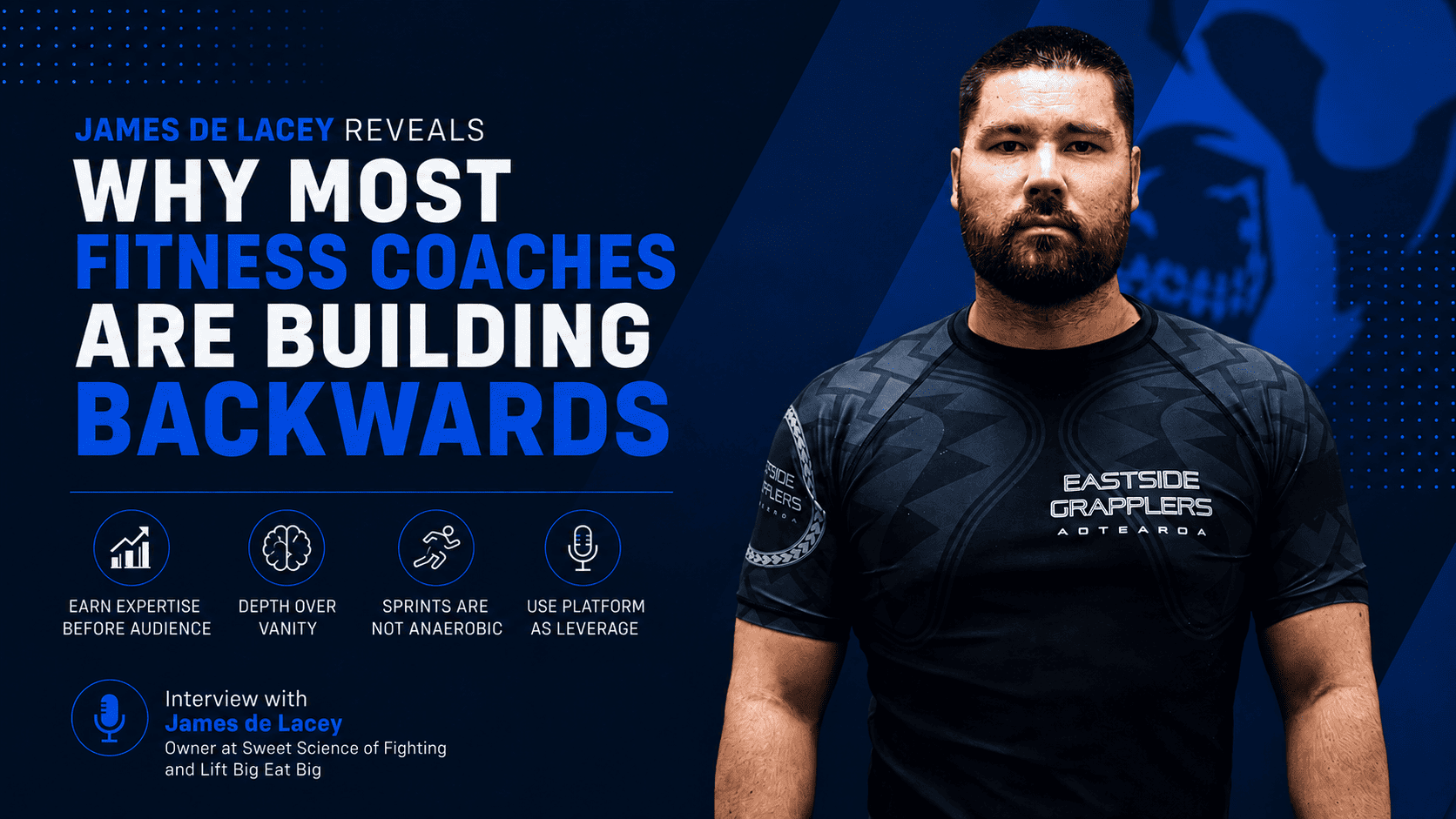
Written by Nell · Interviewed: James de Lacey, Owner at Sweet Science of Fighting and Lift Big Eat Big · June 2026 · 6 min read
James de Lacey holds a Masters in Sport & Exercise Science and spent a decade coaching within international and professional rugby and rugby league across three countries.
We write SEO articles that rank on Google — so you can focus on your business.
See Writing Plans →He has published academic research in strength & conditioning and runs two of the more respected evidence-based training platforms in the space, Sweet Science of Fighting and Lift Big Eat Big.
The Man Who Worked Three Countries Before He Opened a Camera
There is a particular kind of credibility that cannot be manufactured.
James de Lacey has it, not because of a title, but because of where he earned his reps: pitchside, in professional rugby and rugby league environments, across three different countries, doing the unglamorous work of actually making elite athletes better. The academic research came alongside that, not instead of it.
By the time most fitness influencers were hitting their first hundred thousand followers, de Lacey had already spent years in environments where being wrong had real consequences. That context shapes everything about how he builds content, runs his brands, and talks about the industry he now operates in publicly.
What the Online Fitness Industry Gets Backwards
Things the reader assumed were fine, and aren’t.
- Building a following first → de Lacey argues most coaches chase audience before they have anything worth saying, and the content shows it
- Social media presence as proof of expertise → volume of output is mistaken for depth of knowledge, repeatedly
- Aerobic vs. anaerobic training as a binary → energy system science hasn’t caught up with what actually happens inside the body during sport
- The Huberman model of growth → provocative certainty builds fast audiences, but the information underneath often doesn’t hold
- A “turning point” as the key to brand growth → de Lacey’s brands grew without one, and that tells you something important about what actually works
Most Coaches Have Barely Coached Before They Start Posting
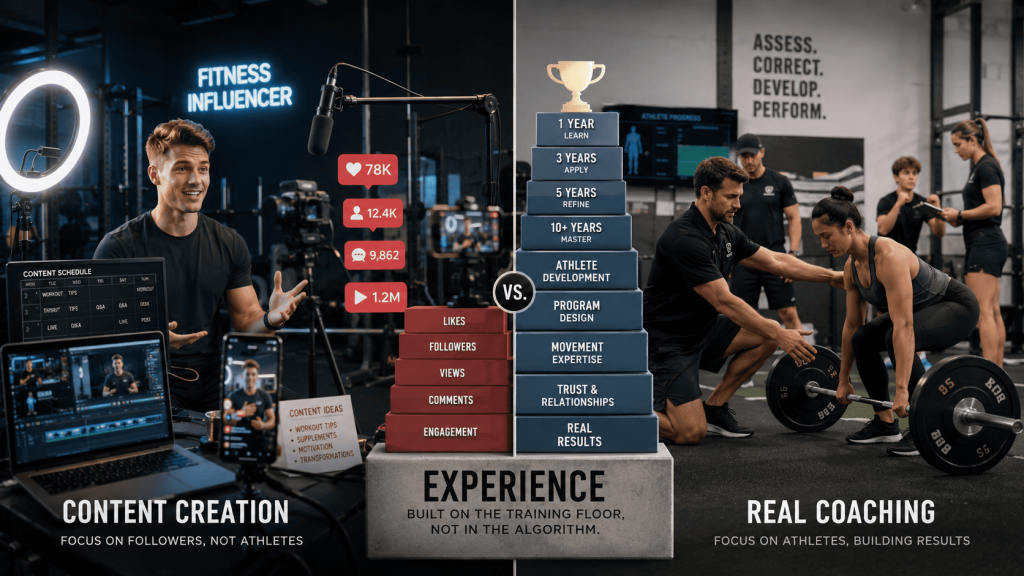
When asked what coaches most commonly get wrong when trying to build online, de Lacey didn’t hesitate. It’s a question he fields often, coaches come to him not for training advice, but for content strategy.
Need SEO content that actually ranks? We write data-driven articles designed to bring organic traffic to your site.
See Our SEO Writing Plans →The pattern he describes is consistent: coaches arrive wanting to know about content strategy, posting frequency, platforms. What they actually need to hear is something harder.
“Most coaches want to build a big following and have a big online coaching business,” he says. “The problem is, most have barely coached in real life. In my opinion, you must develop the knowledge, application, and expertise first before going all out on social media. Otherwise the content is just the same as the 1000s of fitness influencers.”
That last line lands like a verdict. The fitness content space is not short on volume, it is short on coaches who have spent enough time actually coaching to know what the real problems are.
De Lacey’s position is that going online before you’ve earned that knowledge doesn’t just produce mediocre content. It produces content that is indistinguishable from everything else out there, regardless of production value or posting consistency.
“You must develop the knowledge, application, and expertise first before going all out on social media.”
Sweet Science of Fighting Didn’t Take Off, It Just Got Better Than Everything Else
It would make a cleaner story if there had been a moment. A viral post, a collaboration, an algorithm shift that changed everything. De Lacey doesn’t offer one, because there wasn’t one.
When asked about the turning point for Sweet Science of Fighting, he gives the kind of answer that is easy to undervalue: “No real turning point. It’s moreso that the information is higher level than most of the generic fitness content you’ll see online and based on my decade of work in professional sport.”
That’s it. No hack, no growth playbook. The brand grew because the information was better, rooted in real applied experience that most people creating combat sports content simply don’t have.
A decade working inside professional rugby and rugby league, across multiple countries, produces a different kind of understanding than a personal training certification and a YouTube subscription.
It also explains why that depth of information tends to attract a different kind of reader. When the information is genuinely higher level, the people who find it tend to stay.
“It’s moreso that the information is higher level than most of the generic fitness content you’ll see online and based on my decade of work in professional sport.”
The Huberman Problem: Why Going Full Clickbait Works, and Why de Lacey Won’t Do It
This is where the interview gets honest in a way that most people in the space won’t be.
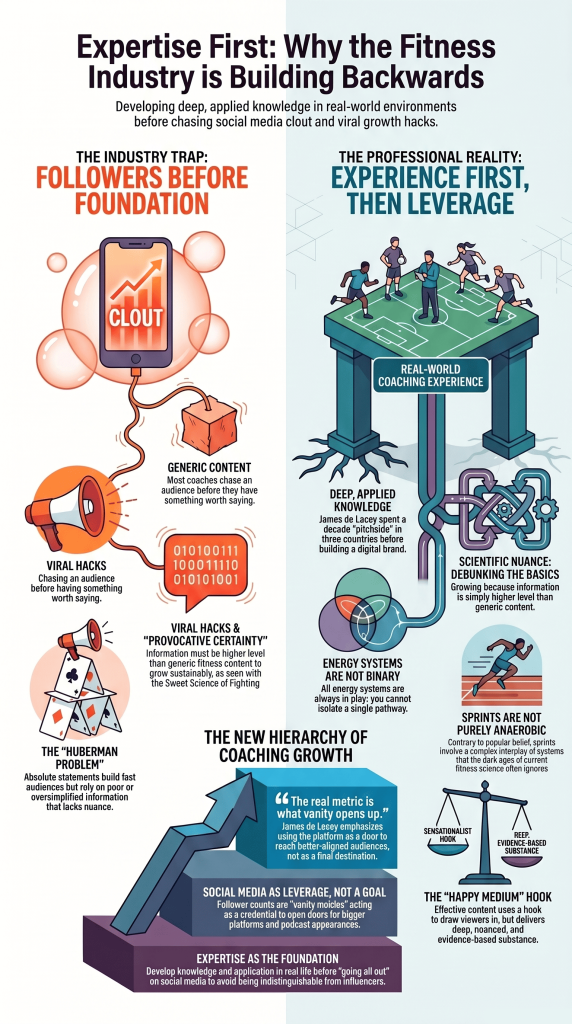
De Lacey describes balancing scientific accuracy with content that actually reaches people as “one of the hardest things to juggle”, and then names the trap by name. “You can go full clickbait/absolute statement and you’ll grow an audience fast. Think Huberman and all the wellness podcasters who spew poor information.”
That’s a pointed sentence to put in print. But he’s identifying something real: the format that grows fastest online, confident, simple, declarative, is structurally at odds with how evidence-based information actually works. Nuance doesn’t clip well. Uncertainty doesn’t make good hooks.
His solution is deliberate: “I’ve found this happy medium where the hook can be a little more sensationalist but then the information presented is more indepth and provides nuance.” The surface draws people in. The substance is what keeps them, and what separates his audience from one built on misinformation packaged as wellness.
“You can go full clickbait/absolute statement and you’ll grow an audience fast. Think Huberman and all the wellness podcasters who spew poor information.”
Sprints Are Not Anaerobic. And the Industry Still Doesn’t Know That.

By the point de Lacey gets to energy system development, you can tell this is the topic he most wants to correct.
Asked what training principle for combat sports athletes remains most underrated or misunderstood in 2026, he moves directly to the science: “Energy system development is still in the dark ages. People think it’s aerobic vs anaerobic when all energy systems are always in play and you can’t isolate any one pathway.”
Then he drops the line that stops the conversation: “Contrary to popular belief, sprints are not anaerobic.”
It’s a position that cuts against how most conditioning coaches still program sessions online. Coaches are still designing sessions around a model of the body that exercise science has moved well past.
The stakes here are practical. Misunderstanding how energy systems actually work doesn’t just produce suboptimal training programs, it produces athletes who are conditioned for a version of sport that doesn’t match the physiological reality of what happens inside a fight or a match.
“Energy system development is still in the dark ages.”
The Real Metric Isn’t Vanity, It’s What Vanity Opens Up
Everything de Lacey has said up to this point might suggest someone skeptical of social media growth for its own sake. And he is, but his final answer reframes the whole picture.
Asked what’s next, he’s direct: “Continue growing social media. While it’s a vanity metric, it leads to bigger podcast appearances etc.”
It’s a more pragmatic framing than the usual ‘build your community’ rhetoric. The follower count isn’t the point. The follower count is the credential that gets you into rooms where the real opportunities are, larger platforms, better-aligned audiences, more credibility for the work that actually matters to him.
He’s not chasing numbers because numbers are the goal. He’s treating numbers as leverage. That’s a different orientation entirely, and it tracks with everything else he’s said: build the expertise first, let the quality carry the content, use the platform that results from that as a door, not a destination.
For coaches who want to build something real rather than something fast, that sequencing is probably the most useful thing he’s said.
“It’s a vanity metric, but it leads to bigger podcast appearances.”
Want to go deeper with James’s work? Explore the evidence-based training content he’s built at Sweet Science of Fighting and Lift Big Eat Big, two platforms built on a decade of professional experience, not a content calendar.
Stop Guessing. Start Ranking.
Get a free sample article written for your niche. See the quality before you commit.
Get Your Free Sample Article →No credit card needed • 100% tailored to your niche