


Learn how project-based pricing works, how it compares to hourly billing, and when a fixed-price model is the best choice for agencies and clients.
If you’re hiring an agency or running one, you’ve probably heard about project-based pricing. But what does it actually mean?
We write SEO articles that rank on Google — so you can focus on your business.
See Writing Plans →Project-based pricing is a model where the client pays one fixed price for a clearly defined project. Instead of charging by the hour, the agency agrees on the scope, deliverables, timeline, and budget before work begins.
Think of it like building a house. You agree on the plans and the total price before construction starts. As long as the plans don’t change, the price stays the same.
This pricing model works best for projects with clear goals and predictable deliverables, such as website redesigns, SEO audits, branding projects, content writing packages, landing pages, and email campaigns.
The process starts with discovery. The agency and client define the project scope, milestones, revision limits, payment terms, and expected deliverables before calculating a fixed project price.
One of the biggest advantages is predictable budgeting. Clients know the total investment upfront, while agencies can focus on delivering results instead of tracking billable hours.
Project-based pricing also rewards efficiency. As teams improve their workflows, they can complete projects faster without changing the agreed project cost.
One common challenge is scope creep. When new requests are added after work begins without adjusting the budget or timeline, projects can quickly become unprofitable. A detailed scope of work and a formal change request process help prevent this.
Compared to hourly billing, project-based pricing provides greater cost certainty but less flexibility. For ongoing SEO, paid advertising, or continuous content production, a retainer or hourly pricing model is often a better fit.
When pricing a project, agencies typically consider project complexity, required expertise, technical requirements, team size, deadlines, revision limits, software costs, overhead, and project risk.
Successful fixed-scope projects usually follow a structured workflow that includes discovery, kickoff, scope confirmation, planning, production, review, revisions, and final delivery. Clear communication throughout every stage helps keep everyone aligned.
Project-based pricing works best when the scope is clearly defined, the timeline is predictable, and the deliverables are measurable. If requirements are expected to change frequently, a more flexible pricing model is often the better choice.
At JetDigitalPro, project-based pricing is used whenever work can be planned clearly from the beginning. Careful planning, defined deliverables, and transparent communication help create smoother projects for both agencies and clients.
Whether you’re choosing an agency or building your own pricing strategy, success starts with defining the work before it begins. A well-scoped project leads to better budgeting, stronger collaboration, and better outcomes for everyone involved.
Thanks for listening.
Think of project-based pricing like buying a house. You agree on the total price based on the approved plans instead of paying builders by the hour and hoping the project stays within budget. For agencies, this means agreeing on one fixed price for a clearly defined scope of work. The focus shifts from tracking hours to delivering the agreed results.
At JetDigitalPro, we’ve found that a well-defined scope helps keep expectations aligned and projects on track for everyone involved. Keep reading to see when project-based pricing makes sense, how to price it with confidence, and how JetDigitalPro handles fixed-scope engagements.
Project Pricing at a Glance
Project-based pricing works best when the project is carefully planned from the start and everyone agrees on the scope, budget, and expectations.
- Project based pricing agency models work best when deliverables, timelines, and approvals are clearly documented.
- Fixed fee agency pricing gives clients predictable budgets while helping agencies improve efficiency and project profitability.
- Success depends on accurate project cost estimation, change request pricing, and milestone based payments.
What Is Project-Based Pricing?
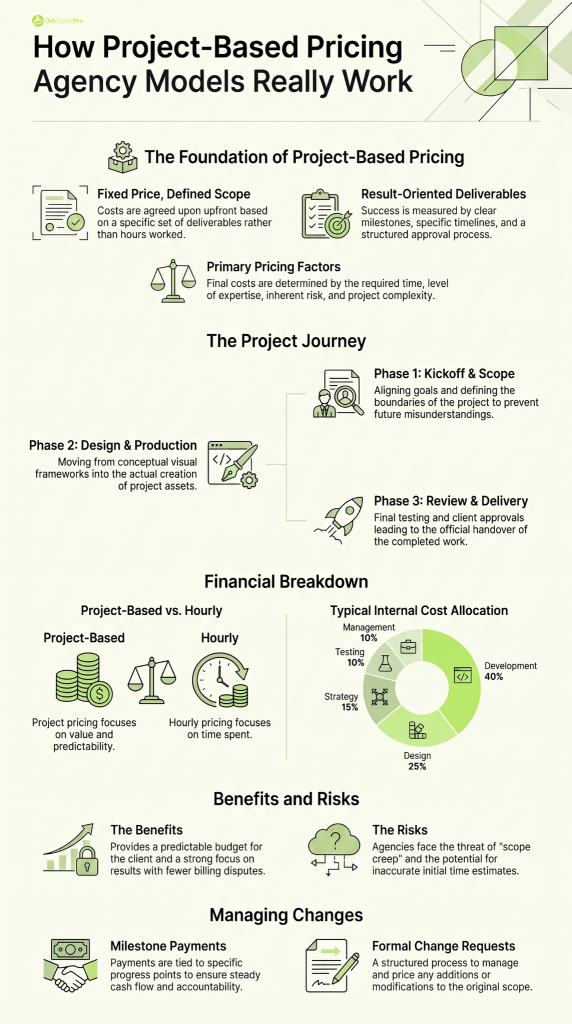
Project-based pricing is a pricing model where a client pays one agreed price for a specific project. The price stays the same as long as the project remains within the agreed scope.
Need SEO content that actually ranks? We write data-driven articles designed to bring organic traffic to your site.
See Our SEO Writing Plans →Unlike hourly billing, this model focuses on the final outcome instead of the number of hours spent completing the work. Both sides know the total cost before work begins, making budgeting much easier.
Many agencies use more than one pricing model depending on the type of work. According to the Agency Management Institute, nearly half of agencies combine different pricing methods based on each engagement. That makes sense because every project has different goals, timelines, and levels of complexity.
At JetDigitalPro, we choose project-based pricing when the work can be clearly planned from the beginning. A detailed scope helps reduce surprises and gives both our team and our clients a shared understanding of what will be delivered.
How Project-Based Pricing Works
A successful fixed-price project begins long before the proposal is signed. Most of the work happens during planning.
First, both sides discuss the project’s goals. This includes understanding what the client wants to achieve, what deliverables are needed, and when the project should be completed.
Next comes the project scope. This document explains exactly what is included and what is not. A good scope often covers:
- Project objectives
- Deliverables
- Timeline
- Revision limits
- Client responsibilities
- Payment schedule
After the scope is approved, the agency calculates the project price. That price usually considers estimated labor, required skills, project risk, software costs, overhead expenses, and a reasonable profit margin.
Once everyone agrees, work begins.
If new requests come up that were not part of the original agreement, they are usually handled through a change request instead of being added at no extra cost. This keeps the project organized and protects both parties from misunderstandings.
When Project-Based Pricing Makes Sense
Project-based pricing works best when the work can be defined clearly before production starts.
Some common examples include:
- Website redesigns
- Landing page development
- Brand identity projects
- SEO audits
- Content writing packages
- Marketing strategy documents
- Logo design
- Email campaign creation
These services might help customers to understand how agencies manage their pricing and packages.
These projects usually have clear deliverables and measurable completion points.
On the other hand, some work is harder to predict. Ongoing SEO, continuous content production, paid advertising management, or long-term consulting often change from month to month. In those situations, a monthly retainer or hourly billing may provide more flexibility.
Choosing the right pricing model depends on how predictable the work will be.
Benefits of Project-Based Pricing
Both agencies and clients can benefit from fixed-scope pricing when expectations are clear.
Easier Budget Planning
Clients know the total investment before work begins. There is no need to estimate weekly hours or wonder how much the final invoice will be.
Research from Joe O’Mahoney shows
“Clients often prefer a higher fixed price over a variable, lower price due to the certainty it provides. This phenomenon is known as the “Taxi Meter effect,” where the anxiety of an unknown, ever-increasing cost outweighs the potential for savings.” – Joe O’Mahoney
Better Focus on Results
Because payment is tied to the completed project instead of time spent, the conversation stays focused on deliverables and outcomes.
Fewer Billing Questions
Hourly invoices often raise questions about time entries. Fixed pricing removes many of those discussions because the agreed amount is already known.
Better Internal Planning
Agencies can schedule designers, writers, developers, and project managers more efficiently when the work has a defined scope.
Encourages Efficiency
Experienced teams often complete projects faster over time. Under a project-based model, improving internal processes benefits both the agency and the client without changing the agreed price.
Challenges to Consider
Project pricing is not without risks.
The biggest challenge is scope creep.
Scope creep happens when additional work is added after the project has started without adjusting the budget or timeline. Small requests may seem harmless, but several minor changes can quickly become a large amount of extra work.
Another challenge is inaccurate estimating.
If an agency underestimates the effort required, the project may take much longer than expected. That reduces profitability and can place unnecessary pressure on the team.
Communication also matters.
If deliverables are not clearly defined, both sides may have different expectations about what the finished project should include.
These challenges can usually be managed through careful planning, detailed documentation, and regular communication.
Project-Based Pricing vs. Hourly Pricing
The right pricing model depends on the project rather than one approach being better than the other.
| Feature | Project-Based Pricing | Hourly Pricing |
| Cost | Fixed upfront | Changes with hours worked |
| Scope | Clearly defined | More flexible |
| Budgeting | Easy to predict | Less predictable |
| Best for | Defined projects | Changing work |
| Billing | Per project | Per hour |
| Changes | Through change requests | Added billable hours |
Many agencies use both models because different types of work call for different approaches.
For content-focused projects, different agency pricing models can also reflect the level of research, writing, optimization, and ongoing SEO support included in the engagement.
How to Price a Project Accurately?
Pricing a project is where things can get tricky. Too high, and you risk losing the client. Too low, and the work becomes stressful and unprofitable.
A solid pricing process usually starts with breaking the project into parts. Each part is estimated based on effort, time, and skill needed.
At JetDigitalPro, we often look at three main factors:
- Time required to complete each task
- Level of expertise needed
- Risk or uncertainty in execution
Then we map those into a total cost estimate. It’s not just math. Experience plays a big role here too.
Some agencies also add a buffer to handle unexpected work. This helps protect the project from going over budget when small changes appear.
Key Factors That Affect Pricing
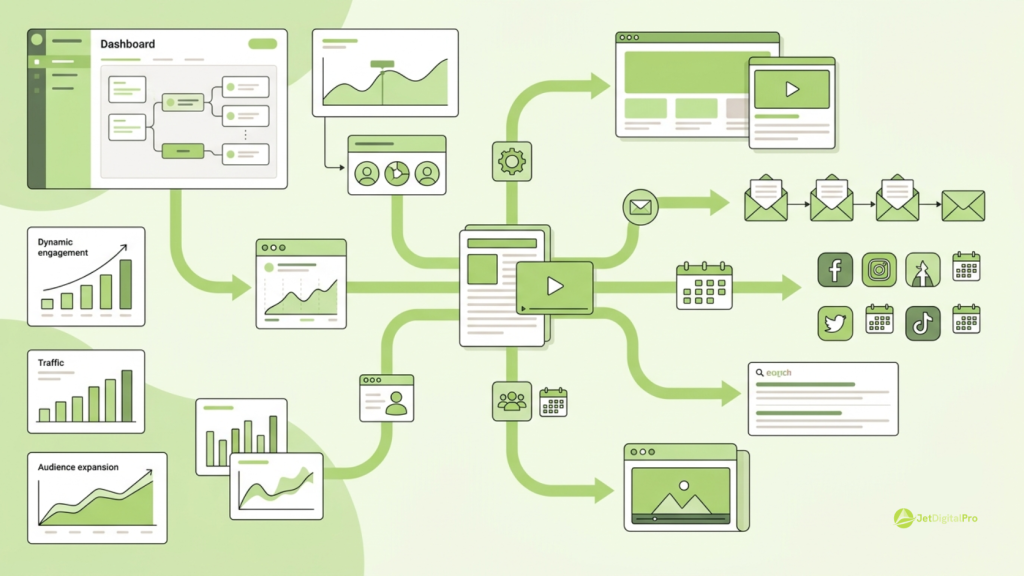
Different projects can vary a lot in cost. Even if two projects look similar on the surface, the details often change everything. Many of these pricing factors influence the final project quote, especially when agencies evaluate complexity, timelines, and resource requirements.
Here are some common factors:
- Project complexity
- Number of revisions
- Client response time
- Technical requirements
- Size of the team involved
- Deadline urgency
A tight deadline usually increases cost because it requires faster work and more focused resources.
Simple Pricing Breakdown Example
Here’s a simplified example of how a project budget might be structured:
| Cost Component | Description | Example Share |
| Strategy & Planning | Research and setup | 15% |
| Design | Visual layout and UI work | 25% |
| Development | Building the actual product or site | 40% |
| Testing | Fixing bugs and checking quality | 10% |
| Project Management | Coordination and communication | 10% |
This is not fixed for every project, but it helps show how budgets are often distributed behind the scenes.
How Agencies Manage Fixed-Scope Projects?
Once pricing is set, the focus shifts to execution.
A clear workflow helps keep everything on track:
- Kickoff meeting
- Scope confirmation
- Design or planning phase
- Production work
- Review and feedback rounds
- Final delivery
Each step has its own checkpoints. This reduces confusion and keeps progress visible.
As noted by SAGE Journals
“A key advantage of fixed-price contracts is that the implementation risks to the client are negligible; the risks are transferred to the contractor.” – SAGE Journals
At JetDigitalPro, communication is kept consistent throughout the project. Regular updates help avoid surprises and give clients a clear view of progress.
Handling Changes Mid-Project
Changes are normal. Very few projects stay exactly the same from start to finish.
The key is how those changes are handled.
If something is outside the original scope, it is usually handled in one of two ways:
- Adjust the timeline
- Add a change request with updated pricing
This keeps the project fair and balanced for both sides. Without this structure, small changes can quietly grow into larger issues.
Why Do Clients Often Prefer Fixed Pricing?
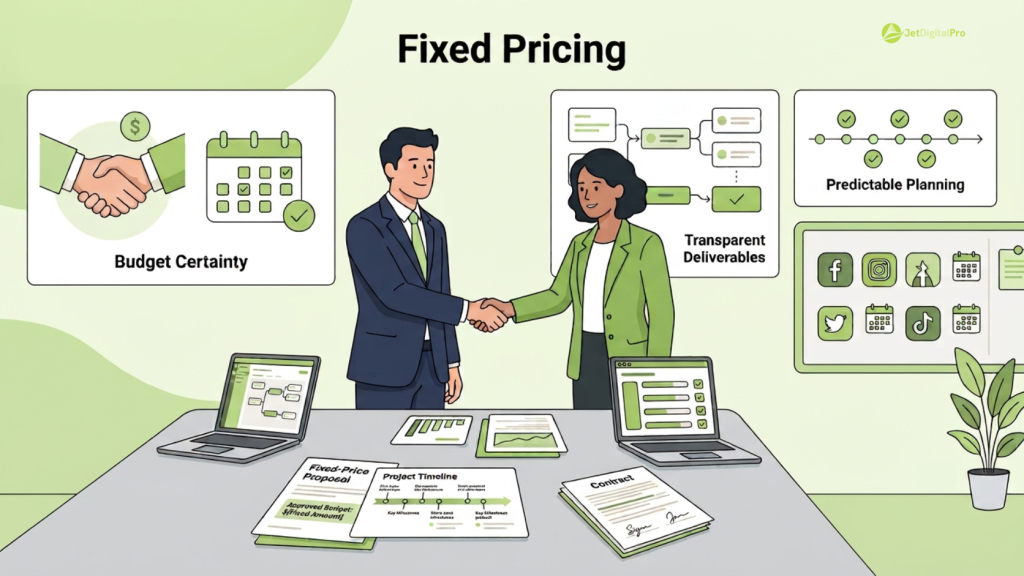
Many clients prefer project-based pricing because it feels predictable. They know the total cost before work begins, which makes planning easier.
It also reduces stress. There are no ongoing calculations or surprise hourly bills.
Most importantly, it keeps the focus on results instead of tracking time.
That shift alone changes how conversations happen during the project.
Common Mistakes to Avoid
Even with a strong system, mistakes can happen.
Some of the most common include:
- Vague project scope
- Missing revision limits
- Underestimating time
- No buffer for changes
- Poor communication during execution
Each of these can be avoided with better planning upfront.
One mistake stands out more than others: unclear scope. That one issue alone can affect cost, timeline, and final quality.
When Project-Based Pricing May Not Fit?
Not every project works well with fixed pricing.
It may not be ideal when:
- Requirements change often
- Work is ongoing with no clear end
- Scope is not fully defined
- Experimental or research-heavy work is involved
In those cases, flexible models like retainers or hourly billing may work better.
Choosing the right model is less about preference and more about how predictable the work is.
FAQ
How do I compare fixed fee agency pricing with hourly billing?
Fixed fee agency pricing works best for projects with clear goals, timelines, and deliverables because the total cost is agreed upon before work begins. Hourly billing is more suitable when the scope may change during the project. Comparing hourly vs project pricing helps you choose the option that best matches your budget, timeline, and project requirements.
What should I check before accepting an agency pricing proposal?
Before accepting an agency pricing proposal, review the project scope, deliverables, timeline, payment schedule, revision limits, and responsibilities for both parties. Confirm that the agreement explains how additional work will be handled through change request pricing. A detailed proposal helps prevent misunderstandings, reduces project delays, and gives everyone clear expectations from the start.
Can project cost estimation change after a project starts?
Yes. Project cost estimation can change if the project scope expands or new deliverables are requested after work begins. In these situations, the agency may adjust the fixed project cost by issuing a change request with updated pricing. Clearly defining the project scope before work starts helps reduce unexpected costs and pricing changes.
Are milestone based payments a good option for larger projects?
Yes. Milestone based payments divide the total project cost into scheduled payments based on completed phases, such as planning, design, development, and final delivery. This payment method helps both parties monitor progress and manage cash flow. Combining milestone payments with a project completion payment also creates clear expectations throughout the project.
How can small businesses choose the right project pricing structure?
Small businesses should compare the project pricing structure, deliverables, timeline, and included services before selecting an agency. Instead of choosing the lowest quote, evaluate whether the proposal matches your business goals and expected results. For project pricing for small businesses, custom project pricing often provides better value because it reflects the actual scope and project requirements.
Keep Your Projects Simple From the Start
When a project lacks clear direction, it’s easy to deal with delays, changing costs, and extra work that no one planned for. That gets frustrating fast. Clear project pricing helps you know what to expect, so you can stay focused on getting the results you want.
JetDigitalPro makes fixed scope projects easier with clear planning, defined deliverables, and steady communication. If you’re ready to start your next project with a simple, reliable process, contact JetDigitalPro today.
References:
- https://joeomahoney.com/pricing-advices-for-ambitious-consultancies/#content
- https://gas-dd.sagepub.com/lp/sage/from-the-editor-UcnPiygIIY
Related Articles:
- https://jetdigitalpro.com/factors-affecting-agency-pricing/
- https://jetdigitalpro.com/seo-agency-pricing-and-packages/
- https://jetdigitalpro.com/seo-content-agency-pricing-models/
Stop Guessing. Start Ranking.
Get a free sample article written for your niche. See the quality before you commit.
Get Your Free Sample Article →No credit card needed • 100% tailored to your niche