

Written by Nell · Interviewed: Chris M. Walker, CEO at Legiit · May 2026 · 5 min read
Chris M. Walker bio: Walker has spent over a decade in the link-building trenches, building authority for clients across competitive verticals.
We write SEO articles that rank on Google — so you can focus on your business.
See Writing Plans →Walker sequences link campaigns by front-loading no-follow signals before scaling into guest posts and niche edits, an approach he says most agencies skip entirely. Their work spans organic SEO, AI citation optimization, and entity-building across the full digital ecosystem.
The Person Who’s Watched Link Building Survive Every “Death” Announcement
Most SEOs talk about link building in the past tense, something Google used to reward, something AI is finishing off. Walker doesn’t. They’ve watched enough algorithm shifts, enough AI overview rollouts, and enough chatbot hype cycles to know that the fundamentals don’t disappear. They just get harder to see.
What makes Walker’s perspective worth paying attention to isn’t a title. It’s pattern recognition built from actually doing the work, sequencing link campaigns, watching what sticks, and identifying which sources AI-generated answers are citing. That last part is where things get interesting in 2026.
What the Link Building Industry Won’t Tell You Right Now
- AI overviews and chatbots “killing” links. They still cite sources. Those sources are still links. The game shifted; it didn’t end.
- Relevance is the north star of link building. Authority has quietly overtaken it, and sites like Forbes are ranking for terms they have no business owning.
- Spraying links and hoping. This is still the dominant agency strategy, and it’s costing clients real money.
- Building just a website. Google now needs to understand your entity across the entire web, not just your domain.
- The mindset that survives. Consistent, diversified effort across every surface where your brand can exist.
The Citations Inside AI Answers Are Just Link Building With a New Name
When the question came up about whether link building still moves the needle in a world of AI overviews and chatbots, Walker didn’t hesitate. The answer, they said, was almost obvious once you look at the screen.
“If you go to an AI overview, and you see these, you can see the sources, and those are still links.” The delivery was matter-of-fact, not defensive, not evangelical. Just someone pointing at something everyone else is apparently choosing not to see.
Need SEO content that actually ranks? We write data-driven articles designed to bring organic traffic to your site.
See Our SEO Writing Plans →What’s changed isn’t whether links matter. It’s about which links matter and how you go about acquiring them. Editor’s note: AI systems still need to cite something, and Walker’s observation implies that citations reward sites with existing link authority.
Walker’s team has operationalized this directly: “We go, and we find those links, like we look in at the sources and we try to either get links in those specific posts or at least on those specific sites, and that’s worked really well for us.”
“The citations are what really matter the most.”
Relevance Is Losing to Authority, and Most Agencies Haven’t Caught Up
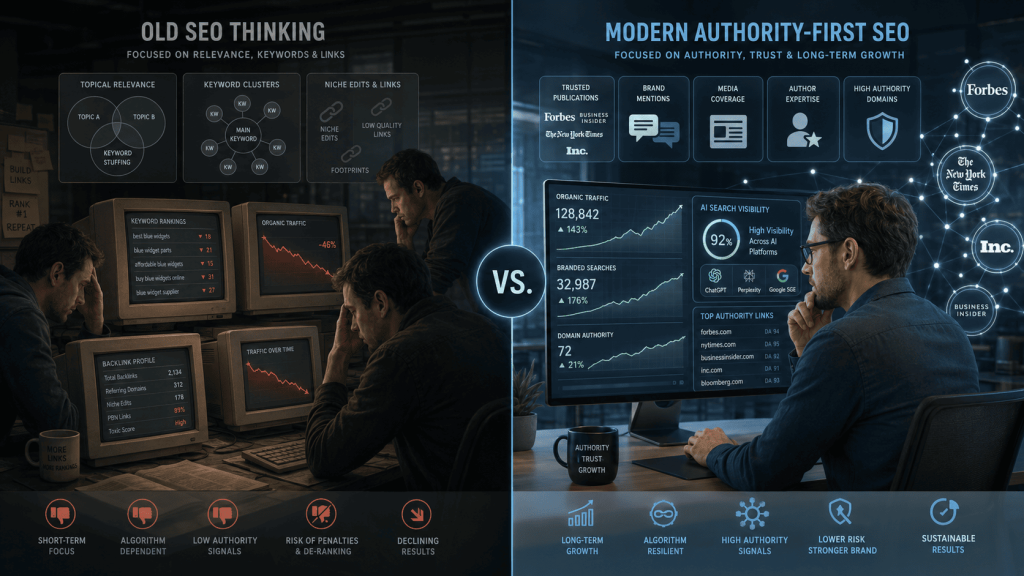
One shift Walker flags, though he frames it as a strong read rather than hard data: relevance, once the counterweight to raw domain authority, has been losing ground.
“I feel like relevance is actually less important than it used to be.” They pushed further: “It used to be that relevance and authority were competing, and now I don’t think you can really make an honest case for relevance being as important as authority when a site like Forbes or whatever it is this week can rank for a term like best boxing gloves over a really relevant boxing glove site.”
This has real consequences for how link campaigns should be built. If a tangentially related high-authority site beats a hyper-relevant lower-authority one in the SERPs, then chasing niche-exact links at the expense of authoritative placements is a losing trade. The implication: “Authority gets more and more important, and relevance gets less and less important.”
This isn’t just a tactical note. It’s a strategic reorientation. Agencies still selling clients on “relevant niche links only” as a quality signal may be optimizing for a version of Google’s algorithm that’s already moved on.
“I don’t think you can really make an honest case for relevance being as important as authority.”
The Biggest Waste of Money in Link Building Is Still the Most Common Service Being Sold

When the conversation turned to what agencies get wrong, Walker didn’t reach for diplomatic language.
“It’s really low-quality agencies that don’t know what they’re doing, and they just want to fire links at something and hope they get rankings.” The point landed with some heat.
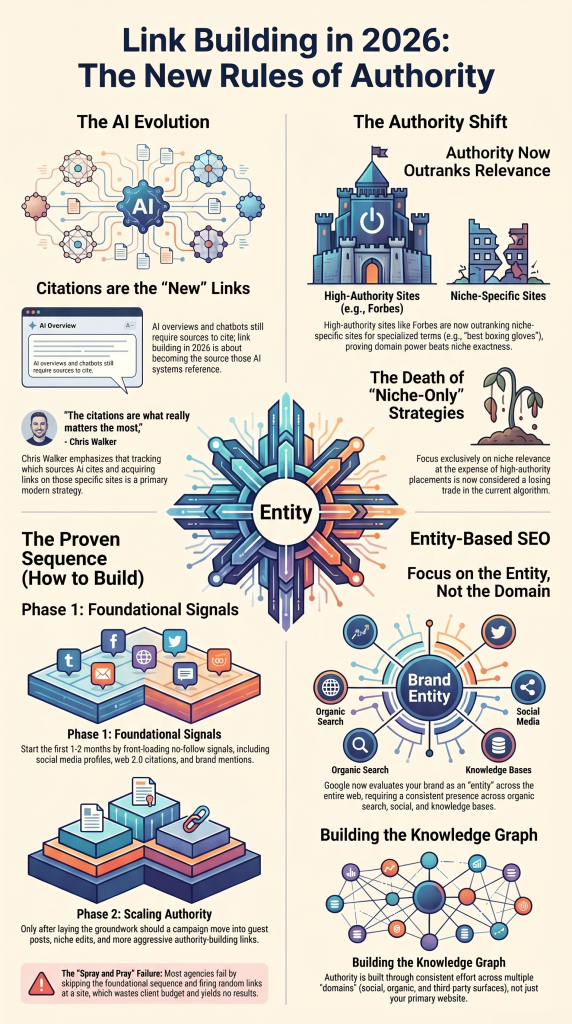
Walker’s own approach runs opposite to this. The first month or two of any campaign is deliberately heavy on no-follow signals: “web 2.0 citations, social media profiles, and so on.” Only after that groundwork is laid does the campaign scale into guest posts, niche edits, and PBNs. The sequencing matters. Most agencies skip it entirely.
“They just throw a bunch of links at something and hope that they can get results, and it’s really, it’s really kind of pathetic, to be honest, that they offer these kinds of services and take people’s money, and they have no idea what actually works.”
That’s a direct line, the kind the industry doesn’t often say out loud.
“They have no idea what actually works.”
Building Authority From Scratch in 2026 Means Thinking Beyond Your Website
The final question, what one piece of advice would you give a business building real authority from scratch, produced the answer that reframes everything else in the conversation.
It’s not about your website. Not anymore.
“I realized that it’s gonna take time and consistent effort across multiple domains. And when I say domains, I don’t mean website domains. I mean social, across organic, across everywhere, and building up the knowledge base and the knowledge graph so that Google understands your entity.”
Reading between the lines: this is the shift that makes the rest of the interview land differently. Link building isn’t just about moving link equity to a URL. It’s about training Google’s understanding of what your brand is, what it stands for, and where it appears. Social profiles, citations, web 2.0 properties, and guest content aren’t just link sources. They’re signals that build entity recognition.
“Spend as much time building out the brand and focus, don’t focus just on the website like we used to be able to do.”
In a world where Google’s understanding of your brand extends beyond your website, Walker argues this is the mindset that scales.
“Don’t focus just on the website like we used to be able to do.”
Want to build a link strategy that actually sequences correctly? Chris and their team handle everything from entity-building foundations to high-authority placements. Start at Legiit.
Stop Guessing. Start Ranking.
Get a free sample article written for your niche. See the quality before you commit.
Get Your Free Sample Article →No credit card needed • 100% tailored to your niche
