


Keyword research is how you listen before you write. You’re not chasing clever phrases, you’re tracing the exact words people reach for when a problem finally feels sharp enough to fix. Those searches show you what they’ve tried, what they don’t understand yet, and how ready they are to act.
When you build content from that language, it doesn’t feel like a pitch, it feels like someone finally put their thoughts in order. Over time, this turns scattered visits into steady, search-led demand. If you want that kind of base for your content, keep reading.
We write SEO articles that rank on Google — so you can focus on your business.
See Writing Plans →Key Takeaways
- Start with your business core, not a tool’s suggestions.
- Prioritize keywords based on clear commercial intent.
- Group keywords into thematic clusters for greater authority.
The Foundation is Your Own Business

We start where the work is closest to the ground: our own services and our own customers. Before opening any software, we ask simple, practical questions. What problems do we solve every week? What keeps coming up on sales calls?
From there, we build a list of seed keywords, those broad, steady terms that define our corner of the market, like “white-label SEO content” or “agency blog writing.” They’re not clever, they’re just accurate. This reflects how SEO writing services work by grounding keyword research in real business needs rather than guesses.
This list matters because it’s pulled from lived experience, not random guesses from a tool. We read through old proposals, support threads, and our own service pages, watching for phrases that repeat.
The point is to catch the real vocabulary of our niche, the way people actually talk when money and deadlines are involved. Only after that do we bring in tools to stretch, test, and grow this base. Tools should help you see more, not tell you who you are.[1]
Sources for seed keywords:
Need SEO content that actually ranks? We write data-driven articles designed to bring organic traffic to your site.
See Our SEO Writing Plans →- Client sales calls and support questions
- Core service pages and past project descriptions
- Competitor service offerings (analyzing their focus)
Expanding the Universe of Possibilities
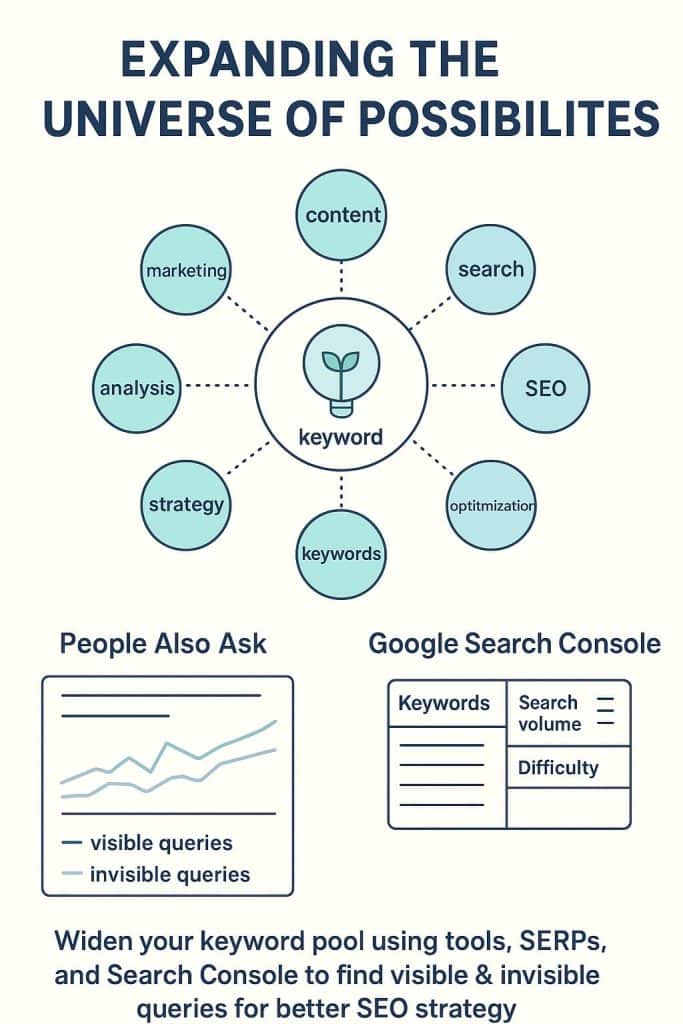
Once the seed terms feel solid, we start widening the circle. Now the tools and SERPs earn their place. We plug those core phrases into keyword tools and study what spins out around them.
On Google, we pay close attention to “People Also Ask” and the “Related Searches” at the bottom of the page, because those lines often read like half-finished thoughts from real people. This thorough approach aligns with quality assurance SEO writing practices, ensuring the content matches genuine search intent.
At the same time, we open Google Search Console and check which queries already bring visitors to our site. That view shows us where we’re visible and where we’re still invisible. Maybe we show up for “blog writing service” but miss “scalable content for agencies,” even though it’s the same type of buyer. During this stage, we don’t filter too hard.
We collect variations, odd phrasings, long questions and everything. Each keyword goes into a spreadsheet with basic notes like search volume and difficulty, so we can sort and prioritize with a clear head later.
The Art of Prioritization and Grouping
A giant keyword list looks impressive, but on its own, it won’t guide your work. This is where you start making choices. We sort every keyword against a simple lens: relevance, intent, and opportunity.
Relevance is the hard line, it has to connect directly to what you actually sell or support. Then we look at intent, searching for signs that someone is close to hiring or buying, like phrases with “service,” “pricing,” or “for agencies.”
Opportunity is where strategy and patience meet. Big-volume, high-competition keywords become long-term plays, the ones you chip away at over time. The near-term gains usually come from lower-volume, long-tail phrases with strong commercial intent, the kind of queries that sound almost like a brief.
Once we’ve ranked keywords through that lens, we group them into tight, topical clusters. All “link building” queries sit together, for example, forming the base for a focused content hub that tells Google, “we know this area well.”
This is how you grow topical authority on purpose. Instead of scattering 50 posts across 50 unrelated topics, you create about 10 or so that circle one pillar subject and its natural subtopics. That structure holds up better in modern search, it’s easier for users to follow and easier for search engines to understand.[2]
Criteria for prioritization:
- High relevance to core services
- Clear commercial or strong informational intent
- A workable balance of search volume and competition
Turning Data into a Content Engine

Once the list is shaped and grouped, the real work starts: translating keywords into a publishing plan. Each cluster becomes a mini project. The main pillar term turns into a deep, central guide, while the surrounding keywords become supporting articles, FAQs, or service pages.
Choosing the right structure for content also depends on selecting appropriate content delivery formats service to meet user needs across devices and contexts.
Internal links connect these pieces, so readers (and crawlers) can move naturally from broad overviews into sharper, more specific answers.
We also use these clusters to spot where we’re absent. If a competitor has a well-built hub around a theme we haven’t touched, that shows a gap we can plan around. The whole system runs in cycles, not sprints.
We track which pages attract the right visitors, which queries lead to calls or sign-ups, and then adjust the map accordingly. The keyword document shifts with that feedback, staying alive and tied to how the site and the business actually grow.
FAQ
How do I start the keyword research process when I’m new to this?
You can begin by using seed keyword selection to explore basic ideas, then try keyword suggestion tools for broader options. Look at search volume analysis, keyword difficulty metrics, and CPC keyword data to compare choices. Tools like Google Keyword Planner or Ubersuggest free tool help you see patterns so you can build a simple list without feeling overwhelmed.
How can I find content marketing keywords that match what users really want?
Start with user query analysis and check People Also Ask queries, related searches extraction, and autocomplete keyword ideas. These show what people actually ask. Use informational keywords, buyer intent keywords, and conversational keywords AI to shape topics. You can also track seasonal keyword trends or evergreen keyword selection to stay useful for readers over time.
What tools help me discover gaps that other sites already cover?
You can use competitor keyword analysis to see what others rank for, then try keyword gap identification or content gap keywords to find missing areas. Tools like Organic Research tool, Ahrefs Keywords Explorer, and Keyworddit Reddit keywords show real topics people follow. A long-tail keyword finder also helps you uncover smaller openings with less competition.
How do I group keywords so my site has a clear structure?
Try keyword clustering techniques and topic cluster planning to organize ideas. You can build pillar page keywords, cluster content keywords, and internal linking keywords to guide readers. Serpstat keyword clustering, Surfer SEO keywords, and Clearscope content optimization help shape pages. This structure keeps content simple, steady, and easy for search engines to understand.
How do I track keyword performance after I publish my content?
Use position tracking keywords and Organic Traffic Insights to see how pages change over time. Check Search Console data, Google Analytics keywords, and multi-region keyword data to compare regions. Look for voice search keywords, mobile keyword trends, and local SEO keywords to follow user habits. This routine improves your keyword prioritization matrix and future plans.
A Process for Sustainable Growth
Effective keyword research is the foundation of content delivery that actually drives results, not just impressions. It clarifies market demand, aligns your strategy with user intent, and positions your content as the most relevant answer.
At Jet Digital Pro, we use this framework to guide every project, ensuring each asset has purpose, direction, and measurable SEO impact for our agency partners. Ready to turn intent into outcomes? Let’s build your strategy at Jet Digital Pro
References
- https://landingi.com/wp-content/uploads/2024/11/78-Best-Digital-Marketing-Statistics-for-Marketers-in-2024_Landingi.pdf
- https://www.sistrix.com/ask-sistrix/seo-strategy/why-long-tail-keywords-are-important-for-seo-success/
Related Articles
- https://jetdigitalpro.com/how-seo-writing-services-work/
- https://jetdigitalpro.com/quality-assurance-seo-writing/
- https://jetdigitalpro.com/content-delivery-formats-service
Stop Guessing. Start Ranking.
Get a free sample article written for your niche. See the quality before you commit.
Get Your Free Sample Article →No credit card needed • 100% tailored to your niche