

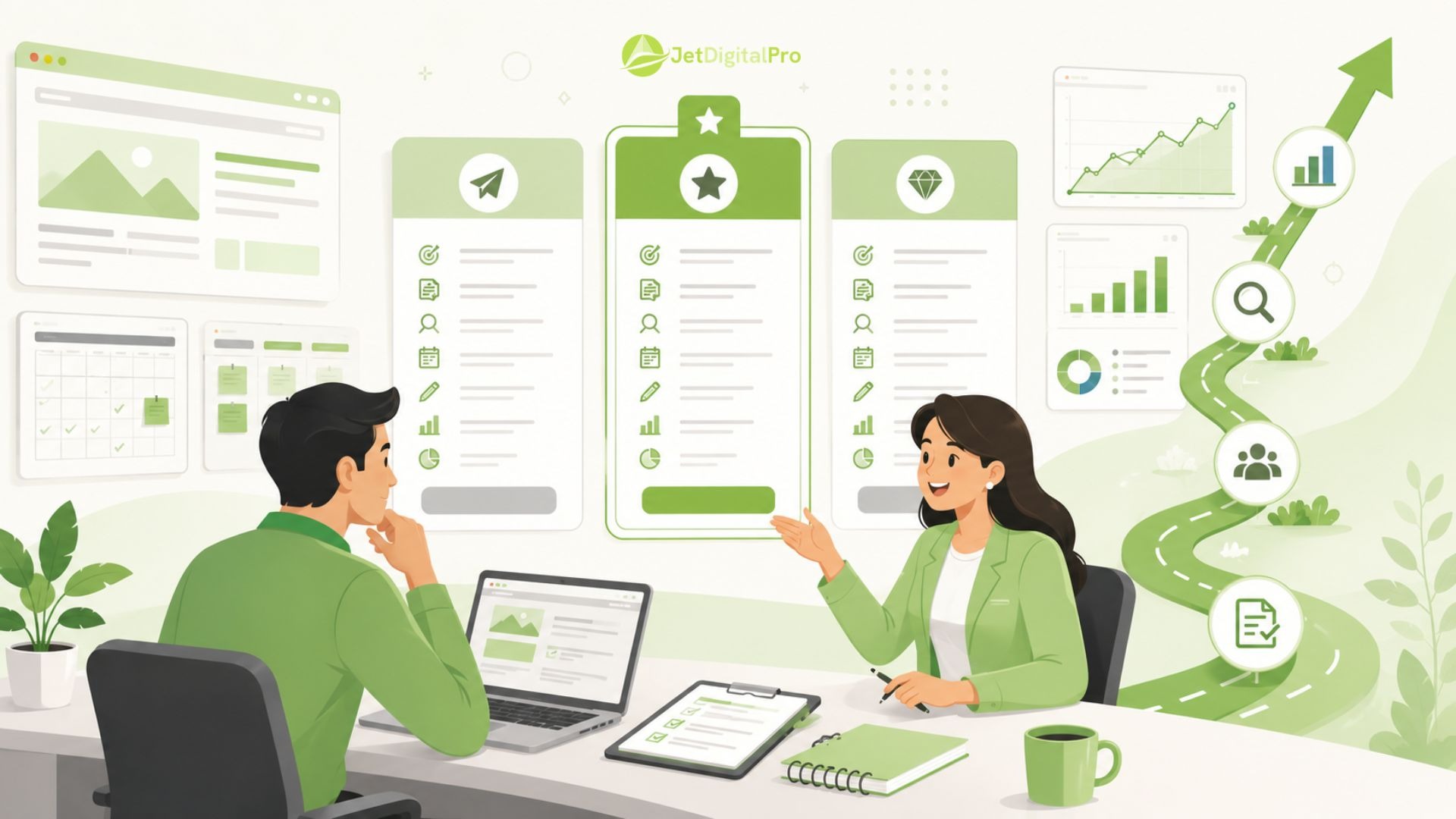
Learn how to evaluate agency content packages by focusing on strategy, SEO, human editing, AI, and measurable business growth instead of content volume alone.
Hey, welcome to this explainer. Let’s crack the code on picking a content package that drives actual long-term growth.
We write SEO articles that rank on Google — so you can focus on your business.
See Writing Plans →When you hire an agency, are you just buying words? Stop buying random puzzle pieces. A great content package is a complete marketing system that consistently improves over time. Think of it like an engine that combines strategy, content creation, and SEO into one predictable monthly process.
Everything starts with strategy. You need to understand your audience, target the right keywords, and identify opportunities to outperform your competitors before any content is written.
Execution then brings that strategy to life by connecting SEO articles, landing pages, and supporting content into one cohesive system. Different business goals require different approaches, whether you’re generating leads or building long-term brand authority.
Remember, you usually get what you pay for. Low-cost content packages often skip research and quality control, while premium services invest in experienced human editors who improve accuracy, clarity, and search performance.
The real measure of success isn’t page views or vanity traffic. It’s qualified leads, conversions, and revenue generated through content that supports your business objectives.
AI can speed up drafting, but it can’t replace strategic thinking or editorial judgment. The strongest agencies combine AI efficiency with experienced human editing to produce reliable, high-quality content.
Never overlook the statement of work. It protects both sides by clearly defining deliverables, deadlines, revision limits, and project expectations, helping prevent misunderstandings and costly delays.
When comparing agencies, don’t focus only on how many posts they promise each month. Evaluate their research process, editorial standards, SEO methodology, reporting, and how they measure results.
Ultimately, you’re not just purchasing content. You’re investing in a marketing system designed to deliver sustainable business growth. For example, Jet Digital Pro combines AI-assisted production with a rigorous 11-step human editing process, professional SEO, and transparent white-label reporting. If your content isn’t becoming a long-term business asset, it’s simply another expense.
An agency content package combines strategy, writing, SEO, and tracking into a single monthly payment. This system is built to help your business grow predictably. In fact, about 60% of marketing agencies now operate on this basis, because it works for long-term investment.
Monthly packages make it easier to plan topics, deliver work on time, and track results compared to separate, one-time projects. Let’s look at how a strategic package differs from a basic service, and how Jet Digital Pro builds marketing that grows.
What to Know About Agency Content Packages?
- Strategy should guide every deliverable before production begins.
- Strong agency content packages combine SEO, creation, distribution, and reporting into one workflow.
- Real business results, like new leads, sign-ups, and sales, matter much more than how many articles you publish.
What’s an agency content package?
It’s a monthly subscription for content marketing. You pay a flat fee each month for a set bundle of services, instead of getting a new bill for every single project.
We learned this lesson the hard way back in our early days when a client explicitly asked us, ‘Why am I paying for 4 separate blog invoices a month when my organic traffic is flatlining?’ They didn’t want piecemeal deliverables; they wanted an integrated system.
That change forced us to stop doing one-off jobs. Instead, we built a single dashboard that connects our keyword research directly to real sales tracking. That realization shifted our entire approach to content retainers.
The model is popular for a reason. A HubSpot report says 59% of agencies now offer retainer services. It gives clients a fixed budget to plan with, and lets agencies manage their team’s time without constant project turnover. Everyone follows one strategy.
One-off campaigns can’t keep up. What people search for and how they behave online changes. A monthly package lets you adjust your content as you go, which tends to work better over time than a single, isolated push.
Key benefits are straightforward:
- A consistent monthly cost.
- Reliable publishing dates.
- Smoother topic planning.
- Steady SEO gains.
- Regular check-ins on performance.
It helps to see how this monthly model differs from paying for projects one by one.
Why do agencies package services?
Packaging services is about stability for everyone involved.
For the agency, it means less time spent guessing at costs for each new task and more time actually doing the work, researching, planning, and refining content. For the client, it removes the monthly surprise. You know what you’re getting, what it costs, and when it will be done.
From our own work, we’ve found these packages make teamwork smoother. With a set plan in place from the start, everyone knows their job, when drafts are due, and how feedback will work. It cuts down on the back-and-forth and lets everyone focus on making the content better.
What’s the real difference?
Think of it like buying a cup of coffee versus signing up for a monthly coffee subscription.
A one-off project-based pricing project is a single purchase. You pay a flat fee, you get a specific thing, say, a website or five blog posts, and that’s the end of it. The job is to finish that task, hand it over, and move on. The relationship is usually over once the files are delivered.
A content package is more like that subscription. You pay a regular monthly fee for an ongoing service. The work isn’t done after the first batch goes live. Your writer or team sticks around, looks at what’s working (or what’s flopping), and adjusts the plan. It’s not about finishing one job; it’s about building something bigger over months or years, piece by piece.
Here’s the side-by-side:
Need SEO content that actually ranks? We write data-driven articles designed to bring organic traffic to your site.
See Our SEO Writing Plans →One-Off Project
- You get individual items.
- The price changes with each job.
- There’s little room for changes after delivery.
- The goal is short-term: get this thing done.
Content Package
- You’re buying into a long-term plan.
- You have a fixed cost every month.
- The work is constantly being refined.
- The goal is long-term growth.
The core difference is mindset. One is a transaction. The other is a partnership.
Why businesses choose content packages?

The main draw is momentum. A single post is an event. Regular posting builds a following. We see clients switch from ordering posts occasionally to a monthly plan. Their website changes. It stops being a random folder of files and starts to look like a guidebook, where everything connects.
For most owners, marketing is a huge source of anxiety. They don’t have the time or confidence to do it themselves. A package removes that burden. It’s a predictable system that delivers work on a schedule.
It fixes the big issues:
- Inconsistent posting becomes a reliable calendar.
- No marketing staff is solved by an outsourced team.
- No direction is forced by a long-term plan.
- No feedback is replaced with performance data.
The monthly fee isn’t a magic solution. You still need a strategy. But it transforms marketing from a series of frantic, one-time jobs into a calm, ongoing operation. That’s the real value.
What problems do these packages fix?
Most business owners underestimate the work behind a single blog post. It requires more than just typing. You must find a topic and research it. Then, you have to write, edit, and optimize the draft for Google. Finally, you must get approval, publish the post, and track its traffic. Managing all those separate jobs is a massive time drain.
A monthly package bundles that entire process. It’s far simpler than trying to hire a writer, an editor, and an SEO specialist separately.
This is exactly why we built our service the way we did. We don’t just deliver a finished article and disappear. We manage the workflow. We use smart software to gather data quickly. This tool gives our human strategy team a fully analyzed foundation to build upon.
We do the final editing, the actual blog writing, the on-page SEO setup, and provide white-label support. This combination lets us maintain a consistent brand voice and high quality, without letting anything slip through the cracks. It turns a chaotic, multi-step chore into one smooth, reliable operation.
What should a good agency content package include?
A solid package ties everything together: the plan, the creation, the fine-tuning, the sharing, and the tracking of results.
Data backs this up. Top marketers track their results closely. The Content Marketing Institute (CMI) reports that 84% of top-performing B2B marketers measure content performance. They do this to ensure their strategy matches their business goals. That matches what we see: just publishing stuff isn’t enough. You have to know if it’s working.
It all starts with a plan. Good packages begin with research, figuring out who you’re talking to, checking out competitors, mapping keywords, and understanding what people are actually searching for. An editorial calendar sets the schedule. Skipping this step usually means your content feels random and doesn’t attract visitors.
Then, you turn that plan into actual content that meets your goals.
A complete package will typically cover things like:
- SEO blog articles
- Landing pages
- Website copy
- Email campaigns
- Video scripts
- Updates to old content
- On-page SEO tweaks
- Internal linking
- Performance reports
Lock in your strategy before you produce any content formats.
Why is strategy the foundation?
Great writing with no plan is like building a house without blueprints. You might have nice bricks, but the whole thing will probably fall over.
Every successful campaign we’ve run began the same way. We had to answer three questions: Who are we talking to? What are they actually searching for? How will we know if this is working? The answers to those questions decided everything else, what we wrote about, where we posted it, and how we measured success.
The data backs this up. Research from the Content Marketing Institute shows that the most effective marketers overwhelmingly point to one thing: knowing their audience inside and out. The writing matters, of course. But the strategy comes first.
It’s the roadmap that tells you what to write, and who you’re writing it for. Insights from Quiet Corner Communications indicate.
“64% of successful content marketers have a documented strategy, but only 40% of B2B marketers actually have this critical documentation in place.” – Quiet Corner Communications
What belongs in execution?
Execution is where the plan hits the road. It’s taking your strategy and making actual things, content that moves the needle.
For most businesses, the power isn’t in one type of content. It’s in the mix. Think about a detailed guide you publish on your blog. That’s your anchor piece. Then, you can build around it:
- A short newsletter email that tells your list about the new guide.
- A simple landing page where visitors can download a related checklist in exchange for their email.
- A quick LinkedIn post giving your take on the guide’s main point, to build your reputation.
The behind-the-scenes work makes this system strong. You optimize the guide so Google can find it (that’s SEO). You link from your new guide to your older, related articles. This turns separate pieces into a connected web.
You’re building a path. Each piece of content is a step along the way, guiding a stranger from their first search to becoming a customer.
How is success measured?
You know you’ve succeeded when your marketing actually helps the business.
Forget likes and page views. The numbers that count show if your content is working. We track things like:
- Real prospects: Are readers turning into potential customers?
- Actions taken: How many visitors sign up, download, or buy?
- Google results: Do we show up when people search for what we do?
- More customers: Are we getting new clients consistently?
- Sales proof: Can we tie a sale back to a blog post or guide?
These metrics tell you if your content is just online decoration, or if it’s a real tool for growth.
Which content package fits your goals?
The best package for you depends on what you’re trying to do. Are you aiming for more search traffic, building your reputation, or generating leads? Each goal needs a different mix of content.
Trying to fit every client into the same box usually doesn’t work well.
Here’s a basic guide:
| Goal | Primary Deliverables | Best Fit |
| Organic growth | SEO articles, keyword research, site audits | SEO Package |
| Brand authority | Social content, videos, opinion pieces | Brand Package |
| Lead generation | Landing pages, email sequences, free guides | Demand Generation Package |
Certain tactics deliver massive returns. For example, email marketing generates $36 for every $1 spent. Because of this high return, we build email sequences directly into our core packages instead of selling them as expensive add-ons.
It’s also true that not every business needs a huge, complex plan. Small companies win by dominating one or two channels. Publishing consistently in a few places delivers better results than spreading your budget too thin across every platform.
How much should you expect to pay?
The price isn’t just for articles. You’re paying for everything behind them: the research, the writing quality, the SEO setup, the performance reports, and the strategy that are among the factors affecting agency pricing.
Industry numbers give us a ballpark. HubSpot says 45% of agency monthly retainers fall between $2,500 and $7,500. Costs rise if you need more complex strategy, expert knowledge, or content in different formats like video or email.
Here’s a general look:
Starter
- Typical Cost: $2,000–$5,000/month
- Best For: Small businesses
Growth
- Typical Cost: $5,000–$10,000/month
- Best For: Growing companies
Enterprise
- Typical Cost: $10,000–$25,000+/month
- Best For: Large organizations
Cheaper plans usually cut corners somewhere. That might be in research depth, editing time, SEO optimization, or reporting detail.
We see clients compare SEO agency pricing by numbers first, like “who gives me four blog posts?” But one agency’s four posts might come from days of research and planning. Another’s might be written fast to fill a quota.
That difference in how the work gets done affects your results far more than the simple count of published pieces.
Why cheap content packages disappoint?

They focus on quantity. To give you many posts for little money, they cut the planning that makes content work.
These deals promise “ten posts a month” for a low price. You get the posts, but not the important parts: no customer research, no keyword plan, and no report on sales or leads. Just a note saying it’s done.
Low-cost providers frequently rely on unedited, automated generation that lacks strategic depth, resulting in generic copy that fails to engage real buyers.
Data shows companies spending over $4,000 on a key piece are 2.6 times more likely to call their strategy “very successful” than those spending under $500. The higher cost buys the research and editing that get results.
Watch for these red flags:
- No written strategy.
- Pricing by word count only.
- Vague SEO promises.
- “Unlimited revisions” with no rules.
- Reports tracking only clicks, not sales.
Not all affordable options are bad. A small business might need simplicity. The key is whether the provider streamlined the process smartly, or just removed the strategy to cut costs.
How can you spot “AI slop”?
Look for content that feels familiar and shallow. The writing will repeat the same general advice you’ve read a hundred times. It won’t include unique examples or mention any real data or experts.
Often, it doesn’t even properly answer the question you searched for. You might also notice keywords awkwardly forced into sentences without adding any useful information.
Our workflow pairs robust research frameworks with an intensive 11-step human editing process to guarantee that every piece is authoritative and accurate. We believe speed is important, but not if it means being inaccurate, sounding generic, or skipping the research.
This approach lets us work fast for our clients while ensuring the final content is accurate, sounds like their brand, and is built to actually perform well in search results over time.
How can you prevent scope creep?
Clear rules, a written list of deliverables, and a set revision policy protect everyone.
We learned this early. Good projects can go off track without clear boundaries. A single out-of-scope request delays deadlines, wastes team resources, and distorts your performance data.
Data backs this up. HubSpot reports only about a third of agencies price based on value delivered. Many charge by the hour or per deliverable, making it hard to discuss scope after work begins.
The solution is a Statement of Work. This document spells out:
- What’s delivered (e.g., two blog posts).
- The publishing schedule.
- Rounds of revisions included.
- The approval process.
- What the client provides (like info or access).
- Frequency of performance reports.
We also ensure all client assets and information are ready before starting. This prevents delays.
What should every Statement of Work include?
Think of a Statement of Work (SOW) as a pre-game huddle. Its job is to stop arguments before they happen. You need a document that answers the questions people will definitely ask later.
A strong SOW covers these bases:
Timelines. Don’t just say “soon.” Give real dates. When is the first draft due? How many days do you get to review it? Lock it in.
Ownership. Assign people, not just roles. Who, by name, sends the background info? Who gives feedback? Who has the final yes-or-no?
Communication. Choose your weapon. Are you using email, Slack, or a project board? Pick one main method and stick to it.
Scope Boundaries. This is your force field. Clearly state what the work does not include. Explain what counts as a new request, which usually costs extra.
Putting this in writing protects both sides. It keeps the project on course and prevents sticker shock on the invoice. A good SOW means everyone is looking at the same map.
Why do intake requirements matter?
Making content is like building a model. If you don’t have all the pieces in the box, you can’t start. You’re stuck.
If we’re missing key things from you, your brand’s colors and fonts, the deep details on your product, a login to your website, or time with your main expert, everything stops. Dead stop. The whole schedule gets pushed back.
That’s why we get everything we need from you up front, before the first word is written. It’s a boring step, but it’s the one that makes everything else move fast. It keeps us from wasting days emailing “Can you send this?” and “Do you have that?” It’s how we actually hit our deadlines.
Should agencies sell deliverables or business outcomes?
The best partnerships don’t count blog posts. They measure results.
There’s a big shift happening right now. Agencies are stopping the sale of simple packages, like “four blogs a month.” They’re starting to sell what clients actually want: more people finding them online, a reputation as an expert, and better sales leads.
It’s logical. A company doesn’t pay for content just to fill up its website. It pays for content to grow.
Here’s how the focus changes:
Deliverable Selling: Four blog posts.
Outcome Selling: Organic search growth.
Deliverable Selling: Ten social posts.
Outcome Selling: Stronger brand authority.
Deliverable Selling: Monthly reports.
Outcome Selling: Pipeline insights.
Deliverable Selling: Content volume.
Outcome Selling: Business performance.
The data agrees. The Content Marketing Institute says 82% of top B2B marketers credit their success to understanding their audience. A plan works better than just making stuff.
We see it ourselves. When every piece of content has a job, to generate a lead, to answer a key question, the talk changes. You stop asking “how many?” and start asking “how much did we move the needle?”
What Is AI’s Real Impact on Agency Content?
AI acts like a turbocharger. It doesn’t steer, but it gives your content engine a serious boost.
Everything is faster now. Research takes minutes, not hours. A blog post draft appears instantly. Need ten social posts and an email from that? One click does it.
Early industry data shows that AI tools speed up the writing process. Marketing teams using AI can cut down drafting times significantly. They also lower their initial production costs by more than 30%.
That saved time goes to strategy. We spend less effort on writing, and more on planning the right message for the right audience.
Our daily uses are simple:
- Pulling data for reports.
- Outlining articles.
- Converting webinars to blogs.
- Basic grammar checks.
The problem? AI has no judgment. It gets facts wrong. It misses your brand’s voice and ignores recent customer feedback.
So a human reviews everything. We correct errors, fix the tone, and add strategic links or calls-to-action.
It’s not a competition. It’s a partnership. AI brings the speed. We bring the sense. That’s the only way to grow your content without wrecking its quality.
Why should reporting go beyond traffic?
Good reporting should show how your content investment leads to real business results.
Traffic numbers only tell part of the story. A page that gets thousands of visitors but no serious leads is less valuable than one that attracts fewer, but much more interested, potential customers.
For a long time, measuring content’s return was a big struggle. Research from the Content Marketing Institute showed only 39% of marketers felt successful at it. While reporting tools are much better now, knowing how to measure impact is still what separates okay content programs from great ones. Data from Onewrk demonstrates.
“Only 35% of B2B marketers have a documented content marketing strategy with clear success metrics. This means 65% are essentially flying blind, unable to prove the value of their content investments to leadership .” – Onewrk
We suggest tracking things that actually matter to your business, like:
- Qualified leads
- Conversion rate
- Customer acquisition cost
- Organic keyword growth
- Sales pipeline contribution
- Revenue attribution
Regular reports with this data also help you make smarter decisions. You can see which topics are actually working and deserve more focus, and which ones might need a rewrite or should be dropped.
How can you choose the right agency partner?
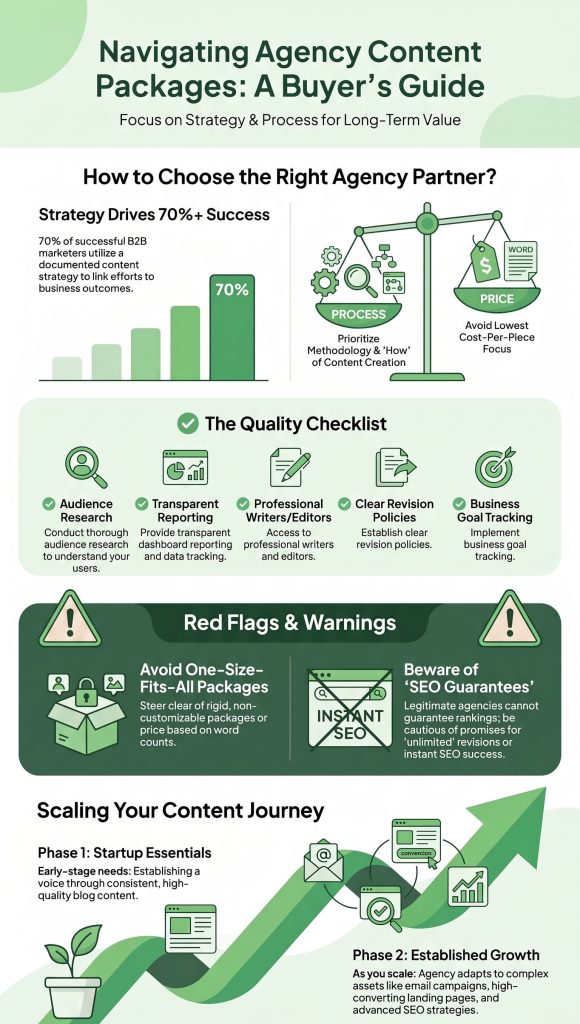
Don’t just shop for the lowest price. You’re buying a process.
Price matters, but it’s a bad way to decide. Annual research from the Content Marketing Institute consistently finds that the most successful B2B marketers are significantly more likely to possess a documented content strategy compared to their less successful peers. The method is what matters.
When comparing agencies, skip the pitch. Ask how they work.
- How do you research my audience?
- What will your reports actually show?
- Who writes and edits?
- What’s the revision policy?
- What business goals, like leads, will you track?
Watch for red flags. Avoid agencies with one-size-fits-all packages, word-count pricing, specific SEO guarantees, or “unlimited” revisions.
Your needs are unique. A new startup might need focused blog posts. An established company might need email, landing pages, and technical SEO.
The right partner solves your problems today and can adapt as you grow.
FAQ
How do monthly content packages maintain consistent quality over time?
Monthly content packages maintain quality by following a structured production process instead of rushing content. Reliable providers build comprehensive retainers that integrate strict editorial oversight, transparent workflows, and rigorous quality checks. They also review performance, edit every piece, and refine future content based on results. This approach keeps publishing consistent while maintaining accuracy, readability, and relevance for your audience.
What should businesses compare besides content package pricing?
Content package pricing should never be the only factor when comparing providers. Businesses should evaluate what deliverables are included, along with the project scope, turnaround times, revision allowances, and overall pricing structures. Comparing deliverables, revision policies, reporting, communication, and scalability provides a clearer picture of long-term value than focusing on price alone.
Which content formats should be included in custom content packages?
Custom content packages should include formats that support your marketing goals and audience preferences. Many businesses benefit from a mix of search-optimized blog posts, high-converting landing pages, targeted email campaigns, and engaging social copy. Others may also need video content packages, infographic content packages, or case study content packages to support different stages of the customer journey.
When should a business upgrade from affordable content packages to premium content packages?
A business should upgrade from affordable content packages when its content needs become more complex or competitive. Premium, enterprise-level retainers typically include advanced optimization, deep semantic keyword research, and detailed revenue-attribution tracking. These additional services help businesses improve search visibility, measure results, and support larger content marketing initiatives.
Can agency content packages be customized for different business sizes?
Agency content packages can be customized to match different business sizes, budgets, and marketing objectives. Retainers tailored for startups and small businesses generally focus on essential publishing schedules to generate steady baseline growth. Larger organizations often require multi-channel distribution strategies, coordinated campaigns, custom brand positioning, and highly flexible publishing volumes to support broader marketing strategies and larger publishing schedules.
Building content packages that last
The best packages connect strategy, writing, SEO, and reporting into one system. We help agencies scale with white-label content. Our process uses AI for speed, then puts every piece through 11 human editing steps. We handle writing, on-page SEO, link building, and management. You get consistent, high-quality output without the internal hassle.
Ready for white-label content you can trust to grow with your agency? Start with Jet Digital Pro.
References
- https://www.researchgate.net/publication/405699542_Customer_Engagement_Mediates_the_Effect_of_Content_marketing_on_Purchase_Intention
- https://www.researchgate.net/publication/400598756_Customer_engagement_mediates_the_effect_of_content_marketing_on_customer_retention_among_mie_sedaap_consumers_in_surabaya
Related Article
- https://jetdigitalpro.com/seo-agency-pricing-and-packages/
- https://jetdigitalpro.com/factors-affecting-agency-pricing/
- https://jetdigitalpro.com/project-based-pricing-agency/
Stop Guessing. Start Ranking.
Get a free sample article written for your niche. See the quality before you commit.
Get Your Free Sample Article →No credit card needed • 100% tailored to your niche