

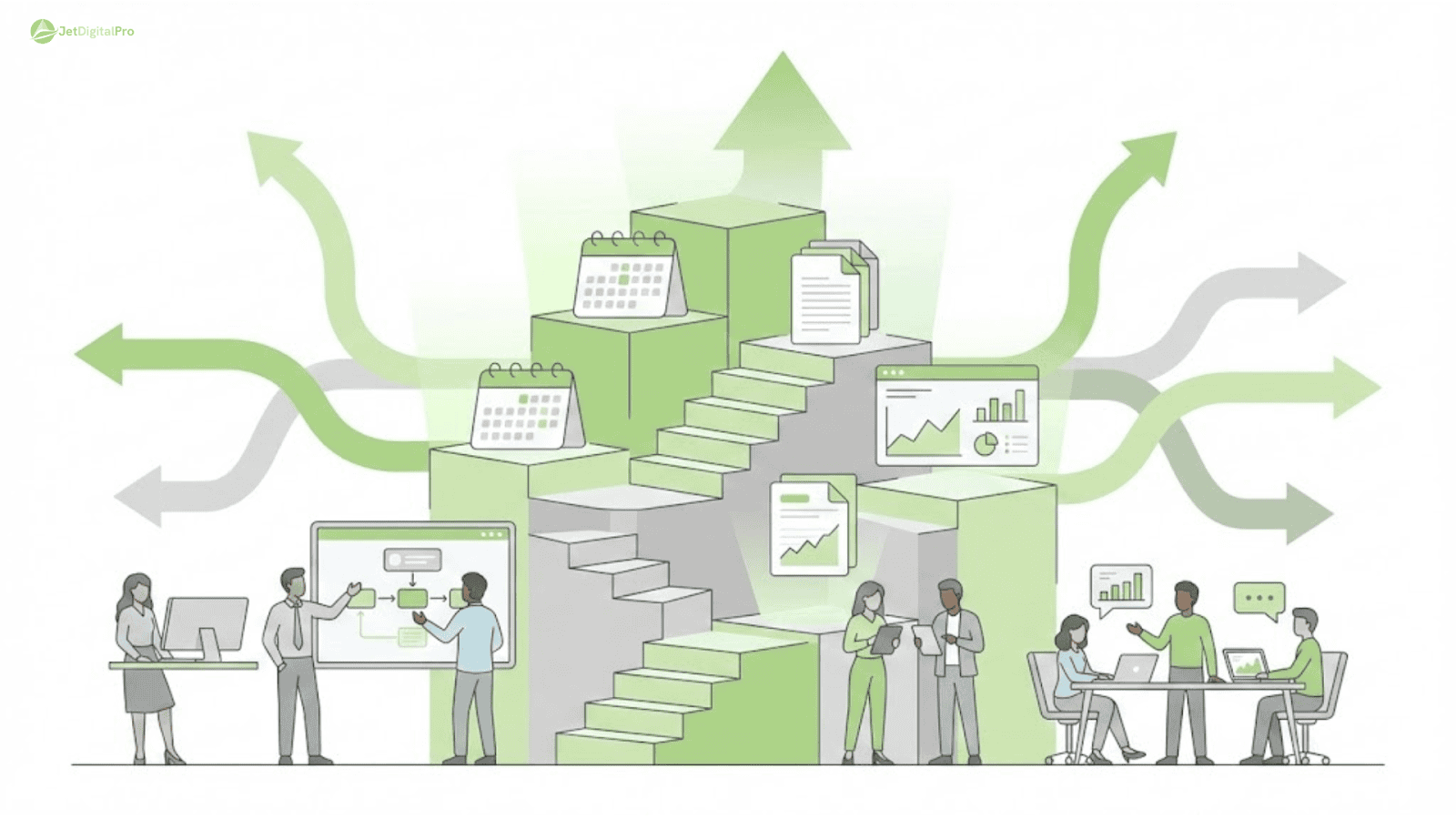

Scalability with a content agency means growing our client base and output without increasing costs or lowering content quality at the same rate. Unlike software, content work depends on people, process, and judgment. According to the Content Marketing Institute, most agencies struggle to grow past early traction because quality breaks before revenue catches up.
We have lived through that phase ourselves. In this guide, we share what actually works, based on first-hand experience scaling content operations for long-term stability. Keep reading if you want a clearer path to agency scaling without burning out your team or clients.
Key Takeaways
- Scalability depends more on systems than talent alone.
- Quality content can scale if processes remove repetitive tasks.
- Strategic partnerships quietly become the secret weapon for agency growth.
What Does Scalability Mean in a Content Agency Context?
Scalability in a content agency means increasing clients, content creation volume, and revenue growth without matching increases in cost or quality loss.
We learned early that scaling content is not about publishing more. It is about delivering consistent outcomes to a growing client base with fewer internal bottlenecks. Content agencies deal with non-homogeneous work.
Each target audience has different tones, formats, and client expectations. That variability creates pain points when team members rely on tribal knowledge instead of documented systems.
Scalability also ties directly to client retention rates. When quality drops, retention drops. When retention drops, revenue growth becomes fragile. That cycle hits fast if agency scaling is reactive instead of planned.
As Andrew Davis famously said, “Content builds relationships. Relationships are built on trust. Trust drives revenue”.
To stabilize long-term growth, we had to define scalability as operational calm. Fewer emergencies. Clear project management. Predictable delivery. That shift changed how we approached scalable content.
Here is how we frame scalable content internally:
- Clear content strategy tied to client demands
- Repeatable briefs that remove guesswork
- Quality checks that scale with volume
Scalability is not speed. It is control.
Why Is Scaling Harder for Content Agencies Than for SaaS Businesses?
To clarify why traditional SaaS growth models often fail for service-based businesses, we break down the differences below.
| Scaling Factor | Content Agency | SaaS Business |
| Core Product | Custom, client-specific content | Standardized software product |
| Scalability Driver | People, processes, and judgment | Code and infrastructure |
| Automation Level | Limited by creative variability | High and repeatable |
| Onboarding Effort | Manual and relationship-driven | Automated and self-serve |
| Quality Control | Human-led and process-dependent | System-led and predictable |
| Margin Behavior | Must be protected deliberately | Improves naturally with scale |
| Founder Dependency | Often high during early growth | Usually decreases over time |
Content agencies struggle to scale because services are custom, people-dependent, and variable, while SaaS relies on standardized products and automation. SaaS companies sell the same product to every customer.
Content agencies deliver unique outputs every time.
McKinsey research highlights that efficient growth is most correlated with value creation, a metric that service businesses must fight harder to maintain compared to top-quartile SaaS companies that achieve Net Revenue Retention (NRR) rates of 113%.
Every new client introduces new client expectations. Different approval styles. Different brand rules. Different social media goals. That variability limits automation.
Hiring also becomes risky. Writer performance varies widely, and onboarding drains senior time. We experienced quality scaling issues when we hired fast without tightening documentation.
Another challenge is founder dependency. In many marketing agencies, founders remain the final gatekeepers for quality content. That works at ten clients. It fails at fifty.
Key differences we see between SaaS and content agency scaling:
- SaaS scales code once; content scales people repeatedly
- SaaS onboarding is automated; agency onboarding is manual
- SaaS margins improve with volume; agencies must defend margins
Understanding this difference helped us stop copying SaaS growth playbooks that never fit content creation.
What Are the Biggest Operational Challenges When Scaling a Content Agency?
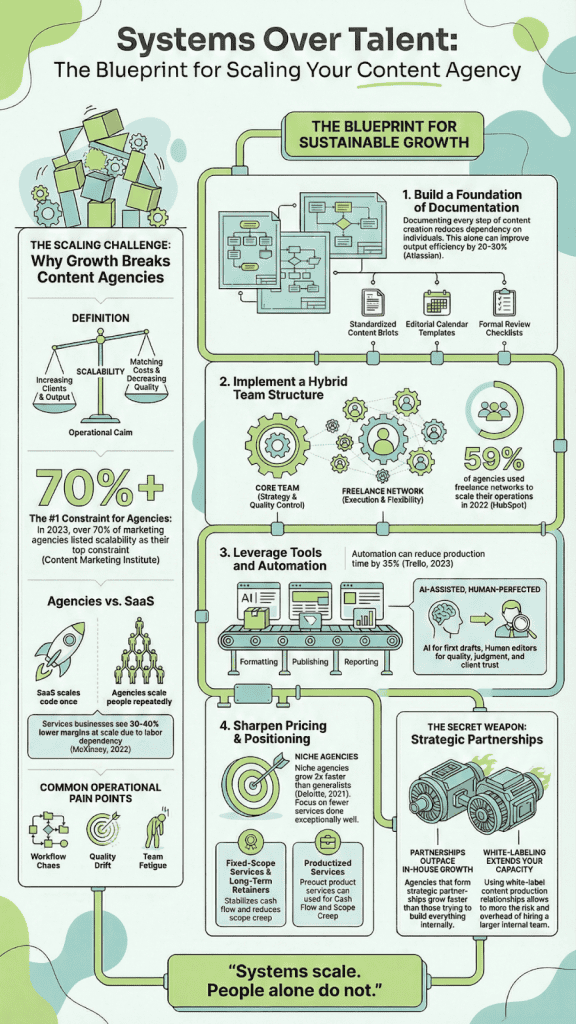
Alt text: Content agency scalability blueprint: This infographic outlines strategies for scaling a content agency, including documentation, hybrid teams, automation, and pricing models to optimize operations and productivity.
The main challenges are non-repeatable client requirements, hiring skilled writers, workflow bottlenecks, and maintaining quality under higher volume.
When our client base expanded quickly, we hit friction everywhere. Upwork data from 2021 showed writer hiring costs rise by 25% during growth phases. We felt that cost pressure immediately.
The first issue was workflow chaos. Without structured project management tools, content piled up in email threads. Deadlines slipped. Client satisfaction dropped.
The second issue was quality drift. As volume increased, editors focused on speed instead of standards. That damaged retention rates.
The third issue was team fatigue. Repetitive tasks consumed senior team members who should have been focused on content strategy and client relationships.
The most common operational pain points we see now include:
- Inconsistent briefs causing rewrites
- Manual reporting slowing account management
- Fragmented communication across team members
Each problem compounds as you scale your agency. Ignoring them early makes scaling exponentially harder later.

How Can Processes and Documentation Enable Scalable Content Production?
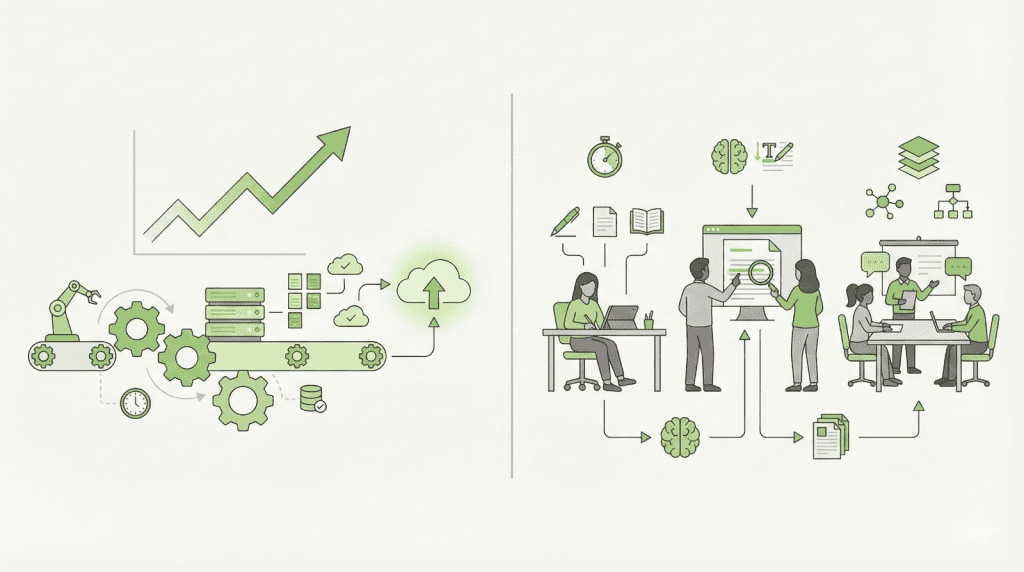
Alt text: Content agency scalability: This image showcases a comprehensive workflow for content creation and management, including data analysis, collaboration, and automated processes to enhance productivity and efficiency.
Documented workflows and templates reduce dependency on individuals and allow consistent delivery across teams as volume increases.
Teams that build strong agency expertise early are able to scale output without constant senior oversight. According to Atlassian, process documentation improves output efficiency by 20–30%. We saw similar gains once we stopped relying on memory and started relying on systems.
We began by documenting every step of content creation. From intake to publishing. Not in theory, but in real operational language that new team members could follow.
Templates became critical. Standardized briefs reduced editor feedback loops. Editorial calendars stabilized output across social media, blogs, and email marketing.
Documentation also improved client satisfaction. Clear processes set realistic timelines and aligned client expectations.
Our core process improvements included:
- Fixed content offerings with defined scopes
- Checklists for quality content review
- Clear handoffs between writers, editors, and managers
This shift allowed quality scaling without constant oversight.
Which Team Structures Support Sustainable Scaling in Content Agencies?
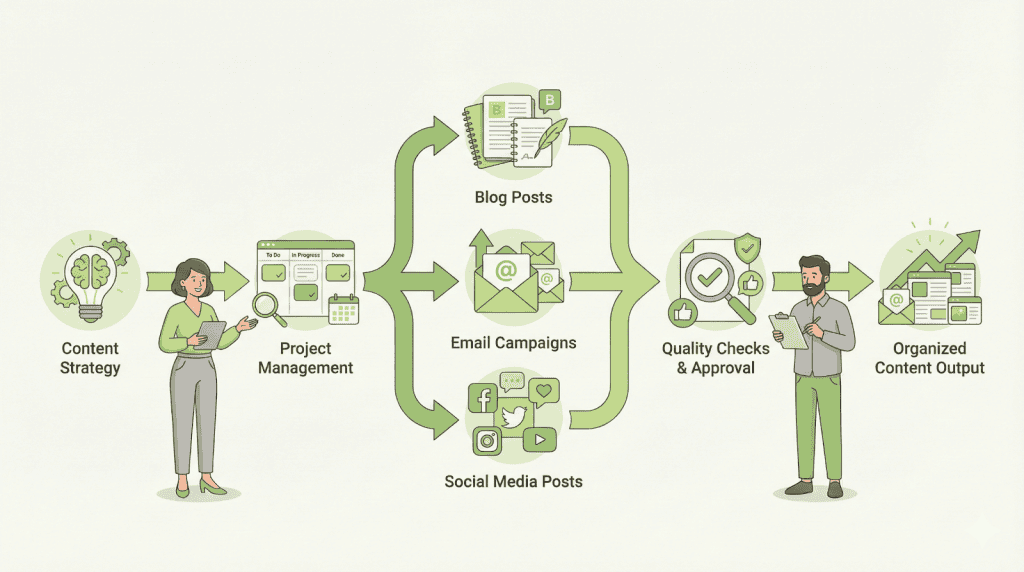
Alt text: Content agency scalability: This image illustrates a comprehensive content management workflow, encompassing strategy, project management, blog posts, email campaigns, quality checks, and organized content output.
Hybrid teams combining core staff with vetted freelancers offer flexibility, cost control, and faster scaling during demand spikes.
In 2022, 59% of agencies used freelancer networks to scale, according to HubSpot. We use a similar hybrid structure.
Core team members own strategy, quality control, and client relationships. Freelancers handle execution once processes are stable. This structure protects margins and delivery speed.
The key is not outsourcing blindly. Freelancers must work inside documented systems. Otherwise, quality becomes unpredictable.
We also learned to cap onboarding. Turning down work temporarily preserved client retention and team morale.
A sustainable team model usually includes:
- A small strategy-focused core team
- Flexible execution support
- Clear ownership for each client account
This structure allowed us to deliver exceptional work without overhiring.
How Do Tools and Automation Improve Scalability Without Reducing Quality?
Automation and AI tools streamline distribution, tracking, and first-draft creation, allowing teams to focus on editing and strategy.
35% production time reductions were reported in 2023 by teams using automation, according to Trello usage data. We experienced similar gains.
Automation helped us remove repetitive tasks like formatting, publishing, and reporting. That freed senior staff for high-value work and reinforced consistent quality across growing content volumes. AI-assisted drafting improved speed, but only when paired with human editing. Quality content still requires judgment.
At Jet Digital Pro, we built our workflow around this hybrid approach. We use AI to support scale, then human editors to protect quality and client trust. It allows scalable content without sacrificing standards.
Key tools we rely on include:
Are You a Digital Agency?
White Label SEO Content Services for Agencies
Scalable, customizable, and results-driven content solutions for your clients.
- Project management tools for visibility
- Editorial calendars for consistency
- Analytics tied to key performance indicators
Tools do not replace people. They protect them.
What Pricing and Positioning Strategies Improve Scalable Growth?
Productized services, niche positioning, and early price increases improve margins and make growth more predictable.
Deloitte research from 2021 showed niche agencies grow 2× faster than generalists. We saw this firsthand.
Clear service offerings reduce scope creep. Fixed pricing models reduce negotiation overhead. Both improve delivery confidence.
We also shifted toward retainers instead of one-off projects. That stabilized cash flow and improved client retention rates.
Strong positioning also attracts better-fit clients. When you position your agency clearly, client expectations align faster.
Effective scaling strategies often include:
- Fewer services done better
- Pricing that funds quality
- Long-term client relationships over volume
Growth without positioning is chaos.
What Real-World Patterns Show Successful Content Agency Scaling?
Agencies that standardize workflows and tools can scale rapidly without quality loss, even with custom services.
In one documented case shared by Content Marketing Institute, a mid-sized European agency scaled from under 5 clients to over 30 active brands while publishing more than 12,000 content pieces. The key was process audits and strict workflow discipline.
Another pattern we consistently observe is partnership-led scaling. Agencies that adopt a strategic approach to partnerships grow faster than those trying to build everything in-house.
White-label relationships quietly extend capacity, especially when agencies choose an SEO writing agency model over relying entirely on freelancers.
This reduces hiring risk and protects margins.That approach has supported our own scaling journey at Jet Digital Pro, especially for agencies needing flexible SEO content production without expanding internal teams.
The lesson is consistent. Systems scale. People alone do not.
FAQ
How does scalability with a content agency support long term revenue growth?
Scalability with a content agency helps manage client demands without hurting quality content. By refining pricing models, project management, and content offerings, a marketing agency can grow its client base steadily. This approach supports long term revenue growth, improves client satisfaction, and allows agencies to scale your agency without overwhelming team members.
Need a Strategic SEO Content Partner?
Let’s craft SEO content that ranks, converts, and grows your brand.
Talk to UsWhat pain points do agencies face when scaling content creation?
Common pain points include maintaining quality scaling, handling repetitive tasks, and meeting rising client expectations. As agency scaling progresses, team members may struggle with workload and consistency. Clear content strategy, better project management tools, and defined service offerings help reduce friction while scaling content and delivering exceptional results.
How can scalable content improve client retention rates?
Scalable content allows a marketing agency to serve a wider target audience while staying consistent. When quality content is delivered across content marketing, email marketing, and social media, client satisfaction improves. Meeting client expectations consistently strengthens client relationships, boosts client retention, and increases overall client retention rates over time.
What role does project management play in scaling your marketing agency?
Project management keeps content creation organized as client base and content offerings grow. Clear workflows, key performance indicators, and project management tools reduce errors and missed deadlines. This structure supports scaling your marketing agency, helps team members collaborate better, and ensures agencies deliver exceptional work even during rapid growth.
How do marketing agencies position themselves while scaling agency operations?
Marketing agencies position your agency by aligning marketing strategy with client demands and retention goals. Strong client relationships, strategic partnerships, and clear content strategy act as a secret weapon. By focusing on client satisfaction and scalable content, agencies can scale your agency smoothly while supporting sustainable agency scaling.
Scalability With a Content Agency: What Actually Lasts
Scalability with a content agency is not about shortcuts. It is about protecting quality while expanding responsibly. When systems, teams, and partnerships align, scaling becomes predictable instead of painful.
We have seen that long-term growth comes from disciplined execution, not hype. If you are ready to scale your agency with confidence, the right structure makes all the difference.
Start building your scalable content foundation at Jet Digital Pro.
Related Articles
- https://jetdigitalpro.com/agency-expertise-and-resources/
- https://jetdigitalpro.com/consistent-quality-from-agency/
- https://jetdigitalpro.com/strategic-approach-from-agency/
- https://jetdigitalpro.com/benefits-of-using-an-seo-writing-agency
References
- https://contentmarketinginstitute.com/b2b-research/b2b-content-marketing-trends-research
- https://www.mckinsey.com/industries/technology-media-and-telecommunications/our-insights/the-net-revenue-retention-advantage-driving-success-in-b2b-tech
What Our Clients Say
"Premium SEO agencies wanted $5K+ monthly for content that took forever to deliver. Cheap AI tools gave me content that didn't convert. JetDigitalPro hit that..."
 Peter Baranik
"I am very satisfied and happy to recommend this service to anyone looking for support in streamlining their workflows. They are professional, cordial and res..."
 AnnieLu
"Nell was accommodating, we used his VAs service for several months. Good work and great customer service. Recommend them for anyone who needs overseas VAs"
 Jake L
Ready to grow your business?
Get a free consultation and see how our team can help you achieve your goals.
P.S – Whenever you’re ready,
we’re here to help elevate your SEO content.
Partner with us for strategic, scalable content that drives real organic growth.
Contact Us Now