


An SEO content QA process is what turns a published article into an asset you can actually trust. It gives you a way to check intent, structure, technical SEO, and readability without guessing or relying on “feel.”
After working on thousands of pieces for agencies, we’ve seen how Google responds when content is consistent, accurate, and genuinely helpful to the reader, not just stuffed with search terms. This guide walks through the same layered QA system we use at Jet Digital Pro for white-label content, keep reading to shape your own version of it.
Key Takeaways
- A checklist is useless without a staged review process.
- E-E-A-T isn’t a buzzword; it’s demonstrated through specific signals.
- The final QA happens after publishing, monitoring real user data.
Why a Checklist Alone Isn’t Enough
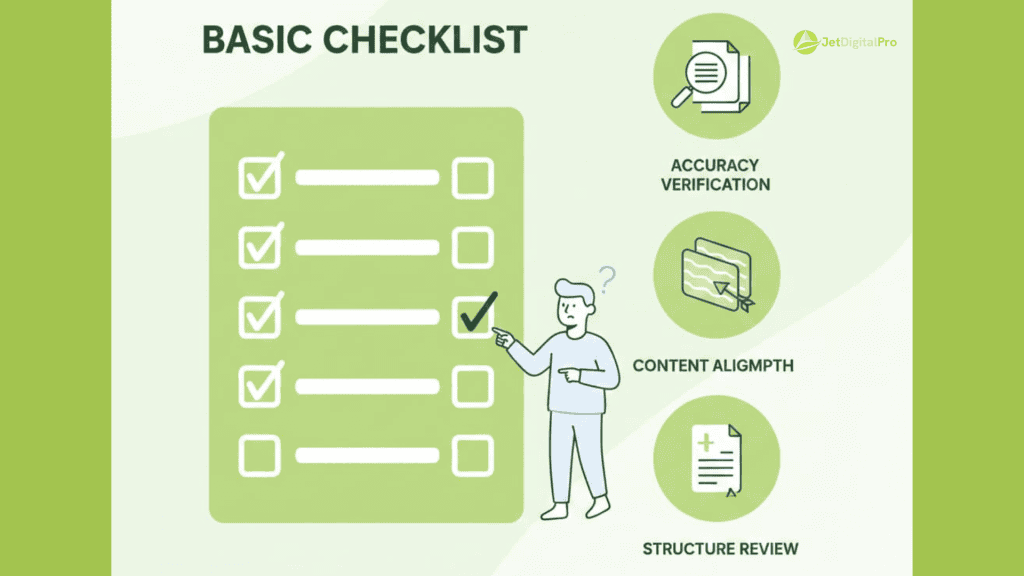
A QA checklist can help, but on its own it won’t protect your SEO content. You can tick boxes for title tags and meta descriptions and still miss intent, logic gaps, or messy structure. Real quality assurance SEO writing is a workflow, not a document.
It moves through defined review stages, each one looking at the piece from a different angle. Think of it like a controlled assembly line, where every stop has a clear purpose and a fresh set of eyes. That’s how you catch logic errors early, polish language later, and save the tiny details for last.
You start with the writer’s own revision, focused on clarity and the main point. Then it moves to an editor who looks at flow, gaps, and reader experience. After that, a technical review checks SEO and accessibility with less emotion and more precision.
This layered path is what separates “good enough” from content that can compete on page one, especially when you’re working at scale for many clients at once. Without a structure like this, consistency becomes guesswork.
- Self-edit for grammar and core message.
- Peer review for flow and gaps.
- Final audit for technical SEO and accessibility.
Building Your On-Page Optimization Checklist
The research phase is where the data work really starts. Effective SEO writing doesn’t begin with a blank page, it begins with understanding how services research keywords and what your audience truly looks for. We start with a seed keyword, a broad term tied to your products or services.
On-page optimization starts with the elements search engines read first. Your title tag should stay under 60 characters, include the primary keyword, and be unique across the site. The meta description works more like a short ad: it needs to earn the click while still reflecting the page honestly.
From there, your heading structure carries the weight. One H1 for the main idea, then H2s and H3s to break the topic into a clear, logical outline. This helps both readers and crawlers understand how the content fits together.
Keyword use should feel natural, not forced. You’re blending primary and secondary terms, plus closely related phrases, in a way that sounds like one human talking to another. Aim for a reading level around 7th grade: short paragraphs, direct wording, and helpful lists where they make sense.
Tools like Hemingway can help flag dense or tangled sentences that might slow readers down. This layer is all about making the page easy to scan, easy to understand, and easy for search engines to classify.[1]
Assessing the Real Quality of Your Content
Once you’ve covered the basics, the real test starts: is this page actually good? Not “fine,” not “passable” good enough to beat what’s already ranking. Originality is the floor, so yes, a plagiarism checker is mandatory, but it’s just the first filter. Put your draft side by side with the current top results for your target query and study them.
Ask yourself:
- Are you clearer than they are?
- Are you more thorough without rambling?
- Do you answer the follow-up questions readers naturally have after the first answer?
That extra layer of usefulness is usually where real differentiation appears.
Intent alignment sits right next to that. If the query shows buying intent, the content should:
- Help compare options
- Explain trade-offs
- Reduce doubts and confusion
If the query is informational, the structure should teach in a simple, step by step way. In both cases, every strong claim needs backup. That means checking facts, citing solid sources, and being careful with numbers, because vague or unsupported stats erode trust fast.
All of this feeds into E-E-A-T experience, expertise, authoritativeness, and trustworthiness. You can support that by:
- Adding an author bio with relevant credentials
- Showing real-world experience (tests you ran, tools you used, products you tried)
- Linking to reputable references where it makes sense
Then there’s engagement, which is easy to overlook. A strong piece doesn’t just sit there, it nudges the reader toward the next step, click, sign up, compare, or move into a related topic. Structurally, that means:
- Clear subheadings that pull the eye down the page
- Logical sections that make it feel “easy to keep going”
- CTAs or internal links placed where questions naturally arise
When readers stay longer, scroll deeper, and interact instead of bouncing, they’re quietly telling search engines, “this page delivers.” That’s where real quality and SEO performance finally meet.
The Non-Negotiable Technical SEO Audit
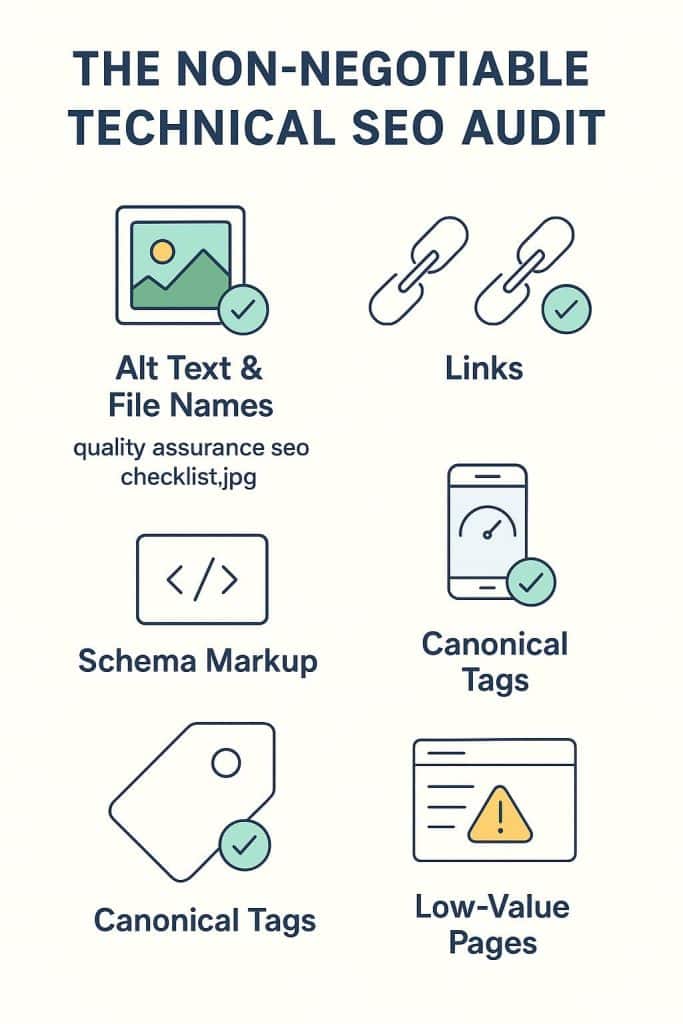
Technical SEO is the quiet layer that decides whether great content actually performs. Even a strong article can stall if images, links, or markup are mishandled. This is why understanding how SEO writing services work is crucial, they combine technical and content strategies to make sure your pages rank consistently and reliably.
Start with images: every one should have clear, descriptive alt text that explains the image for screen readers and gives search engines context.
File names matter too, a name like quality-assurance-seo-checklist.jpg is far more useful than IMG_4395.jpg when crawlers scan your site. Then check every internal and external link. Broken links interrupt the reading experience and slowly chip away at trust.
Structured data is another key piece. Using the right schema for articles, how-tos, or FAQs can help your page earn rich results and stand out in search. The page itself needs to be mobile-friendly and quick to load, since speed and usability both feed into rankings and user satisfaction.
Canonical tags should be in place to prevent duplicate content problems, especially on large sites. Any thin, low-value pages should be revised or consolidated so they don’t drag the domain down. This whole layer exists to make sure the site carrying your words is as carefully tuned as the content on it.
- Alt text for every image and relevant file names.
- Zero broken internal or external links.
- Proper schema markup and fast page load times.
Implementing a Staged Review Workflow
A reliable QA system grows out of a repeatable workflow, not one-off checks. It usually starts with the writer, right after the first draft. They run a self-edit pass, using tools like Grammarly for grammar and spelling and Hemingway for clarity and sentence structure.
Then they test the draft in an SEO tool to review keyword balance, topical coverage, and overall optimization. This first phase cleans up the most obvious errors and weak spots.
Next, the draft goes to a peer or editor. Their focus is different: they’re looking at the big picture, flow, structure, completeness, and brand voice. They ask whether the argument makes sense, whether any questions are left hanging, and whether the tone matches what readers expect from that brand. Only after those layers does the final QA scan begin.
That last review is more technical: checking accessibility (contrast, alt text, heading order), making sure all elements load correctly, and confirming there are no layout or link issues.
At the same time, the piece is lined up with analytics and search demand, so it targets topics and terms that actually bring traffic. Once it passes this stage, it’s ready to publish and that’s where the next phase starts.
Post-Publish Monitoring and Iteration

The real test of content quality happens after it goes live. Once a piece is published, it should be watched, not forgotten. Track how it ranks for its primary and secondary keywords. Use analytics to study traffic, bounce rate, and average time on page.
If you see a high bounce rate or very short visits, that can signal a mismatch between the query and the content, even when the writing itself is strong. These numbers give you a grounded way to judge whether the page is doing its job.
From there, updates become part of the plan, not an afterthought. You might tighten an intro, expand a shallow section, adjust headings, or add a clearer call to action. Sometimes the fix is as simple as answering a related question that searchers clearly care about.
Other times, it means adding fresh data, new examples, or updated screenshots so the page doesn’t age out of relevance. Over time, this loop of monitoring and revision turns a single article into an asset that keeps growing.
At Jet Digital Pro, this ongoing review is built into how we support agencies, so content doesn’t just launch in good shape, it keeps improving as the search landscape and user behavior change.[2]
FAQ
How can I build a solid SEO content quality assurance routine?
A strong SEO content quality assurance routine starts with a QA checklist SEO writing setup. Include a content optimization checklist, on-page SEO audit, title tag verification, meta description review, heading hierarchy check, and keyword density analysis. Add LSI keyword integration, content readability score checks, grammar error detection, plagiarism content check, and a factual accuracy verification step to keep work reliable.
What should I review to keep my SEO writing clear and easy to read?
Check your content readability score and run a semantic relevance check and lexical field analysis to keep ideas smooth. Tools like readability tools Grammarly and Hemingway app usage help tighten tone. Combine user intent alignment with flow logical structure, tone consistency check, and brand voice alignment so every page feels natural, useful, and comfortable for readers.
How do I make sure my pages meet search guidelines and trust standards?
Run an E-E-A-T compliance audit with expertise signals SEO, trustworthiness factors, and experience demonstrations. Add content depth analysis and topical authority signals to show value. Include author bio inclusion and competitor content benchmark steps. Review thin content removal, duplicate content scan, and canonical tag inspection to ensure your pages follow search rules and stay trustworthy.
What technical elements matter most when checking pages before publishing?
Run a rendered HTML audit, schema markup validation, image alt text optimization, and page load speed check. Add mobile responsiveness test, broken link checker, internal linking audit, and external backlink validation. Confirm meta robots tags work as expected. Review image file naming, caption optimization, and video embedding test so visual content stays clean, light, and well-structured.
How do I keep quality high after content goes live?
Use post-publish monitoring with ranking performance track and traffic analytics review. Fix keyword cannibalization issues and update content freshness. Add engagement metrics review, bounce rate optimization, dwell time improvement, and CTA placement check. Follow your editorial review process with peer verification steps, self-edit checklist routines, and a final approval workflow supported by automated QA tools and manual audit best practices.
Your Blueprint for Content Excellence
Quality assurance SEO writing turns solid ideas into dependable results. It bridges the gap between hoping content performs and confidently knowing it’s built to succeed.
With a staged workflow, real quality signals, and consistent post-publish care, you create a content system that scales without losing precision. These layers make every page more resilient, more relevant, and more profitable. Ready to elevate your agency’s output? Talk to JetDigitalPro.
References
- https://moldstud.com/articles/p-the-impact-of-meta-tags-on-click-through-rates-and-seo-rankings
- https://moldstud.com/articles/p-the-benefits-of-updating-and-refreshing-your-existing-content-for-seo-results
