


You’re not just hiring a service, you’re choosing a management style, managing agency vs freelancer. The real difference between an agency and a freelancer isn’t just cost or skill, it’s the weight on your shoulders. One path lets you delegate the whole problem, the other makes you the de facto project manager.
We’ve managed both sides of this equation, and the right choice boils down to how much of your own time you’re willing to trade for control. If you’re ready to stop being the middleman and start being the director, keep reading.
What Managing Agency vs Freelancer Really Means for You
- Your Role Flips Completely: With an agency, you brief a strategist. With a freelancer, you become the strategist, project manager, and quality control.
- Scalability Has a Hidden Cost: A freelancer’s flexibility is real, but scaling means you managing multiple people. An agency’s scalability is built-in, but you pay for the structure.
- Risk Shifts from People to Process: A freelancer’s risk is their personal availability. An agency’s risk is misalignment within their own team. You manage different kinds of fires.
What Actually Changes in Your Daily Role?
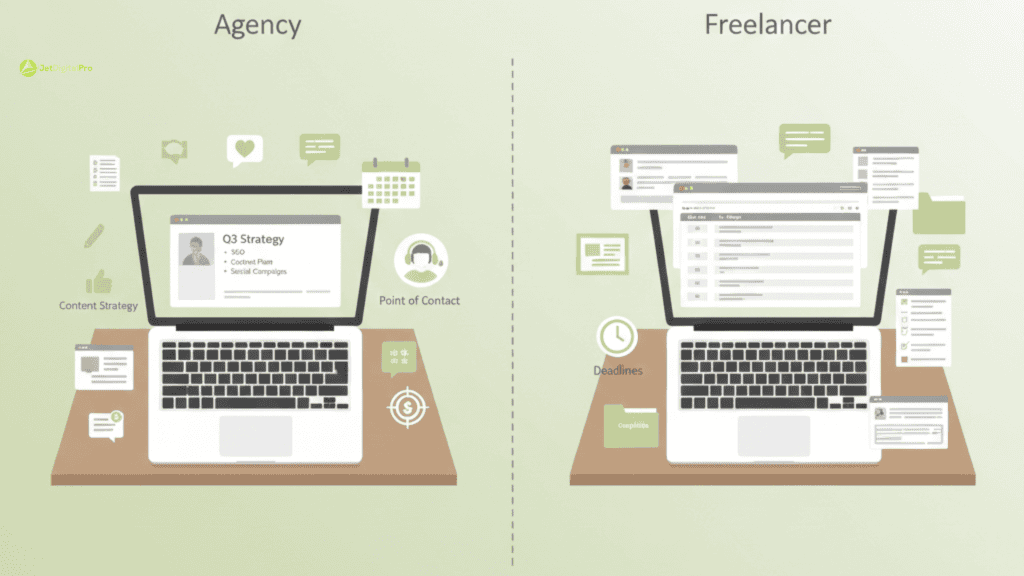
This is the part nobody talks about enough. When you hire a digital marketing agency, you gain a point of contact, an Account Executive or project lead. Your job is to communicate goals, approve strategies, and review outputs. You’re steering the ship. When you hire a graphic designer or writer who’s a freelancer, you gain a direct report.
“For ongoing projects where you want to scale your business, it’s good to choose an agency if you are looking for long term and long-lasting results. With a freelancer, you can get quick wins but without consistent optimisation, they rarely carry long-lasting benefits.” – Gaasly Blog
You’re now responsible for the brief, the deadlines, the feedback loops, and often the content management system. You’re in the engine room, not just on the bridge. The mental load is categorically different.
We’ve seen SMB owners burn out not from their core work, but from the overhead of managing a patchwork of talented but disconnected freelancers. It’s a real thing.
The Structural Divide: Team vs. Solo Operator
An agency is a system. A freelancer is a specialist. This isn’t a value judgment, it’s an architectural fact.
- Agencies operate on collaborative power. A Creative Director shapes the brand identity, a writer drafts the blog posts, a specialist plans the content promotion. You’re buying a process.
- Freelancers offer depth in a lane. A brilliant strategist might craft your calendar, but when weighing an agency vs freelancer for SEO content, you have to decide if you need a single writer or a full production house. You’re buying a specific skill.
This structure dictates everything. An agency has account managers and quality assurance steps built into their pricing. A freelancer’s quality is direct and personal, but there’s no internal team to catch an off-day. One is a safety net, the other is a high-wire act. Both can get to the other side, but your heart rate will be different.
Communication: Layers vs. Direct Lines
Here’s a typical week. With an agency, you have a weekly sync. You talk strategy with your main contact. They handle the internal chatter with their graphic designer and social media team. You see polished presentations.
With a freelancer, you might get a Slack message at 10 PM with a quick question, a Google Doc link, and a request for feedback “when you have a sec.” It’s immediate, sometimes chaotic, always personal.
The agency filters noise but can sometimes dilute urgency. Understanding the flow of communication agency vs freelancer is vital, as the freelancer gives you raw access but can also bring the noise right to your doorstep. There’s no right answer, only what your tolerance for interruption looks like.
The freelancer gives you raw access but can also bring the noise right to your doorstep. There’s no right answer, only what your tolerance for interruption looks like.
Setting the Guardrails: Contracts and KPIs
This is where management becomes concrete. Your contract management approach must differ.
For an Agency:
Focus on outcomes and strategy. The contract should outline the project scope: “Manage our Google AdWords and social media campaign to increase qualified leads by 20% in Q2.” Define the KPI reporting schedule. They should bring the how to the table. You’re buying their market research and strategic method.
For a Freelancer:
Focus on tasks and deliverables. The contract should be painfully specific: “Write eight 1,200-word blog posts on content marketing for small businesses, with two rounds of revisions, delivered every Tuesday.” You define the how in the brief. You’re buying their execution of your plan.
Getting this wrong is the most common mistake. Holding an agency to a tiny task list wastes their collaborative power. Giving a freelancer a vague strategic goal is a recipe for frustration on both sides. We’ve had to relearn this ourselves more than once.
| Management Aspect | Agency Focus | Freelancer Focus |
| Contract Core | Outcomes, Retainers, Strategic Goals | Deliverables, Project Fees, Specific Tasks |
| Key KPIs | Business Metrics (ROI, Lead Growth, Brand Lift) | Output Metrics (Posts Written, Designs Delivered, Code Commits) |
| Change Process | Formal Scope Change Orders | Direct Negotiation & Rate Adjustment |
The Tools That Keep You Sane
You can’t manage either model with just email. It becomes a nightmare. For agencies, insist on access to their project management platforms like Asana or Trello for high-level project progress views. You should see timelines and major milestones, not every single task. For freelancers, you often need to provide the system.
A shared Trello board or a simple Google Sheet with deadlines can prevent 90% of the “wait, what’s next?” messages. The tool isn’t as important as the rule: all official requests, feedback, and assets live here. This creates a record, saves your sanity, and is crucial for any kind of scalable solutions if you add more people later.
Cost, Risk, and The Reliability Equation
Let’s talk numbers without buzzwords. An agency’s higher cost isn’t just for the work, it’s for the reduction of your own effort and risk. You’re paying for their administrative support, their HR department, their software development licenses. A freelancer’s lower rate is for the work, period. The risk? It lands back in your lap.
Their laptop breaks, your project deadlines slip. They get a better offer, you’re back on the hunt. An agency has a team, so someone else picks up the work. That reliability has a price tag.
For mission-critical work like your core web design, determining an agency or freelancer which is better for your specific growth stage is the first step toward stability. For a one-off email campaign, the risk is lower.
Scaling Up: What Growth Actually Demands
You need more done. With a freelancer, scaling means you finding, vetting, and onboarding another specialist. And another. You are now a staffing agency. Your job is talent acquisition and remote hiring. With an agency, scaling often means revising the retainer or project scope. Their team gets bigger on your account behind the scenes.
The scalable solutions are built into their model. This is the hidden fork in the road. Your business’s growth trajectory should inform this choice early. If you plan to scale quickly, an agency’s structure can absorb that growth more smoothly, even if the initial cost gives you pause.
Keeping an Eye on Quality
Quality assurance looks different. With an agency, you’re auditing the final output against the strategy. You’re in a review meeting saying, “This social media strategy doesn’t feel aligned with our brand identity.” With a freelancer, you’re often proofreading the copy, checking the image resolution, testing the button link. You’re managing the granular details.
“Agencies have standard operating procedures (SOPs) in place to ensure quality control. Freelancers, on the other hand, usually work solo and might not always follow a structured approach. … Agencies work on long-term retainers, meaning they are invested in your success.” – Mavlers Blog
Your performance monitoring shifts from strategic alignment to tactical correctness. Neither is inherently better, but you must know which type of energy you have to give.
We’ve found that SMB owners who are deep in the details of their product often clash with the strategic distance of an agency, while founders who are big-picture thinkers can get frustrated micromanaging a freelancer’s pixel placement.
The Burnout Factor (Their’s and Yours)
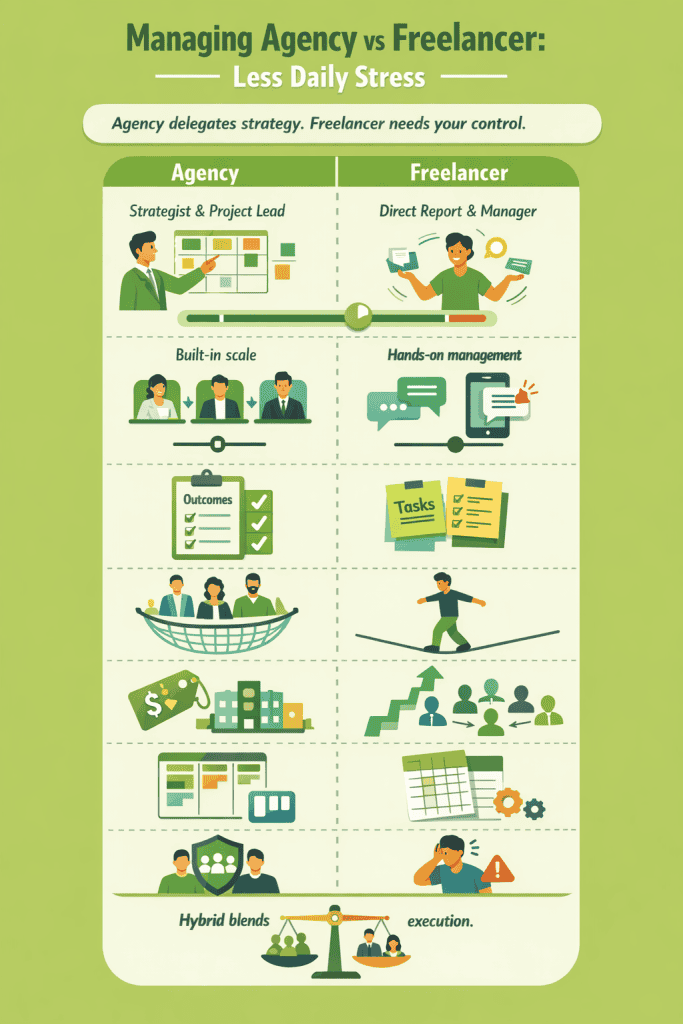
Availability isn’t just about time zones. Freelancers juggle multiple clients. Your urgent request might land during their crunch time for someone else. They have no backup planning unless you’ve arranged it. Their burnout becomes your problem.
Agencies plan for this with teams, but your account manager might change, or your project might be shifted to a less experienced team member. The risk of burnout migrates from the individual to the system.
You combat this with clear contracts and regular check-ins. Ask the direct question: “Who is my backup if you’re unavailable?” A good freelancer will have a network. A professional agency will have a documented process.
When Your Choice Should Be an Agency
Choose an agency when the problem is complex and integrated. You need a branding agency to overhaul your visual identity and messaging across all touchpoints. You need a digital marketing agency to run a coordinated campaign across search, social, and email. You need a lead generation agency to build and manage a full funnel.
Choose an agency when you lack the internal bandwidth to manage multiple specialists and you need the work to feel cohesive and strategically sound. Choose an agency when you want to think with someone, not just hand off a task.
When Your Choice Should Be a Freelancer
Choose a freelancer when the need is specific, tactical, or experimental. You need a stunning graphic design for a new product launch. You need a expert to audit your Google AdWords account for two weeks. You want to try content creation on a new platform like TikTok without a long-term commitment.
Choose a freelancer when you have the time and skill to provide a crystal-clear brief and manage the process. Choose a freelancer for peak flexibility and direct access to top-tier niche talent, especially if you’re on a tight ad budget.
The Hybrid Model: A Practical Path for 2025
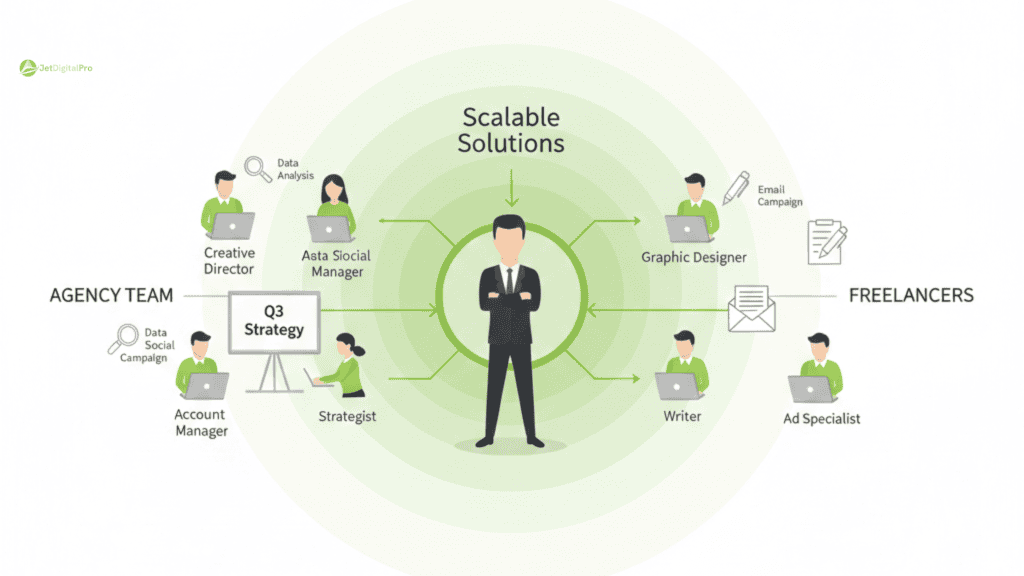
This is where many savvy businesses, including ours at times, are landing. Use an agency for the core, ongoing strategic layer, the content strategy, the social media management blueprint, the high-level SEO architecture.
Then, use vetted freelancers for the high-volume execution, writing the individual blog posts, creating the daily graphics, producing the video clips. The agency sets the standard and manages the brand cohesion; the freelancers operate within that framework.
This balances cost with strategic oversight. It’s how we structure some of our own service delivery, ensuring scalable solutions without sacrificing a cohesive voice.
Mistakes We’ve Seen (And Made)
Don’t make the agency a glorified freelancer by micromanaging their tactics. Don’t make the freelancer a pseudo-agency by asking for strategic plans outside their lane. Don’t skip the KYC process or skimp on defining legal parameters in the contract.
Don’t assume communication will just “work out.” The biggest mistake? Not aligning your own internal effort with the model you chose. If you hired an agency but spend all day in the weeds with them, you bought the wrong thing.
A Simple Framework for Your 2025 Decision
Ask yourself these questions in order.
- Complexity: Is this a single task or a multi-faceted project requiring different skills?
- Bandwidth: Do I have the time to manage the person and the process directly?
- Duration: Is this a one-off or an ongoing need?
- Risk Tolerance: Can I absorb it if this person disappears for a week?
If your answers lean toward complex, low bandwidth, ongoing, and low tolerance, lean agency. If they lean toward simple, free time, short-term, and higher tolerance, lean freelancer. For everything in the middle, consider the hybrid model.
FAQ
How does managing agency vs freelancer affect my content strategy?
When managing agency vs freelancer, your content strategy shifts depending on structure. A digital marketing agency may guide market research, content marketing, and content promotion for small businesses.
A freelancer may focus on content creation like blog posts or social media captions. You’ll either review strategic direction or define project scope yourself and manage execution more closely.
Who handles social media and digital ads better?
In managing agency vs freelancer, agencies often run full social media campaigns, digital ads, and Google AdWords with account managers overseeing project progress. Freelancers may handle social media management or a single ad budget with direct input from you.
If you want one point of contact, agencies help. If you want hands-on control, freelancers fit better.
What changes in contract management and legal responsibility?
Managing agency vs freelancer changes how you approach contract management and legal parameters. Agencies usually have formal agreements, clear project scope, administrative support, and structured processes.
With freelancers, you may need tighter task definitions, KYC process checks, and clarity around tax reporting. The responsibility for documentation and compliance often falls more on you.
How does scaling work with remote hiring?
Managing agency vs freelancer affects talent acquisition and remote hiring. Scaling with freelancers may require adding a graphic designer, virtual assistant, or bilingual remote talent one by one.
You’ll manage collaboration tools and project deadlines yourself. Agencies offer collaborative power and scalable solutions internally, so growth often means expanding the retainer, not rebuilding the team.
Wrapping It Up: Your Next Step
You don’t get a prize for doing things the hard way. The right choice is the one that fits your business and frees you up to do what you’re best at. If you want that agency-level partnership, the strategic focus, the quality checks, and a team you don’t have to manage, that’s exactly what we built.
Stop managing content and start scaling your agency. Book your free strategy call now.
References
- https://gaasly.com/en-GB/blog/should-i-hire-a-digital-marketing-agency-or-a-freelancer-whats-right-for-me
- https://www.mavlers.com/blog/agency-vs-freelancer-digital-marketing/
