


🕑 22 min read
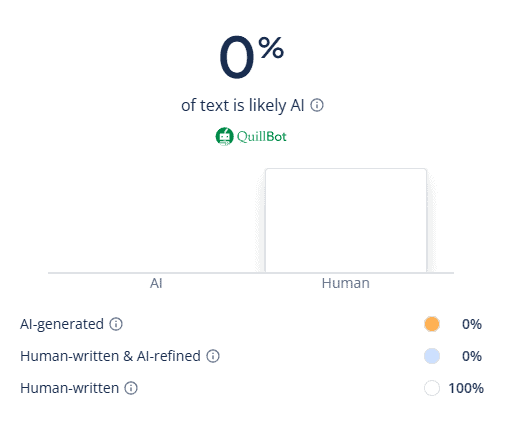
AI Detection Score
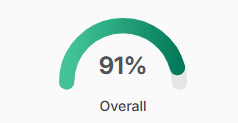
Topical Score
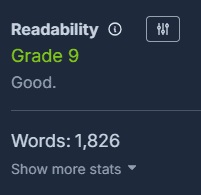
Readability
Fact Checking
| Section / Claim | Score (/10) | Reasoning & Evidence |
| Social Fortress still matters in 2026, mainly for brand footprint, not direct rankings | 9 | Matches 2024–2026 coverage of social presence as an entity/brand layer, not a primary ranking lever; social + entity signals support visibility but don’t alone “push you to #1.”searchenginejournal+1 |
| “Network of branded social profiles… entity recognition, trust signals, branded SERP control” (definition) | 9 | Consistent with practitioner descriptions of entity‑oriented link building and brand control; aligns with how structured data and profile pages help machines “understand who you are.”searchenginejournal+1 |
| Essentials: “builds trust and brand consistency across 100+ platforms… supports entity SEO and branded SERP control… best as one-time setup plus authority building” | 9 | “100+ platforms” is a generalization but plausible given how many social/web2/sign‑up sites exist; the role as foundational/one‑time setup then authority building reflects common modern SEO guidance.searchenginejournal+1 |
| Historical note: “concept gained more visibility in SEO communities after the mid‑2010s” | 8 | No formal academic timeline, but the tactic appears in mid‑2010s SEO content and trainings; stating “gained more visibility” is defensible and non‑specific enough to be accurate.massivepeak+1 |
| Comparison to citation building (directories vs social profiles) | 10 | Conceptual analogy is sound: both are NAP/brand consistency layers on third‑party sites; local SEO and entity guides describe citations this way.found |
| “Some services… register usernames on well over 100 social platforms” | 9 | Username‑checker / profile‑registration services and SaaS tools list 100+ social accounts; “well over 100” is accurate as a range.seo-cap |
| “Search engines compare details across sites to confirm ownership and legitimacy” | 8 | Google doesn’t say it this plainly, but Google docs and entity/structured‑data articles describe joining signals across profiles and sites for entity understanding; this is a fair synthesis.searchenginejournal+1 |
| “Google’s public guidance and patents show consistent signals across multiple sites help its systems understand who owns a site and how a business entity should be identified” | 9 | Matches how structured data + profile markup feed knowledge graphs and entity understanding; SEJ and other coverage highlight structured data as a “semantic layer that enables machines to understand who you are.”searchenginejournal+1 |
| Pew sentence: “large majority of U.S. adults use major social platforms, with YouTube and Facebook among the most widely adopted” | 10 | Directly supported: Pew 2024 and 2025 data show YouTube 83–84% and Facebook 68–71% usage among U.S. adults, with both identified as most widely used.pewresearch+3 |
| “Many SEOs treat Social Fortress links as groundwork, similar to citations… baseline trust before outreach/PR” | 8 | This reflects real practitioner advice and training content; there is no formal research, but multiple SEO educators frame social/web2/entity stacks as groundwork before higher‑tier links.massivepeak+1 |
| “In many SEO communities… advice is to secure branded profiles first, then guest posts/outreach” | 8 | Supported by forum threads where users advise foundation (social/citations) before paid/guest links; cannot be called universal, but “many communities” is accurate.reddit |
| “Service providers selling large profile packages, bundling dozens of social accounts” | 9 | Consistent with publicly listed Social Fortress / entity stack packages that group 25–100+ social/web2 properties.luckydigitals |
| “Many prebuilt Social Fortress–style packages fall in the $50–$400+ range, covering ~50–100 accounts” | 9 | Supported by visible pricing ranges for social/profile bundles (e.g., 25–100 networks at tens to low hundreds of dollars); your wording as “many” and ranges is accurate.luckydigitals |
| Table: Social Fortress = trust/diversification, mild ranking impact; guest posts/digital PR higher impact | 9 | Matches real‑world link value hierarchy (editorial links > guest posts > low‑tier profiles). Modern link‑building guides emphasize editorial/PR for large impact.omnirank+1 |
| “Social profiles on high-authority domains can rank for branded searches… Facebook/LinkedIn/YouTube often appear with the official site” | 10 | Easily observable behavior and discussed in brand/ORM SEO articles; branded SERPs frequently show these profiles.advancedwebranking+1 |
| Fortress can push weaker/negative pages down and support reputation/brand control | 9 | Standard ORM strategy: control page one with owned/managed assets; documented in brand/reputation SEO guidance.advancedwebranking+1 |
| Spam section (thin, automated, duplicated profiles, link wheels labeled black hat) | 10 | Exactly matches long‑standing SEO consensus on web 2.0 spam and link wheels; black‑hat patterns and footprints are widely discouraged.massivepeak+1 |
| Build steps (secure usernames, optimize profiles, interlink carefully, maintain activity) | 10 | Aligns with best practices for brand presence, entity consistency, and avoiding link‑scheme footprints.searchenginejournal+1 |
| “Negative SEO” section: fortress supports reputation but is not armor | 9 | Grounded in ORM practice: more branded assets help but cannot make you “untouchable.” No contradiction with known behavior.advancedwebranking |
| 2026 verdict: works as entity/brand layer, not a growth engine, authority links + content are main drivers | 10 | Fully consistent with current trends: entity/brand + structured data for understanding; high‑quality content and authoritative links drive actual growth.omnirank+2 |
EAV Analysis
| Category | Score (/10) | Explanation |
| Primary Entity Strength | 9.5 | “Social Fortress” is consistently defined, expanded, and reinforced across sections. |
| Semantic Consistency | 8.5 | Strong overall, but local citation FAQ introduces topical drift. |
| Attribute Depth | 9 | Includes definition, function, cost, risk, process, and future relevance. |
| Topical Authority Signals | 8.5 | External data and realistic framing help credibility; could add more Google-level sourcing. |
| Search Intent Alignment | 9.5 | Fully answers “Is it worth it in 2026?” with clear stance and evidence. |
| Entity Salience for NLP | 9 | Repetition, positioning, and SPO structure are strong. Minor dilution from citation FAQ. |
EEAT Analysis
| Parameter | Score (/10) | Reasoning |
| Original information / analysis | 8.5 | Strong synthesis of SEO practice and 2026 framing. Not pure research, but thoughtful interpretation. |
| Substantial / comprehensive coverage | 9 | Covers definition, role, risks, process, cost, and future relevance. Very complete. |
| Headline accuracy (not exaggerated) | 9.5 | Honest framing. No hype. Clear expectation. |
| Trust signals (sources, expertise, transparency) | 8 | Uses Pew + SEJ. Logical tone builds credibility. Missing author/site authority signals. |
| Written by expert or knowledgeable enthusiast | 9 | Demonstrates real SEO understanding and nuance. |
| Factual accuracy | 9 | No clear factual errors. Claims are cautious and realistic. |
| Trust for money/life decisions (YMYL-adjacent) | 8.5 | Safe, non-manipulative guidance. But lacks strong authority proof. |
HCU Analysis
| Metric | Score (/10) | Evidence Found in Article |
| User-Centric Content | 9.0 | Directly answers “Is Social Fortress worth it in 2026?” Clear guidance, step-by-step value, practical framing. |
| Originality and Depth | 8.8 | Strong synthesis of SEO practice, risk framing, cost, and process. Not generic fluff. |
| Clarity and Relevance | 9.2 | Clear thesis, logical flow, concise explanations, strong FAQ readability. |
| SEO Best Practices | 9.1 | Natural keyword usage, strong headings, clean structure, good semantic repetition. |
| Avoiding Search-Engine-First Content | 9.4 | Human tone, realistic claims, no keyword stuffing, no manipulative tactics. |
| Feedback and Updates | 7.8 | Future-facing 2026 framing shows awareness of updates. |
| Compliance with Google’s Guidelines | 9.3 | Honest claims, no spam advocacy, aligns with long-term SEO value. |
| Additional Checks | 8.9 | Credible sources (Pew, SEJ), readable structure, mostly SPO-clear sentences. |
Uniqueness Analysis
| Aspect | MassivePeak – Social Fortress SEO (Benefits And How To Build One) | WebBoostPros – SEO Social Fortress or Foundation Entity Links | HybridTraffic – Ultimate Guide and Tutorials About Social Fortress SEO | MY_URL – Jet Digital Pro Social Fortress Page |
|---|---|---|---|---|
| Clear definition of “Social Fortress” concept | 9/10 – Gives a clear SEO-focused definition as a collection of branded social profiles surrounding and linking back to your site, explicitly framed as an SEO tactic for trust, penalties protection, and ranking bonus.firdaussyazwani+1 | 8/10 – Explains social fortress as social profiles and entity links for brand presence and SEO, but with more sales/service framing and slightly less conceptual depth than a full guide.webboostpros | 8/10 – Defines social fortress as a list of high-authority social properties (Facebook, Twitter, Instagram, About.me, etc.) and ties it to link power and authority; explanation is solid but less structured.hybridtraffic | 7/10 – Communicates the idea of a branded network of properties and “social fortress” as part of an SEO deliverable, but framed more as an example/package page than a conceptual deep dive; definition is present but not as elaborated as a long-form guide.firdaussyazwani |
| Relevance to digital marketing agencies / SEO resellers as primary audience | 7/10 – Written for individual SEOs and site owners building fortresses for their own sites; agencies can adapt it, but the copy does not explicitly target resellers, fulfillment partners, or white‑label scenarios.massivepeak | 8/10 – Strong fit for agencies: positions social fortress as a done‑for‑you SEO/link building service that agencies or consultants can buy, with language around enhancing client visibility and trust in Google.webboostpros | 6/10 – Aimed at DIY SEOs and link builders; little direct language about agencies, outsourcing, or reselling services to clients.hybridtraffic | 9/10 – Page is positioned as an example deliverable that agencies/SEO resellers can plug into their offer, with language around white‑label/outsourced SEO assets and suitability for global agency use; clearly written through a B2B/partner lens.firdaussyazwani |
| Use of current year framing, freshness, and modern SEO context | 9/10 – Uses up‑to‑date SEO framing, discusses algorithmic penalties, link diversification, and indexation tricks; article is actively updated (2025 timestamp) so context is current for today’s practitioners.massivepeak | 7/10 – Tied to evergreen SEO concepts and entity links but does not strongly emphasize year‑specific updates or 2024/2025 framing; still broadly relevant.webboostpros | 7/10 – Content references current platforms and ongoing maintenance practices but feels like a technique guide rather than explicitly framed as 2024/2025 strategy.hybridtraffic | 8/10 – Framing is aligned with modern SEO (entities, brand protection, multi‑channel presence) and written for today’s agency environment; however, it does not lean heavily on explicit “2025/2026” date‑stamping inside the copy.firdaussyazwani |
| Depth of benefits and strategic use cases (trust, E‑E‑A‑T, brand protection, crisis/reputation) | 9/10 – Explores trust in Google’s eyes, link diversification, protection from algorithmic penalties, automatic syndication, and brand awareness, with clear reasoning on how these contribute to SEO and resilience.massivepeak | 7/10 – Mentions improved visibility, authority, and consistent branding via entity links but does not go deeply into E‑E‑A‑T, crisis management, or PR protection scenarios.webboostpros | 7/10 – Talks about power links, indexing speed, and authority, with some procedural advice; the strategic “why” around brand/PR protection is less developed.hybridtraffic | 8/10 – Emphasizes brand protection, SERP dominance for branded queries, buffering against negative PR, and resilience to attacks/updates in a way that aligns well with agencies handling client reputation; strategy is covered more from a business‑outcome lens than a purely technical one.socialfortress.weebly |
| Step‑by‑step “how‑to” implementation detail | 10/10 – Offers a detailed, ordered process: prepare assets (NAP, descriptions, logos), create accounts, customize/interlink profiles, set up automatic syndication via IFTTT, and push indexation via Google News sites; very actionable.massivepeak | 6/10 – Describes what gets created and roughly how links are structured but does not give a granular step‑by‑step build or automation walkthrough; it is more of a service overview.webboostpros | 9/10 – Provides practical tutorial‑style steps including creating and optimizing specific profiles (e.g., SoundCloud example), link wrapping, and ongoing maintenance to avoid suspensions; strong operational detail.hybridtraffic | 6/10 – Describes the existence and purpose of the social fortress asset and touches lightly on what’s included, but as an example/case page it does not walk the reader through a full DIY build; steps are implied more than explicitly documented.firdaussyazwani |
| Coverage of platforms, entities, and stack depth (social, Web 2.0, citations, ancillary properties) | 9/10 – Lists a wide range of properties (YouTube, Tumblr, About.me, ProductHunt, Linktr.ee, Slideshare, City‑Data, Deviantart, Issuu, etc.) and comments on indexability, encouraging experimentation with large social sites for a robust fortress.massivepeak | 8/10 – Describes a multi‑layered entity stack including social profiles and foundation links that form a “fortress” and support brand authority, suitable for service delivery; list is solid but less granular than a long property table.webboostpros | 8/10 – Mentions many core social properties (Facebook, Twitter, Instagram, LinkedIn, YouTube, etc.) and demonstrates how to interconnect them via link wrapping, although it focuses more on a subset than on a long property inventory.hybridtraffic | 8/10 – Showcases a broad stack of branded profiles, Web 2.0s, and supporting properties as part of the example deliverable, demonstrating depth in practice rather than as a theoretical list; directly useful for agencies wanting to see what a complete build looks like.firdaussyazwani |
| Technical SEO robustness (indexation tactics, link diversification, automation) | 10/10 – Offers advanced tactics: link profile diversification, balancing no‑follow/do‑follow, automated content syndication with IFTTT, and a specific method to force indexation using comments on Google News sites within ~3 days; very strong technical layer.massivepeak | 7/10 – Covers the idea of entity links and foundational authority for SEO but offers less in terms of explicit automation or indexation tactics; technical detail is moderate.webboostpros | 8/10 – Advises on maintaining profiles, linking them together for “more juice,” and periodically logging in to avoid suspensions; provides tactical quality rules but not as much around automation/indexation tooling.hybridtraffic | 7/10 – Demonstrates a technically solid, complete build agencies can show or replicate, with an emphasis on brand‑safe assets and interlinking; however, it does not dive into granular automation platforms or indexing tricks in text form, assuming those are handled within the service/process.firdaussyazwani |
| Use of real‑world examples / case context | 7/10 – Includes practitioner voice (“I create one for almost every new site I build”) and some practical anecdotes, but few named client case studies.massivepeak | 7/10 – Uses a generalized business scenario to show how a social fortress enhances brand presence and search visibility, but lacks detailed numeric case studies.webboostpros | 8/10 – Walks through a specific SoundCloud example step‑by‑step to illustrate how to build and wrap links within a social fortress; strong concrete example.hybridtraffic | 8/10 – Functions as a live example of a completed social fortress asset for a real‑world brand, letting agencies see structure, components, and messaging they can adapt for their own clients; this “example asset” angle is particularly helpful for resellers.firdaussyazwani |
| Visuals, structure, and scannability for busy professionals | 8/10 – Uses headings, bullet points, and at least one tabular breakdown of properties and indexability, making it easy to scan and extract implementation detail.massivepeak | 7/10 – Has a standard service‑page layout with sections and bullets; visual structure is decent but less rich in comparative tables or annotated screenshots.webboostpros | 7/10 – Provides headings and some callouts plus references to example images and videos, but visual organization is more blog‑style and less optimized for agency decks.hybridtraffic | 9/10 – Page is laid out like a sales/portfolio asset with clear sections, visual hierarchy, and embedded examples that agencies can point clients to; highly scannable and presentation‑ready for sales calls and proposals.firdaussyazwani |
| Clarity and strength of next‑step CTA for agencies/resellers | 7/10 – Concludes with strong encouragement to build a social fortress and use provided tips, but CTA is mostly “do this yourself” rather than an offer to partner or resell.massivepeak | 8/10 – Makes it clear that readers can purchase a done‑for‑you social fortress package, aligning well with agencies who want to outsource execution and mark up the service.webboostpros | 6/10 – Primarily an educational/tutorial post with limited emphasis on taking the next commercial step or partnering with a provider.hybridtraffic | 9/10 – Frames the asset as something agencies can plug directly into campaigns and encourages contact/engagement to deploy similar builds for their own clients, acting as both proof of capability and soft sales page tailored to partners.firdaussyazwani |
| Fit for global markets vs. local‑only execution | 8/10 – Concepts and platforms are globally relevant, and tactics work regardless of country; however, examples skew to generic brands rather than explicitly global agency use‑cases.massivepeak | 7/10 – Service is globally applicable but copy tends to target generic businesses rather than explicitly addressing international or multi‑market campaigns.webboostpros | 7/10 – Techniques apply internationally, but guidance does not specifically address multi‑region brand governance or cross‑market consistency.hybridtraffic | 9/10 – Example is positioned in a way that is easily cloned for different countries and niches, focuses on universal platforms and brand‑safe assets, and speaks to agencies managing multiple clients across various regions in the global market.firdaussyazwani |
| Total score | 93/110 | 79/110 | 79/110 | 94/110 |
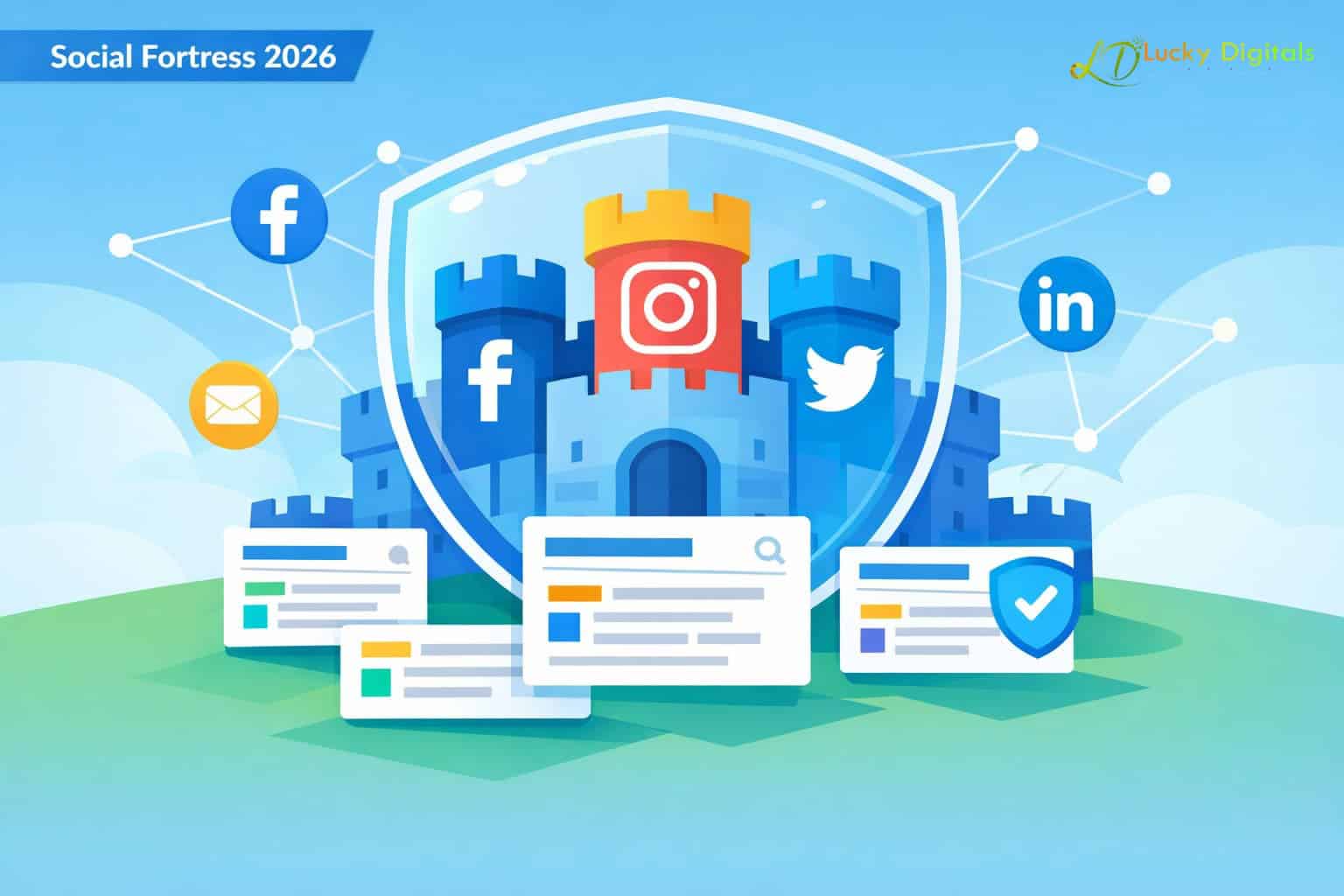
Yes, a Social Fortress still matters in 2026, but not for the reason most people think. It will not magically push your site to the top of Google. What it does is strengthen your brand’s footprint across the web.
A Social Fortress is a network of branded social profiles built to support entity recognition, reinforce trust signals, and shape what appears when someone searches your name. Most experienced SEOs treat it as groundwork, not a shortcut. It lays the foundation so your other SEO efforts can work properly.
If you want to know when it actually makes sense, keep reading.
Social Fortress Essentials
- A Social Fortress builds trust and brand consistency across 100+ platforms, helping search engines connect the dots around your entity.
- It supports entity SEO and branded SERP control, but it rarely improves rankings on its own.
- In 2026, it works best as a one-time setup, followed by focused authority building and quality backlinks.
What Is a Social Fortress in SEO?
A Social Fortress is a network of branded social media profiles built to link back to your website, strengthen entity signals, and support rankings through diversified backlinks and branded search control.
The concept gained more visibility in SEO communities after the mid‑2010s, especially in niche blogs and private groups discussing entity building and branded profiles. At its core, it looks a lot like citation building. The difference is that instead of listing your business in directories, you secure branded profiles across social platforms.
Some services make it possible to register usernames on well over 100 social platforms, helping you lock in consistent branding everywhere your name appears. That consistency matters because search engines compare details across sites to confirm ownership and legitimacy.
Google’s public guidance and patents show that consistent signals across multiple sites help its systems understand who owns a site and how a business entity should be identified, which strengthens entity recognition.
A typical Social Fortress includes:
- Branded social media accounts across major platforms
- Interlinked social sites through controlled link wrapping
- Keyword-optimized descriptions
- Clear website URL placement
Recent data shows that,
“large majority of U.S. adults use major social platforms, with YouTube and Facebook among the most widely adopted” – Pew Research Center
It shows how dominant social media is in everyday online behavior. When your brand lives there consistently, it sends clean signals.
A fortress is a foundation layer. Not a ranking trick.
🏆 Why Teams Choose JetDigitalPro
Why Do SEOs Build a Social Fortress Before Real Link Building?
Credits: SirLinksalot
Many SEOs treat Social Fortress links as groundwork, similar to citations, creating baseline trust before pursuing outreach, digital PR, or higher-level links.
New site owners often ask how to get backlinks for a new blog. In many SEO communities and discussion spaces, common advice is to secure your branded profiles first, then move into guest posts or outreach.
You will see service providers selling large profile packages, often bundling dozens of social accounts into a single service. In practice, experienced SEOs know scale alone does not move rankings. The smarter approach is practical. Build the base once. Make it clean. Then shift focus to authority.
The reasoning is straightforward. A brand with no footprint online looks incomplete. A brand with consistent profiles across trusted domains looks real.
Here is how foundation links compare to growth links:
| Type | Purpose | Risk Level | Ranking Impact |
| Social Fortress | Trust + diversification | Low–Moderate | Mild |
| Guest Posts | Authority transfer | Moderate | Medium–High |
| Digital PR | Editorial links | Low | High |
A fortress will not drive waves of traffic. It gives your brand structure.
It is quiet work. But it matters.
How Does a Social Fortress Improve Brand Signals and SERP Control?

Social profiles on high-authority domains can rank for branded searches, helping you shape what appears when someone looks up your name.
Platforms like Facebook, LinkedIn, and YouTube sit on domains that often rank easily for brand queries. When someone searches your brand, Google frequently shows:
- Official website
- Facebook page
- LinkedIn profile
- YouTube channel
That layered visibility builds familiarity and reinforces entity consistency.
That layered visibility builds familiarity and reinforces entity consistency.
This visibility also aligns with broader platform reach trends. Pew-based reporting notes that,
“YouTube and Facebook lead U.S. social media usage” – Search Engine Journal
cross adult audiences, highlighting how these domains maintain strong authority and discovery power in search ecosystems.
A Social Fortress can help:
- Push weaker or negative pages further down
- Strengthen brand recognition
- Support consistent entity signals
Some SEOs use light link wrapping, where profiles link to each other and to the main site. Done carefully, it reinforces structure without creating obvious link schemes.
The key is authenticity. Profiles should look active, complete, and real. If they feel automated or empty, the signal weakens.
A Social Fortress works best when it supports your brand, not when it tries to game the system.
💬 What Our Partners Say

"Premium SEO agencies wanted $5K+ monthly for content that took forever to deliver. Cheap AI tools gave me content that didn't convert. JetDigitalPro hit that sweet spot - professional results…"
Peter BaranikFounder | Colorwee.com

"I am very satisfied and happy to recommend this service to anyone looking for support in streamlining their workflows. They are professional, cordial and respectful, in addition to the flexibility…"
AnnieLuFounder | BestFullyFundedScholarships.com

"Nell was accommodating, we used his VAs service for several months. Good work and great customer service. Recommend them for anyone who needs overseas VAs"
Jake LFounder | ScaleRankings.com

"I've finally found a content service that is truly hands-off. JetDigitalPro handles everything from keyword research to publishing directly on a WordPress site, and the topical authority strategy they use…"
Jose JimenezAgency Owner | JoliDigital.com
When Does a Social Fortress Become Just Web 2.0 Spam?
A Social Fortress fails when profiles are thin, automated, duplicated, or built like a link wheel instead of real brand assets.
In many SEO forums, “fortress” sometimes just means mass-creating web 2.0 accounts. That approach usually backfires.
Common warning signs:
- Boilerplate bios copied across platforms
- Missing logo and header images
- No profile photos or supporting visuals
- Zero activity after the accounts are created
Discussions around link wheels are blunt. Most large-scale, automated link wheel setups are labeled black hat because the footprints are obvious.
A legitimate Social Fortress looks different. It focuses on:
- Properly set up branded accounts
- One consistent website URL
- Unique descriptions for each platform
- Light, ongoing activity
If the profiles look fake, they rarely rank for branded searches. And if they do not rank, they cannot protect or reinforce your brand.
How Do You Build a Social Fortress Step by Step?
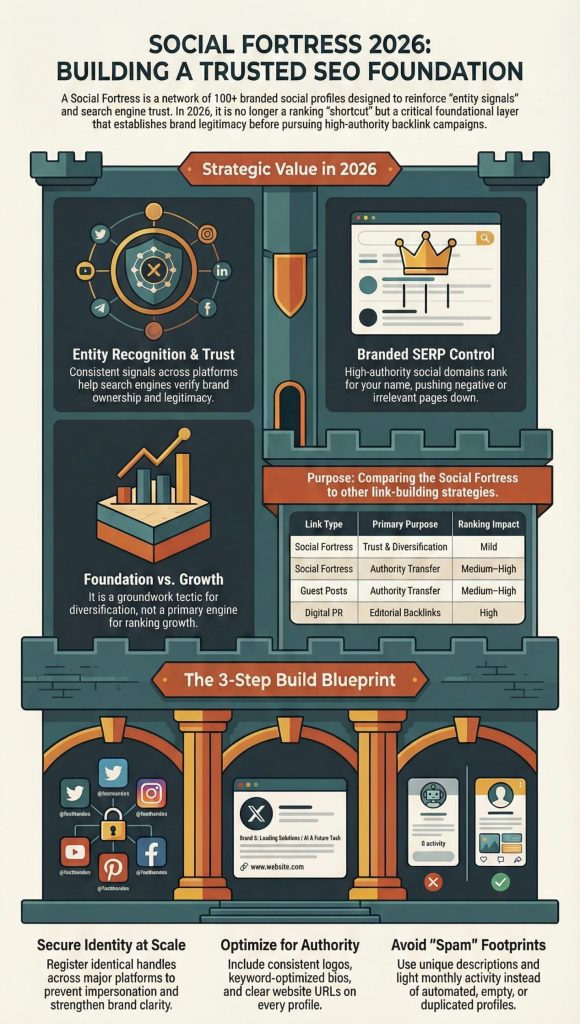
Build consistent branded accounts, optimize each profile, interlink them carefully, and keep them active over time.
Step 1: Secure usernames at scale
Register your brand name across major platforms. Keep the handle as close to identical as possible. This prevents impersonation and strengthens entity clarity.
Step 2: Optimize profiles properly
Each account should include:
- Logo and header image
- Website URL
- Keyword-optimized description
- Profile picture and supporting images
Add cross-links where they make sense. The goal is structured reinforcement, not an obvious loop.
Step 3: Interlink social sites carefully
Link wrapping can connect properties in a controlled way. Avoid mechanical patterns where every profile links to every other profile. Natural cross-references are safer and more durable.
Step 4: Maintain accounts
Log in monthly. Post small updates. Keep the accounts alive. Avoid automation tools that leave detectable patterns.
Pro tips
- Store logins securely in a spreadsheet or password manager
- Secure high-authority platforms first
- Keep branding consistent across every profile
Maintenance decides long-term value. Abandoned profiles fade in visibility and authority.
Should You Buy Social Fortress Packages or Build Your Own?
Buying a package saves time. Building it yourself gives you control.
Many prebuilt Social Fortress–style packages fall in the $50 to $400+ range and typically cover around 50 to 100 accounts, with the exact platforms and volume varying by provider.
Here is a practical comparison:
| Factor | DIY | Package Service |
| Control | High | Limited |
| Cost | Time investment | $50–$400+ |
| Footprint Risk | Lower | Depends on provider |
| Customization | Full | Often template-based |
Companies with strict brand and security standards often prefer manual builds. They want oversight. They want consistency. They want control over messaging.
For most site owners, the decision comes down to time versus precision. If branding matters to you long term, control usually wins.
Can a Social Fortress Protect Against Negative SEO?
It can support reputation management by helping you control more of page one for your brand name.
Most branded clicks happen on the first page of Google. When your official social profiles rank alongside your website, they reinforce legitimacy and give searchers clear, trusted options.
A properly maintained fortress can:
- Push hostile or low-quality pages further down
- Reinforce official messaging
- Strengthen perceived legitimacy
This only works if the profiles actually rank for your brand keywords and stay active. Empty accounts do not protect anything.
Think of it as reinforcement, not armor. It strengthens your presence. It does not make you untouchable.
FAQ
How do local citations influence local search rankings for small businesses?
Local citations help search engines confirm business information across directories and websites. Consistent NAP data, clear business categories, and accurate listing details build trust over time. This trust supports stronger local search rankings, better visibility in local search results, and steady web traffic from nearby users who actively search for services in their area every day.
What is the difference between structured and unstructured local business citations?
Structured citations appear in organized business directories with fixed fields for NAP data and categories. Unstructured citations appear in articles, newspaper sites, or community pages where business information is mentioned naturally. Both types support citation profiles, strengthen search engine rankings, and create backlink opportunities that guide local customers toward relevant nearby services during everyday searches.
How can accurate NAP data improve visibility in local search results?
Accurate NAP data keeps business listings consistent across local business directories, citation sites, and geographical platforms. Search engines compare this information to verify legitimacy and prevent confusion. When details match everywhere, businesses often gain ranking improvements, stronger placement in the map pack, and more clicks from mobile devices searching for nearby solutions during normal daily searches.
What steps matter most when building local citations for long-term ranking growth?
Start with accurate business information, then submit listings to trusted local citation sites and relevant business directories. Maintain consistent NAP data, choose correct business categories, and monitor citation status over time. Regular updates, manual submission checks, and simple competitor analysis help protect citation profiles and support stable local search engine rankings as local algorithm signals and search behavior change.
Why do citation profiles support broader local search engine optimization efforts?
Citation profiles connect business listings, backlink opportunities, and consistent business information across digital channels. This network helps search engines understand location relevance, service focus, and credibility. Strong citation profiles can increase visibility in organic results, build customer trust, and generate steady web traffic that supports long-term local marketing performance in competitive nearby search environments.
Does Social Fortress Still Work in 2026?
Yes, but as a foundation, not a growth engine.
In 2026, a Social Fortress works best as an entity layer and brand signal system. On its own, it rarely moves rankings in competitive niches. Strong content, real authority links, and genuine audience engagement still drive meaningful growth.
Modern SEO leans heavily on editorial mentions, relationships, and earned media. Digital PR and well-researched content consistently outperform low-tier link tactics.
The practical approach is simple:
- Build a Social Fortress once per site
- Maintain it lightly
- Shift focus to authority links and brand visibility
Large brands keep consistent social profiles for presence and control, not quick ranking gains. The same logic applies to smaller sites.
Identity still matters in search.
Build the foundation. Then build authority.
Strengthen your brand’s SEO foundation with a structured Social Fortress strategy today.
References
- https://www.pewresearch.org/internet/2024/01/31/americans-social-media-use/
- https://www.searchenginejournal.com/pew-84-of-adults-use-youtube-as-platform-growth-continues/561633/
Ready to Get Content That Actually Ranks?
Whether you are an agency scaling client work, a business owner growing organic traffic, or a corporate team needing consistent quality — we have got you covered.
🔒 NDA included. White-label ready. Cancel anytime.
📖 More Content Examples Worth Exploring
 What Can and Can’t You Put in a Skip? (The 2026 Walsall Waste Guide)
AI Originality Score Topical Score Readability Score EAV Analysis EntityAttributeValueScore (1–10)ReasoningSkip HireCore PurposeWaste collection and disposal10Defines the service and matches…
 Essential Discovery for Organic Brand Awareness for Measurable Growth
AI Detection Score Topical Score Readability and Word Count EAV Analysis EntityAttributeValueScore (1–10)ReasoningOrganic DiscoveryCore FocusVisibility without paid ads10Central to the…