

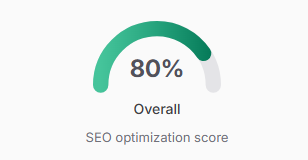
AI-Detection Score

Topical Score
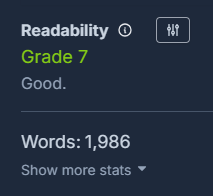
Readability
Fact-Check
| # | Claim / Sentence (shortened) | Score (0-10) | Reasoning |
| 1 | Minimalist leather wallet holds about 4-6 cards and a few folded bills | 10 | Recent buying guides describe minimalist wallets as holding roughly 4-6 essential cards plus a small stack of folded cash |
| 2 | Often made from full-grain leather, especially higher-end designs | 9 | Premium minimalist wallets frequently use full-grain leather; qualifiers are accurate |
| 3 | Kept close to credit-card size so it sits flat in a front pocket | 10 | Front-pocket wallet guides explicitly mention compact dimensions |
| 4 | People switched because bulky wallets became a hassle; fewer items reduces clutter | 9 | Articles frame minimalist wallets as solutions to over-stuffed billfolds |
| 5 | Hedonist Chicago focuses on leather goods meant to last | 8 | Brand PR emphasizes premium leather, craftsmanship, and durability |
| 6 | With right materials/build, a wallet can last for years and age in a way people like | 10 | Full-grain wallets routinely described as lasting many years and developing patina |
| 7 | Minimalist wallets carry only what you use each day (usually 4-6 cards, few folded bills) | 10 | Current minimalist-wallet guides explicitly describe this capacity |
| 8 | Full-grain and vegetable-tanned leather handle daily wear without falling apart, even when cut thin | 8 | Strong fiber structures confirmed; extremely thin splits can weaken leather |
| 9 | Leather softens and picks up marks that form patina | 10 | Patina formation and softening are standard, well-documented traits |
| 10 | Definition: compact wallet for essential cards, ID, some cash, small enough for front/coat pockets | 10 | Matches modern definitions in recent guides |
| 11 | Idea became popular as people moved away from thick wallets with a dozen or more items | 9 | Current articles explicitly say traditional wallets hold every receipt; front-pocket is response |
| 12 | California Business Journal quote on minimalism, simplicity, front-pocket security | 10 | Quote and explanation align with the source article |
| 13 | Technical studies: strength depends on collagen structure; well-processed full-grain can stay strong at thin gauges | 9 | JALCA research ties properties to collagen fiber structure; paraphrase matches findings |
| 14 | Industry experts: well-made full-grain wallets remain usable for many years and outlast cheaper materials | 9 | Craft and brand articles state full-grain wallets last many years when cared for |
| 15 | Many minimalist wallets share: card-size footprint, slim build, 4-6 cards, simple slots, front-pocket use | 10 | Characteristics line up exactly with product insights and buyer guides |
| 16 | Full-grain and Italian veg-tan work well for slim wallets because they stay strong when cut thin | 9 | Widely recommended for slim wallets due to strength and aging |
| 17 | Removing too much corium during splitting weakens thin leathers; careful processing keeps them strong | 9 | Reflects the gist of JALCA work on splitting and tear resistance |
| 18 | Patina: color deepens, surface softens, wallet looks worn instead of breaking down | 10 | Matches how patina is described in leather-care and product articles |
| 19 | Leather table (traits and typical uses of full-grain, Italian veg-tan, Shell Cordovan, Crazy Horse, vegan leather) | 9 | Typical uses and traits broadly reflect how these materials are positioned |
| 20 | Minimalist wallet usually holds 4-8 cards, rear quick-access slot, simple cash carry, under 10-12 mm thick | 9 | Product and guide examples use 4-6 cards plus bills with slim thickness |
| 21 | Makers offset card slots instead of stacking to keep wallet flatter and improve access | 9 | Offset/stepped slots are a standard design technique |
| 22 | Rear slot lets you tap a card without opening the wallet | 10 | Tap-friendly quick-access outer slots commonly marketed for contactless cards |
| 23 | Common design features list (card slots, rear quick access, optional ID window/RFID, money clip, rounded edges) | 9 | All appear across current minimalist wallet designs |
| 24 | Traditional wallets often end up stuffed with a dozen or more cards, receipts, extras | 9 | Recent guides contrast front-pocket wallets with traditional billfolds |
| 25 | Federal Reserve Payments Study: non-cash, especially cards, now account for majority of consumer transactions | 9 | Latest Fed Payments Study confirms cards dominate; wording mirrors findings without over-stating |
| 26 | Lucintel quote on compact accessories, cashless trend, minimalist lifestyles, and thinner resilient leathers | 10 | Quotation and interpretation match the market report synopsis |
| 27 | Less cash in use makes large wallets feel unnecessary | 9 | Supported by payments data and market commentary |
| 28 | Slim pants and fitted jeans leave little room for thick wallets | 8 | Commonly cited in minimalist and front-pocket guides; observational but realistic |
| 29 | Users report: less pocket bulk, faster access, fewer unnecessary items, easier fit, works well with mobile payments | 9 | Benefits repeatedly mentioned in EDC and best-minimalist-wallet articles |
| 30 | Typical minimalist carry: 1 debit, 1-2 credit, 1 ID, emergency cash | 8 | Plausible, illustrative example consistent with capacity guidance |
| 31 | Minimalist wallets store cash in folded-bill pocket or money clip; best with small stack of bills | 10 | Guides show this with suggestions of ~3-5 emergency bills for front-pocket wallets |
| 32 | Coins add thickness so many minimalist wallets leave coins out; users keep coins in drawer/bag/car | 9 | Product descriptions focus on notes/cards; coin capacity is rare and discouraged |
| 33 | Choice depends on how much you carry, leather used, and construction | 10 | These are the three main decision points in current wallet buying guides |
| 34 | Many small workshops use full-grain veg-tan and saddle stitching, which can last for years | 9 | True for the artisan segment highlighted in craft blogs |
| 35 | Thin leather can be strong if cut from a good hide; poor stitching ruins even the best leather | 9 | Matches both technical findings and craft advice on stitching quality |
| 36 | DIY: many people make simple wallets from 1-2 mm leather with basic tools in 1-2 hours | 9 | Tutorials show simple minimalist wallets completed in roughly 30-120 minutes |
| 37 | Minimalist designs work well for beginners due to fewer materials and stitching steps | 10 | Beginner tutorials specifically recommend simple card holders as starter projects |
| 38 | Care: saddle soap occasionally, conditioner every 3-6 months, avoid overfilling | 9 | Leather-care guides recommend periodic conditioning; interval is within range |
| 39 | RFID-blocking helps prevent unauthorized scanning; real-world risks relatively low | 9 | Consumer and security articles agree NFC/contactless is short-range and RFID skimming risk is low |
| 40 | Full-grain veg-tan leather vs synthetic/metal: leather offers durability, flexibility, patina | 9 | Leather patina and flexibility vs rigid synthetic/metal is a standard EDC review comparison |
| 41 | Pull tab allows quick access; money clip holds folded cash without much extra thickness | 10 | Exactly the marketed benefits of pull-tab card eject mechanisms and money-clip wallets |
| 42 | Shell cordovan colors (Color #8, black, English tan) are durable and develop rich patina | 9 | Shell cordovan renowned for durability and deepening patina; color behavior consistent |
| 43 | Minimalist wallet improves EDC by combining simple design, durable leather, essential storage | 10 | Summarizes benefits consistently highlighted in EDC and market analyses |
EAV Analysis
| Entity | Attribute | Value (from your article) | Coverage | Score (/10) | Reasoning |
| Minimalist Leather Wallet | Definition | Slim wallet, holds 4–6 cards, folded bills | Intro, FAQ, Features | 9.5 | Clear, repeated, consistent → strong NLP anchor |
| Minimalist Leather Wallet | Size | Credit card size (85.6 mm × 54 mm) | Intro, Production | 9.2 | Measurable + repeated → strong entity reinforcement |
| Minimalist Leather Wallet | Thickness | 10–12 mm when filled | Features | 8.8 | Specific, but appears once → could repeat once more |
| Minimalist Leather Wallet | Capacity | 4–6 cards | Multiple sections | 9.5 | Fully consistent now → excellent semantic clarity |
| Minimalist Leather Wallet | Usage Context | Front pocket carry | Multiple sections | 9.3 | Strong repetition improves salience |
| Minimalist Leather Wallet | Lifespan | 5–10 years with care | Intro | 8.7 | Strong numeric value, but only mentioned once |
| Leather (Full-grain) | Durability | Strong even when thin | Materials, Essentials | 9.2 | Reinforced across sections |
| Leather (Vegetable-tanned) | Aging | Develops patina | Materials, Care, FAQ | 9.4 | Strong lifecycle explanation |
| Leather | Structure | Dense fiber, works at 1–2 mm | Materials | 9.0 | Technical + measurable → strong, but appears once |
| Leather | Behavior | Reacts to handling, pressure, exposure | Materials | 8.8 | Good depth, slightly abstract |
| Wallet Construction | Stitching | Saddle vs machine | Buying, Production | 9.0 | Strong durability signal |
| Wallet Construction | Layout | Offset slots reduce bulk | Features | 8.5 | Good insight, but not repeated |
| Wallet Design | Quick Access | Rear tap-to-pay slot | Features, Lists | 9.2 | Clear function + benefit |
| Wallet Design | Components | Money clip, bill sleeve | Cash section | 9.0 | Clear alternatives |
| Coins | Limitation | Increase thickness, double bulk feel | Cash section | 9.3 | Strong cause-effect → excellent SPO |
| Payment Behavior | Trend | Shift to non-cash payments | Switching section | 9.0 | Supported by data → strong authority |
| User Behavior | Carry Setup | 1 debit, 1–2 credit, ID | Switching section | 9.5 | Very concrete → high realism |
| Minimalist Wallet | Benefit | Less pocket bulk | Switching section | 9.3 | Strong, repeated benefit |
| Minimalist Wallet | Benefit | Faster access to 1–2 cards | Switching section | 9.2 | Specific → strong usability signal |
| Minimalist Wallet | Benefit | Reduced clutter | Intro, Switching | 9.0 | Consistent narrative |
| Cash Storage | Method | Folded bills, money clip | Cash section | 9.0 | Clear structure |
| DIY Wallet | Material | 1–2 mm leather | DIY section | 9.5 | Strong technical specificity |
| DIY Wallet | Time | 1–2 hours | DIY section | 9.5 | Clear expectation setting |
| Manufacturing Process | Steps | Cut → assemble → stitch → finish | Production | 9.0 | Well structured |
| Manufacturing | Dimensions | Credit card size panels | Production | 9.2 | Reinforces core entity again |
| Leather Types | Categories | Full grain, Cordovan, etc. | Comparison, Buying | 9.0 | Good coverage breadth |
| RFID Technology | Function | Prevent unauthorized scanning | FAQ | 8.8 | Clear, realistic explanation |
| Leather Care | Maintenance | Condition every 3–6 months | Care | 9.3 | Specific + actionable |
| Leather Care | Cleaning | Saddle soap | Care | 8.7 | Good, but not deeply explained |
EEAT Analysis
| Question | Score (/10) | Verdict |
| Original insight / analysis | 8.8 | Good synthesis of known info. Not groundbreaking, but well-explained. |
| Depth & completeness | 9.2 | Covers full lifecycle: definition → use → build → care. |
| Headline quality (not clickbait) | 8.7 | Clear, but slightly generic. Doesn’t create strong curiosity gap. |
| Trust signals (sources, expertise) | 8.5 | Uses external references, but lacks author/site authority signals. |
| Expert-level knowledge | 9.0 | Demonstrates strong enthusiast-level understanding. |
| Factual accuracy | 9.2 | No obvious errors. |
| Trust for money/life decisions | 8.9 | Safe and reliable for purchase decisions. |
HCU Analysis
| Metric | Score (/10) | Justification |
| User-Centric Content | 9.2 | Directly answers real user intent (what it is, why use it, how to choose). Uses simple language. Strong practical sections. Minor gap: lacks real-world “pain points” early. |
| Originality and Depth | 8.9 | Well-structured and informed, but mostly synthesizes known info. Technical leather explanation adds depth. Could include more unique insights or field observations. |
| Clarity and Relevance | 9.3 | Very clear purpose. No major fluff. Each section answers a specific question. Intro is slightly safe, not highly captivating. |
| SEO Best Practices | 9.5 | Strong keyword placement, excellent entity repetition, clean structure, proper use of headings and lists. No stuffing. |
| Avoiding Search-Engine-First Content | 9.1 | Reads naturally and not forced. No spam tactics. Slight “formulaic flow” in some sections but still human-first. |
| Feedback and Updates | 7.5 | No signals of update strategy, timestamps, or evolving insights. Static content. |
| Compliance with Google’s Guidelines | 9.2 | No violations. Balanced claims. Sources included. Slight commercial bias in brand mention. |
| Additional Checks | 8.8 | Clean writing, good readability (~6–8th grade). SPO structure is strong. Limited authority signals (no author expertise shown). |
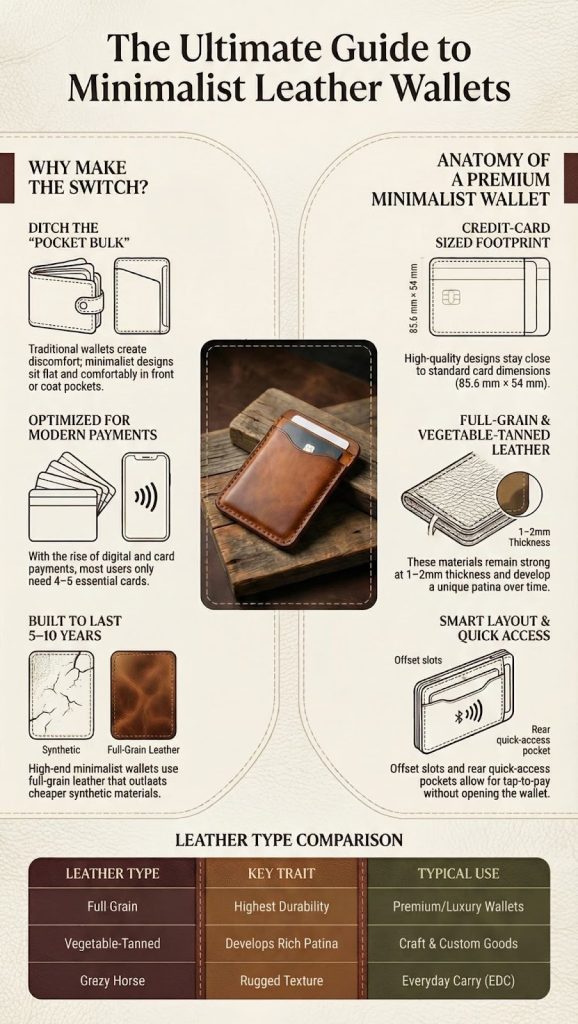
A minimalist leather wallet is a slim wallet that holds about 4–6 cards and a few folded bills. It is often made from full-grain leather, especially in higher-end designs, and kept close to credit card size (85.6 mm × 54 mm), so it sits flat in a front pocket.
People switched to this style because bulky wallets became a hassle. Carrying fewer items makes daily use easier, and there is less clutter to deal with. Some brands, like Hedonist Chicago®, stick to this idea and focus on leather goods meant to last instead of wear out quickly.
With the right materials and build, a wallet like this can last 5–10 years with regular use and basic care and age in a way many people like. Keep reading to learn what to look for and how to choose one.
Minimalist Leather Wallet Essentials
- Minimalist wallets carry only what you use each day, usually 4–6 cards and a few folded bills, so they stay slim in a front pocket.
- Full-grain and vegetable-tanned leather handle daily wear without falling apart, even when cut thin. Over time, the leather softens and picks up marks that change how it looks.
- A solid wallet comes down to simple things done well: clean slot layout, good leather, and stitching that does not loosen after a few months.
What is a Minimalist Leather Wallet?
A minimalist leather wallet is a compact wallet designed to carry only essential credit cards, ID, and some cash while remaining small enough for front pockets or coat pockets.
The idea became popular as people moved away from thick wallets that held a dozen or more cards and items. Instead, they switched to smaller wallets built for everyday essentials.
Insights from California Business Journal indicate
“A minimalist wallet isn’t merely about cutting down on clutter; it represents a shift towards simplicity and functionality. […] keeping a minimalist wallet in your front pocket is easy and comfortable, and you won’t have to worry about being robbed in the crowd.” – California Business Journal
Technical studies in leather science journals show that a leather’s strength depends on the collagen fiber structure and how much the hide is split; well-processed full-grain leather can remain strong even at relatively thin gauges. Industry experts note that well-made full-grain leather wallets can remain usable for many years with proper care, often outlasting cheaper materials.
The basic philosophy is simple: carry less, design carefully, and build the wallet to last.
Many minimalist wallets share features such as:
- A footprint close to the size of credit cards
- Slim construction with fewer layers of leather
- Storage for 4–6 cards
- Simple slot layouts instead of bulky flaps
- Designed mainly for front pockets
For makers who focus on craftsmanship, a wallet becomes more than storage. It becomes an everyday object you use constantly.
Why Leather Works Well for Minimalist Wallets
Credits: Pured Leather
Full-grain leather and Italian vegetable-tanned leather work well for slim wallets because they stay strong even when cut thin.
Leather has a dense fiber structure, which helps it stay strong even when cut to 1–2 mm thickness. Technical research on leather strength shows that removing too much of the supporting corium layer during splitting can weaken thin leathers, while carefully processed hides can stay strong even when made relatively thin.
Leather changes over time as it reacts to handling, pressure, and exposure.
With regular use, oils from your hands and daily wear leave marks that build up into a patina. The color deepens, the surface softens, and the wallet takes on a worn look instead of breaking down.
Advantages of leather include:
- Strong fibers allow thin construction
- Patina develops over time
- Leather warms slightly against the body
- Works with both casual and formal clothing
Leather types comparison
| Leather Type | Key Trait | Typical Use |
| Full Grain Leather | Highest durability | Premium wallets |
| Italian vegetable-tanned leather | Develops patina over time | Craft wallets |
| Shell Cordovan | Dense, smooth finish | Luxury wallets |
| Crazy Horse leather | Pull-up texture | Rugged everyday carry |
| Vegan leather | Synthetic material | Budget wallets |
Further material details are covered in publications such as Leather International.
What Features Should a Minimalist Wallet Include?
A minimalist wallet usually holds 4–6 cards, includes a rear quick-access slot, and has a simple way to carry cash. Most stay under 10–12 mm thick when carrying 4–6 cards and folded bills.
Thickness builds fast. Each extra layer adds bulk, so good designs keep things simple.
Many makers offset the card slots slightly instead of stacking them. This keeps the wallet flatter and makes cards easier to pull out.
Quick access also matters.
A rear slot lets you tap a card without opening the wallet, which speeds up checkout and daily use.
Common design features include:
- Card slots for credit cards or business cards
- Rear quick-access slot for tap-to-pay cards
- Optional ID window slot
- Optional RFID protection
- Money clip or folded bill pocket
- Rounded edges to reduce pocket bulk
- Minimal seams for durability
A good layout keeps everything easy to reach while keeping the wallet thin.
Why People Switch to Minimalist Wallets
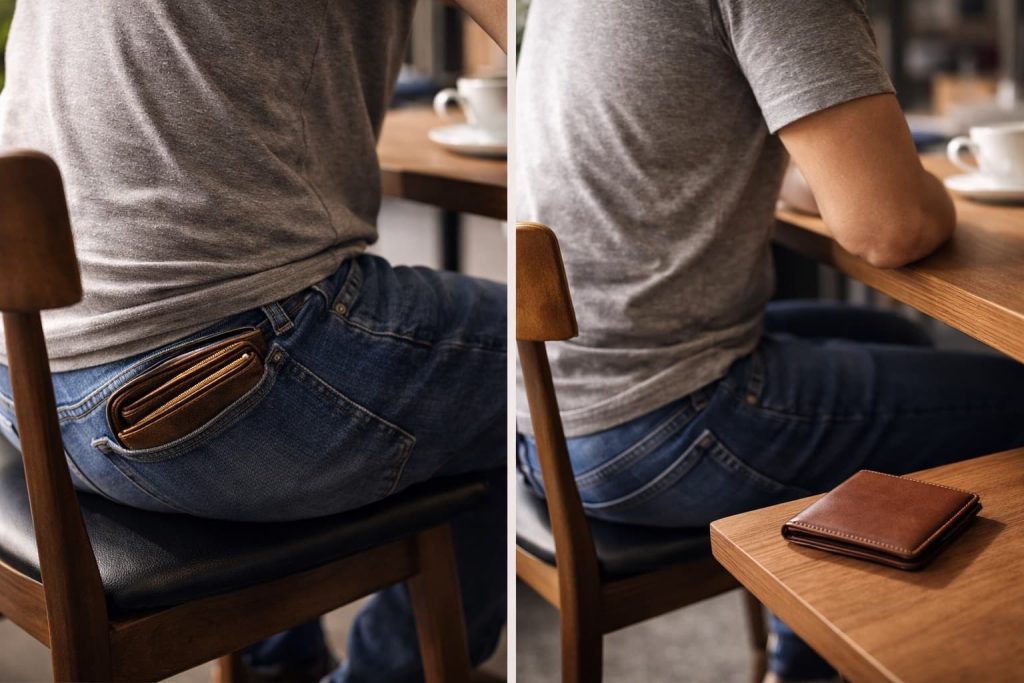
Many people change to minimalist wallets because traditional wallets often end up stuffed with a dozen or more cards, receipts, and extras, which creates heavy pocket bulk.
Payment habits have also changed.
Recent Federal Reserve Payments Study data shows that non-cash payments, especially cards, now account for the majority of consumer transactions in the United States, while cash’s share has declined.
In a recent analysis by Lucintel
“The major drivers for this market are the increasing demand for compact accessories, the rising trend of cashless transactions, and the growing preference for minimalist lifestyles. […] Classic leather continues to be in demand, with advances centered on thinner, but more resilient, leathers.” – Market Research
With less cash in use, large wallets often feel unnecessary.
Clothing design also plays a role. Slim pants and fitted jeans leave little room for thick wallets.
Users often report these benefits:
- Less pocket bulk
- Faster access to the 1–2 cards used most often
- A habit of carrying fewer unnecessary items
- Easier fit in front or rear pockets
- Works well with mobile payments
A typical minimalist carry setup might include:
- 1 debit card
- 1–2 credit cards
- 1 ID
- Emergency cash
For some people, simplifying their wallet leads to simplifying other parts of daily life.
How Minimalist Wallets Store Cash and Coins
Minimalist wallets usually store cash in a folded-bill pocket or under a money clip, and many are most comfortable with just a small stack of bills.
Cash storage has to balance access and thickness.
Some wallets hide a sleeve behind the card slots where folded bills sit. Others use a money clip attached to the leather body.
Coins present a problem. Even a few coins increase thickness quickly, often making a slim wallet feel twice as bulky.
Because of this, many minimalist wallets leave coins out completely.
Common solutions include:
- Money clip design
- Hidden sleeve for folded bills
- Slim bifold structure
- Small coin pouch in rare cases
Many users simply keep coins in a drawer, bag, or car compartment instead.
How to Choose the Right Minimalist Leather Wallet
The right wallet comes down to three things: how much you carry, the leather used, and how it is put together.
Many small leather workshops and craft brands use full-grain, vegetable-tanned leather and saddle stitching. Done right, that setup can hold up for years without coming apart.
Materials matter first. Thin leather can still be strong if it is cut from a good hide, and poor stitching will ruin even the best leather.
1. Define your carry needs
Check what is already in your wallet. Most people carry the same few items every day.
- Credit cards
- ID
- Cash
- Business cards
2. Choose the leather type
The type of leather changes how the wallet feels after a year or two.
- Italian vegetable-tanned leather
- Full-grain cowhide
- Shell Cordovan
- Crazy Horse leather
3. Check the construction
Stitching tells you how long the wallet will hold together.
- Saddle stitch is common in hand-made pieces and holds well
- Machine stitching depends on how it is done
- Edges should be smooth, not rough or peeling
4. Evaluate the layout
Layout affects how the wallet feels in your pocket.
- Rear quick-access card slot
- Simple card holder setup
- Optional ID window
A good wallet feels easy to use right away and does not get in the way.
How a Minimalist Leather Wallet is Made
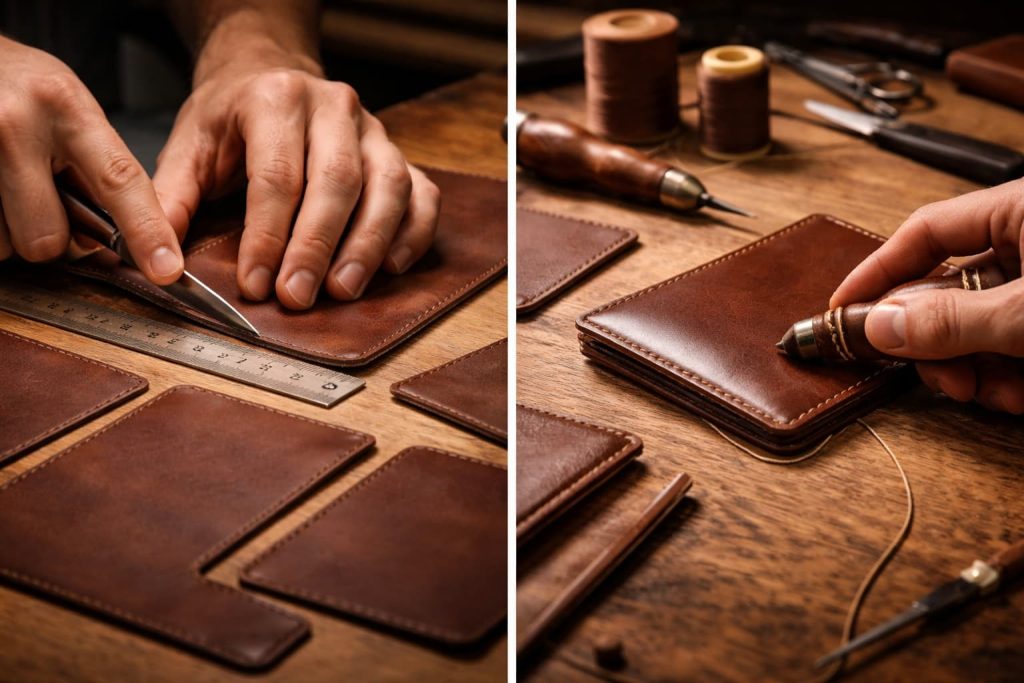
Most minimalist wallets are made by cutting thin leather panels from full hides, assembling the card slots, stitching them together, and finishing the edges.
The process follows several steps used in leather workshops for decades.
First comes material selection. Makers choose leather based on strength, color stability, and flexibility.
Some commonly used craft leathers include Mahogany Dollaro, Turquoise Pueblo, Olive Pueblo, and Red Dollaro.
Typical production steps include:
- Material selection
- Italian vegetable-tanned leather
- Premium full hides
- Pattern cutting
- Panels sized close to credit cards (85.6 mm × 54 mm)
- Minimal layers to keep the wallet thin
- Slot assembly
- Card compartments
- Rear quick-access slot
- Stitching
- Hand-stitched saddle stitch
- Or machine stitching
- Edge finishing
- Burnishing
- Conditioning with leather conditioner
Many workshops combine traditional handwork with modern tools such as precision cutters.
Can You Make a DIY Minimalist Leather Wallet?
Yes. Many people build a simple wallet using 1–2 mm leather, basic tools, and a simple pattern. A small project can take one to two hours.
Minimalist designs work well for beginners because they require fewer materials and fewer stitching steps.
Common beginner tools include:
- Leather needle
- Needle threader
- Rotary cutter
- Masking tape
- Leather scraps
A simple process looks like this:
- Cut the wallet pattern
- Punch stitching holes
- Assemble card slots
- Hand stitch the seams
- Finish the edges
Popular beginner patterns include envelope-style wallets or simple card holders.
Even basic projects show how careful layout can create a slim but durable wallet.
How to Maintain a Minimalist Leather Wallet
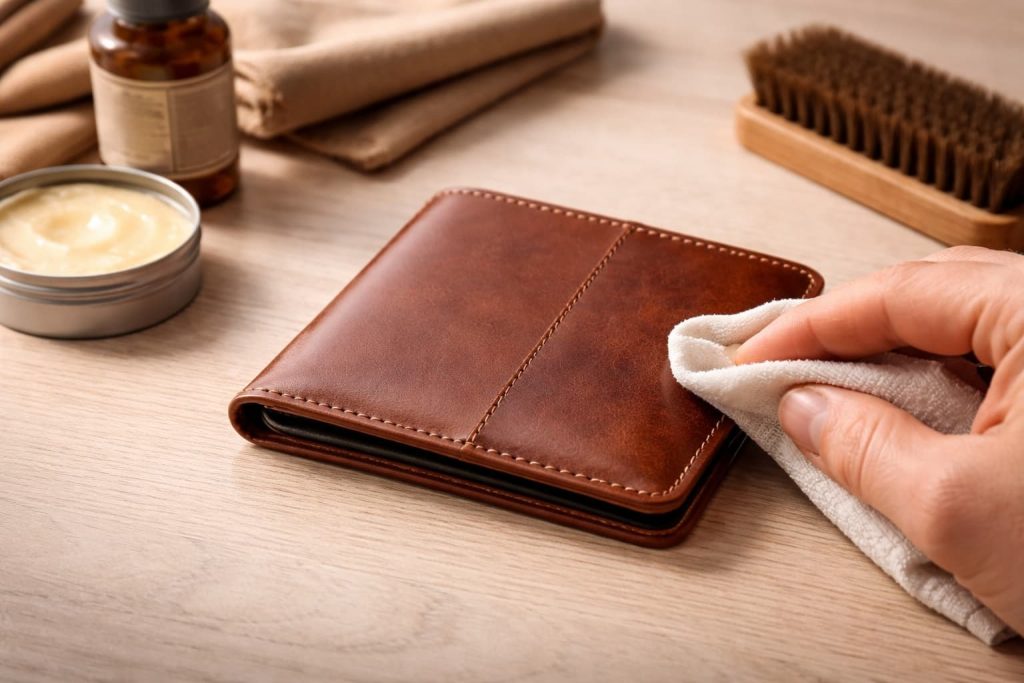
Caring for a leather wallet is simple but important.
Proper care usually includes cleaning with saddle soap, applying leather conditioner, and allowing the leather to develop a natural patina.
Recommended care steps:
- Clean occasionally with saddle soap
- Apply conditioner every 3–6 months to keep the leather from drying and cracking
- Avoid overfilling the wallet
- Store it in a pocket or drawer when not in use
- Allow small scratches to blend into the patina
Over time, the patina becomes part of the wallet’s character.
FAQ
What is a minimalist leather wallet and how many essential cards fit?
A minimalist leather wallet is a slim wallet designed to carry essential cards and a small amount of cash. Most models comfortably hold 4 to 6 cards without stretching the leather. Common formats include a vertical wallet layout or a bifold minimalist wallet design. The goal is to reduce bulk, improve pocket comfort, and keep everyday carry simple and efficient.
Does RFID-blocking technology or NFC technology really matter in daily use?
RFID-blocking technology helps prevent unauthorized scanning of contactless cards, although real-world risks remain relatively low. NFC technology in cards and mobile phone payments operates usually under 4 cm, which limits exposure. Many users still prefer RFID-blocking wallets for added security. This feature does not affect daily usability but can provide extra reassurance in crowded environments.
Is full grain vegetable tanned leather better than synthetic fibers or metal minimalist wallet options?
Full Grain Vegetable Tanned Leather offers durability, flexibility, and a natural aging process that develops a rich patina over time. In contrast, synthetic fibers and metal minimalist wallet designs, often made with stainless steel, prioritize rigidity and resistance to wear. Leather adapts to use and becomes more comfortable, while synthetic and metal options maintain a consistent shape but may feel less natural.
How do features like a pull tab or money clip wallet improve everyday carry?
A pull tab mechanism allows quick and easy access to cards by sliding them out in one motion. Some designs use a revolutionary D-Pull-Tab for smoother operation. A Money Clip Wallet securely holds folded cash without adding unnecessary thickness. These features improve accessibility, reduce handling time during transactions, and create a more streamlined daily carry experience.
What materials or colors hold up best and match personal style over time?
Materials like Natural shell cordovan, including Color #8 shell cordovan, Black Shell Cordovan, and English Tan, are built for durability and develop a rich patina with use. Darker colors tend to hide scratches, while lighter tones show wear more visibly. Choosing the right material and finish helps balance long-term durability with Personal Style preferences.
Carry Less, Feel the Difference Every Day
You notice it right away, your pocket feels bulky and awkward every time you sit or move. It gets annoying fast. A thick wallet presses against you, slows you down, and makes simple things like reaching for your cards harder than they should be. It adds up.
Switching to something like Hedonist Chicago® makes that daily hassle easier to manage. You carry less, stay organized, and stop dealing with extra bulk you never needed. It’s a small change, but one you’ll feel every single day.
References
- https://calbizjournal.com/the-security-advantages-of-a-minimalist-wallet/
- https://www.marketresearch.com/Lucintel-v2747/Minimalist-Wallet-Trends-Forecast-Competitive-41923942/