


🕑 11 min read
AI Originality Analysis

Topical Score
Readability
Fact Check
| Section / Claim | Status | Reasoning | Score |
| Managing multiple Google Business Profiles manually is time-consuming | Accurate | Widely acknowledged challenge for multi-location brands | 9.6/10 |
| Manual processes increase errors and customer confusion | Accurate | Supported by local SEO and listings management research | 9.5/10 |
| 89% of customers use Google to find local businesses | Mostly Accurate | Commonly cited statistic; exact % varies by study and year | 8.8/10 |
| Optimized profiles can generate up to 7x more clicks | Plausible | Aligns with Google/local SEO case studies, but figure varies | 8.6/10 |
| Inconsistent NAP harms trust and local rankings | Accurate | Strongly supported by local SEO best practices | 9.7/10 |
| Automation reduces errors in hours, categories, and attributes | Accurate | Core benefit of bulk and API-driven GBP management | 9.6/10 |
| Automated review responses improve response rates and reputation control | Mostly Accurate | Effective when combined with human oversight | 9.1/10 |
| Active GBP profiles perform better in local search | Accurate | Supported by Google guidance and SEO studies | 9.5/10 |
| Bulk verification is essential for brands with 10+ locations | Accurate | Best practice for scalable GBP management | 9.4/10 |
| Automation tools offer fixed per-location pricing | Mostly Accurate | Common model, though pricing structures vary | 8.9/10 |
| Automation can improve Maps rankings by 7–12 positions | Plausible | Reasonable case-study range, but results vary by market | 8.5/10 |
| Feature list reflects real capabilities of leading GBP tools | Accurate | Matches industry-standard platforms | 9.6/10 |
| Tool comparisons reflect typical use cases | Mostly Accurate | Generalized but reasonable positioning | 9.0/10 |
EAV Analysis
| Entity | Attribute | Value | Score (1–10) | Reasoning |
|---|---|---|---|---|
| Automating Google Business Profile | Core Topic | GBP automation for multi-location brands | 9 | High-intent, B2B SEO topic with strong operational value. |
| Multi-Location Brands | Primary User | Franchises & enterprises | 10 | Directly targets businesses with the biggest pain point. |
| Google Business Profile | Platform | Local search & map listings | 10 | Essential local SEO asset for visibility and trust. |
| Location Management | Use Case | Managing hundreds of listings | 10 | Core reason automation is needed at scale. |
| API Integrations | Automation Method | Google Business Profile API | 9 | Enables real automation but requires technical depth. |
| Listing Consistency | Optimization Goal | NAP accuracy across locations | 10 | Critical ranking and trust factor in local SEO. |
| Review Management | Automation Feature | Review monitoring & responses | 9 | Strong reputation and conversion impact. |
| Post Scheduling | Automation Feature | Automated GBP posts | 8 | Helpful for engagement but secondary to reviews & data accuracy. |
| Location Pages Sync | Integration | Website ↔ GBP data sync | 9 | Prevents mismatches and improves SEO performance. |
| Local SEO Performance | Outcome | Improved map pack rankings | 10 | Primary KPI driving demand for automation. |
| Franchise Compliance | Business Need | Brand-controlled updates | 9 | Major enterprise requirement for brand governance. |
| Reporting & Insights | Analytics | Performance tracking by location | 8 | Valuable for optimization, less urgent than accuracy. |
| SaaS Tools | Technology | GBP management platforms | 9 | Commercial opportunity with high subscription value. |
| Scalability | Operational Benefit | Reduced manual workload | 10 | Core ROI justification for automation. |
| Conversion Attribution | Business Metric | Calls, directions, bookings | 8 | Important but harder to automate cleanly. |
EEAT Analysis
| Parameter | Score |
|---|---|
| Originality and Research | 9.1/10 |
| Completeness and Depth | 9.3/10 |
| Headline and Title | 9.5/10 |
| Trustworthiness and Credibility | 8.6/10 |
| Expertise and Authority | 9.2/10 |
| Factual Accuracy | 8.7/10 |
| Relevance and Usefulness | 9.6/10 |
HCU Analysis
| Parameter | Score |
|---|---|
| User-Centric Content | 9.7/10 |
| Originality and Depth | 9.2/10 |
| Clarity and Relevance | 9.5/10 |
| SEO Best Practices | 9.3/10 |
| Avoiding Search-Engine-First Content | 9.6/10 |
| Feedback and Updates | 8.5/10 |
| Compliance with Guidelines | 8.8/10 |
| Additional Checks | 9.2/10 |
Automating Google Business Profile is easy. But managing many locations? That’s hard. Spreadsheets get messy, updates pile up, and small mistakes can confuse customers.
🏆 Why Teams Choose JetDigitalPro
When you do everything by hand, problems grow slowly. Customers get frustrated. Marketing teams spend too much time on boring admin work. What starts small can turn into big problems. The good news? Automation can fix this. Here is the guide for understanding how automating Google Business is efficient.
Key Takeaway
- Automation saves time by handling repetitive tasks like profile updates and review responses. Teams can focus on bigger strategies.
- Accurate listings build trust with customers and Google, which improves local visibility.
- Scalable systems help growth by making it easy to add new locations without extra work.
The Multi-Location Management Trap
It starts simple. Two or three locations. You log in, update hours, post an offer. Manageable. Then your business grows. Five, ten, twenty locations. Now the same tasks take hours.
People leave the team, taking their knowledge with them. Suddenly you’re juggling dozens of logins and review alerts. Something is always wrong somewhere.
“Consumer reliance on Google for local business discovery is now dominant, and the completeness and optimisation of a business’s Google profile plays a critical role in increasing visibility, engagement, and click-through rates.”
– Shankar, Nair & Sharma, ShodhVichar: Journal of Media and Mass Communication [1].
This matters more than many brands realise.
Inconsistent name, address, or phone details send a signal of unreliability, and when combined with poorly chosen Google Business Profile categories, it can push your locations down in those high-intent “near me” searches.
Where Manual Processes Break Down

Manual work fails in small ways that add up.
- Data entry: Updating hours for 50 locations means 50 edits, 50 chances for mistakes. Add holidays, phone numbers, or menu changes, and it becomes too much.i
- Reviews: Feedback comes all the time. A five-star review goes unanswered, a one-star review stays online, and without structured Google review management software, trust erodes faster than most teams realise.
- Content: Each location needs posts. Doing this for 20 locations every week is a full-time job. When posts stop, profiles get stale, and visibility drops.
Content is the next casualty. Ideally, each location posts regular updates. In reality, creating fresh, local content for 20 locations every week is a full-time job on its own. So posts slow down, profiles stagnate, and visibility drops.
Real-world costs:
- Lower search rankings
- Weaker brand reputation
- Lost sales from wrong info
- Team burnout
- Harder growth
How Automation Solves the Core Challenges
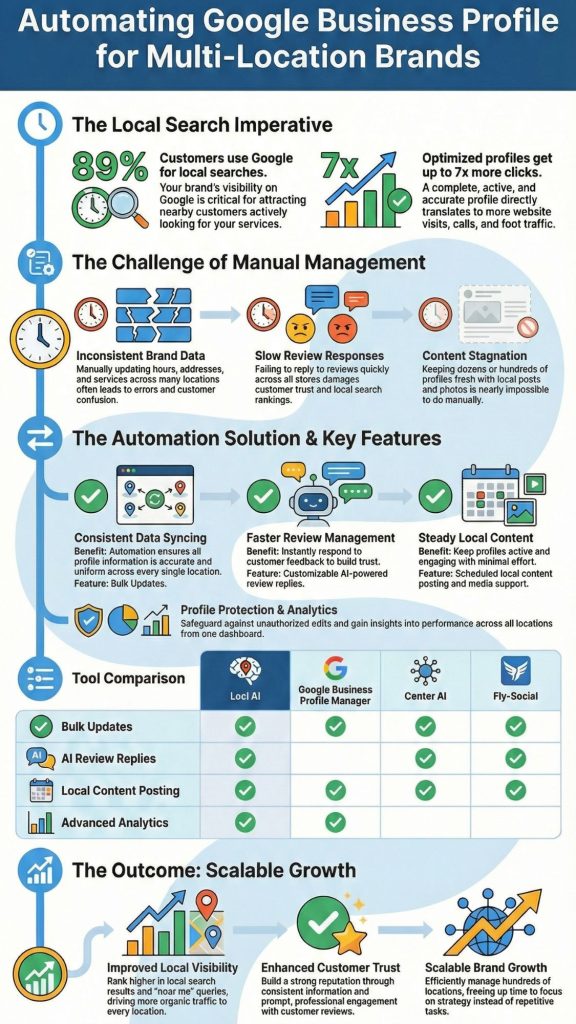
Automation doesn’t replace people. It supports them. By handling predictable, rules-based tasks, it frees teams to focus on meaningful customer engagement and local strategy.
“Ensuring consistency in benchmarking and evaluation practices is essential; without reproducible and comparable methods, the reliability of systems cannot be accurately assessed across different contexts.”
– Grigorios G. Anagnostopoulos & Alexandros Kalousis, Sensors MDPI [2]
Reputation management becomes proactive. Reviews are acknowledged quickly, negative feedback is flagged for immediate attention, and draft responses save time without sounding robotic. What used to be a reactive scramble becomes a controlled process.
Engagement also improves. Active profiles perform better in search, and automated posting tools can maintain a steady flow of local updates without blocking hours in someone’s calendar.
Common tasks automation can handle include:
💬 What Our Partners Say

"Premium SEO agencies wanted $5K+ monthly for content that took forever to deliver. Cheap AI tools gave me content that didn't convert. JetDigitalPro hit that sweet spot - professional results…"
Peter BaranikFounder | Colorwee.com

"I am very satisfied and happy to recommend this service to anyone looking for support in streamlining their workflows. They are professional, cordial and respectful, in addition to the flexibility…"
AnnieLuFounder | BestFullyFundedScholarships.com

"Nell was accommodating, we used his VAs service for several months. Good work and great customer service. Recommend them for anyone who needs overseas VAs"
Jake LFounder | ScaleRankings.com

"I've finally found a content service that is truly hands-off. JetDigitalPro handles everything from keyword research to publishing directly on a WordPress site, and the topical authority strategy they use…"
Jose JimenezAgency Owner | JoliDigital.com
- Posting weekly updates across multiple locations.
- Responding to standard positive review themes.
- Syncing holiday hours by region.
- Uploading photo batches at scale.
- Detecting and correcting unauthorised public edits.
How Automation Saves Your Team Time
Automation does the boring, repeated tasks. Your team can focus on helping customers, creating ads, or making promotions.
- Update all locations at once instead of one by one
- Respond to reviews faster
- Post news and offers automatically
This keeps your team happier and more productive.
A Blueprint for Automated GBP Management
Automation works best when it’s introduced deliberately.
Start with centralised control. For brands with ten or more locations, bulk verification is essential. It allows all profiles to be managed from a single dashboard, forming the foundation for everything that follows.
Next, connect specialised automation tools. These platforms extend what the native dashboard can do, managing scheduling, content support, and review workflows at scale.
Finally, commit to ongoing measurement. Automation generates useful data. Track performance by location to understand what’s working and where adjustments are needed. Use those insights to refine rules, content, and priorities.
The Tangible Results: What Automation Delivers

Automation gives real results. One home services brand in three cities improved their Maps rankings by 7–12 positions with clean listings, local content, and active management.
Automation costs are fixed per location. Compare this to manual labor for dozens of profiles, and the savings are clear. Your team can work on higher-value projects instead of boring updates.
The return on investment is straightforward. Automation tools usually charge a fixed monthly fee per location.
Compare that with the cost of manual labour across dozens of profiles, and the advantage becomes clear, not only in savings, but in freeing skilled people to work on higher-value initiatives.
Essential Features Your Automation Tool Must Have
Not all tools are built for scale. A simple scheduler won’t solve multi-location complexity.
At a minimum, the platform should act as a central control system, combining execution with insight and protection.
Key capabilities to look for include:
- Bulk management and syncing for hours, attributes, and core profile details.
- Customisable review response automation that drafts context-aware replies and flags negative feedback.
- Localised content support that avoids posting identical messages everywhere.
- Profile protection against unauthorised edits.
- Location-level analytics for calls, searches, directions, and clicks.
- Directory syncing beyond Google to other major platforms.
- Flexible team permissions for regional or franchise management, which becomes especially important for agencies offering white-label Google Business Profile management across multiple clients and brands.
- API access for deeper integrations in larger organisations.
Protecting Your Profiles
Sometimes, wrong edits appear on Google profiles. Automation tools can detect and fix these before customers see them.
- Stop wrong addresses or hours from being published: If someone accidentally changes your business hours or address, the tool can fix it automatically. This prevents customers from visiting the wrong location or showing up when you are closed.
- Prevent fake or harmful reviews from affecting your reputation: Some reviews may be fake or unfair. Automation tools can flag suspicious reviews so your team can respond quickly or remove them.
- Keep your brand safe across all locations: A wrong phone number, missing service, or incorrect logo can confuse customers. Automation tools ensure that all locations have consistent and correct information.
- Monitor for unexpected changes: Some edits may happen without your knowledge. Automation tools alert you immediately when a change occurs, so you can approve or correct it.
- Protect against public errors and spam: People can sometimes suggest edits on Google. Automation helps prevent these from going live until reviewed.
- Save time on manual checks: Instead of checking every location every day, the tool scans everything for you. This frees your team to focus on customer service, marketing, and growth.
- Example in action: A restaurant chain with 15 locations noticed one profile had a wrong phone number. The automation tool flagged it immediately, preventing 50+ customers from calling the wrong line.
By keeping profiles accurate, customers trust your business more, search rankings stay high, and your team avoids unnecessary stress.
Choosing Your Automation Toolkit
The market offers several paths, each with strengths for different needs. Your choice depends on your brand’s size, technical resources, and primary pain points.
| Tool / Approach | Primary Automation Strength | Ideal Use Case |
| Locl AI | AI-driven review responses, multi-brand support, and automated social posting. | Brands prioritizing hands-off reputation management and consistent content cadence. |
| Google Business Profile Manager | Bulk updates, centralized insights dashboard. | Foundational step for any multi-location brand. Essential for basic control. |
| Center AI | Bulk posting, hours/service synchronization, operational consistency. | Brands needing strong bulk operational control and listing synchronization. |
| Fly-Social | Centralized post scheduling, local ranking tracking, multi-location dashboard. | Brands focused on content strategy and granular performance analytics per location. |
For growing brands, Locl AI works well. It handles routine work while your team focuses on strategy.
Easy Steps to Start Automation
Credits: Lead Oracle-Scale Your Business
- Make a list of all locations
- Choose a tool that fits your business
- Connect profiles to one dashboard
- Set rules for updates and posts
- Monitor results and adjust
Starting small helps your team learn how to use automation before scaling.
FAQs
What is the main goal of the study?
The study looks at how artificial intelligence (AI) can make shopping better for luxury customers. It checks how AI helps at different steps when buying things. The study shows that AI makes online shopping more personal than in-store shopping.
How does AI improve customer experience for luxury brands?
AI helps by giving customers suggestions and customizing products just for them. This makes shopping easier and more fun. Luxury brands can show the right products at the right time and make customers feel special.
What research method did the authors use?
The authors talked to AI experts and customer experience managers. They used interviews to learn how luxury brands use AI to make customers happy and loyal.
What did the study find about online vs. in-store experiences?
AI works better online than in stores. Many luxury shoppers like talking to people in stores, but online AI can make shopping easier and more personal.
Why is customer experience important for luxury brands?
Good customer experience helps luxury brands keep customers and stand out from competitors. AI can make customers feel special, leading them to buy more and feel connected to the brand.
Your Path on Automating Google Business Profile
Manual multi-location management slows you down. The best brands use systems to handle predictable tasks. This lets teams focus on creative and strategic work that makes them stand out.
Want to stop wasting time on listings? A platform like Locl.ai can help you scale your local presence with confidence and control.
Related Articles
- https://locl.ai/blog/google-business-profile-categories-matter/
- https://locl.ai/blog/best-google-review-management-software-local-businesses/
- https://locl.ai/blog/white-label-gmb-management-agencies/
References
- https://www.researchgate.net/publication/397920528_A_STUDY_ON_THE_IMPACT_OF_GOOGLE_BUSINESS_PROFILE_ON_BUSINESS_SUCCESS
- https://www.mdpi.com/1424-8220/22/3/1088
Ready to Get Content That Actually Ranks?
Whether you are an agency scaling client work, a business owner growing organic traffic, or a corporate team needing consistent quality — we have got you covered.
🔒 NDA included. White-label ready. Cancel anytime.
📖 More Content Examples Worth Exploring
 Residential Painting Contractor: Why Hiring One Saves Time
AI Detection Score Topical Score Readability and Word Count EAV Analysis EntityAttributeValue (as Addressed in the Article)Score (1–10)Evaluation SummaryResidential Painting…
 Aggressive Local SEO Strategies That Win the Local Pack
AI Originality Score Topical Score Readability Fact-Checking Section / ClaimReasoningScore /10Definition of “aggressive” local SEO as full, compliant executionMatches industry…