

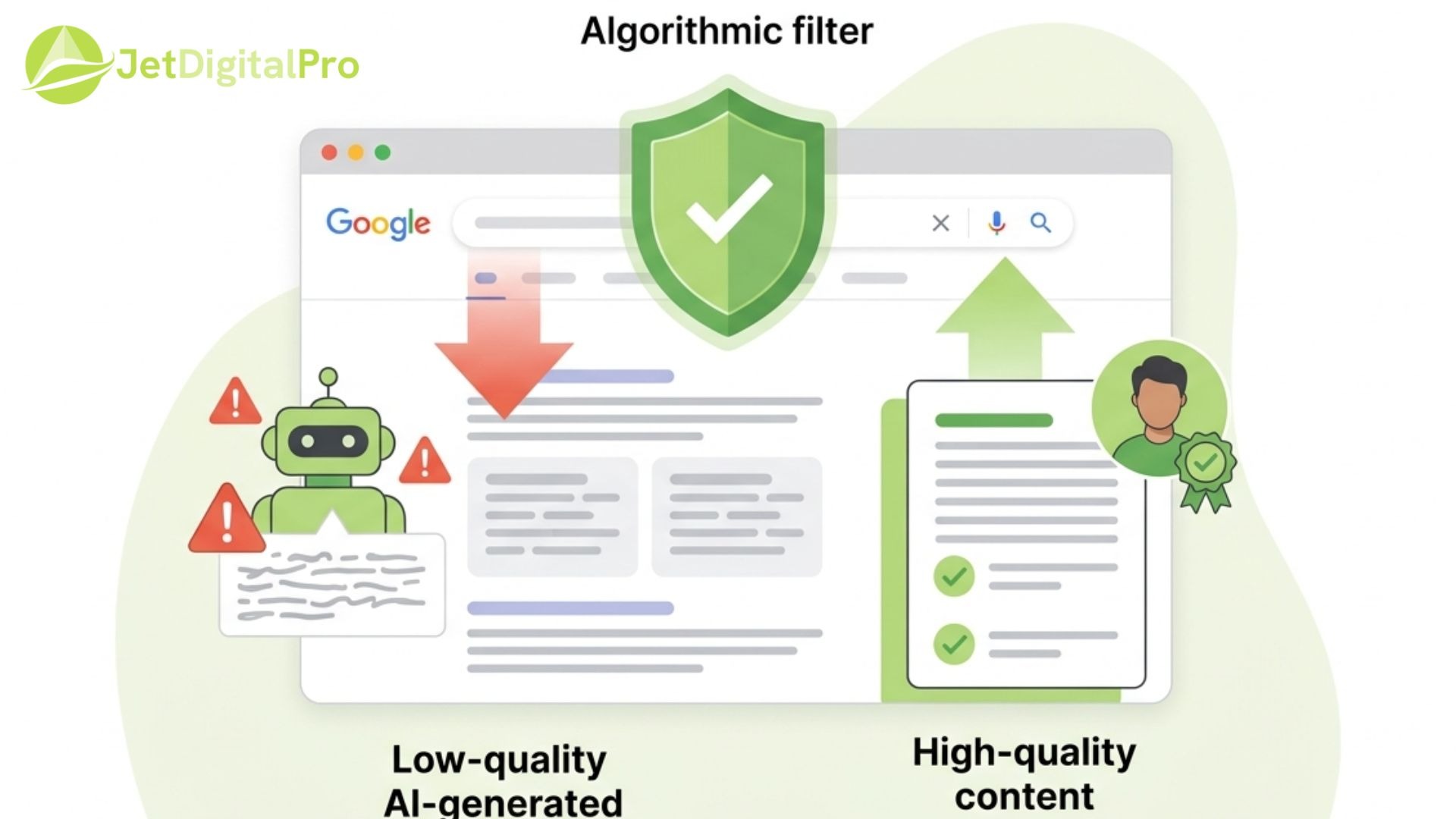
The March 2026 Core Update didn’t penalize AI content, it penalized bad content, forcing many businesses to rethink how they choose the best SEO content writing services. Google’s algorithm now ruthlessly filters out mass-produced, unhelpful pages, rewarding those that demonstrate real experience and add new information.
If you saw traffic drops of 60–80%, you were likely relying on AI without human oversight. The winners? Sites that used AI as a tool within a rigorous editorial process focused on E-E-A-T and original insights. This isn’t an AI crackdown. It’s a quality crackdown. The path forward is clearer than you think. Keep reading to understand what survived and how to adapt.
We write SEO articles that rank on Google — so you can focus on your business.
See Writing Plans →AI SEO Reality Check
What actually matters now in ranking and visibility has shifted, here’s the distilled truth behind AI-driven search.
- Google targets low-value content, not the AI tool itself.
- “Information Gain” from original data and experience is now critical.
- Being cited in AI Overviews is more valuable than ranking #1.
How the March 2026 Core Update Redefined Quality
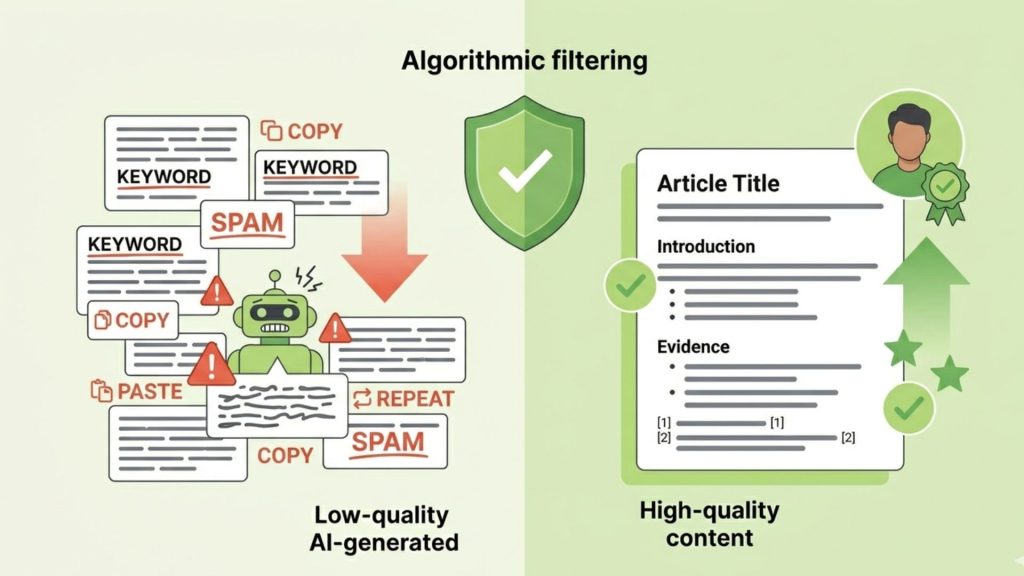
You watched your analytics dashboard, the numbers bleeding red. A sudden drop, a tremor in your organic traffic. For many, it was a catastrophe. Sites that churned out AI content without a human editor in the loop saw collapses, 60–80% losses according to analysts at Xpert.Digital. It felt personal, a direct strike. But the algorithm wasn’t looking for AI fingerprints; it was looking for value, or rather, the absence of it.
The Anatomy of the Quality Crackdown
The update sharpened Google’s ability to spot content that merely exists, content that fills a page but adds nothing to the conversation. This includes thin content, generic advice, and paragraphs that sound knowledgeable but cite no real experience. It’s the stuff that feels like it was assembled, not written.
The scope of this impact was massive, affecting 55% of all monitored websites (Ahrefs & Semrush, 2026). The volatility was not distributed equally; industries relying on templated content bore the brunt of the algorithmic shift.
| Metric/Category | Impact Result | Source |
| Mass-produced AI content (No editing) | 60–80% traffic loss | Xpert.Digital |
| Overall market volatility | 55% of websites affected | Ahrefs & Semrush |
| Affiliate Marketing sites | 71% negative impact | Semrush / Ahrefs |
| Content with “Information Gain” | +22% average visibility | Xpert.Digital |
Prioritizing “Information Gain” Over Rehashing
So, what did Google reward instead? It rewarded information gain. This is a technical term for a simple concept: your page must give the reader something they couldn’t easily get from ten other pages.
Need SEO content that actually ranks? We write data-driven articles designed to bring organic traffic to your site.
See Our SEO Writing Plans →The message is stark: rehashing the SERP is a dead-end strategy. To survive and thrive, your content needs to demonstrate:
- Original research or proprietary data
- First-hand experience and case studies
- Expert analysis that offers a new perspective
Websites that successfully integrated these elements saw their visibility grow by an average of 22% post-update.
The New Gold Standard: E-E-A-T and Author Credibility
This shift is cemented in the E-E-A-T framework, especially that first “E”: Experience. It’s no longer enough for an author to be an expert; they must show they’ve “done the thing.”
The data confirms that the era of anonymous content is over. Currently, 72% of top-ranking sites now feature detailed author bios with verifiable credentials, a significant jump from 58% before the update. This shift aligns with how improving E-E-A-T with human editing strengthens trust signals, turning author pages into a measurable ranking factor. The bio is no longer mere decoration, it is a direct, critical signal to the algorithm that your content is backed by real-world authority.
Why “Information Gain” Is Your New SEO Currency
Think of the last time you searched for something complex. You clicked through three or four articles, each saying roughly the same thing. You left unsatisfied. Google’s quality raters feel that same frustration. The March 2026 update is their tool to fix it. “Information gain” is now the primary metric for page quality. It asks: does this content add something new?
This doesn’t mean you need a laboratory. For a local business, it could be a detailed breakdown of a service process with photos you took. For a software reviewer, it could be a performance benchmark test you ran yourself, not just quoting a press release. It’s the delta between what’s already out there and what you provide. That delta is your ranking fuel.
The economic incentive is clear. Investing in content with genuine information gain delivers a high ROI at a relatively low cost compared to other marketing tactics, a fact underscored by an NP Digital survey of 312 companies, which highlights that SEO-driven content remains a high-ROI strategy. When you build on real experience, you’re not just chasing algorithms; you’re building a sustainable asset.
AI Overviews: The New Battlefield for Organic Traffic
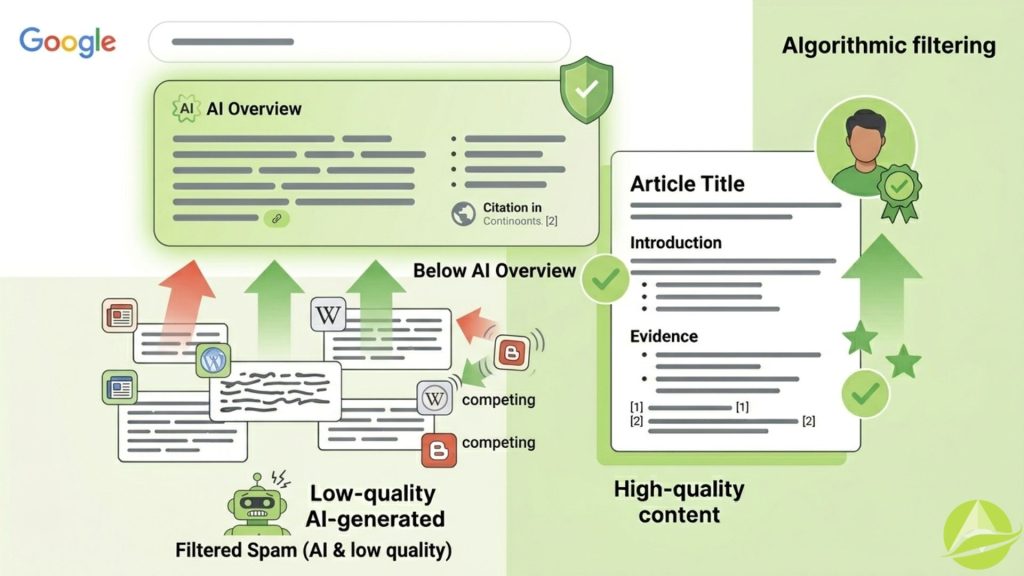
You search for a B2B software solution now. Before the blue links, you get an answer. A synthesized summary, pulling from various sources. This is the AI Overview, and as of March 2026, they appear in 82% of B2B technology searches, up from just 36% a year ago. The stakes are high: when an AI Overview is present, the CTR for the traditional #1 organic spot drops by 34.5%. The landscape has fundamentally changed. The old goal, ranking number one, has been complicated.
When an AI Overview appears, the click-through rate for that number one organic spot drops by 34.5%. People get their answer upfront. But here’s the crucial twist: brands that are cited within that AI Overview earn 35% more organic clicks than brands that are not. The new objective isn’t just to rank. It’s to be selected as a source.
This creates a different content strategy. You must write for synthesis. Your content needs to be clear, authoritative, and packed with the specific data or insights that an AI might extract. It’s about being a reliable reference. A listicle where you rank your own product first? That’s failing. Research shows 43.8% of ChatGPT-cited pages are these self-promotion listicles, and brands using them saw visibility drops of 30-50% after the December 2025 update. Google is filtering out the self-serving.
The game is about citation, not just position. Your content must be so useful, so definitive, that it becomes a piece of the answer.
Is AI-Assisted Content Still Safe to Use?
The data here is liberating. A massive Ahrefs study of 600,000 pages confirms that 86.5% of top-ranking content uses some form of AI, with a near-zero correlation (0.011) between AI usage and ranking penalties. Furthermore, Originality.ai reports that 70.95% of AI-generated pages are indexed within 36 days, proving Google does not block AI, it simply filters for quality. The correlation between AI content and ranking penalties was near-zero, 0.011. Google isn’t hunting for AI. It’s hunting for mediocrity.
The distinction is in the process. AI can draft, suggest, structure. It’s incredibly efficient. Originality.ai research shows 70.95% of AI-generated pages are indexed by Google within 36 days. But after the draft comes the human work. The editing, the fact-checking, and the layer of real experience reflect how human expertise shapes AI content, ensuring it reads like something genuinely written, not assembled. This is the oversight that the update demands.
- Use AI for scale and initial structure.
- Apply human editors for nuance, accuracy, and E-E-A-T.
- Always verify facts and add original insight.
The sites that crashed used AI as a factory line, publishing its output directly. The sites that thrived used AI as a collaborator, a first step in a rigorous editorial pipeline. The tool is safe. The careless use of the tool is not.
Which Industries Felt the Heat?
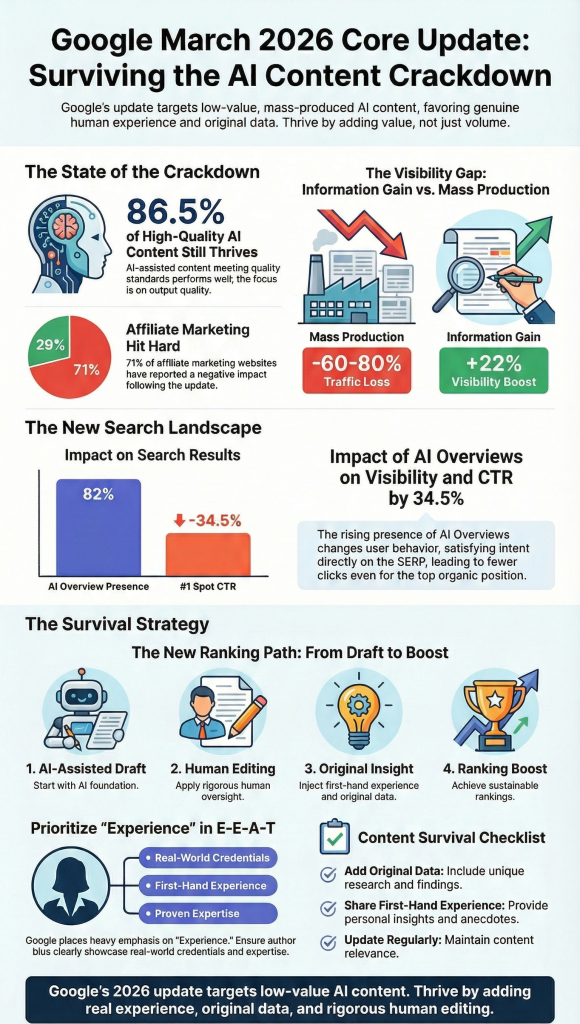
The update was not evenly felt. Some sectors were shaken far more than others. Affiliate marketing sites, often reliant on templated product comparisons and thin reviews, were the hardest hit. 71% of them saw a negative impact. Their model, which frequently depended on scaling content without deep expertise, was directly challenged by the new emphasis on experience and originality.
Content that hadn’t been updated in over 90 days also suffered, with traffic drops of 20-40%, with traffic drops of 20-40% according to Wisdek’s analysis of over 300 business websites. In an era where information changes daily, ‘staleness’ is now treated by Google as a proxy for low value.
Conversely, B2B technology, finance, and health sectors, where credible, expert-led content is already a necessity, were more stable. They had the foundation to adapt. For them, the update was a validation of their existing efforts, and an impetus to go further.
The pressure is immense because the stakes are high. According to OptinMonster, 95% of searchers never go past the first page of results. Visibility is everything. The March 2026 update simply made that visibility contingent on a new, higher standard of substance.
FAQ
What changed in the Google March 2026 Core Update for AI-generated content?
The Google March 2026 Core Update focuses on an AI-content crackdown targeting low-value AI content, scaled content, and generic AI content. It strengthens E-E-A-T enforcement and prioritizes helpful content, original content, and experience-based content. Sites using AI-assisted content must ensure human-edited AI content meets search intent, adds information gain, and avoids thin content or unhelpful content.
How does E-E-A-T affect rankings after the March 2026 rankings shift?
E-E-A-T signals now play a bigger role in ranking volatility and ranking fluctuations. Author expertise, author trustworthiness, and clear author bios improve page quality. Content with first-hand experience, expert-reviewed content, and strong author credentials performs better. Weak E-E-A-T guidelines compliance, especially in YMYL content like health content or finance content, can lead to traffic drops.
What type of content is most impacted by the AI-content crackdown?
The AI-content crackdown impact is strongest on AI-spam content, AI-thin content, duplicate content, and low-quality pages. Content lacking topical authority, semantic SEO, or intent matching struggles in AI-search results. Pages without unique insights, original research, or data-driven content are filtered by AI content filters and semantic filters, reducing AI-search visibility and overall rankings.
How can I recover from traffic drops after this core update?
Start with a content audit and SEO audit checklist to identify content gaps, low-quality pages, and unhelpful content. Focus on content pruning, improving content depth, and adding comprehensive coverage. Strengthen E-E-A-T improvements with expert-led content and editorial oversight. Core update recovery also depends on improving user-experience signals like dwell time, bounce rate, and page experience.
What is the best SEO strategy for AI-first search in 2026?
An effective SEO strategy 2026 focuses on human-centric content and AI-human collaboration. Use AI drafting and AI editing carefully, ensuring AI-content transparency and human-in-the-loop validation. Optimize for AI-overviews, AI-search competition, and AI-search rankings by aligning with user intent, adding proprietary data, and creating value-driven content that meets evolving Google ranking factors.
Building Content That Survives the Next Update
Build for what lasts, not what ranks today. This is where working with an SEO content writing agency becomes practical, especially when scaling original research, expert-backed insights, and consistent publishing. Start with real authors, clear bios, credentials, and lived experience.
Create original value through surveys, testing, or interviews. Use AI as a tool, but refine it with human judgment for accuracy and usefulness. Audit and improve weak or duplicate pages, and keep content fresh. Write knowing AI may surface your work, make it reliable enough to represent your expertise.
Need scalable, Google-resilient content?
Partner with JetDigitalPro
References
- https://xpert.digital/zh-cn/google-2026-%E5%B9%B4-3-%E6%9C%88%E6%A0%B8%E5%BF%83%E6%9B%B4%E6%96%B0/
- https://optinmonster.com/seo-ranking-factors/
Stop Guessing. Start Ranking.
Get a free sample article written for your niche. See the quality before you commit.
Get Your Free Sample Article →No credit card needed • 100% tailored to your niche
