

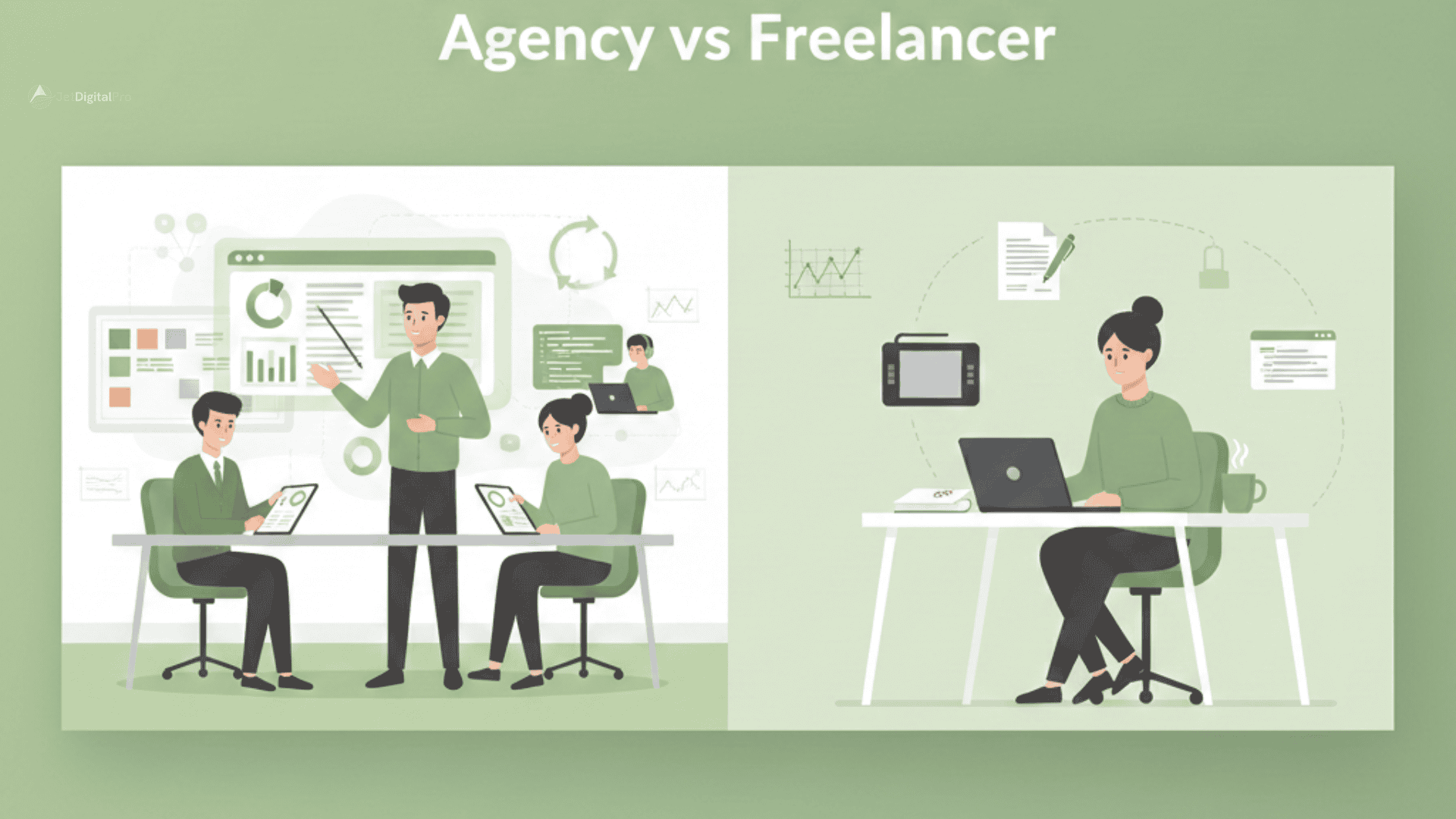
Agency vs freelancer explained: systems vs focus, scale vs speed—choose based on your project size, budget, and risk tolerance.
Choosing between an agency and a freelancer isn’t about which is definitively better—it’s about how you define quality for your specific project.
We write SEO articles that rank on Google — so you can focus on your business.
See Writing Plans →At the core, agencies ensure quality through structured workflows, project managers, and multi-step reviews. Freelancers, on the other hand, rely on individual discipline and deep specialization.
Think of it this way: an agency operates like a production system, while a freelancer works like a specialist craftsman.
Agencies stand out when it comes to consistency and scale. They are built for predictability and handling complex, multi-channel marketing, with team reviews acting as a safety net against single points of failure.
But if you don’t need a large system and just want a specific task completed quickly, freelancers are often the better choice.
Freelancers offer speed, flexibility, and highly focused expertise in areas like SEO or UX design. You also benefit from direct communication and lower costs.
However, there are trade-offs. Since a freelancer is a single person, you take on more risk in terms of capacity limits, availability, and potential delays.
In the end, agencies give you systems and scalability, while freelancers give you focus and agility. The right choice depends on your project size, budget, and risk tolerance.
Choosing between an agency and a freelancer comes down to what you mean by “quality.” Is it about having a predictable, repeatable process with multiple people checking the work? Or is it about getting deep, focused expertise from one talented person? Agencies work like a factory line, with systems to ensure nothing slips through.
Freelancers are more like a solo craftsperson, pouring their full skill into one piece. Neither is inherently better. Your project’s size, budget, and how specialized it needs to be will tell you which path leads to the quality you’re looking for. Keep reading to know quality differences agency freelancer
Quality Differences: Agency vs Freelancer at a Glance
- Agencies use structured teams and processes for consistent results on larger projects.
- Freelancers offer deep, niche expertise for faster, personalized work on specific tasks.
- Match your project’s scope and complexity to the provider’s strength.
Understanding Quality Differences: Agency vs Freelancer
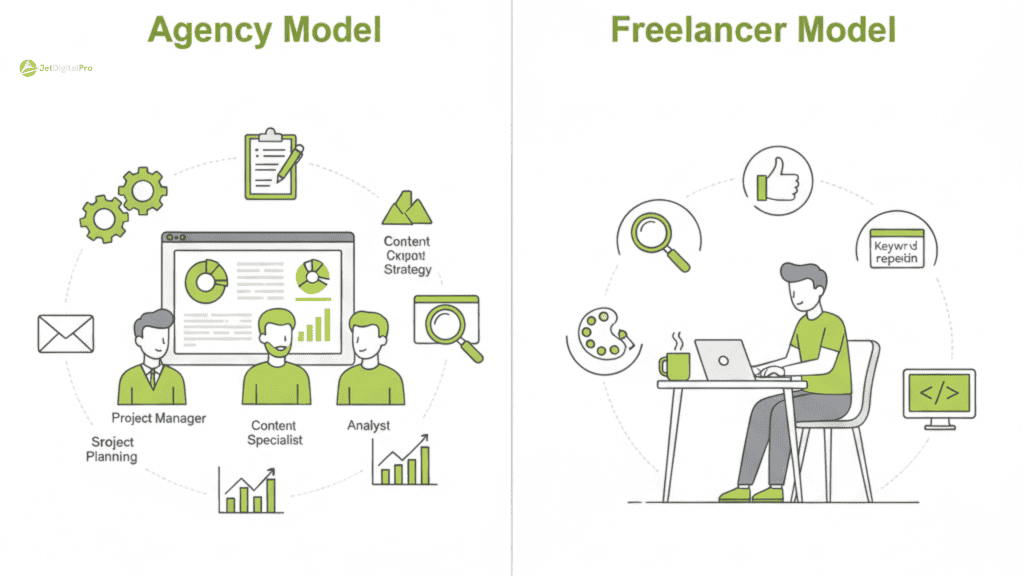
Quality differences agency freelancer usually come down to structure. A marketing agency builds quality through systems: defined digital marketing strategy, shared content plan, structured check-in meetings, and oversight from a project manager using project management platforms.
“Agencies are generally better at meeting deadlines and maintaining quality due to their larger teams and structured processes. If your main concern is knowing your SEO will not grind to a halt because one person is away, an agency gives you that peace of mind. You get a team that can step in and pick up where someone else left off, keeping your campaigns on track no matter what happens.” – VeecoTech Blog
A freelancer builds quality differently. Their strength lies in individual depth, whether in keyword research, graphic design, or work from skilled UI/UX designers. There’s no built-in QA department. The system lives in their own expertise.
Need SEO content that actually ranks? We write data-driven articles designed to bring organic traffic to your site.
See Our SEO Writing Plans →Agencies offer institutional quality designed for stability and long-term goals. Freelancers offer specialized, personal execution. When deciding between an agency or freelancer, which better suits your needs depends on your project requirements, acceptable risk level, and overall project complexity.
Why Agencies Deliver More Consistent Quality
Consistency is the core advantage of a marketing agency. You are hiring a process, not just talent.
A typical workflow includes:
- Draft review aligned with brand identity
- SEO validation of keyword research
- Oversight by a project manager
- Feedback coordination by client account managers
- Alignment with the editorial calendar
In software development, agencies rely on code review, unit tests, and structured automated testing. Tools like a CRM system and real-time analytics reporting maintain visibility.
This layered structure supports complex content marketing, large email campaigns, and advanced campaign complexity. For major Business Decisions, predictable execution often outweighs creative experimentation.
How Freelancers Provide Deep Niche Expertise
Freelancers compete on focus. Many specialize deeply in areas like social media management, database architecture, or high-end web design. Because they carry lower overhead costs, their hourly rate can translate into real cost savings, especially for a small business with a tight project scope.
Freelancers work best when the project requirements are clearly defined and the scope does not require cross-functional teams. The inherent flexibility of agency vs freelance models means you can manage the communication process directly when choosing the latter for specialized, high-end design or code.
- The project requirements are clearly defined
- The scope does not require cross-functional teams
- You can manage the communication process directly
Without a formal QA department, quality depends on discipline and experience. When commissioning freelancers for precise tasks, you often gain sharper expertise. However, scalability remains limited by individual capacity.
Operational Scale and Its Impact on Output Quality
Scale directly affects quality control. A development agency divides responsibility among specialists, one expert in Objective C, another focused on libraries and frameworks, and a dedicated web developer or graphic designer.
- Agencies also invest in:
- Extensive testing devices
- Multiple Android devices and iOS devices
- Infrastructure supporting scalable solutions
A freelancer may manage database architecture, front-end work, and deployment alone. While capable, constant context switching can impact depth. For complex web solutions or high project complexity, team specialization typically strengthens quality outcomes
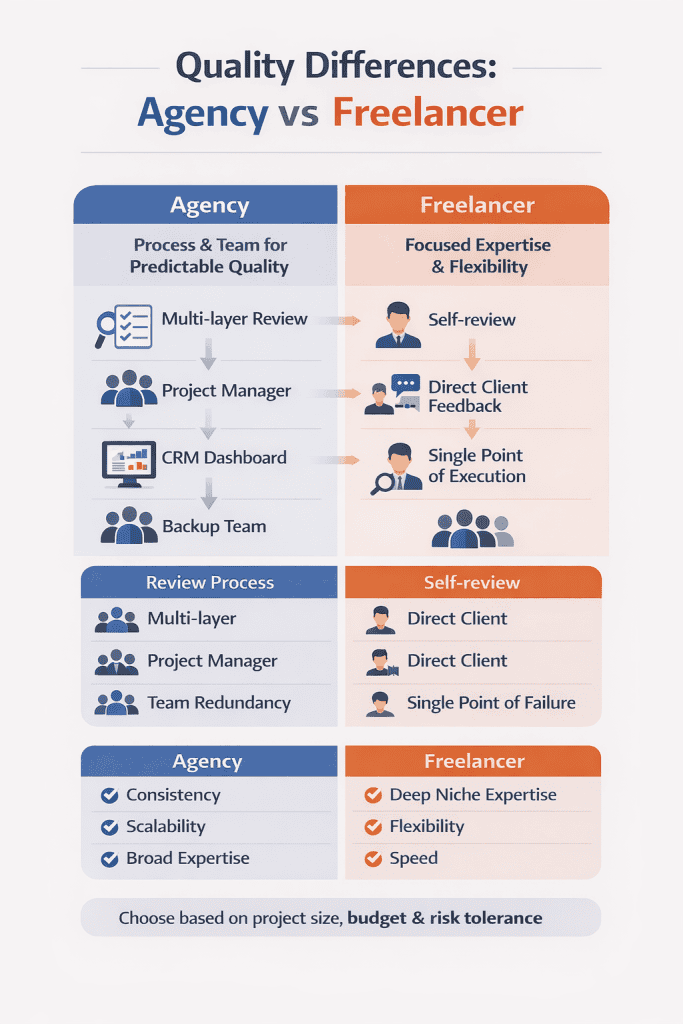
Quality Control Systems: Team Reviews vs Solo Execution
| Aspect | Agency Model | Freelancer Model |
| Review Process | Multi-layer review & QA | Self-review |
| Oversight | Project manager & account managers | Direct client feedback |
| Monitoring | CRM system, unified client dashboard | Manual tracking |
| Backup | Team redundancy | Single point of failure |
Agencies rely on formal project management, documented communication strategy, and internal checkpoints. Freelancers rely on personal standards.
An agency provides a safety net. A freelancer provides autonomy. Your tolerance for risk determines which model fits best.
Consistency vs Variability: What Clients Actually Experience
With an agency, the experience feels standardized. Reports follow a schedule. Brand management remains consistent across social media, email campaigns, and broader content creation efforts.
“The level of quality and consistency depends on the content production model chosen. Agencies have built-in quality control processes… Content undergoes editing and quality assurance before delivery. Since freelancers work independently, maintaining a uniform tone and style may require additional oversight.” – nDash Marketing Blog
Freelancers offer a more direct relationship. Communication is fast, ideas are flexible, and execution can feel more tailored. However, variability appears if they become overbooked.
For ongoing reputation management or long-term growth strategy, consistency matters. For tactical needs, flexibility may matter more. This is where quality differences agency freelancer become highly visible in daily execution.
Scalability and Resource Access in Complex Projects
As projects grow, quality demands increase. Agencies can expand team involvement without breaking systems, making them a strong choice when comparing an agency vs freelancer for SEO content at scale.
Their strategic planning and cross-functional coordination support large-scale digital marketing initiatives. Their strategic planning, cross-functional coordination, and infrastructure support large-scale digital marketing initiatives.
Freelancers face natural capacity limits. To scale, they must work longer hours or outsource informally.
When commissioning agencies for projects with high campaign complexity, you gain built-in structure. When commissioning freelancers for targeted deliverables within a fixed project scope, you gain speed and focus. Scalability is often the deciding factor.
Speed and Flexibility in Small, Defined Tasks
Freelancers excel in agility. There is no internal routing through account managers or extended kickoff meetings.
They are ideal for:
- One-off graphic design
- Focused web design
- Quick keyword research
- Specific plugin builds by a web developer
Agencies may move slower initially, but they ensure alignment with a broader content plan and overall digital marketing strategy. For clearly defined tasks, freelancers often deliver faster. For initiatives tied to long-term support, agencies provide stability and coordination.
Cybersecurity and SEO: Where Quality Gaps Become Visible
Cybersecurity and SEO clearly show how service models shape quality. In cybersecurity, an agency-style MSSP delivers 24/7 monitoring through a Security Operations Center, ensuring constant oversight and immediate incident response.
The strength lies in infrastructure and team capacity. A freelance expert may provide excellent threat hunting or vCISO guidance, but cannot realistically offer continuous round-the-clock coverage. The gap is structural, not about skill.
SEO reflects the same pattern. Agencies combine technical audits, content strategy, and link building into one coordinated system. A freelancer might create outstanding, rank-worthy content, but if a site has technical or mobile performance issues, that content cannot reach its full potential.
Agencies solve cross-functional gaps internally, while freelancers often require clients to hire multiple specialists and manage integration themselves.
Cost Structure and Its Influence on Work Standards
An agency’s higher pricing reflects structured systems and higher overhead expenses. These costs fund senior oversight, internal project manager roles, and formal quality control.
Freelancers operate with leaner structures:
- Lower overhead costs
- Flexible hourly rate
- Direct accountability
- Potential cost savings
However, standards vary by individual. Agencies embed standards into process. Freelancers rely on personal discipline. Your due diligence becomes critical before making major Business Decisions.
Common Client Pain Points: Overhead, Ghosting, and Overbooking
Clients often feel agency overhead is inflated, with layers of account managers and office costs that don’t always translate into visible results. It can seem like you’re funding their brand as much as your own.
With freelancers, the concerns are different: ghosting mid-project or overbooking that leads to rushed, inconsistent work. These are not imaginary fears but real risks tied to business structure.
The agency pain point is often perceived value, too much structure, not enough clarity. The freelancer pain point is the opposite, too little structure. The middle path removes unnecessary overhead while keeping essential systems.
By using efficient project management tools and real-time reporting, it’s possible to maintain reliability, strategic oversight, and multi-stage quality control without excessive cost.
When an Agency Is the Better Quality Choice
An agency is the better option when quality depends on predictability, scale, and coordination. Integrated marketing strategies require alignment across social media, content, email, and paid campaigns.
Software development projects demand code reviews, testing processes, and collaboration between specialists. In complex environments, structured systems protect quality.
Agencies are also ideal when you lack internal oversight. Their team functions as an outsourced department with built-in project management and accountability. The process they provide ensures deadlines are met and standards are maintained.
For long-term growth initiatives that require scalability and strategic continuity, the agency model offers comprehensive, system-driven quality that reduces operational risk.
When a Freelancer Delivers Superior Results

A freelancer excels when the project scope is narrow and clearly defined. If you need a logo, a niche whitepaper, or a specific plugin, deep specialization often produces sharper results than a broad team approach. The advantage lies in focused expertise and direct collaboration.
Freelancers are also effective for testing ideas before committing to large-scale strategies. They offer cost-efficient solutions for businesses with limited budgets but specific needs.
When you have internal capacity to manage timelines and communication, a highly skilled freelancer can deliver work that feels more tailored, innovative, and personally invested than what a larger team might produce.
FAQ
How do quality differences show between a marketing agency and freelancer?
Quality differences between a marketing agency and freelancer usually appear in structure and depth. An agency brings account managers, a project manager, and clear project management systems. A freelancer often works alone, handling communication and execution directly.
For digital marketing or social media management, agencies may offer broader support, while freelancers provide focused expertise. The right choice depends on project scope, campaign complexity, and long-term goals.
Are overhead costs worth it when hiring a marketing agency?
Overhead costs can feel high because agencies cover account managers, project management platforms, and internal teams. However, those overhead expenses support strategic planning, check-in meetings, and real-time analytics reporting.
For complex digital marketing strategy or software development, that structure reduces risk. If your project requirements are simple, commissioning freelancers at an hourly rate may deliver better cost savings.
When does project complexity require a development agency?
High project complexity often demands a development agency with a QA department and structured code review. Large software development projects may involve database architecture, automated testing, unit tests, and testing devices like Android devices and iOS devices.
If scalable solutions and long-term support matter, an agency model handles mobile solutions, libraries and frameworks, and coordination better than one web developer.
Is a freelancer better for small business marketing needs?
For a small business with limited budgets, commissioning freelancers can be practical. A skilled graphic designer, web developer, or content creation specialist can handle clear project scope tasks efficiently.
If you only need web design, keyword research, or a focused content plan, a freelancer may offer flexibility and direct communication without the added overhead expenses of a development agency.
Making the Strategic Choice for Your Project’s Quality
Choosing between an agency and a freelancer means matching your project’s specific needs. An agency provides a structured system for larger, ongoing work. A freelancer delivers focused expertise for a specialized task.
Your budget, timeline, and need for consistency will make the right choice clear. The goal is a quality outcome that reliably moves your business forward.
If you’re a digital agency looking for reliable, high-volume content to scale your client services, let’s discuss a solution. Book a free discovery call with JetDigitalPro today.
References
- https://www.veecotech.com.my/blog/outsourced-seo-vs-freelance-seo/
- https://www.ndash.com/blog/agencies-vs-freelancers-which-content-model-fits-your-strategy
Related Articles
- https://jetdigitalpro.com/agency-vs-freelancer-for-seo-content/
- https://jetdigitalpro.com/agency-or-freelancer-which-better/
- https://jetdigitalpro.com/flexibility-agency-vs-freelance/
Stop Guessing. Start Ranking.
Get a free sample article written for your niche. See the quality before you commit.
Get Your Free Sample Article →No credit card needed • 100% tailored to your niche