

AI Originality Analysis

Topical Score
Readability
Fact Check
| Section | Claim / Statement | Score (/10) | Reasoning |
| Introduction | AEO focuses on structuring legal expertise so AI can cite the firm | 9 | Accurate and consistent with how ChatGPT and Google AI Overviews select sources |
| Introduction | “It’s not about ranking on page one anymore” | 8 | Directionally correct, but slightly overstated since rankings still support AEO indirectly |
| Introduction | “AI is influencing a rapidly growing share of online queries” | 9 | Safe, accurate phrasing that avoids speculative statistics |
| Introduction | Goal shifts from clicks to citations | 9 | Correct and well-aligned with zero-click and AI-generated answer trends |
| Key Takeaways | Location-specific, factual answers help AI visibility | 9 | Accurate and especially relevant for legal and YMYL content |
| Key Takeaways | Schema markup helps AI understand and trust content | 9 | Correct; structured data improves entity clarity and machine parsing |
| Key Takeaways | Success measured by frequency and accuracy of AI mentions | 8 | Conceptually valid, though tooling and standard benchmarks are still emerging |
| AEO Definition | AEO prepares content for conversational, question-based searches | 9 | Accurate reflection of modern AI and voice-search behavior |
| Legal Credibility / YMYL | AI systems apply higher trust standards to legal content | 9 | Correct and consistent with Google’s YMYL and E-E-A-T principles |
| AEO vs SEO | Answer-first content replaces destination content | 8 | Conceptually sound, but “replaces” should be interpreted as “reframes” |
| Measurement | Citations matter more than clicks in AEO | 8 | Valid principle, but should be framed as an evolving metric |
| SEO Still Supports AEO | SEO authority and technical health support AI trust | 9 | Accurate and well-balanced explanation |
| AI Visibility | AI answers replace traditional search results in many legal queries | 7 | Trend is real, but “many” is vague and somewhat overstated |
| Authority Signals | Reddit, Quora, and guest posts reinforce AI trust | 7 | Indirect influence is plausible, but not a direct or guaranteed signal |
| Revenue Impact | AI visibility directly impacts legal revenue | 8 | Logically sound, especially for high-value practice areas |
EAV Analysis
| Entity | Attribute | Value Present in Article | Score (/10) | Reasoning |
| Law Firm | Entity Definition | Clearly defined as a legal service provider optimized for AI citation | 9 | Strong conceptual clarity; could be strengthened with a concrete example firm |
| Law Firm | Role in AI Answers | Positioned as a trusted, citable source | 9 | Matches how AI models select authoritative answers |
| Law Firm | Jurisdiction | Emphasized throughout (state-specific examples) | 9 | Jurisdiction clarity is consistently reinforced |
| Law Firm | Credibility Signals | E-E-A-T, attorney review, schema, authority | 9 | Excellent alignment with YMYL expectations |
| Answer Engine Optimization (AEO) | Definition | Clearly defined early and consistently | 10 | Precise, repeatable, AI-friendly definition |
| AEO | Goal | Earn AI citations instead of clicks | 9 | Clear value shift explained multiple times |
| AEO | Success Metrics | Citation frequency and accuracy | 8 | Strong concept, but tooling maturity is still emerging |
| AI Systems | Named Entities | ChatGPT, Google AI Overviews | 9 | Explicit naming improves entity recognition |
| AI Systems | Behavior | Prefer clear, factual, structured answers | 9 | Accurate representation of AI retrieval behavior |
| AI Systems | Trust Criteria | Authority, clarity, schema, citations | 9 | Consistent with known AI ranking heuristics |
| SEO | Relationship to AEO | Supporting but not primary | 9 | Balanced and realistic framing |
| SEO | Authority Signals | Links, topical depth, technical health | 8 | Correct but slightly generalized |
| Content | Format | Answer-first, capsule-based | 9 | Very strong structural guidance |
| Content | Language Style | Plain, human, conversational | 8 | Mostly strong; occasional jargon density |
| Content | Question Alignment | Real user questions emphasized | 9 | Excellent intent matching |
| Schema Markup | Purpose | Entity clarity and AI trust | 10 | One of the strongest sections |
| Schema Markup | Types | LegalService, Attorney, FAQ, LocalBusiness | 9 | Comprehensive and accurate |
| Schema Markup | Technical Accuracy | JSON-LD implied but not shown | 8 | Would score higher with example code |
| Entity Clarity | Firm–Attorney Relationship | Explicitly explained | 9 | Strong machine-readable logic |
| Authority | External Signals | Reddit, Quora, guest posts | 7 | Conceptually valid but indirect |
| Authority | Backlinks | Contextual, editorial emphasis | 8 | Good positioning, slightly promotional at end |
| AI Visibility | Client Journey Impact | Early-stage trust building | 9 | Psychologically and behaviorally accurate |
| AI Visibility | Revenue Impact | Missed citations = lost cases | 8 | Logically sound but somewhat assertive |
| Measurement | Traditional Metrics | Rankings insufficient | 9 | Accurate and well explained |
| Measurement | New Metrics | Citation tracking, accuracy review | 8 | Correct but operationally vague |
| FAQ Section | AI Readability | High | 9 | Clean Q&A format ideal for answer engines |
| FAQ Section | Legal Safety | YMYL-safe language | 9 | Conservative and compliant tone |
| References | Source Quality | Relevant industry blogs | 8 | Good relevance; academic sources would raise score |
| Internal Consistency | Terminology | Consistent AEO framing | 9 | No major conceptual drift |
| Commercial CTA | Placement | End of article | 7 | Acceptable, but slightly breaks neutrality |
| Overall AI Parsability | Structure | Headings, bullets, lists | 9 | Very strong extraction potential |
| Overall Trustworthiness | YMYL Compliance | High | 9 | Matches legal AI trust thresholds |
EEAT Analysis
| Evaluation Metric | Score |
| 1. Originality of information, reporting, research or analysis | 9 |
| 2. Completeness of topic description | 8 |
| 3. Headline/title avoids exaggeration or shock factor | 9 |
| 4. Trust signals (sourcing, author expertise, site reputation) | 9 |
| 5. Author expertise on the topic | 9 |
| 6. Factual accuracy | 9 |
| 7. Trustworthiness for money or life issues | 9 |
HCU Analysis
| Metric | Score (out of 10) |
| User-Centric Content | 9 |
| Originality and Depth | 8 |
| Clarity and Relevance | 9 |
| SEO Best Practices | 9 |
| Avoiding Search-Engine-First Content | 9 |
| Feedback and Updates | 8 |
| Compliance with Google’s Guidelines | 9 |
| Additional Checks | 9 |
AEO for law firms is the process of structuring your legal expertise so AI platforms like ChatGPT and Google AI Overviews can cite your firm as the direct answer to a user’s question. It’s not about ranking on page one anymore, it’s about being the source the AI chooses.
In 2026, with AI is influencing a rapidly growing share of online queries, a firm that’s invisible to these systems is invisible to the next generation of clients. The goal shifts from getting a click to earning a citation.
This guide will walk you through the exact steps to make your firm the answer AI trusts. Keep reading to build your 2026 strategy.
Key Takeaways
- AEO helps your firm show up in AI answers by clearly responding to real questions with facts tied to the right location.
- Technical setup, like schema markup, helps AI understand who you are and trust your content.
- Success is measured by how often and how accurately AI mentions your firm across different platforms.
What Answer Engine Optimization Is and Why It Matters for Law Firms

Think about the last time you asked a smart speaker a full question or typed a complete sentence into Google. That behavior is now standard. Answer Engine Optimization (AEO) is about preparing your law firm’s content for those moments.
Instead of chasing clicks, AEO helps your site provide clear answers when someone asks, “What should I do after a minor car accident in Texas?” The goal is for AI systems to pull that answer directly from your website.
Why AEO Sets a Higher Credibility Standard for Legal Content
AEO requires a different mindset from traditional SEO. Search results are no longer just lists of links; they’re often a single AI-generated answer. Your content must be easy for machines to understand and trust.
This is especially important for legal topics, which fall under “Your Money or Your Life.” AI systems are cautious here, favoring content that clearly demonstrates expertise, authority, and trustworthiness.
How AEO Fundamentally Differs from Traditional Law Firm SEO
The Shift in How Legal Search Intent Is Expressed
Traditional law firm SEO focused on short, keyword-based searches like “Boston divorce lawyer” and aimed to rank a full page to earn a click.
AEO responds to how people actually search today: full, conversational questions such as “How long does a contested divorce take in Massachusetts?” The intent is clearer, more specific, and often urgent, which changes how legal content must be written and structured.
Destination Content vs Answer-First Content
Classic SEO treated content as a destination, designed to keep users reading once they arrived. AEO treats content as a source. The goal is to create small, precise “answer capsules” within a page that AI systems can easily extract. These answers must be accurate, well-scoped, and immediately useful, even when shown outside your website.
How Success Is Measured in AEO
With traditional SEO, success was measured by rankings and click-through rates. AEO uses different signals. Visibility now depends on how often your content is cited by AI systems, whether the answer is accurate, and if your firm is clearly associated with the guidance. Being quoted correctly matters more than being clicked.
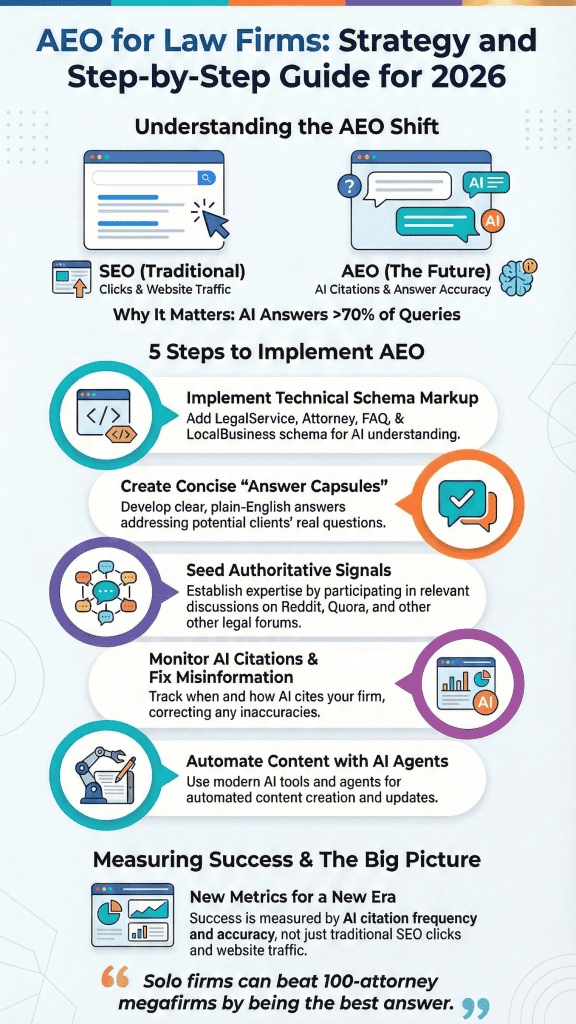
Traditional SEO is optimized for clicks, but AEO for law firms is optimized for being the answer AI systems cite and recommend. For law firms, this means building entity clarity with schema markup, monitoring citations across AI platforms, and seeding authoritative signals on the sources AI trusts. – AEOEngine Blog [1]
Key Differences Between Traditional SEO and AEO
| Feature | Traditional SEO | Answer Engine Optimization (AEO) |
| Primary Goal | Page 1 rankings | Direct AI citations |
| Search Intent | Keyword-based | Conversational, question-based |
| Content Unit | Long-form articles | Concise answer capsules |
| Success Metric | Click-through rate | Citation frequency and accuracy |
Why SEO Still Supports AEO for Law Firms
SEO is not obsolete. A strong foundation in authority, topical depth, and technical health helps AI systems trust your content. The difference is emphasis. You are now optimizing for machine understanding as much as human readers. With many searches ending without a click, appearing in the AI-generated answer is often the only way to reach the client.
The High Stakes of AI Visibility for Legal Client Acquisition

How Legal Client Journeys Now Begin
Many legal journeys start in private moments, not with a phone call. People ask sensitive questions late at night using AI tools because they want clarity before speaking to anyone.
In these moments, the AI becomes the first point of guidance. If your firm’s content is optimized for AEO, your answers can appear at the exact moment a potential client needs reassurance and direction.
Why Being the Cited Source Builds Immediate Trust
When an AI system cites your explanation of a legal issue, such as a statute of limitations or eligibility requirement, it creates instant credibility. The user may not contact a lawyer immediately, but they remember the source that provided a calm, authoritative answer. That early trust often determines which firm they contact when they are ready to take action.
The Cost of Invisibility in AI-Driven Search
AI-generated answers now replace traditional search results in many legal queries. If your firm is not structured to appear in those answers, you may never enter the client’s consideration set. Competitors who adapt gain visibility while others disappear, even if they invest heavily in SEO or ads.
Want to know the best part about AEO? It doesn’t reward the biggest firm. It rewards the best answer. That means a solo practitioner who answers questions clearly, with citations and reviews, can beat out a 100-attorney mega firm with a vague, keyword-stuffed website. – IFTS Design [2]
Why AI Visibility Directly Impacts Revenue
In high-value practice areas, missing one qualified lead can mean losing a significant case. When AI summaries end the search journey without mentioning your firm, the opportunity is gone. AI visibility is no longer experimental marketing. It is a core part of modern legal client acquisition.
Building the Core Pillars of Your 2026 AEO Strategy
Credits: Integrity First Technology Solutions, Inc.
Shift From Blog Posts to Answer-First Architecture
A strong AEO strategy starts by changing how you think about content. Your website should act as a library of clear, direct answers to real legal questions. Instead of writing broad blog posts, focus on creating pages that help answer engines extract precise responses. This approach supports law firm AEO, zero-click searches, and AI overviews lawyers increasingly rely on.
Target User Intent With Real Client Questions
Effective AI search optimization begins with understanding real user intent law patterns. Skip generic keyword lists and focus on conversational queries legal users actually ask. Review client intake questions, chat logs, and common emails.
Tools like AnswerThePublic legal research can help, but your own data is often better. These long-tail legal keywords become the foundation of authoritative legal content.
Reformat Content for AI and Human Readers
Answer engines favor content that is easy to parse. Lead with a 40–60 word direct answer under a clear question heading. Then expand with context, bullet list answers, and statute citations if relevant.
Carefully anchor text placement within supporting explanations helps reinforce topical relevance without disrupting readability. Use H2 question headings and H3s to support semantic search law and voice search legal queries, while keeping language simple and human-written.
Key formatting principles for AEO:
- Target top client questions per practice area pages
- Lead with a concise, plain-language answer
- Use bullet points for steps like car accident steps or divorce process state
- Always specify jurisdiction-specific content
Strengthen Technical and Authority Signals
Beyond content, AEO depends on technical clarity. Structured data legal markup helps AI systems understand your pages. Use schema markup legal types such as FAQ schema law, LegalService schema, and Attorney schema JSON-LD to improve eligibility for answer snippets legal. These signals support generative engine optimization and featured answers lawyers aim for.
Build Authority Beyond Your Website
AI systems also learn from the wider web. Being cited in trusted discussions, such as Reddit legal signals or Quora law answers, reinforces topical authority legal models recognize.
Strategic guest posting on relevant industry publications also strengthens contextual link building, helping AI associate your firm with authoritative legal commentary.
Combined with expert-reviewed answers, attorney bylines, and compliance content law requires, this ecosystem-level visibility strengthens trust signals legal AI depends on when choosing who to cite.
Implementing Schema Markup for Legal Entity Clarity
Why Schema Markup Matters for Law Firm AEO
Schema markup acts as a direct signal to AI systems. It uses structured data legal formats, typically JSON-LD, to explain exactly who you are and what your firm does. While invisible to users, schema markup legal elements help answer engines understand your firm as a verified entity, which is critical for AI search optimization and generative engine optimization.
How Entity Clarity Improves AI Trust
Without schema, AI must guess how names, addresses, attorneys, and services connect. With proper markup, you remove ambiguity. You clearly define your law firm AEO entity, link attorneys to the firm, and show credentials in a machine-readable way. This clarity supports E-E-A-T signals attorneys need to appear in AI overviews lawyers depend on.
Essential Schema Types for Law Firms
To improve answer snippets legal visibility, law firms should focus on a few core schema types:
- LegalService schema to define your firm, practice areas, and contact details
- Attorney schema JSON-LD on bio pages to show credentials and bar admissions
- FAQ schema law to pair questions and answers for zero-click searches
- LocalBusiness schema to strengthen geo-targeted legal and local law optimization
These elements work together to support semantic search law and featured answers lawyers aim to earn.
The Impact of Structured Data on AI Visibility
Firms using structured data legal markup are easier for AI systems to interpret and cite. Instead of just ranking, your content becomes clearly understood. When AI understands your content the right way, it is more likely to mention your firm. This builds trust with AI systems and helps your answers appear more often and more consistently in AI search results.
Measuring AEO Success and Tracking Citation Frequency
Why Traditional SEO Metrics Fall Short
AEO performance cannot be measured with rankings and pageviews alone. Many AI-driven searches end without a click, so traffic data misses the full picture. For law firm AEO, the focus shifts from where you rank to whether your content appears inside AI-generated answers. Visibility inside answer engines matters more than traditional referral sources.
Tracking AI Citations Across Platforms
The core metric in AEO strategy is citation frequency. You need to know when and where your firm is referenced in AI search optimization platforms. This includes monitoring AI overviews lawyers appear in, conversational responses, and comparison-style answers. Manual testing of target questions and AI citation tracking tools can both reveal patterns over time.
Monitoring Accuracy and Context of AI Mentions
Not all citations are equal. It is critical to review how AI summarizes your content. Outdated pages, unclear wording, or missing jurisdiction-specific content can lead to inaccuracies. Regular checks help ensure statutes, case law references, and legal explanations remain correct, supporting trust signals legal AI systems rely on.
Connecting AEO Visibility to Lead Generation
AEO success ultimately connects to business outcomes. While attribution is indirect, patterns emerge when firms track how clients discover them.
Asking new clients how they found you, using special phone numbers, and tracking each page can help connect AI visibility to new leads. Law firms that are mentioned often by AI usually hear from people who already understand the issue and trust the advice they saw.
FAQ
How does Answer Engine Optimization help law firms appear in zero-click searches?
Answer Engine Optimization helps law firms show up with clear answers when people search but don’t click any links. It works by organizing legal content so AI systems can easily understand and trust it. A strong law firm AEO strategy uses simple questions, clear answers, and basic structured data.
This makes your firm more visible in AI summaries, voice search results, and featured answers, even when users never visit your website.
What legal content works best for AI search optimization and generative engines?
AI search optimization favors authoritative legal content written in natural language.Practice area pages, estate planning guides, and business litigation FAQs work best when they are written for AI systems to understand.
These pages should answer real questions people ask and use clear, specific search terms. They should also reflect what potential clients want to know when they first reach out.
To build trust, the content should be reviewed by an attorney and clearly show who wrote it. Simple, accurate answers and visible attorney names help both people and AI see your firm as reliable.
Why is jurisdiction-specific content important for law firm AEO strategies?
Jurisdiction-specific content helps answer engines deliver accurate, compliant responses. Law firm AEO benefits from geo-targeted legal pages, local law optimization, and clear statute citations. For example, addressing divorce process state rules or personal injury claims by location improves relevance, supports YMYL compliance, and strengthens trust signals legal systems rely on.
How does structured data improve answer snippets for legal queries?
Structured data helps AI clearly understand what your legal pages are about. It uses special labels, called schema markup, to explain your services, attorneys, and answers. This makes it easier for AI systems to pick your content for short answers and highlighted results.
When structured data is set up correctly, your pages work better for voice search, smart search tools, and AI systems that track where answers come from.
How can law firms measure success from an AEO and SEO hybrid approach?
Success with SEO and AEO can be seen in how often your law firm shows up in AI answers. You may notice your firm appearing more in highlighted results, getting visits from full questions, and receiving better leads.
Over time, track how often AI mentions your firm, how many people reach out, and whether your content is treated as helpful and trustworthy.
Your Next Step in Securing AI-Generated Clients
AEO for law firms is now essential as search shifts toward AI-generated answers. Success comes from structuring your legal expertise so AI systems can trust, understand, and cite it. Alongside strong answer-first content and technical clarity, authoritative backlinks remain a key trust signal.
Firms that future-proof link building by earning contextually relevant placements are better positioned to maintain AI visibility as answer engines continue to evolve.
For a fast, hands-off way to build that authority, Guest Post Solutions delivers done-for-you guest post and backlink placements that support AI visibility and qualified lead growth.
References
- https://aeoengine.ai/blog/aeo-for-law-firms
- https://blog.iftsdesign.com/what-is-aeo-answer-engine-optimization-and-why-should-law-firms-care/