


Our first agency hire was a disaster. Six months and a significant budget later, we had a stack of beautiful reports and exactly zero leads. The problem wasn’t creativity; it was a complete misalignment we should have spotted in the first conversation. We learned the hard way that hiring an agency is less about their pitch and more about the questions to ask potential agency teams early on.
The right questions act like a diagnostic tool, revealing the operational truth behind a polished portfolio. This isn’t about interrogation, it’s about building a foundation. Ask these questions, and you move past sales talk to see whether you’re hiring a true partner.
We write SEO articles that rank on Google — so you can focus on your business.
See Writing Plans →Keep reading to turn your next agency interview from a sales call into a strategic evaluation.
Key takeaway
- Verify success with hard numbers, not just pretty portfolios.
- Insist on meeting your actual execution team, not just the salespeople.
- Clarify every financial and contractual detail before you sign.
Understanding Strategic Alignment and Expertise
| Evaluation Area | What to Ask the Agency | Strong Alignment Signals | Warning Signs |
| Industry relevance | Have you worked with businesses in our industry? | Specific examples with clear challenges explained | Vague answers or unrelated industries |
| Depth of experience | What problems have you solved in this space? | Mentions industry-specific risks and opportunities | Talks only in generic marketing terms |
| Proof of success | Can you share case studies with real results? | Quantifiable metrics tied to business outcomes | Visual portfolio with no performance data |
| Metrics used | How do you measure success for clients like us? | Leads, conversions, ROAS, organic growth | Vanity metrics like likes or impressions |
| Core specialization | What services are your deepest expertise? | Clear focus on 1–2 core strengths | Claims to be “great at everything” |
| Learning curve impact | How fast can you execute in our market? | Shows existing playbooks and insights | Admits they’ll “figure it out as we go” |
You need an agency that gets your world. General marketing experience is fine, but you want someone who speaks the language of your industry, who knows its unique pitfalls and opportunities. This alignment is your first line of defense against wasted time and money.
Industry Relevance
How long an agency has been in business matters less than what they’ve been doing. A ten-year-old agency might have spent nine years in a different vertical. The critical question is: Have you worked with businesses in my specific industry? Ask for examples. Not just company names, but a brief on the challenges those clients faced.
If they can’t provide this, they’ll be learning on your dime. You’re not just buying services, you’re buying accumulated, relevant knowledge.
Evidence of Success
Anyone can show you a portfolio of nice-looking websites or social media graphics. You need to see the engine under the hood. Always, always ask for case studies with quantifiable results. Look for metrics that tie directly to business goals, especially when evaluating a SEO content writing agency that claims to drive measurable growth beyond rankings alone.
- Percentage increase in qualified leads
- Improvement in website conversion rate
- Growth in organic traffic over a set period
- Demonstrable return on ad spend (ROAS)
The Specialization Trap
Beware of the agency that claims to do everything brilliantly. A firm that simultaneously excels at high-end video production, complex technical SEO, and precision-paid media is rare. It’s better to find a master of the one or two services you truly need, especially when you’re choosing the right SEO content agency for long-term authority and consistency. Ask them: What are your core service lines, and which do you consider your deepest expertise? Their answer should be confident and focused.
Need SEO content that actually ranks? We write data-driven articles designed to bring organic traffic to your site.
See Our SEO Writing Plans →Evaluating the Team and Operational Capacity

The charming team in the pitch meeting often isn’t the team doing the work. You must bridge that gap. You’re hiring people, not a brand name. Their capacity, expertise, and direct involvement determine your success, which is why learning how to assess agency expertise early helps you avoid surprises after onboarding.
Who Does the Work?
This is perhaps the most important question you can ask. Politely insist on meeting the account manager and the lead strategist or specialist who will be hands-on with your project. Ask about their tenure at the agency and their specific experience. A high turnover rate here is a major red flag, it means you’ll be constantly re-onboarding new people [1].
Outsourcing Transparency
Many agencies, including ours at Jet Digital Pro, use specialized white-label partners for specific tasks. There’s nothing wrong with this, it ensures experts handle each component. The key is transparency.
You should ask: What work is done in-house, and what is managed through specialist partners? A trustworthy agency will explain this model openly, detailing how they maintain quality control and unified communication even when leveraging external experts.
Adaptability
Marketing changes fast. A strategy from six months ago might be obsolete today. Probe how the team stays current. Do they hold regular training? How do they adapt to core algorithm updates from Google or Meta? Their answer shouldn’t be vague. It might involve named industry resources, testing protocols, or continuing education for the team. You need a team that learns constantly.
Deconstructing the Strategy and Execution Process
A great idea is worthless without a clear path to make it real. You’re buying a process. Their methodology for understanding your business, planning, executing, and measuring is the blueprint for your results. Miss a detail here, and the whole project can go off the rails.
Onboarding and Discovery
A rushed discovery phase is a bad sign. A thorough agency will want to deeply understand your business, your customers, and your competitors before proposing a single tactic. Ask them to walk you through their onboarding process. How many meetings are typical? What documents or audits do they produce? This phase should feel investigative, not transactional.
The Tech Stack
The tools an agency uses tell you a lot about their efficiency and compatibility with your team. Ask about their primary software for:
- Project management (e.g., Asana, Trello)
- Communication (e.g., Slack, Microsoft Teams)
- Reporting and analytics (e.g., Google Data Studio, agency dashboards)
You don’t need to be an expert in every tool, but you need to know how you’ll receive updates and see progress. If their entire workflow is built on a platform your company blocks, you’ve got an immediate problem.
Defining Success
This is non-negotiable. Before a contract is signed, you must agree on what success looks like and how it will be measured [2]. Ask: What Key Performance Indicators (KPIs) do you recommend for our goals, and how will you track them? Furthermore, establish the reporting rhythm. Will you get a formal report weekly, bi-weekly, or monthly? What will that report contain? Clarity here prevents future disagreements about value.
Financial Transparency and Contractual Terms
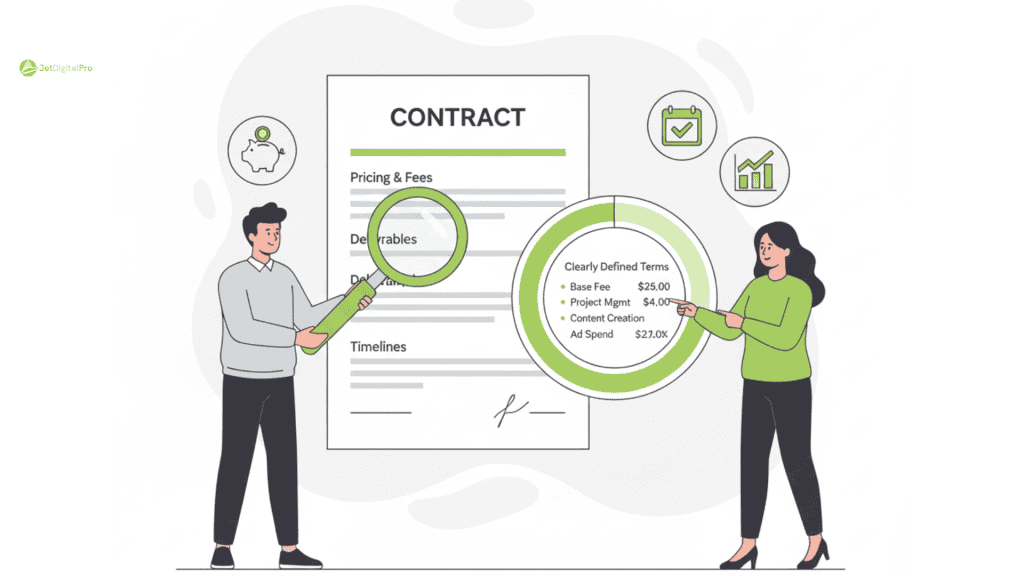
Money talks. A vague proposal leads to invoice surprises and strained relationships. Treat the financial and legal discussion as a collaborative effort to define the partnership’s boundaries. It’s not adversarial, it’s essential.
Pricing Models Explained
Agencies typically bill in one of three ways: monthly retainers, project-based fees, or hourly rates. Each has pros and cons. A retainer provides ongoing access and priority. A project fee offers cost certainty for a defined deliverable.
Hourly billing can be good for small, unpredictable tasks. Ask them to explain why their chosen model is the best fit for the work you’ve discussed. Listen for a logical, client-focused rationale.
The “Hidden” Costs
The proposal price is rarely the final price. You must ask about the edges of the agreement. What is the revision policy? Are there limits? Do they pass along costs for premium software licenses or advertising spend markups? What happens if you want to scale a successful campaign mid-cycle? Are there additional fees? Getting these answers in writing protects you both.
Exit Strategies
Hope for the best, plan for the worst. You must understand what happens if the partnership ends. Who owns the website content, the ad account data, the creative assets? Is there a transition period? What is the notice period for termination? Asking these questions at the start isn’t pessimistic, it’s professional. It ensures a clean, fair separation if things don’t work out.
Communication Flow and Cultural Fit
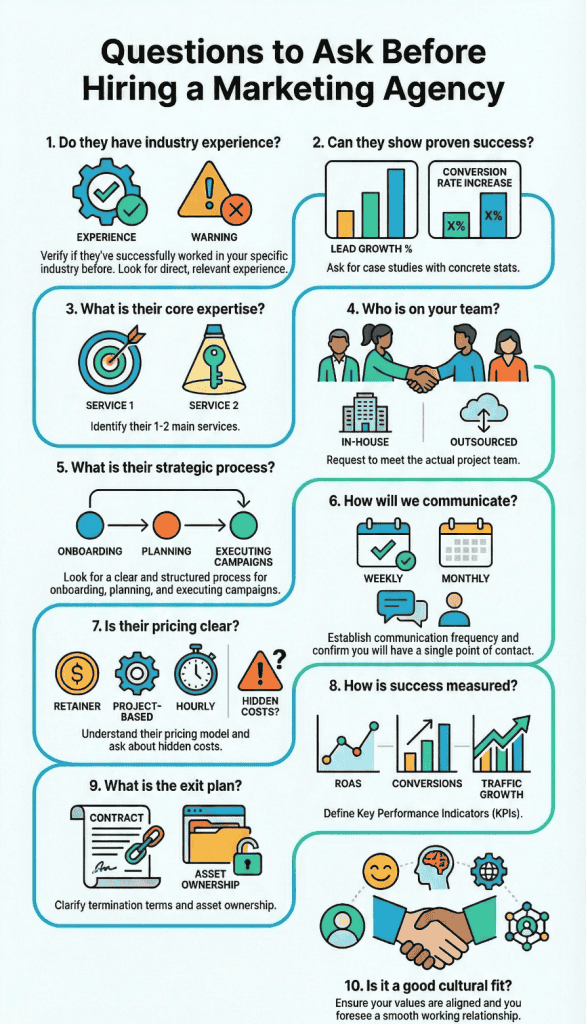
This is the human layer. You can have the perfect strategy and contract, but if you dread talking to your account manager, it will fail. The day-to-day interaction determines the partnership’s health. You need a rhythm that feels productive, not stressful.
The Point of Contact
Clarify this on day one. Who is your single point of contact for questions and issues? What is their expected response time for urgent versus non-urgent matters? Avoid setups where you’re passed between a sales contact, an account manager, and a project manager without clear ownership. You need one person who is ultimately responsible for your success.
Feedback Loops
Ask how they handle it when a client doesn’t like something. Do they get defensive, or do they have a structured process for feedback and iteration? Similarly, ask how they manage scope creep, those “just one more small thing” requests that can derail timelines and budgets. A good agency will have a clear change order process to handle this professionally without friction.
Reference Checks
Always ask for references. But be strategic. Don’t just ask for their happiest client. Ask to speak to a client whose project faced significant challenges. Ask the reference: When something went wrong, how did the agency handle it? The answer to that question is more revealing than any case study. It shows you their character under pressure.
FAQ
What agency selection questions should I ask in the first meeting?
Use clear agency selection questions that follow an agency evaluation checklist. Ask about their strategy development process, campaign planning questions, KPI measurement techniques, and performance tracking methods. A strong potential partner interview also covers communication protocols, point of contact designation, and reporting frequency standards so you know how work, feedback, and decisions will flow.
How do I evaluate an agency’s experience and real capabilities?
Focus on experience verification queries, case study requests, and portfolio review questions. Ask team expertise questions, capacity assessment inquiries, and resource allocation queries. A solid agency vetting process includes industry specialization focus, niche market experience, and business size compatibility, ensuring the agency has handled challenges similar to yours before.
What pricing, contract, and scope questions should I clarify early?
Raise pricing model details, retainer fee structure, project-based pricing, and hourly rate transparency. Ask for contract terms clarification, scope of work definition, and revision policy explanation. Good digital agency inquiries also cover additional cost disclosures, payment schedule breakdown, termination clause details, notice period requirements, and ownership rights clarification.
How should an agency measure success and report results?
Ask about success metrics definition, ROI calculation examples, and agency performance metrics evaluation. Strong marketing firm questions include toolset and software use, reporting cadence, progress reporting cadence, and quarterly review meetings. Clear answers on KPI tracking, budget overrun safeguards, and quality assurance steps show maturity and accountability.
What questions reveal long-term fit and risk handling?
Cover culture fit assessment, values alignment questions, and long-term partnership vision. Ask about risk management practices, crisis response plans, and scope creep prevention. Smart client agency questionnaire topics include onboarding process overview, scalability options discussion, data privacy compliance, intellectual property terms, and post-project support expectations.
Your Final Agency Evaluation Checklist
Asking questions isn’t enough. You need a clear way to compare answers. We built Jet Digital Pro after seeing how confusing this process becomes for growing teams. Move from gut feel to structure by scoring agencies on experience, process clarity, pricing transparency, and communication.
The best agency isn’t the cheapest or flashiest. It’s the one that answers clearly, shows real data, explains pricing confidently, and treats your questions as the start of a partnership.
Ready to simplify your agency search?
Contact Jet Digital Pro
References
- https://influencermarketinghub.com/what-to-ask-a-creative-agency-before-hiring/
- https://surferseo.com/blog/questions-to-ask-marketing-agency/
Related Articles
- https://jetdigitalpro.com/seo-article-content-writing-agency/
- https://jetdigitalpro.com/choosing-the-right-seo-content-agency/
- https://jetdigitalpro.com/assess-agency-expertise-seo/
Stop Guessing. Start Ranking.
Get a free sample article written for your niche. See the quality before you commit.
Get Your Free Sample Article →No credit card needed • 100% tailored to your niche