


Building authority with SEO content isn’t about gaming a system. It’s about proving you know your stuff so well that Google has no choice but to recommend you. We see it as becoming the library, not just another book on the shelf.
It requires a shift from chasing individual keywords to owning entire topics, demonstrating real-world experience, and building a web of trust that both users and algorithms recognize. If you’re tired of short-lived rankings and want to build a foundation that withstands algorithm updates, this approach is your blueprint. Keep reading to learn the practical steps.
We write SEO articles that rank on Google — so you can focus on your business.
See Writing Plans →Key Takeaways
- Own topics completely instead of just ranking for keywords.
- Show, don’t just tell, your expertise and trustworthiness.
- Build a network of internal and external signals that reinforce your authority.
Build a Web, Not a Pile of Pages
Think of your website as a city. You wouldn’t just build random houses with no roads connecting them. You’d have a central downtown (your pillar page) with streets leading out to different neighborhoods (your cluster content). This is the concept of content clusters.
A pillar page covers a broad topic comprehensively, like “Sustainable Gardening.” Then, you create individual, detailed articles for subtopics like “Composting for Beginners,” “Heirloom Tomato Varieties,” and “Natural Pest Control.” The magic happens when you link them all together internally [1].
This internal linking does two critical things. It helps users discover more of your relevant content, increasing their time on site. More importantly, it sends a powerful signal to Google. You’re essentially mapping out your expertise, showing that you have deep, organized knowledge on this specific subject area. You’re building topical authority.
- Start with one broad topic central to your business.
- Identify 5-10 core subtopics your audience cares about.
- Create a hub (pillar page) that links to each detailed cluster article.
- Ensure every cluster article links back to the pillar page.
This structure creates a self-reinforcing system of relevance. Search engines crawl this web and understand the depth of your content. It’s a foundational step that many skip, opting instead for a scattered approach that never gains momentum.
At Jet Digital Pro, we build this architecture into every content strategy from the ground up, because without it, you’re just shouting into the void.
Of course, a well-built city needs substantial buildings. That means going deep, not just wide. Surface-level articles won’t cut it anymore.
Need SEO content that actually ranks? We write data-driven articles designed to bring organic traffic to your site.
See Our SEO Writing Plans →Depth is Your Greatest Weapon
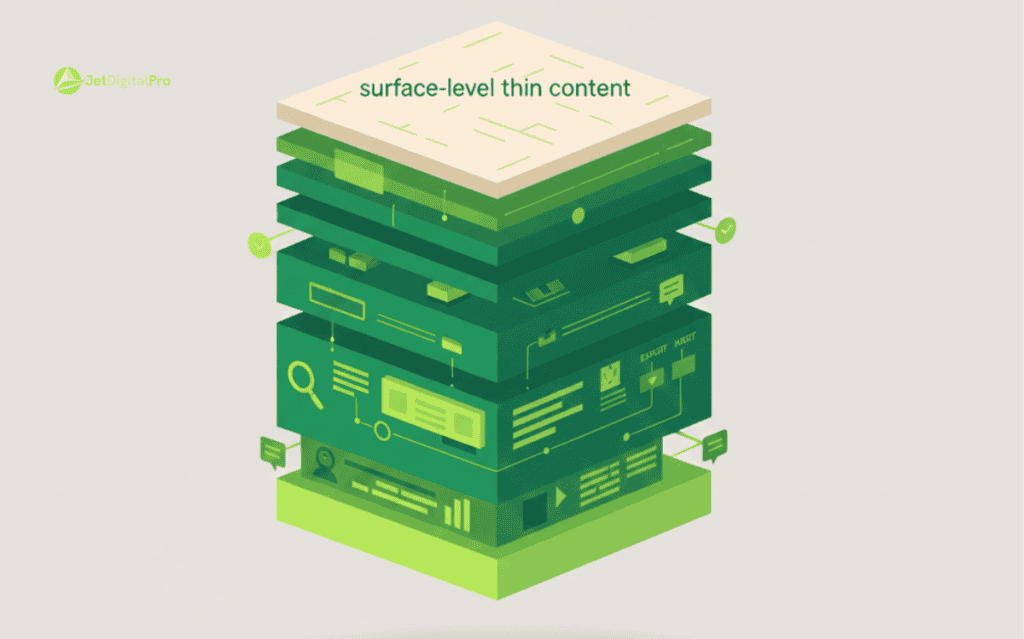
Google’s algorithms have gotten sophisticated. They can recognize fluff. They reward content that provides a complete, satisfying answer to a user’s query. This is where long-form, in-depth content shines.
We’re talking about guides that are 2,000 words or more. But length alone isn’t the goal. The goal is comprehensiveness. You want to be the single best resource on the internet for that specific topic [2].
This means incorporating different types of information. Don’t just describe a process, show it with screenshots or embedded videos. Don’t just state an opinion, back it up with data, case studies, or original research.
Use semantic SEO naturally. This isn’t about stuffing synonyms. It’s about covering the topic so thoroughly that you naturally include related concepts, questions, and terminology. This demonstrates a genuine, nuanced understanding.
Readability is crucial. No one will stick around a 3,000-word article that’s a solid block of text. Break it up. Use subheadings (H2s, H3s) to create a clear content hierarchy. Employ bulleted lists for digestible points.
Add relevant images, infographics, or charts. These elements keep the reader engaged and signal to Google that the content is well-structured and user-friendly. It’s the difference between a textbook and a compelling expert guide.
A common mistake is to publish a great piece of content and then forget about it. The web is a living thing, and your content should be too. What was definitive last year might be outdated today. Google takes note of freshness.
Treat Your Content Like a Living Asset
The work doesn’t stop when you hit “publish.” Content naturally loses value over time, and when that happens, authority fades too. That’s why regular content refreshes are a big part of good content writing. Make it a habit to revisit your top-performing articles every six to twelve months.
When you review an older piece, run through a few simple questions:
- Is the information still relevant?
- Are the data points and statistics up to date?
- Have any new best practices emerged?
- Do all internal and external links still work?
Updating an article with fresh data, clearer explanations, or a few new sections can lead to real ranking improvements. In everyday content writing practice, this shows both Google and your readers that you care about keeping your content useful, not just publishing and moving on.
This approach is much more efficient than constantly creating new content from scratch. You’re building on something that already works instead of starting over each time. In many cases, even small updates can bring traffic back and keep an article performing well for months.
All of these on-page efforts matter, but they mainly tell Google what you say about your expertise. To truly build authority, you also need others to back it up. That’s where the outside world comes in.
Let the World Validate Your Expertise
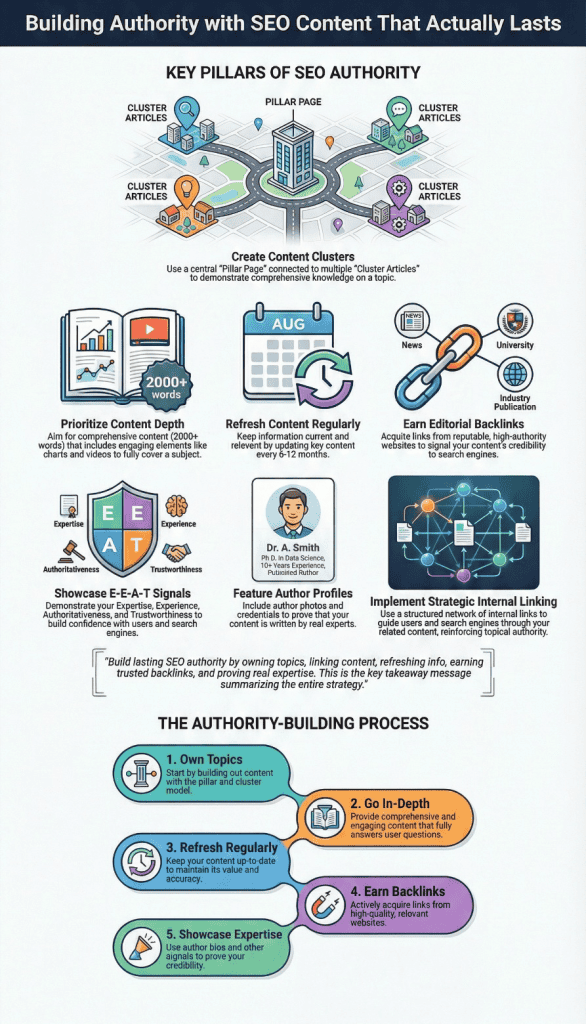
Backlinks from other reputable websites are like votes of confidence in the eyes of search engines. A link from a major industry publication tells Google, “This site is a trusted source.” But not all links are created equal.
A spammy link from a low-quality directory can hurt you. You want editorial backlinks, meaning another site’s author naturally links to your content as a reference because it’s genuinely helpful.
How do you earn these? You create something truly link-worthy. This could be groundbreaking original research, an incredibly detailed ultimate guide, a unique tool, or a compelling case study. Then, you let the right people know about it through digital PR or strategic outreach.
Another powerful method is guest posting on authoritative sites in your niche, where you can naturally link back to your own deep resources. This process builds your domain authority, which in turn helps all your pages rank better.
But it’s not just your website that needs to be authoritative. The faces behind the content matter immensely. This is the core of Google’s E-E-A-T framework.
TL;DR: How Lasting SEO Authority Is Built
| Authority Element | What It Does | Why It Matters for SEO |
| Topic Clusters | Organizes content around one core topic | Signals deep topical authority to Google |
| Pillar Pages | Covers broad topics comprehensively | Helps rank for multiple related keywords |
| Content Depth | Provides complete, satisfying answers | Improves dwell time and user trust |
| Content Refresh | Keeps information accurate and relevant | Maintains rankings over time |
| Editorial Backlinks | Earns validation from trusted sites | Strengthens domain and page authority |
| E-E-A-T Signals | Shows real experience and expertise | Builds trust in competitive and YMYL niches |
| Author Profiles | Proves real humans are behind content | Increases credibility and transparency |
| Internal Linking | Connects related content logically | Helps search engines understand relevance |
Together, these elements create a self-reinforcing system of trust that helps your content survive algorithm updates and outperform short-term SEO tactics.
Prove There’s a Real Human Behind the Curtain

Google wants to know that the content it ranks is created by people with real experience and expertise. You can signal this through robust author profiles. Don’t just use a name like “Admin.” Have a dedicated author bio page for each writer. Include their credentials, their background, a professional photo, and a link to their LinkedIn profile or other professional social proof.
When you cite experts, quote them by name and link to their profiles. If you’re writing about a process you’ve personally used, say so. Phrases like “In our experience,” or “Based on our case studies,” add a layer of authenticity that AI-generated content or shallow rewrites can’t match. These trust signals are becoming increasingly important for ranking, especially in YMYL (Your Money or Your Life) niches. It’s about building a reputation, not just a webpage.
The Long Game of Trust
Building authority with SEO content is a marathon, not a sprint. It’s a commitment to quality, structure, and continuous improvement. It’s about moving from being a participant in the conversation to being the source everyone quotes.
By organizing your knowledge into clusters, creating depth that satisfies users, keeping your content current, earning validation through backlinks, and showcasing real expertise, you construct a durable foundation. This foundation doesn’t just bring traffic. It builds trust. And in a crowded digital world, trust is the ultimate ranking signal.
Start building your authority today by auditing your existing content and identifying one topic you can own completely.
FAQ
What does building authority with SEO content mean?
Building authority with SEO content means creating in-depth, trustworthy, and well-structured content that proves real expertise to both Google and readers. It’s about owning topics completely, not just ranking for individual keywords.
Why is topical authority more important than keyword rankings?
Topical authority helps Google understand that your website is a trusted source on a specific subject. When you cover a topic deeply through pillar pages and cluster content, your rankings become more stable and less affected by algorithm updates.
What is a pillar page and how does it support SEO authority?
A pillar page is a comprehensive guide that covers a broad topic in detail and links to related subtopic articles. This structure helps users navigate your content and signals organized expertise to search engines.
How many cluster articles should support one pillar page?
Ideally, one pillar page should be supported by 5–10 high-quality cluster articles. Each article should focus on a specific subtopic and link back to the main pillar page to reinforce topical relevance.
Authority Is Built, Not Ranked
Building authority with SEO content isn’t about shortcuts or chasing short-term rankings. It’s about earning trust through depth, structure, and real expertise.
By owning topics, organizing content into clusters, updating key assets, and validating expertise with credible signals, you create authority that compounds over time, exactly the kind of foundation JetDigitalPro helps agencies and brands build through scalable, hands-off SEO content strategies – get started here.
References
- https://telsamedia.com/blogs/seo-strategies-for-authority-building/
- https://www.scripted.com/how-to-build-authority-with-seo-content
Related Articles
- https://jetdigitalpro.com/seo-article-content-writing-service/
- https://jetdigitalpro.com/stay-competitive-with-seo-writing/
- https://jetdigitalpro.com/why-invest-in-seo-content-writing/
Stop Guessing. Start Ranking.
Get a free sample article written for your niche. See the quality before you commit.
Get Your Free Sample Article →No credit card needed • 100% tailored to your niche