

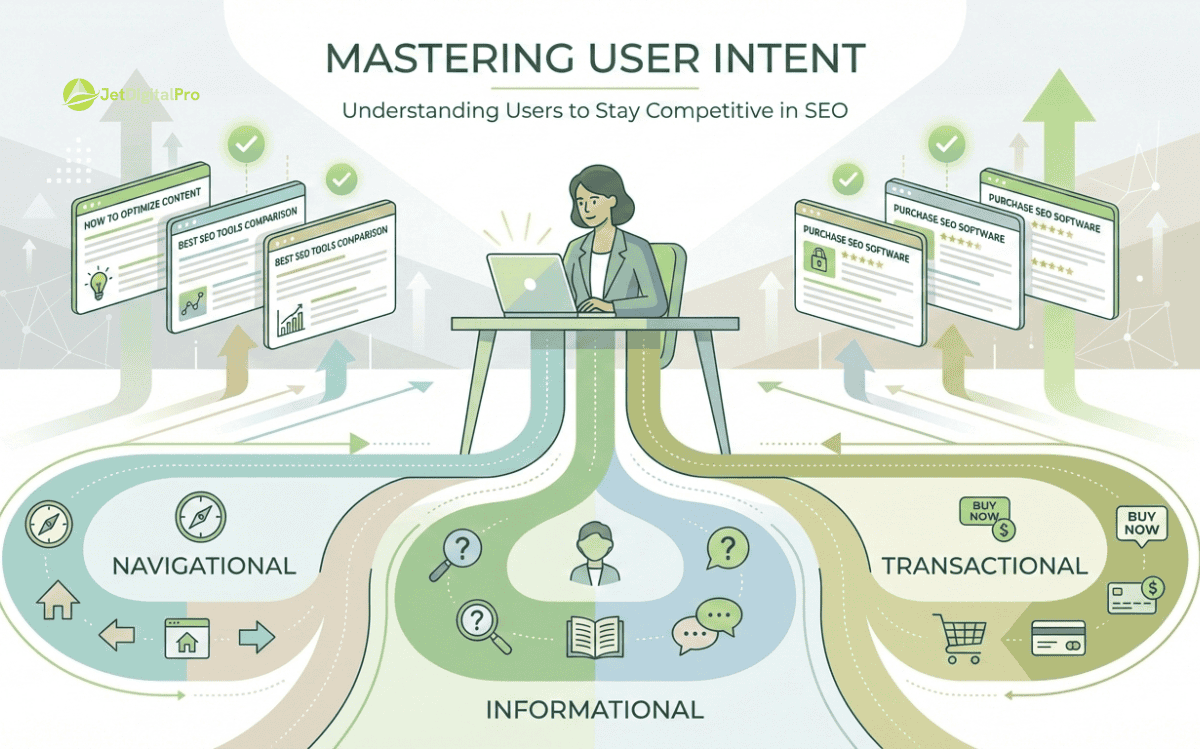
We stay competitive with SEO writing by focusing on the person behind the search query, not just the algorithm. It’s about understanding why someone is typing those words and delivering an answer so complete they have no reason to click back.
This means creating content that builds trust, demonstrates real expertise, and solves a problem better than anyone else. The goal is to make Google confident your page is the definitive resource. It’s a shift from chasing keywords to owning topics.
We write SEO articles that rank on Google — so you can focus on your business.
See Writing Plans →Keep reading to learn how to implement this user-first approach and future-proof your content strategy against the next algorithm update.
Key Takeaways
- Prioritize deep user intent analysis over simple keyword matching.
- Build topical authority through interconnected content clusters.
- Combine AI efficiency with human editorial judgment for quality.
The Non-Negotiable Foundation: Keyword Research That Reads Minds
Modern keyword research is less about finding magic phrases and more about mapping the user’s journey. The old way was to target a broad term like “project management software.” The new way is to understand the different intents behind that search.
Someone might be at the informational stage (“what is project management software”), the commercial investigation stage (“best project management software for small teams”), or the transactional stage (“buy Asana premium”). Each intent requires a completely different piece of content.
- Focus on long-tail phrases that reveal specific problems, like “how to improve team communication in remote project management.”
- Use semantic keywords and related questions to cover a topic exhaustively.
- Analyze competitor content not to copy, but to identify what they’ve missed.
The tools are essential, of course. Ahrefs, SEMrush, and Google’s own Keyword Planner give you the data. But the insight comes from you. You need to interpret the data through the lens of your audience’s needs.
What you’re really doing is building a conversation around a core topic. This leads directly to the next critical component, structuring that conversation in a way that both users and search engines find irresistible.
Need SEO content that actually ranks? We write data-driven articles designed to bring organic traffic to your site.
See Our SEO Writing Plans →Structuring Content for Dominance, Not Just Rankings
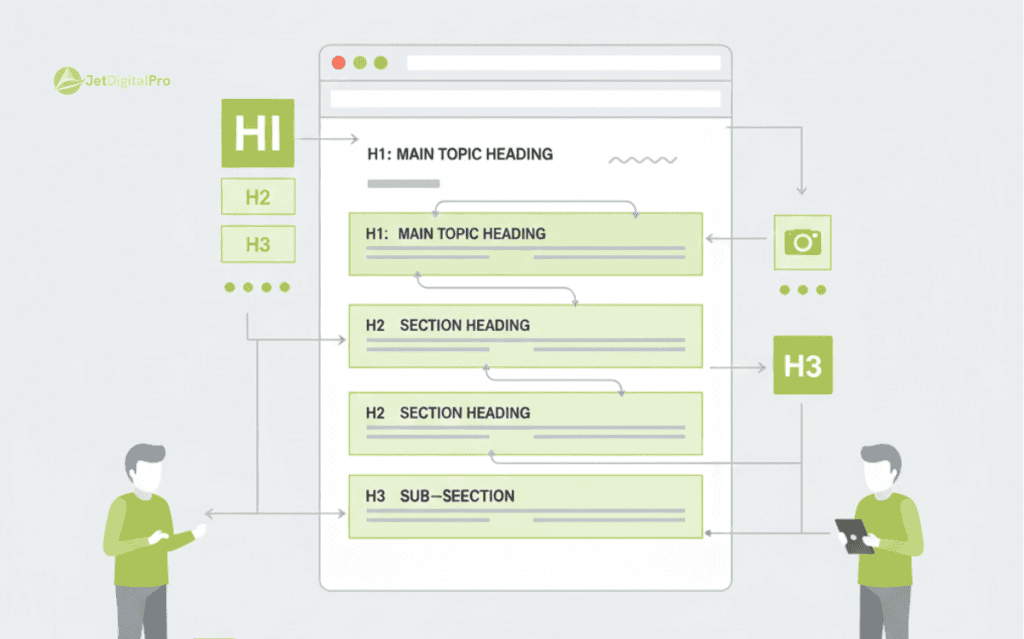
Once you know what your audience wants to talk about, you have to lead the discussion. This is where structure really matters. A wall of text pushes people away, while scannable, well-organized content pulls them in. Clear structure is a core part of good content writing, it puts clarity first, not word count.
You’re not just writing an article. You’re building a resource. That means using structure to guide readers and help Google understand what your page is about.
Start with the basics:
- Use a strong H1 that clearly promises a benefit.
- Break the content into logical sections with H2 and H3 headings [1].
- Keep paragraphs short, usually no more than two or three sentences.
To make complex ideas easier to digest, lean on formatting:
- Bullet points and numbered lists to break information down
- Clear spacing so each idea has room to breathe
- Simple language that gets to the point quickly
This scannable approach isn’t just good for readers. In day-to-day content writing, it also improves your chances of earning featured snippets, since Google favors pages that deliver clear, direct answers.
At Jet Digital Pro, we consistently follow this format because it respects the reader’s time. When content is easy to scan, people stay longer, understand more, and are more likely to trust what they’re reading.
But structure doesn’t stop at a single page. To stay competitive long term, you need topical authority. That’s where content clusters come in:
- A pillar page that covers the main topic at a high level
- Supporting articles that dive deeper into specific subtopics
- Internal links that connect everything together naturally
This kind of structure sends a strong signal to Google that you know the topic inside and out. It also keeps users moving through your site, exploring related content. Most importantly, it’s a system that competitors can’t easily copy overnight.
The Human Touch in an AI World
There’s a lot of talk about AI content generation, and for good reason. It can be a powerful tool for scaling content production. But AI alone cannot understand nuance, empathy, or real-world experience. It can’t tell a story from the trenches.
This is where the human element becomes your ultimate competitive advantage. The content that truly wins is content that feels like it was written by a person who has been there.
This is the philosophy we’ve built into our process. We use AI for initial drafts and ideation, but every piece is rigorously edited and refined by a human expert. They inject the original data, the anecdotal experience, the subtle understanding of a problem that only comes from having solved it.
This combination is what creates content that bypasses AI detection not through trickery, but through genuine quality. It’s content that demonstrates E-E-A-T (Experience, Expertise, Authoritativeness, Trustworthiness) because it’s rooted in reality [2].
- Edit for voice and flow, ensuring the text doesn’t sound robotic.
- Add original insights or data that can’t be found elsewhere.
- Incorporate real-world examples and case studies.
This human refinement process is what transforms a generic article into a trusted resource. It’s the difference between a page that ranks for a few months and one that becomes a permanent, authoritative destination. The final piece of the puzzle is ensuring this high-quality content is technically sound and easy for search engines to find and index.
The Technical Bedrock: Speed, Links, and Freshness

You can write the best article in the world, but if it loads slowly or search engines can’t crawl it effectively, you’ve already lost. Technical SEO is the unglamorous but essential foundation.
Core Web Vitals, Largest Contentful Paint (loading speed), First Input Delay (interactivity), and Cumulative Layout Shift (visual stability), are direct ranking factors. A slow, janky website creates a poor user experience, and Google penalizes that.
Internal linking is another powerful lever. It distributes page authority throughout your site and helps users discover more of your content. When you create those content clusters, internal links are the threads that weave them together.
Then there’s the ongoing work of maintaining freshness. Google favors content that is regularly updated. A quarterly review of your top-performing articles to add new information, update statistics, and refresh examples can give them a significant ranking boost.
Finally, a strong backlink profile from reputable sites acts as a vote of confidence. This isn’t about spammy link building. It’s about earning links by creating content so valuable that others naturally want to reference it. Techniques like HARO (Help a Reporter Out) can connect you with journalists looking for expert sources, resulting in high-quality links and increased authority.
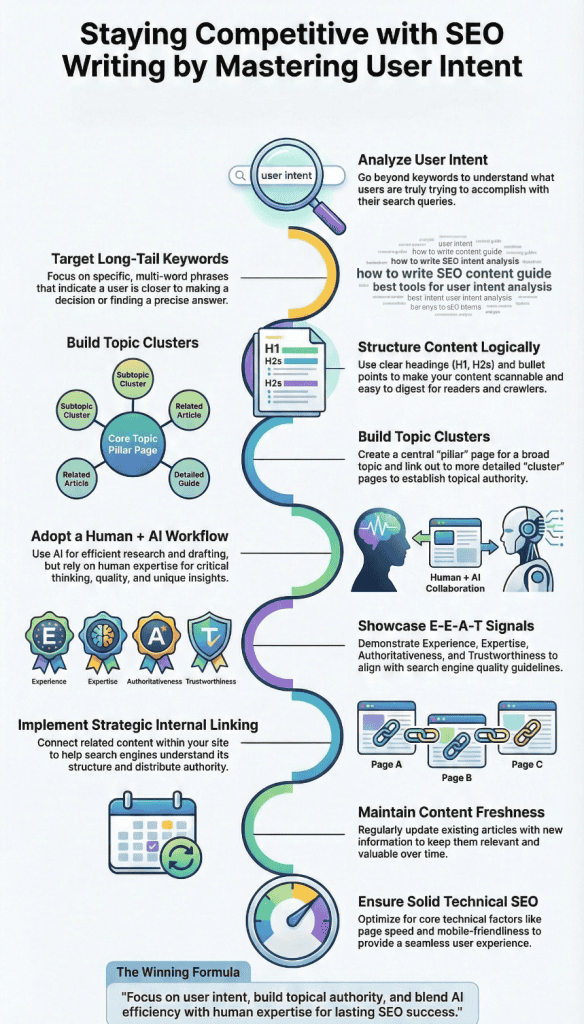
TL;DR: What Keeps SEO Writing Competitive Over Time
| SEO Element | What It Does | Why It Matters for SEO |
| User Intent Analysis | Identifies the real goal behind a search query | Improves relevance, engagement, and rankings |
| Long-Tail Keywords | Targets specific, problem-driven searches | Easier to rank and higher conversion potential |
| Content Structure | Organizes content for scannability and clarity | Enhances UX and featured snippet eligibility |
| Topic Clusters | Groups related content under one core topic | Builds strong topical authority |
| Human + AI Workflow | Combines scale with editorial judgment | Produces natural, Google-resilient content |
| E-E-A-T Signals | Demonstrates real experience and expertise | Builds trust in competitive niches |
| Internal Linking | Connects related pages contextually | Helps search engines understand relevance |
| Content Freshness | Regularly updates key pages | Maintains rankings over time |
| Technical SEO | Ensures speed, stability, and crawlability | Forms the foundation of SEO performance |
FAQ
What does “staying competitive with SEO writing” really mean?
It means consistently creating content that fully satisfies user intent, builds trust, and remains relevant even as Google’s algorithms change.
Why is user intent more important than keywords alone?
Keywords show what people search for, but user intent explains why. Content that matches intent keeps users engaged and signals higher relevance to Google.
How do I identify different types of user intent?
By analyzing search queries, SERP results, and modifiers that indicate informational, commercial, or transactional goals.
What is topical authority in SEO writing?
Topical authority is built by covering a subject comprehensively using interconnected content clusters, signaling expertise to search engines.
How does content structure affect SEO performance?
Clear headings, short paragraphs, and scannable formatting improve readability, user experience, and eligibility for featured snippets.
Your Path to Sustained SEO Success
Staying competitive with SEO writing is a long-term commitment, not a one-off task. It means blending keyword and technical SEO with clear, human-centered writing that truly serves search intent.
When content is structured for depth and clarity, search engines view your site as an authority and users see it as a trusted guide. Algorithms change, but helpful content lasts, and if you want resilient, hands-off SEO growth, start here.
References
- https://searchengineland.com/library/platforms/google/google-algorithm-updates/helpful-content-update
- https://direction.com/eat-seo/
Related Articles
- https://jetdigitalpro.com/seo-article-content-writing-service/
- https://jetdigitalpro.com/why-invest-in-seo-content-writing/
- https://jetdigitalpro.com/building-authority-with-seo-content/
Stop Guessing. Start Ranking.
Get a free sample article written for your niche. See the quality before you commit.
Get Your Free Sample Article →No credit card needed • 100% tailored to your niche