

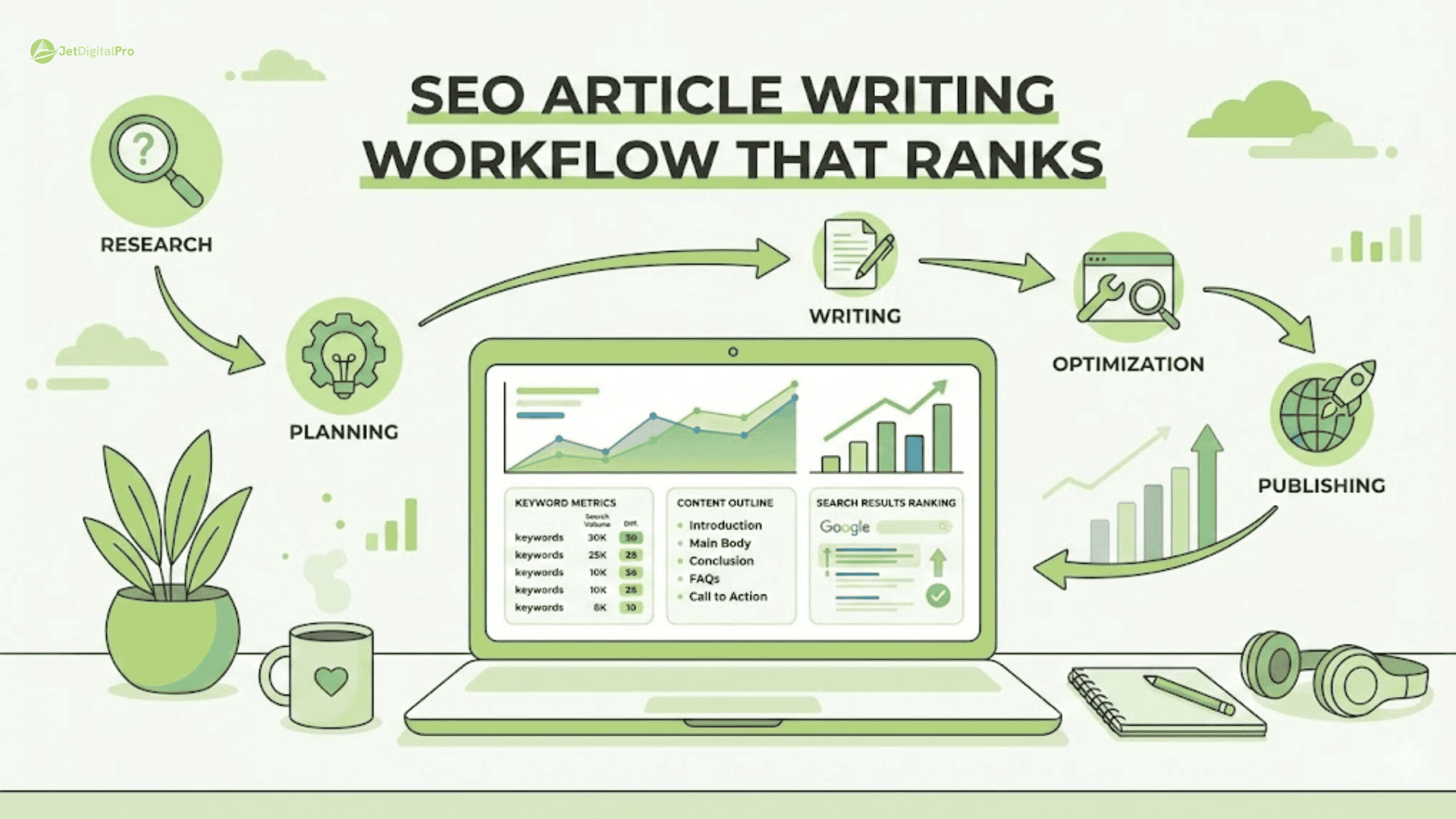
You want your articles to rank, but the process feels messy. We get it. Our typical SEO article workflow is a seven-step machine we’ve refined over thousands of articles.
It starts with deep research and ends with a living piece of content designed to grow. This isn’t about shortcuts. It’s about a repeatable system that consistently produces results. Stick with us, we’ll walk you through the entire process, from the first keyword to post-publish promotion.
We write SEO articles that rank on Google — so you can focus on your business.
See Writing Plans →Key Takeaways
- A successful workflow hinges on understanding search intent before a single word is written.
- The writing phase must balance keyword use with genuine reader value.
- Publishing is just the beginning; ongoing promotion and updates are critical for longevity.
Research: Laying the Foundation
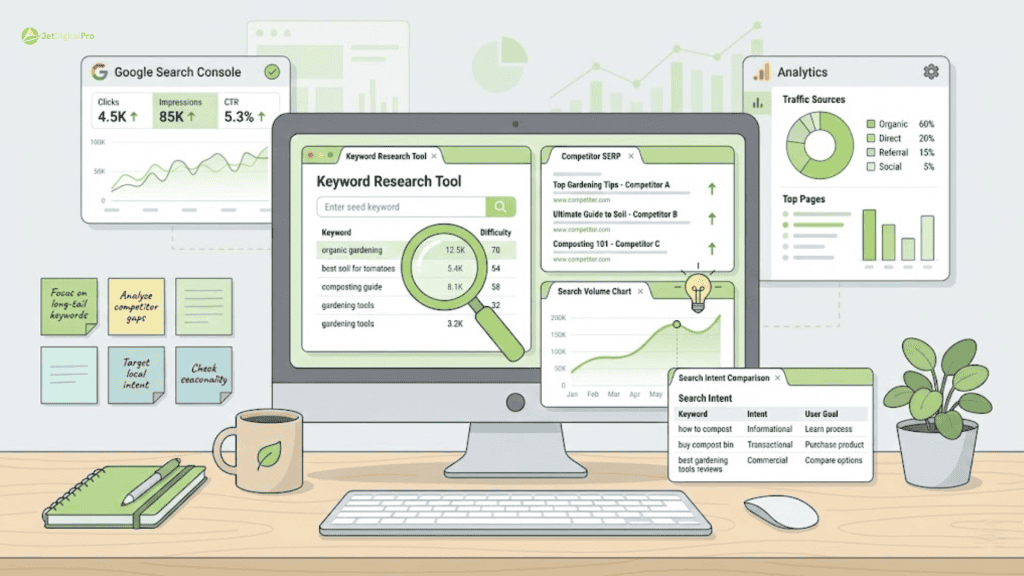
It all begins with a question. What is your audience actually searching for? We skip the guesswork by diving into keyword tools, but we’re not just looking for search volume. Sometimes we also draw insights similar to how teams understand how to research keywords to shape our direction and define search intent early.
We’re looking for a problem we can solve. The primary keyword acts as our compass, but the secondary keywords and semantic terms are the real treasure. They show us the language our readers use.
We then open up Google Search Console and analytics to see what’s already working. This tells us where our audience is already engaged. Next comes the most crucial step: intent analysis.
We look at the top ten results for our main keyword. Are they all listicles? Are they deep guides? This tells us exactly what Google thinks users want. Our job is to match that intent, then exceed it.
The goal here is to find a topic with clear demand that fits into our broader content strategy. We might ask ourselves a few questions.
- Does this topic support a core service or product?
- Can we link this article to other existing content?
- Is the competition level something we can realistically tackle?
Planning: The Blueprint for a Rank-Worthy Article
| Stage | Key Actions | Tools/Outputs |
| Research | Analyze search intent, check search volume, study competitors, pick main keywords | Keyword list, SERP notes, analytics, Search Console data |
| Planning | Build content brief, outline H2/H3, define internal linking strategy | Content brief, structured outline |
| Writing | Create draft using clear language, add examples, natural keyword placement | First draft, edited version |
| Optimization | Improve on-page SEO, add internal links, fix meta tags & alt text | Optimized article ready to publish |
| Publishing & Maintenance | Promote content, track via Search Console + Analytics, update over time | Live content + scheduled revision |
With a solid topic and keyword set, we move to planning. This is where we build the blueprint. A thorough SERP analysis shows us the structure of successful articles.
We note the common H2 and H3 headings. We identify any content gaps, topics the top pages missed or only briefly covered. This is our opportunity to create something more comprehensive.
We translate this analysis into a content brief. This document is our recipe. It contains keyword targets, internal linking ideas, and a layout that makes writing smoother, very similar to how we prepare content flow when thinking about optimized content delivery for different formats.
Need SEO content that actually ranks? We write data-driven articles designed to bring organic traffic to your site.
See Our SEO Writing Plans →It also outlines the internal linking strategy, pointing to relevant pillar pages or related articles on our site. The brief ensures everyone on the team, from writer to editor, is aligned on the goal.
From the brief, we create a detailed outline. The outline is the skeleton of the article. It organizes information in a logical flow that mirrors the user’s journey.
A strong outline makes the writing process faster and keeps the final piece focused and easy to follow. It’s the difference between a meandering blog post and a purposeful guide.
Writing: Where Strategy Meets Story
Now for the main event: writing the first draft. Here’s where we forget about SEO for a little while. The initial focus is purely on the reader.
We follow the outline, but we write to solve a problem or answer a question completely.We use clear, straightforward language. Short sentences. Short paragraphs. It has to be easy to read.
Keyword placement happens naturally. The primary keyword belongs in the title, the first paragraph, and a subheading or two. We sprinkle secondary keywords and related terms throughout the body where they make sense.
We avoid stuffing. The goal is to sound helpful, not robotic. We use bullet points and numbered lists to break up complex information. We add examples to make concepts concrete.
This is the stage where our human-AI hybrid process shines. AI can help overcome writer’s block and generate initial ideas, but a human editor is non-negotiable.
They ensure the voice is consistent, the arguments are logical, and the content provides genuine value. This combination allows for scale without sacrificing quality, producing content that feels original and bypasses AI detection flags.
Optimization: Polishing for People and Bots
Once the draft is written, we shift back into technical mode. This is the on-page SEO optimization phase. We craft a compelling title tag and meta description that includes the primary keyword.
We tweak the URL slug to be clean and descriptive. We double-check that all headings are properly nested and supportive.
Linking is a key part of this step. We implement the internal linking strategy from the brief, connecting this new article to our site’s existing content ecosystem.
This helps spread authority and keeps users engaged. We also add a few authoritative external links to credible sources. This builds trust with both readers and search engines.
We don’t forget the visuals. We add relevant images and ensure each has descriptive alt text. This improves accessibility and provides another signal to search engines about the page’s content.
A final check ensures the article is mobile-friendly and loads quickly. Technical SEO might not be glamorous, but it’s essential.
After You Hit Publish: The Workflow Continues
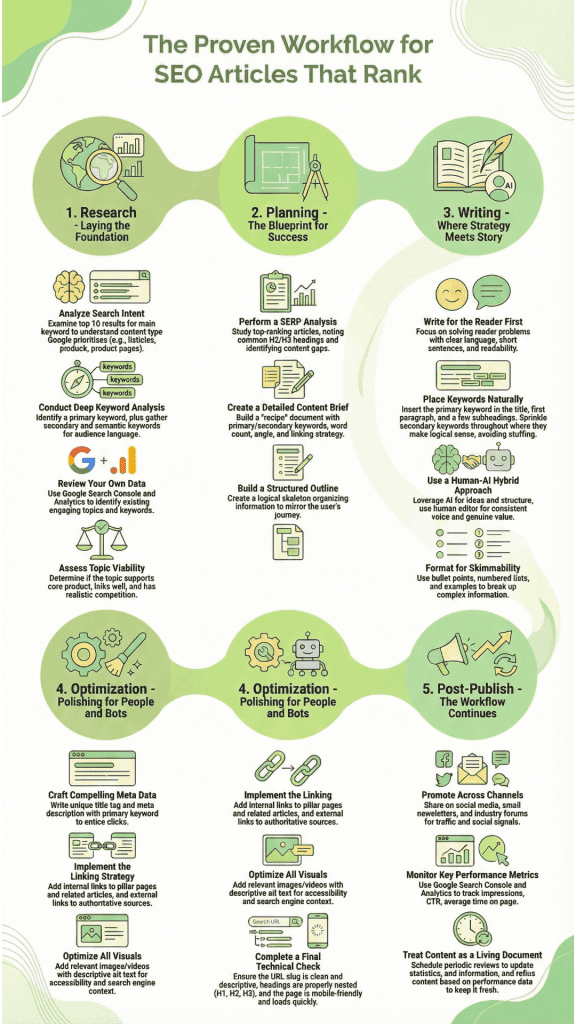
We share the new content across relevant channels, social media, email newsletters, industry forums.This initial push can generate early traffic and social signals, which can positively influence rankings.
Then we watch. We monitor performance in Google Search Console and Google Analytics. If we update content regularly, we often see real gains content updated in the last 90 days performs ~ 24% better than stale pages. This helps us know if the article behaves like expected results when seo writing services work in real application, especially when we want to measure progress over time. [1]
Over the long run, refreshing existing pieces can pay off: in a study of 1,000+ refreshed articles, organic traffic rose by an average of 43% after updates. That’s why we treat content as living assets, not one-time tasks. [2]
Is the article gaining traction? Are there keywords we’re ranking for that we didn’t anticipate? This data is incredibly valuable.
The most successful SEO articles are treated as living documents. We schedule periodic reviews, maybe every six or twelve months. We update statistics, add new information, and refine the content based on performance data.
This tells Google the content is fresh and relevant, which can boost rankings over the long term. It’s how you build evergreen assets.
FAQ
How can I create an seo workflow that covers research, writing, and optimization?
You can create an seo workflow by starting with a keyword research workflow that checks search volume and search intent. After that, move into content creation, write helpful articles, and run a technical seo check.
Add internal links, use seo tools for tracking, and monitor results in google search console and google analytics. Continue optimizing existing content to keep improving your seo.
What types of seo workflows do teams use for content creation and ranking?
Teams use different types of seo workflows, such as a content creation workflow for writing and publishing, a keyword research workflow for picking topics, and an optimization workflow for updates.
Team members may handle writing, linking, or analysis separately. With project management tools and clear steps, a team can finish seo tasks faster and more effectively.
How do I build effective seo workflows for long-term growth?
You can build effective seo workflows by using a clear seo strategy, starting with research, writing, and optimization. Track results in search console and use google analytics to see what needs improvement.
Update and expand existing content regularly. With a consistent workflow seo process, you can improve your seo performance over time.
What is the best way to handle internal links and linking strategy in content creation?
You can handle internal links by planning a linking strategy before writing. Connect new posts to existing content to help readers navigate and help search engines understand your site.
Include internal linking in the content creation workflow, not after publishing. Use seo tools to check for broken links and fix them to support technical seo.
How can I keep seo tasks organized for ongoing optimization and updates?
You can keep seo tasks organized by using simple project management tools to track content creation, technical seo, and optimizing existing content.
Set schedules for reviews, similar to autorenew packs, so updates happen on time. Add content distribution steps and run checks using google search console to keep seo workflows running smoothly.
Why This Workflow Works for Us and Can Work for You
After years of refining our SEO process, we’ve learned that growth comes from consistency, research deeply, write for humans, optimize with intention, and revisit content as it evolves.
This workflow is the same system we use at Jet Digital Pro to help agencies scale content without adding internal strain. If you’d like support implementing a similar process, you can reach out to us here.
Related Articles
- https://jetdigitalpro.com/how-services-research-keywords/
- https://jetdigitalpro.com/content-delivery-formats-service/
- https://jetdigitalpro.com/how-seo-writing-services-work/
References
- https://sqmagazine.co.uk/google-seo-statistics/
- https://gorilla.marketing/seo/services/seo-content/update-impact-study/
Stop Guessing. Start Ranking.
Get a free sample article written for your niche. See the quality before you commit.
Get Your Free Sample Article →No credit card needed • 100% tailored to your niche