

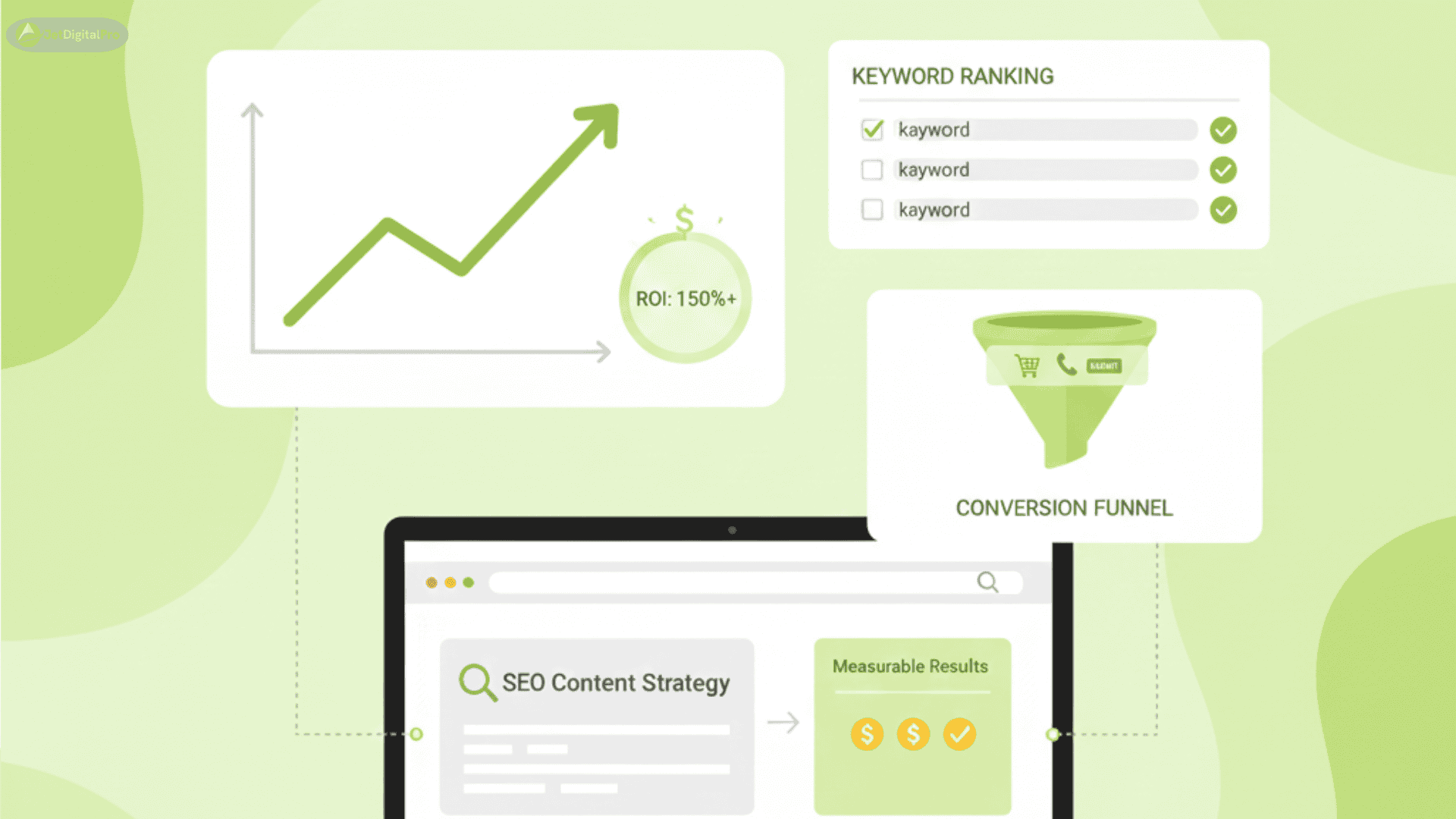
When you track ROI SEO writing service by tying your content to real money, not just pageviews or rankings, you’ll quickly see which pages actually drive revenue and which ones need improvement. It all starts with setting clear financial goals, like how many leads, sales, or booked calls you want from organic search, then tracking the metrics that connect directly to those outcomes.
When you attribute sales and leads back to the content that helped create them, SEO writing stops looking like a vague “content expense” and starts looking like a profit center with proof behind it. Keep reading to learn the exact steps to measure what actually matters.
We write SEO articles that rank on Google — so you can focus on your business.
See Writing Plans →Key Takeaways
- Connect content to cash by tracking revenue from organic search.
- Measure beyond rankings to include leads, conversions, and customer value.
- Calculate true cost by including agency fees, tools, and internal labor.
The Foundation of Measurable SEO Content
You hired an SEO writing service. The content is live. Now what? The real work begins, the work of proving its worth. In a world obsessed with ad spend and instant results, SEO content often feels like a slow, uncertain bet. But that uncertainty vanishes when you have a system for tracking its return. It shifts the conversation from “Are we ranking?” to “How much money are we making?”
Start with the End in Mind: Define Your Goals
Before you look at a single metric, you need to know what success looks like. ‘More traffic’ is not a goal. It’s a hopeful outcome. A real goal is specific and tied to business growth. This clarity helps in accurately analyzing content performance to align efforts with business objectives.
Are you aiming for a 20% increase in qualified leads from organic search within six months? Maybe you want to attribute $50,000 in new revenue to content aimed at a specific product line. These are goals you can build a measurement plan around.
Your Key Performance Indicators (KPIs) must flow directly from these goals.
- Organic revenue or lead volume.
- Conversion rate for visitors from organic search.
- Cost per acquisition from your SEO content.
This focus prevents you from celebrating a number-one ranking for a keyword that never brings in a customer. It forces you to think like a business owner, not just an SEO.
Calculate the Real Investment
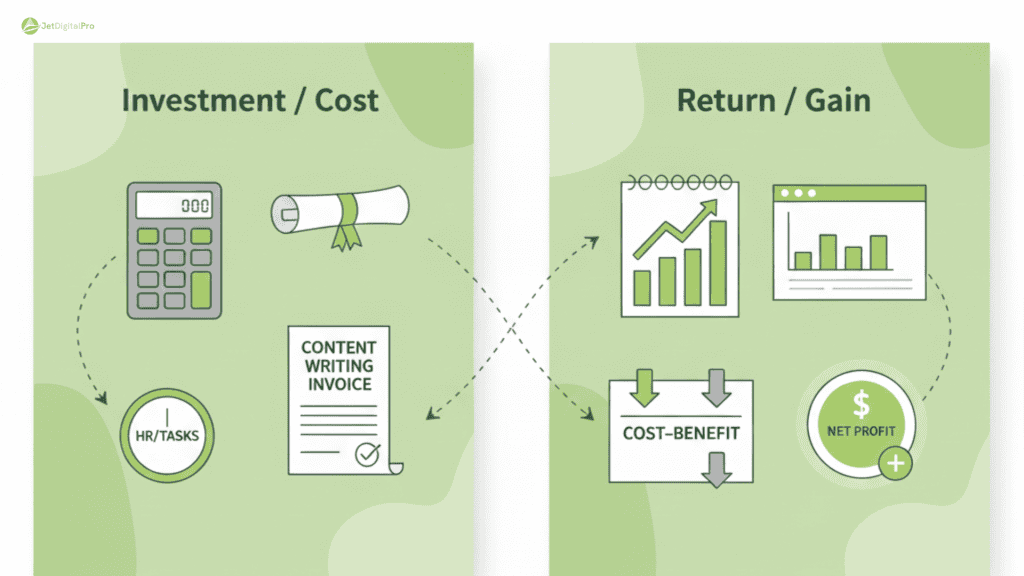
The cost of an SEO writing service isn’t just the invoice from the agency or freelance writer. That’s only part of the picture. To understand your true investment, you have to account for everything, which is essential when you want to calculate the value of SEO content.
This includes subscriptions for tools like Ahrefs or SEMrush that you use for keyword research. It also must include the time your team spends, the project manager briefing the writers, the editor reviewing the posts, the web developer publishing them.
Need SEO content that actually ranks? We write data-driven articles designed to bring organic traffic to your site.
See Our SEO Writing Plans →Add it all up. If you pay a writer $500 for a blog post and your team spends five hours at a blended rate of $50 per hour on it, the true cost is $500+ $250 = $750. This accurate number is crucial for an honest ROI calculation later. Underestimating your cost inflates your perceived return, which is a dangerous mistake.
Measure What Actually Moves the Needle
This is where the rubber meets the road. You’ll live in tools like Google Analytics and Google Search Console. But you have to look past the vanity metrics. Sure, watch your organic traffic grow. That’s a good sign. But the real magic happens when you connect that traffic to actions.
Set up conversion tracking. This means tagging a form submission, a phone call, or a purchase as a “goal” in Google Analytics. Now you can see not just how many people came from a specific blog post, but how many of them became leads.
For e-commerce, you can see the actual revenue generated by visitors who found you through organic search. This is the data that proves value. [1]
Connect the Dots with Revenue Attribution
Most sales don’t happen after one click, and your content shouldn’t get treated like it did nothing just because it wasn’t the final step.
Attribution is simply the way you give credit to each marketing touchpoint that helped close a sale. A customer might find you through a blog post, read a product comparison page a few days later, click an email, and then finally convert through a paid ad.
If you only credit the last click, you miss the quiet work your SEO content already did, building trust, answering doubts, and keeping your brand in their mind.
That’s where multi-channel attribution models help. Instead of saying, “The ad did everything,” you can see:
- Which blog post someone discovered first
- Which pages they visited before they were ready to buy
- How many touchpoints it usually takes before a sale
You don’t need a huge, complex setup to start. Even basic models (like linear or time decay in Google Analytics) already give you a better view than last-click alone.
UTM parameters are a simple but powerful tool here. By tagging your links in:
- Social media posts
- Email newsletters
- Partner campaigns
- Internal promotions
you can trace how people move through your content. Maybe someone first reads a guide from a newsletter link, comes back via organic search, and eventually converts from a branded search ad. Without tracking, you’d never know the guide existed in that path.
The goal isn’t to argue that SEO content deserves all the credit. It’s to show it played a real role in the journey. When you can say, “These blog posts appeared in 40% of the paths that led to a sale this month,” your writing stops looking like a cost and starts looking like part of the revenue engine.
The Moment of Truth: Calculating ROI
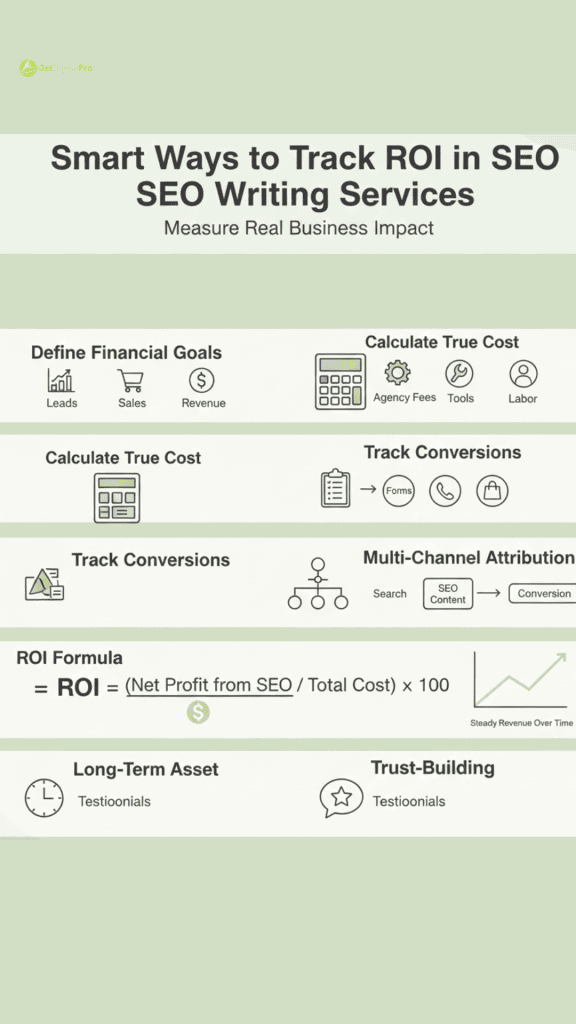
Now you have the numbers. You know the total cost of your SEO writing efforts for a period, say a quarter. And you know the net profit directly attributed to those efforts, the revenue from organic search minus the cost of goods sold. The formula is simple.
ROI = (Net Profit from SEO / Total Cost of SEO Writing) x 100.
A positive ROI means you’re making money. A high ROI means it’s one of your best investments. This number allows you to compare the effectiveness of your SEO writing service against other channels like paid ads or social media marketing. It moves SEO from a speculative cost to a accountable, data-driven investment. [2]
The Long Game of SEO Returns

SEO isn’t a sprint. It’s a marathon, and sometimes it even feels slower than that.
A blog post you publish today might sit quietly for a few weeks, then slowly climb the rankings, and only really hit its stride two or three months later. But once it gets there, that same piece can keep bringing in traffic and leads for one, two, even three years. That’s not just content. That’s an asset.
Because of this delay, you can’t judge SEO returns like you judge a short ad campaign. If you only look at the first 30 days, SEO will almost always look disappointing next to paid ads. So you have to zoom out and ask better questions:
- Is organic traffic growing month over month?
- Is organic revenue growing quarter over quarter?
- Is your cost per acquisition from SEO going down over time?
- Are more of your conversions starting from organic search?
When you track those trends, you start to see the real pattern: SEO returns compound. The content you wrote months ago keeps working while you add new pieces on top of it. That compounding effect strengthens your ability to measure ROI over longer time horizons, where SEO shows its true value.
This long-term view is what justifies ongoing investment. You’re not throwing money at quick impressions that vanish when the budget stops. You’re building a library of content that:
- Attracts searchers at different stages of the journey
- Answers questions your sales team hears every week
- Reduces support tickets by explaining key topics clearly
- Warms up prospects before they ever talk to a human
A paid ad stops the second you pause the spend. A strong SEO page keeps showing up, keeps earning clicks, and keeps helping generate revenue long after the initial work is done. That’s the real return: patient effort now, steady payoff later.
FAQ
What are the best ways to track ROI for a seo writing service?
Tracking roi for a seo writing service starts with clear goals and key metrics. Look at keyword rankings, user behavior, click through rates, website traffic, dwell time, and form submissions.
Use analytics tools like search console and google analytics to see how optimized content performs. This helps businesses understand revenue generated, total revenue, and the true return on investment.
How do I know if my content is optimized for search engines?
Check whether your written content uses relevant keywords, internal links, structured data, and meta descriptions. Optimized for search engines means the content structure fits user intent and search intent.
Good content encourages visitors, reduces bounce rates, and attracts qualified traffic. These steps improve seo, help businesses rank higher, and make it easier for potential customers to find products or services.
What should small business owners measure when calculating the roi of seo?
Small business owners should look at higher conversion, cost per acquisition, lead generation, and marketing roi. Track organic traffic, organic growth, and qualified leads from a seo campaign.
Compare seo costs, agency fees, paid search, paid media, and return on ad spend. This approach ensures informed decisions, making sure marketing efforts support business goals and long-term revenue growth.
How do seo writers create compelling content that aligns with my business objectives?
Seo writers study search trends, competitive analysis, and algorithm changes to create compelling content tailored to the customer journey. They plan content updates, content length, keyword placement, and internal linking.
Their writing strategy focuses on meaningful interactions, helpful website content, and strong content performance. This helps agencies, marketing channels, and marketing strategies stay ahead with content that resonates and ranks well.
What makes an effective seo content strategy for measuring long-term seo success?
An effective seo content strategy uses content marketing strategies, digital marketing strategies, and organic search data to see how content marketing agency services offer value. It tracks key features like user experience, content optimization, mobile optimization, and technical seo.
By watching seo efforts, driving traffic, tracking roi, and measuring roi, brands can see how content that aligns supports successful seo and steady business growth.
Making the Numbers Talk
Tracking the ROI of your SEO writing service goes beyond numbers, it’s about giving your content a clear, measurable voice in dollars and cents. By defining goals, calculating true costs, and tracking revenue attribution, you turn your content strategy from guesswork into a reliable investment. Next time the SEO budget is questioned, you’ll have concrete data, not just assumptions. Ready to make your SEO ROI undeniable? Get in touch with JetDigitalPro today!
References
- https://www.smartbugmedia.com/blog/what-percentage-of-organic-search-traffic-should-be-converting-into-leads
- https://www.ciwebgroup.com/blog/average-roi-from-seo-vs-paid-ads-in-the-trades-what-the-2025-data-shows
Related Articles
- https://jetdigitalpro.com/analyze-content-performance-seo/
- https://jetdigitalpro.com/calculate-value-of-seo-content/
- https://jetdigitalpro.com/measuring-seo-content-writing-roi/
Stop Guessing. Start Ranking.
Get a free sample article written for your niche. See the quality before you commit.
Get Your Free Sample Article →No credit card needed • 100% tailored to your niche